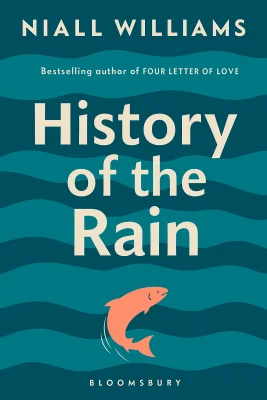
History of the Rain
Categories
Fiction, Audiobook, Historical Fiction, Book Club, Contemporary, Novels, Books About Books, Ireland, Literary Fiction, Irish Literature
Content Type
Book
Binding
Hardcover
Year
2014
Publisher
Bloomsbury Publishing
Language
English
ISBN13
9781408852026
File Download
PDF | EPUB
History of the Rain Plot Summary
Introduction
# Rivers of Memory: A Journey Through Blood and Water In the rain-soaked village of Faha, nineteen-year-old Ruth Swain lies dying in her sky-room, surrounded by three thousand books that smell of fire and flood. Through the skylight above her bed, Irish rain drums against glass like fingers tapping out morse code messages from the dead. Her blood carries something wrong, something the doctors cannot name, and as she races against time to write her family's story, she discovers that some legacies can only be preserved in words before they vanish like salmon returning to the sea. This is the tale of three generations bound by impossible dreams and the relentless pull of water. From her great-grandfather Abraham, a pole-vaulting dreamer who sought God's calling in French trenches, to her father Virgil, a poet who sailed the world's oceans before finding love on an Irish riverbank. Ruth writes not just to remember, but to understand why the Swain blood runs thick with restlessness, why they reach for perfection that always slips through their fingers like river water, and why sometimes the only way to survive drowning is to become part of the current itself.
Chapter 1: The Salmon Legacy: Abraham Swain's Impossible Standard
Abraham Swain discovered flight at seventeen, launching himself skyward with a wooden pole in the gray afternoons of St Bartholomew's School. Each leap carried him higher, but never high enough for his father, the Reverend Absalom, who had cursed his son with what would become the family disease—the Philosophy of Impossible Standard. No matter how perfectly Abraham cleared the bar, it rose again, always beyond reach, always demanding more. The Reverend paced the night roads of Wiltshire, hands clasped behind his back, murmuring prayers that sounded more like accusations. He wanted his son to be proof of God's excellence, a soul polished bright enough for the Almighty's inspection. Abraham tried, excelling at Oxford, reading Classics, waiting for The Call that would summon him to ministry. But God remained silent as stone. When the Great War erupted, Abraham heard a different voice entirely. He enlisted with the Oxfordshire & Buckinghamshire Light Infantry, believing finally that this was his purpose. In the trenches of France, mud-deep and rat-infested, he waited for meaning to reveal itself. When Captain Burke ordered the charge, Abraham leaped from the trench with the same faith that had carried him over countless bars. The German bullets found him—zip, zip, zip—tearing through his uniform, painting him red. He fell into a bomb crater, bleeding into French soil, preparing for death. But a German soldier dropped down beside him, bayonet gleaming. Instead of killing, the man whispered "Tommy okay" and bandaged Abraham's wounds with swift efficiency. Then he climbed back into the war and died with a bullet through his forehead. Abraham survived, saved by enemy hands, carrying the weight of inexplicable mercy. The Standard had broken him, but somehow, impossibly, he lived to pass it on.
Chapter 2: Virgil Adrift: The Poet's Son at Sea
Years later, Abraham's son Virgil inherited both the family curse and its strange grace. Raised in the crumbling grandeur of Ashcroft House in Meath, he devoured books while his father obsessively fished the local rivers, writing "The Salmon in Ireland" as if words could capture what had escaped him in life. When Abraham died of a heart attack while casting for salmon, Virgil found himself alone with his bitter mother Margaret and a house falling into ruin. The bank came calling. Mr. Houlihan, sweating and fly-tormented, tried to explain the mortgage payments while Margaret sat imperious in the drawing room. The furniture was seized, the estate crumbled, and when Margaret suffered her stroke, Virgil was left with nothing but Melville's "Moby Dick" and an inheritance of impossible dreams. At nineteen, he walked away from everything he'd known and signed aboard a merchant ship in Dublin. The sea became his university, teaching lessons no Oxford don could provide. He sailed Caribbean waters so blue they redefined the color itself, worked alongside men with names like Silver and Gray, learned the weight of solitude beneath star-drunk skies. The ocean was vast enough to contain his restlessness, deep enough to swallow his questions. For years he drifted between ports, carrying his father's fishing journals and his grandfather's war-wounded faith. But the sea, for all its immensity, could not fill the hollow spaces in a Swain heart. Virgil read Yeats's "Mythologies" in a leaky cabin off the coast of Ecuador, and the words called him home like a siren song. Ireland, Yeats wrote, was a place where this world and the next were not far apart. The salmon were running, and something deeper than homesickness pulled Virgil back across the Atlantic, back to the rivers his father had fished, back to a destiny he couldn't yet name.
Chapter 3: Riverside Meeting: When Swain Met MacCarroll
Mary MacCarroll first saw him on Fisher's Step in April rain, a tall figure with sun-weathered skin and a ragged beard, standing motionless beside the Shannon. She walked past him twice, her curiosity growing like a seed cracking open in spring soil. He never turned, never acknowledged her presence, and this indifference both infuriated and intrigued her. In a parish where her beauty was acknowledged currency, his blindness to her felt like a challenge. She was eighteen, daughter of the late Spencer Tracy-handsome Fiachra MacCarroll and the formidable Bridget Talty, raised on stories of salmon-people and sea-kings. The MacCarrolls had been river folk since the time when Ireland was seaweed, Tommy Devlin claimed, their blood carrying the restlessness of tides and the stubbornness of stone. Mary had inherited both traits, along with her father's dancing grace and her mother's fierce independence. When she finally confronted the stranger—"What are you doing here?"—Virgil turned with eyes full of dangerous sadness. The look passed between them like lightning, illuminating possibilities neither had imagined. He apologized for trespassing, she told him he could stay, and in that simple exchange, two damaged souls recognized something essential in each other. The river rushed past, carrying away the moment even as it created it. They began walking together, long rambles through the parish where words came slowly but surely. Virgil carried his stories like treasures—Caribbean sunsets, midnight storms, ports where time moved differently. Mary listened with the hunger of someone who had never left County Clare but dreamed of horizons beyond the Shannon's mouth. They were falling in love with each other's worlds, building bridges of narrative across the gulf between sea and shore, between the written and the oral, between impossible dreams and stubborn hope.
Chapter 4: The Stranger Takes Root: Making a Home by the Shannon
Virgil stayed at Phyllis Thomas's unofficial bed and breakfast, but his real residence was the riverbank. Each morning he cast his line into the Shannon's brown waters, not fishing so much as praying, seeking some sign that he belonged in this rain-soaked corner of creation. The parish watched him with the careful attention reserved for omens—this tall stranger who walked their roads without purpose, who courted their most beautiful daughter with nothing but stories and silence. Nan MacCarroll, Mary's mother, observed the courtship with shrewd eyes. She had buried her dancing husband and raised her daughter alone, baking bread to keep them alive, smoking cigarettes with architectural precision so the ash never fell. When Virgil finally caught a salmon—a silver blessing pulled from the river's heart—she knew the stranger had been chosen by forces beyond her understanding. The fish was knowledge made flesh, and she cooked it with the reverence due to sacraments. At the kitchen table, Virgil sat in Spencer Tracy's chair and tried to explain himself without revealing too much. He didn't drink, he said quietly, leaving the sea's darker stories untold. Mary served him water in the blue-banded jug, her hands trembling slightly as she poured. The salmon filled the kitchen with its pink perfume, blessing their first shared meal with the scent of the supernatural. The courtship proceeded at river pace—slow, inevitable, carved by persistence rather than passion. Virgil walked the parish roads, learning the names of fields and families, the intricate genealogies that bound every soul to the landscape. Mary waited and worried, afraid he might vanish as suddenly as he'd appeared. But when he asked Nan to show him their land—fourteen acres of the worst ground in Ireland—his response to the muck and puddles was not despair but wonder. "Beautiful," he said, and meant it. The Impossible Standard had found its perfect match in impossible ground.
Chapter 5: The Golden Twins: Ruth and Aeney in Rain-Soaked Faha
The twins arrived in a flood year, when the Shannon ran high and the fields turned to silver lakes. Ruth swam down first, red and gasping, followed by Aeney with his golden hair already catching light. From birth, they were opposite currents in the same stream—Ruth drawn to books and indoor mysteries, Aeney pulled toward sky and water, toward the dangerous grace of climbing and running and leaping that marked him as chosen. Their father loved them both, but Aeney carried something extra, a luminous quality that made strangers smile without knowing why. He was the boy who could fall fifteen feet through tree branches and emerge laughing, who ran races with such joy that losing became its own victory. Ruth watched from the margins, sharp-eyed and protective, already understanding that her brother's brightness came with a price she couldn't calculate. School separated them cruelly. Mrs. Conheedy, the turnip-faced principal, decreed they must learn independence, splitting the twins into different classrooms like breaking a wishbone. Ruth found herself with the angelic Miss Barry, while Aeney suffered under Mr. Crossan, a rat-faced sadist who delighted in crushing young spirits. The corridor between their classrooms became a gulf neither could cross, and Ruth felt her brother beginning to slip away from her, pulled by currents she couldn't see or follow. At home, Virgil told them bedtime stories of his sailing days, transforming his merchant marine years into treasure island adventures complete with Long John Silver and tropical storms. The twins sailed with him in imagination, their bedroom boats carrying them to blue waters where everything was possible. But even in these shared voyages, Ruth sensed something calling to Aeney from depths she couldn't fathom, something that made him restless even in sleep, his hand searching for the label on his pillowcase like an anchor in the dark.
Chapter 6: The River's Call: Aeney's Fateful Connection to Water
The first time Virgil took Aeney fishing, Ruth stayed behind, committed to her theory that twins must be opposites—if one loved outdoors, the other must choose indoors. She lay in her sky-room listening to their whispered breakfast preparations, the soft thud of wellington boots, the rattle of the fly tin. She should have gone. Even then, she knew she should have gone. They returned with stories of other fish, smaller victories, but something had changed in Aeney. The river had marked him, claimed him in ways that wouldn't become clear for years. He began walking the banks alone, running the muddy tracks with a speed that seemed to defy physics. Neighbors would glimpse him flashing between hedgerows, golden hair streaming, as if he were racing something invisible toward the sea. At the Community Games, Aeney could have won easily. Ruth saw it in his face as he approached the finish line—pure joy, the delight of a boy who had discovered he could fly. But then something shifted. He slowed, let Noelie Hegarty pass him, chose kindness over victory in a gesture that broke Ruth's heart even as it revealed the depth of his goodness. Their father said nothing, but later Ruth found Aeney's race number carefully preserved in a book of Virgil's poetry. The river sang to Aeney in frequencies others couldn't hear. He climbed trees to see it from above, ran its banks to match its speed, stood at its edge with the same stillness his father had shown that first day on Fisher's Step. Ruth watched from windows, from the margins of his adventures, already understanding that love sometimes means letting go, that the brightest lights burn fastest, that some currents are too strong for even the most desperate hands to hold against. On the last day of primary school, with rare sunshine blessing their freedom, Aeney disappeared into the Shannon's brown embrace. Ruth found Huckleberry, their white retriever, sitting motionless on the riverbank, staring at the water with the intensity of a mourner. The search lasted three days. They found his fishing rod tangled in the reeds, his right sneaker washed up on the far bank. But Aeney himself had been claimed by the river, pulled down into the same waters that had called his father home from distant seas.
Chapter 7: Bedbound Chronicles: Ruth's Search Through Pages and Memory
Now Ruth lies in her sky-room, racing against the wrongness in her blood to capture her family's story. The books tower around her bed like paper mountains—her father's library brought up from below, three thousand volumes that smell of fire and rain and dreams deferred. Mrs. Quinty visits twice weekly, bringing cassettes and concern, trying to trim Ruth's "Superabundance of Style" while secretly marveling at the girl's fierce intelligence. Vincent Cunningham courts her with engineering precision and hopeless devotion, bringing news of Robert Louis Stevenson's connections to the Cunningham clan, reading whatever books she mentions in his campaign to join her literary world. Ruth torments him with her sharp tongue and sharper mind, unable to trust goodness, afraid that his love is really pity for the dying girl who reads too much and dreams too little. The rain streams down the skylight like tears from heaven, and Ruth writes with the urgency of someone who knows time is running short. She can feel Aeney slipping away from her narrative, becoming as elusive in memory as he was in life. Where are you? she asks the empty air, but the river outside her window carries no answers, only the endless song of water seeking the sea. Through pages and memory, through the accumulated weight of three thousand books and three generations of impossible dreams, Ruth searches for the thread that connects them all—the salmon-knowledge that flows in Swain blood, the river-wisdom that calls MacCarrolls home, the terrible beauty of lives lived at the edge of the possible. She writes to save them all, to hold them in words before the current carries them away forever. Her father's poems, lost to London publishers and scattered on the Shannon's current, live again in her telling. The fire that nearly claimed their house becomes a baptism by flame, burning away everything except what matters most.
Summary
In the end, Ruth's story becomes a river itself—flowing backward through time to find its source, carrying the weight of all who came before toward an uncertain sea. The Swains and MacCarrolls, bound by salmon-dreams and impossible standards, by the pull of water and the weight of words, discover that some legacies can only be preserved in the telling. Ruth's blood may be wrong, her time short, but her words create their own immortality, a literary stream that will outlast the flesh that wrote it. The river outside her window continues its ancient song, carrying memory and hope toward the Atlantic's embrace. In its brown waters swim the ghosts of all who loved too much, dreamed too large, reached too high—Abraham with his pole-vault faith, Virgil with his sea-deep longing, Aeney with his golden grace. They are all there in the current, all part of the endless story that flows from source to sea, from memory to myth, from the impossible toward something that might, just might, be called home. Ruth finishes her chronicle as the rain finally stops, her words joining the great conversation between those who write and those who read, between the living and the dead, between what was lost and what endures.
Best Quote
“We tell stories. We tell stories to pass the time, to leave the world for a while, or go more deeply into it. We tell stories to heal the pain of living.” ― Niall Williams, History of the Rain
Review Summary
Strengths: The review highlights the book's engaging narrative style, particularly Ruth Swain's unique storytelling approach described as a "river narrative" with a "Meander" style. The character development, especially of Ruth and her father Virgil, is praised for its depth and relatability. The exploration of themes such as ambition, self-reproach, and the burden of high standards is noted as thought-provoking. Overall: The reviewer expresses a strong emotional connection to the book, indicating it offers valuable life lessons and introspection. The narrative's complexity and thematic depth are appreciated, suggesting a high recommendation for readers interested in reflective and character-driven stories.
About Author

Niall Williams
Williams reflects on the intricate layers of human emotion through his evocative storytelling, often weaving the Irish rural experience with universal themes of love, loss, and memory. His novels stand out for their lyrical prose and lush imagery, drawing readers into the magic of everyday life. The author skillfully blends realism with elements of magic realism, offering narratives that explore both the emotional and spiritual dimensions of ordinary lives. A key example is his book "Four Letters of Love," which became an international bestseller and has been published in over twenty countries.\n\nIn his work, Williams consistently highlights the passage of time and the interplay between myth and reality, situating his stories in the rich landscape of the west of Ireland. This is evident in "History of the Rain," which was longlisted for the Man Booker Prize. Readers gain a deep sense of place and culture while engaging with characters who grapple with profound personal challenges. For those seeking to understand the essence of Irish life and landscape, Williams's writing offers a poignant and enriching experience.\n\nWilliams's impact on contemporary literature is marked not only by his celebrated novels but also by his foray into plays and screenwriting. His diverse literary contributions demonstrate a commitment to capturing the complexities of human experience. His work appeals to a wide audience, from those interested in richly crafted narratives to readers fascinated by the intersection of history and personal tales. This short bio underscores Williams's position as a major voice in contemporary Irish literature, respected for his ability to evoke the magic of ordinary moments and to chart the emotional landscapes of his characters.
Read moreDownload PDF & EPUB
To save this Black List summary for later, download the free PDF and EPUB. You can print it out, or read offline at your convenience.
History of the Rain
by Niall Williams
