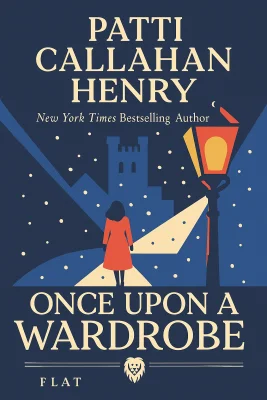
Once Upon a Wardrobe
Categories
Fiction, Christian, Audiobook, Historical Fiction, Fantasy, Book Club, Historical, Books About Books, Christian Fiction, Christmas
Content Type
Book
Binding
Hardcover
Year
2021
Publisher
Thomas Nelson
Language
English
ASIN
0785251723
ISBN
0785251723
ISBN13
9780785251729
File Download
PDF | EPUB
Once Upon a Wardrobe Plot Summary
Introduction
The snow falls heavy on the Worcestershire cottage as eight-year-old George Devonshire sits propped against his pillows, staring at the lion on the cover of a brand-new book. His weak heart beats irregularly, a reminder that his time in this world grows short. But in his hands lies something magical - *The Lion, the Witch and the Wardrobe* by C.S. Lewis. George has fallen completely under its spell, yet one burning question consumes him: where did Narnia truly come from? His seventeen-year-old sister Megs, brilliant at mathematics but skeptical of fairy tales, watches her brother's obsession with growing concern. When George begs her to discover the story behind the story, she reluctantly agrees. What begins as a simple inquiry leads Megs on an extraordinary journey to Oxford, where she encounters the author himself. C.S. Lewis doesn't give her the straightforward answers she expects. Instead, he offers something far more precious - the intertwining tales of his own life, each story a thread in the great tapestry that would eventually become the world of Narnia.
Chapter 1: The Question of Narnia: A Brother's Request
George's breathing comes in shallow gasps as he closes the wardrobe door behind him. The carved wooden space has become his sanctuary, a place where the boundaries between reality and imagination blur. When Megs finds him there, curled among their mother's old coats, his blue eyes shine with desperate hope. "I need you to find out where Narnia comes from," he whispers, clutching the book to his chest like a lifeline. "Not just that someone made it up. I need to know how it got into the world." Megs feels her heart crack. Her brilliant mind, so comfortable with equations and scientific proofs, recoils from such an impossible task. How do you trace the origin of imagination itself? Yet looking at George's pale face, she cannot refuse. He has asked for so little in his short life. She promises to find C.S. Lewis and ask him directly. George's smile illuminates his gaunt features, and for a moment, the approaching shadow of death seems to retreat. But Megs knows that winter is closing in, both outside their cottage windows and in the fragile chambers of her brother's heart. Time is running out, and she has no idea how to catch something as elusive as the birth of a story. The weight of her promise settles on her shoulders as George drifts into peaceful sleep, the book still clutched in his small hands. Through the frost-covered window, Narnia's lamppost seems to flicker in the gathering dusk.
Chapter 2: Meeting the Storyteller: Journeys to the Kilns
Megs trudges through the snow-covered grounds behind the Kilns, feeling foolish. For three afternoons, she has hidden among these Oxford woods, watching C.S. Lewis's house from a distance, unable to summon the courage to knock on his door. The frosted trees stand like sentinels around the property, and she can almost imagine fauns stepping out from behind their trunks. A voice startles her from her reverie. "Well, hello there!" Major Warren Lewis, C.S. Lewis's brother, emerges from the woodland path with twinkling eyes and a kind smile. Caught red-handed in her surveillance, Megs stammers an explanation about her dying brother and his impossible question. Warren's expression softens immediately. "I know just the man who can help you," he says, leading her toward the warm golden light spilling from the cottage windows. "My brother Jack would be delighted to meet you." Inside the Kilns, Megs discovers a world far removed from the sterile precision of her mathematics lectures. Books overflow from every surface, pipe smoke curls toward the low ceiling, and C.S. Lewis himself - "Jack" to his friends - greets her with the warmth of an old family friend. His eyes sparkle with curiosity when she explains George's quest. "Where did Narnia come from?" Lewis muses, settling back in his worn leather chair. "Now that's a question worth pondering. But I suspect the answer isn't what your brother expects. Stories, you see, don't emerge from nowhere. They grow from the soil of a life lived, from joys and sorrows, from other stories that came before." He begins to speak of his childhood in Belfast, of a little boy named Jack who lost his mother and found solace in imaginary worlds. Megs listens, captivated despite herself, as the first threads of the Narnia tapestry begin to emerge from the mists of memory.
Chapter 3: Stories Within Stories: Lewis's Life Unfolds
In the little end room of Little Lea, young Jack Lewis and his brother Warnie create their first imaginary kingdom. Boxen springs to life under Jack's pen - a world of talking animals in medieval dress, complete with maps and detailed histories. The boys craft this realm together, sharing its secrets during long Irish afternoons while their mother grows sicker in the room below. Lewis's voice grows heavy as he tells Megs of his mother's death when he was only nine. The boy who had once felt safe in stories suddenly found himself cast adrift in a world that seemed hostile and meaningless. Shipped off to brutal boarding schools, Jack encountered headmasters who beat students with rattan canes and older boys who tormented the weak. Yet through it all, stories remained his refuge. Norse mythology captured his imagination with its fierce beauty and tragic endings. The young Lewis discovered Wagner's *Ring of the Nibelung* and felt what he called "joy" - a piercing longing that seemed to echo from some distant, half-remembered realm. In dusty school libraries, he devoured tales of gods and heroes, of sacrifice and redemption, storing them away like treasures in his expanding imagination. Megs scribbles frantically in her notebook, trying to capture every detail. She's beginning to understand that Lewis isn't simply answering George's question - he's teaching her to ask better ones. Stories don't emerge from nothing; they grow from the compost of lived experience, transformed by the mysterious alchemy of imagination into something that transcends its origins. The fire crackles in the hearth as Lewis pauses in his tale, his eyes distant with memory. "Every story contains the seeds of every other story," he says quietly. "We are all just gardeners, tending the plots that were planted long before we arrived."
Chapter 4: Numbers and Narratives: Megs's Transformation
Walking back through Oxford's dreaming spires, Megs feels something shifting inside her orderly world. Mathematics had always provided clean answers, elegant proofs where every step led logically to the next. But Lewis's stories resist such tidy categorization, flowing and merging like streams feeding a greater river. At the Bodleian Library, she finds herself drawn away from her physics texts toward the literature section. Almost against her will, she picks up George MacDonald's *Phantastes* - the book that Lewis credits with "baptizing his imagination." Hours pass unnoticed as she loses herself in its fairy-tale landscape, feeling for the first time the peculiar magic that had captured her brother's heart. Her studies begin to suffer, but Megs discovers she doesn't care. Something more important than academic success is happening to her. In the pub where Lewis once met with his writing group, the Inklings, she encounters Padraig, a red-haired Irish student who challenges her assumption that only mathematics contains truth. "Stories and equations are asking the same questions," he tells her over warm cider. "They're both trying to make sense of the mystery we're living inside. The only difference is the language they use." Their debate continues as snow begins to fall outside, and Megs feels her heart opening to possibilities she'd never considered. When Padraig kisses her in a snowbank, she experiences a kind of mathematics she's never encountered in any textbook - the wild arithmetic of the heart, where one plus one somehow equals infinity. But even as these new feelings bloom, the shadow of George's illness looms larger. Christmas approaches, and with it, the growing certainty that this may be her brother's last. The stories she's gathered feel precious but incomplete, like a half-finished equation whose final terms remain tantalizingly out of reach.
Chapter 5: The Irish Adventure: Finding Dunluce Castle
On the morning before Christmas Eve, Padraig appears at the Devonshire cottage with an impossible proposal. His father's car sits in the drive, loaded with blankets and provisions for a journey across the Irish Sea. George's greatest wish, he announces, is within reach - they can visit the ruins of Dunluce Castle, the crumbling fortress that helped inspire Cair Paravel in Lewis's tale. Megs's practical mind recoils from the plan. George is too frail for such a journey, her parents would never approve, and the winter crossing could be treacherous. But looking at her brother's face - suddenly alive with desperate hope - she makes a choice that astonishes her own mathematical soul. Sometimes, she realizes, the most logical thing is to embrace the impossible. They slip away like conspirators in a fairy tale, leaving only a hastily scrawled note of explanation. The drive through England and Wales passes in a blur of snow-covered fields and excited chatter. George pores over the atlas Padraig has brought, tracing their route with a finger that seems steadier than it's been in months. The sea crossing on the car ferry fills him with wonder - gray waves rolling toward a horizon that promises adventure. At Dunluce Castle, perched on its dramatic cliff above the churning Atlantic, George seems transformed. Color returns to his cheeks as he climbs on Padraig's shoulders to see over the ancient walls. The December wind whips through the ruins, carrying the salt smell of distant shores and half-heard echoes of medieval battles. Standing at the edge of the world, surrounded by the bones of a once-mighty fortress, George finally understands what he's been seeking. Narnia didn't come from any single source - it emerged from the collision of story and landscape, memory and imagination, the eternal human need to find meaning in a world that often seems meaningless. In the failing light, with the sea roaring below, he feels connected to something larger than his failing body, something that will endure long after his last breath.
Chapter 6: The Lion's Roar: Understanding What Matters
Christmas morning dawns clear and bright over Worcestershire. The family gathers around George's bed, exhausted but exhilarated by their Irish adventure. Megs reads aloud from her notebook - the stories within stories that Lewis had shared, each one a piece of the vast puzzle that became Narnia. But as she reaches the end of her collected tales, she realizes she still doesn't have the simple answer George originally sought. Lewis himself had been honest about the mystery at the heart of creation. "It all began with a picture," he told her - a image of a faun carrying parcels through a snowy wood, glimpsed in his imagination when he was sixteen and not developed into a story until thirty years later. The Lion came from dreams, from other books, from the deep wells of myth and longing that every human carries. There was no single origin, no clean equation that could explain how wonder enters the world. George listens to the final stories with a peaceful smile, his sketchbook open beside him. Page after page reveals his growing artistic talent - scenes from Lewis's childhood with a magnificent lion watching over them all, protective and fierce and infinitely kind. In every drawing, Aslan is present, not as an intruder in the narrative but as a presence that was always there, waiting to be recognized. "I think the lion follows all of us around," George says quietly, his hand resting over his heart. "We just have to look for him." His words carry a certainty that no amount of research or analysis could provide. Through stories, he has touched something true - not true in the way that mathematics is true, but true in the deeper way that love and hope and courage are true. As the winter afternoon fades toward evening, George drifts into sleep surrounded by the people he loves most. His breathing grows shallow but peaceful, and in the gathering twilight, Megs could swear she hears something like a distant roar - not threatening, but welcoming, calling him toward an adventure greater than any story could contain.
Chapter 7: The Legacy of Wonder: Life Beyond Loss
The funeral fills the small village church to overflowing. Neighbors who barely knew the Devonshire family come to pay their respects to the boy who had lived so briefly but loved so fiercely. C.S. Lewis and his brother Warren sit in the third row, their faces grave with shared sorrow. Padraig holds Megs's hand as she stands to speak, her voice steady despite the tears she cannot hold back. She reads from the story Padraig wrote for George - a tale of a boy born closer to the end of his story than the beginning, but whose brief time in the world was filled with wonder and discovery. The words rise toward the ancient stone ceiling, carrying with them the essence of everything George had taught them about the power of imagination to transform even the darkest circumstances. After the service, Lewis approaches Megs with gentle eyes. "Your brother understood something that many adults never learn," he tells her. "Stories aren't escapes from reality - they're roads that lead us deeper into it. Through Narnia, he found his way to the truth that underlies all stories." Years pass. Megs and Padraig marry and build a life together in the countryside near Oxford. She becomes a writer herself, crafting the tale of her brother's quest and their shared discovery of wonder. The book, illustrated with George's own drawings of the lion who watches over every story, finds its way into the hands of children and adults around the world. In her study, surrounded by books both mathematical and mythical, Megs often thinks of George's final words about the lion who follows us all. She has learned to see him in the equations that reveal the hidden order of the universe, in the stories that kindle hope in dark times, in the love that connects one heart to another across the vast mystery of existence. Narnia, she understands now, doesn't come from any single source - it emerges wherever wonder and sorrow and hope collide, wherever someone dares to believe that there might be something more beautiful waiting just beyond the wardrobe door.
Summary
In *Once Upon a Wardrobe*, Patti Callahan Henry crafts a luminous meditation on the power of stories to transform both teller and listener. Young George Devonshire's dying wish - to understand the origins of Narnia - becomes a journey of discovery that changes everyone it touches. Through Megs's encounters with C.S. Lewis, we see how a master storyteller's life experiences - loss, war, friendship, and wonder - alchemize into the timeless tale that has enchanted generations. George's quest reveals that the deepest truths cannot be reduced to simple equations or pat explanations, but must be approached through the more mysterious pathways of imagination and love. The novel's greatest achievement lies in its recognition that stories don't merely entertain - they heal, illuminate, and connect us to something larger than ourselves. George finds in Narnia not an escape from his brief life, but a road leading deeper into its meaning. His sister Megs discovers that wonder and logic need not be enemies, that the heart has its own mathematics more complex and beautiful than any equation. In the end, Henry suggests, we are all living inside a vast story whose Author remains partly hidden, partly revealed in every tale that kindles hope in the darkness and reminds us that love is the force that holds all worlds together.
Best Quote
“Reason is how we get to the truth, but imagination is how we find meaning.” ― Patti Callahan, Once Upon a Wardrobe
Review Summary
Strengths: The review highlights the novel's ability to blend history and fiction seamlessly, providing a deeper understanding of C.S. Lewis. It praises the emotional depth, describing it as moving, beautiful, and enchanting. The story is noted for its capacity to evoke a range of emotions, from laughter to tears, and for its comforting and inspiring nature. The characters and narrative are described as impactful and memorable. Overall: The review conveys a highly positive sentiment, recommending the novel as a must-read. It suggests that the book is a captivating and heartwarming tale that resonates deeply with readers, encouraging them to revisit C.S. Lewis's works. The reviewer expresses a strong personal connection to the story, indicating its profound impact.
About Author

Patti Callahan Henry
Callahan Henry reframes historical events into compelling narratives, blending meticulously researched facts with fictional storytelling to offer readers both entertainment and insight. Her novels often explore the intricate dynamics of human relationships, as seen in "The Secret Book of Flora Lea" and "Becoming Mrs. Lewis," which investigates the life of C.S. Lewis's wife. Through these stories, Henry aims to delve into themes of love, loss, and discovery, inviting readers to reflect on the enduring impact of history on personal lives.\n\nIn her writing, Henry employs a dual narrative structure and richly developed characters, ensuring that historical contexts are both engaging and enlightening. Her method of integrating real-life events with fictional elements allows her to illuminate lesser-known historical moments, such as the maritime disaster in "Surviving Savannah." This approach not only captivates the audience but also enriches their understanding of the past. Readers who appreciate a blend of historical depth and emotional resonance will find her books particularly rewarding.\n\nBeyond her novels, Henry extends her storytelling through podcasts and live shows like Friends and Fiction, engaging with a broader audience. Her contributions to Parade Magazine and participation in various anthologies underscore her versatility as a writer. Recognition for her work, such as The Christy Award for "Book of the Year" and the Alabama Library Association Book of the Year, highlights her significant impact on contemporary literature. This bio reflects her commitment to crafting narratives that resonate with readers, making her a noteworthy author in today's literary landscape.
Read moreDownload PDF & EPUB
To save this Black List summary for later, download the free PDF and EPUB. You can print it out, or read offline at your convenience.
Once Upon a Wardrobe
by Patti Callahan Henry
