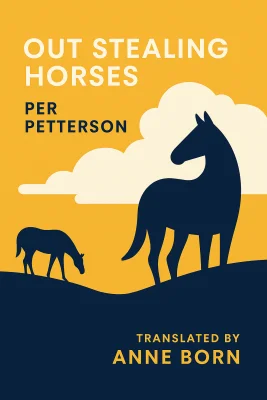
Out Stealing Horses
Categories
Fiction, Historical Fiction, Literature, Scandinavian Literature, Book Club, Contemporary, Novels, Coming Of Age, Adult Fiction, Literary Fiction
Content Type
Book
Binding
Hardcover
Year
2007
Publisher
Graywolf Press
Language
English
File Download
PDF | EPUB
Out Stealing Horses Plot Summary
Introduction
The old man stands in his kitchen, watching snow fall through the darkness onto his remote Norwegian property. At sixty-seven, Trond has retreated here to live alone with his dog Lyra, seeking solitude after losing his wife in a car accident three years prior. But the wilderness holds ghosts he cannot escape. When his neighbor Lars arrives one snowy evening with his border collie Poker, something in the man's weathered face triggers a flood of memories that Trond has spent decades trying to suppress. The recognition hits like a physical blow—this is Lars, the ten-year-old boy who accidentally shot his twin brother Odd with a hunting rifle in the summer of 1948. That same summer when fifteen-year-old Trond spent his last weeks with his father at a cabin by the river, learning to fell timber and discovering secrets about the war that would shatter his understanding of everything he thought he knew. Now, more than fifty years later, the past refuses to stay buried beneath the accumulated snow of time.
Chapter 1: Solitude by the Lake: A Man Retreats to the Wilderness
Trond has chosen this isolation deliberately. The house sits on a ridge overlooking a lake where swans nest in the reeds, connected to the main road by a winding track through dense forest. He bought the property sight unseen, drawn by its remoteness and the promise of self-sufficiency. Here he chops wood, repairs what needs fixing, and walks the forest paths with Lyra, a yellow mongrel he rescued from an animal shelter. The radio provides his only regular human contact, crackling with news from a world that feels increasingly foreign. He listens to cricket scores from countries he will never visit, finding comfort in their irrelevance to his carefully constructed solitude. The millennium approaches, but Trond plans to spend New Year's Eve alone, perhaps getting drunk on a bottle he keeps in reserve for such occasions. His nearest neighbor lives in a cottage by the small river that feeds the lake. From his kitchen window, Trond can see the lights when the man is home. They exchange polite nods when their paths cross, but maintain the careful distance that rural neighbors understand. Until the night Poker goes missing, and the sound of a dog whistle pierces the darkness like a cry from the past. When Trond ventures out to help search for the lost border collie, he encounters Lars properly for the first time. The man's weathered hands and careful movements around the chainsaw speak of a lifetime working the land, but there is something haunted in his manner, a weight he carries that makes him avoid direct eye contact. As they work together to clear the massive birch tree that winter storms have felled across Trond's yard, shared labor begins to break down the barriers between them.
Chapter 2: The Summer of 1948: Two Boys Stealing Horses
The memories arrive with startling clarity, transporting Trond back to his fifteenth summer when everything changed. He had come to the cabin with his father, a mysterious figure whose frequent absences during the war years had left gaps in their relationship that the boy desperately wanted to fill. The timber operation was supposed to be their great adventure together, a chance to work side by side in the ancient rhythms of axe and saw. Jon appeared at their cabin door like a woodland spirit, announcing they were going out stealing horses. The fifteen-year-old neighbor boy had become Trond's guide to the forest's secrets, teaching him to move silently through the trees and read the subtle signs of weather changes in the behavior of birds. Jon never knocked, simply materialized at the threshold with that characteristic squint and half-smile, waiting until Trond sensed his presence and emerged to join whatever adventure he had planned. The stolen horses belonged to Barkald, the local landowner whose property bordered their own. The boys had discovered where he kept four horses in a fenced clearing deep in the forest, and Jon had devised an elaborate plan for capturing and riding them. Trond would climb a birch tree overlooking the paddock while Jon scattered the horses, then drop onto the back of whichever animal passed beneath him. The plan worked perfectly until physics intervened. Trond managed to land on his chosen horse and experienced a moment of pure transcendence, feeling the powerful animal's muscles bunch and flow beneath him as they thundered through the forest. But when the horse swerved sharply at a fence line, momentum carried the boy over the barbed wire in a graceful arc that ended painfully in the heather. Jon retrieved him with characteristic calm, neither impressed nor particularly concerned by his friend's spectacular dismount.
Chapter 3: Tragedy in the Forest: When a Gunshot Changes Everything
The summer's idyll shattered on a morning that began like any other. Jon had returned from one of his solitary hunting expeditions, pleased with his success in bringing down two hares. His skill with the rifle was legendary among the local boys, and he took pride in providing meat for his family's table. But in his excitement to show off his prizes, he made a fatal error—he left the gun loaded when he set it down in the hallway. Ten-year-old twins Lars and Odd had been playing in the basement, tumbling and wrestling with the boundless energy of boys their age. When they discovered the rifle and the hanging hares, they saw an opportunity to play at being their older brother, whom they idolized. Lars grabbed the weapon, swinging it around with theatrical bravado, and pulled the trigger just as his twin stepped into the line of fire. The shot echoed through the valley like a thunderclap, reaching Trond where he worked alongside his father and the other men in their timber operation. They all froze at the sound, recognizing instinctively that this was not the clean crack of a hunting shot but something far more ominous. When Jon's father arrived at the scene, he found one son dead and another traumatized beyond comprehension. The funeral took place three days later under a brilliant blue sky that seemed to mock the gathered mourners. Trond watched Lars run in desperate circles around the churchyard, unable to accept the reality of his brother's death. The image of the boy's frantic flight burned itself into memory—a child trying to outrun an unfathomable tragedy, his legs pumping uselessly against the weight of irreversible loss. Jon stood apart from the graveside ceremony, his face a mask of stone, already retreating into the emotional isolation that would define the rest of his short life.
Chapter 4: Timber and Secrets: Working Alongside Father
The logging operation continued despite the shadow cast by the shooting. Trond's father drove the men with renewed intensity, as if physical labor could somehow restore meaning to a summer that had tilted toward chaos. They felled ancient spruces with crosscut saws, the rhythmic bite of steel teeth eating through heartwood while sawdust fell like golden snow in the filtered sunlight. Franz, the bearded logger who lived near the bridge, proved to be more than a simple woodsman. Over breakfast in his blue-painted kitchen, he revealed the true story of why Trond's father had first come to this valley. During the war, the cabin had served as a waystation for refugees fleeing to Sweden, and his father had been part of the resistance network that guided them across the border. The timber cutting was merely a cover for more dangerous work. The revelation recontextualized everything Trond thought he knew about his father's mysterious absences. Those long months when the family waited without word from him, he had been establishing himself as a trusted presence in the valley, creating the infrastructure necessary to move people and intelligence across the frontier. Jon's mother had been part of the operation, rowing supplies upriver to the cabin and sometimes carrying documents hidden in her food baskets. But the network had been compromised. Franz described the winter day when German soldiers had discovered tracks leading to Jon's family farm, forcing them to destroy the bridge with hidden explosives to prevent pursuit. A refugee had been killed on the riverbank, shot down as he tried to escape with his precious cargo of documents. Trond's father and Jon's mother had fled together into the Swedish forest, leaving behind the careful fiction of their separate lives.
Chapter 5: Resistance and Romance: Uncovering Hidden Histories
The adult relationships that had seemed so mysterious to the fifteen-year-old boy began to make sense in light of Franz's revelations. Trond's father and Jon's mother had been bound together by more than shared danger—they had fallen in love during those clandestine meetings at the cabin. What the boy had witnessed from across the river that morning, the tender embrace on the jetty, was not a moment of weakness but the culmination of a relationship forged in wartime's crucible. The timber drive became a kind of penance for his father, a way of working off the guilt of abandoning his family for something larger than domestic duty. But the logs were cut at the wrong time of year, too full of sap to float properly, and the river was too low for successful rafting. Franz had tried to warn him, but pride and desperation made the man stubborn. Most of the timber would end up stranded in log jams or sunk to the river bottom, generating barely enough money to pay for the train ticket home. Jon's father had known about the affair, had seen his wife rowing upriver to her lover while he remained trapped between knowledge and ignorance, unable to act on what he understood but could not acknowledge. The accident that broke his leg during the timber loading was perhaps inevitable, the physical manifestation of tensions that had been building throughout the summer. When he fell from the log pile, something broke inside him beyond bone and sinew. The competition between the two men had infected every aspect of the work, turning collaborative labor into a contest of wills that could only end in disaster. Trond watched his father and Jon's father push each other to increasingly dangerous extremes, each determined to prove his superiority through feats of strength and endurance that served no practical purpose. The boy found himself caught between admiration for his father's capabilities and horror at the recklessness that those capabilities enabled.
Chapter 6: The Great Abandonment: A Father Disappears
The end came abruptly, without ceremony or explanation. Trond's father announced that the boy would return to Oslo alone while he finished up the remaining work at the cabin. Standing under the oak tree in front of the village shop, waiting for the bus that would begin the long journey home, the fifteen-year-old experienced his first glimpse of genuine abandonment. His father's final words carried a weight that the boy could not yet comprehend: instructions about thinking afterwards, about not growing bitter, about learning from what happens in life. The bus ride became a nightmare of anticipation and dread, every mile carrying Trond further from the world he had discovered that summer and closer to a future he could not imagine. At Elverum station he would change to the train that would deliver him back to his mother and sister, back to the cramped apartment overlooking the Oslo fjord where his father's absence had once been temporary and explainable. Now that absence would become permanent, a void that would reshape the family's entire existence. For weeks afterward, Trond cycled to Østbane station to meet every train from Elverum, convinced that his father would eventually appear with his familiar half-smile and some reasonable explanation for the delay. The futility of these vigils gradually became apparent, but still he continued them, unwilling to accept what his rational mind already understood. The station became a kind of purgatory where hope died by increments, each arriving train delivering other people's fathers but never his own. The letter, when it finally arrived, was brutally concise. His father thanked them for their time together but explained that he would not be returning. There was money in a Swedish bank, proceeds from the timber sale, that his mother could collect with proper documentation. No special message for the boy who had shared that final summer, no acknowledgment of the bond they had forged in the forest. Just a formal farewell that reduced their relationship to a line item in life's larger accounting.
Chapter 7: The Weight of Memory: Confronting the Past
Standing in his kitchen more than five decades later, Trond understands that some encounters cannot be avoided indefinitely. Lars has recognized him just as surely as he has recognized Lars, and the careful distance they have maintained cannot survive this mutual knowledge. The boy who shot his brother and the boy who lost his father are bound together by that terrible summer, linked by tragedies that shaped the men they became. The recognition forces Trond to confront questions he has spent a lifetime avoiding. Was Lars the son who stayed to work the family farm while Jon escaped to sea? Did he inherit the life that should have belonged to his older brother, or was he condemned to remain in the place where his greatest mistake occurred? The man's haunted demeanor suggests that inheriting his brother's future brought no peace, only a different kind of torment. As they work together to clear the fallen birch from Trond's yard, their shared labor creates a bridge across the decades. The rhythmic bite of chainsaw teeth through deadwood becomes a form of communication, a way of acknowledging their connection without forcing it into words. Lars moves with the practiced efficiency of someone who has spent his life working with his hands, but there is something desperate in his need to stay busy, as if motion can keep memory at bay. When Ellen arrives unexpectedly from Oslo, her presence disrupts the careful equilibrium Trond has constructed in his retreat. His daughter's questions force him to articulate what he has tried to leave unspoken—that his withdrawal from the world is not just grief for his dead wife but a reckoning with patterns of abandonment that stretch back to his fifteenth year. The visit becomes a test of whether he can maintain relationships without repeating his father's pattern of disappearing when life becomes too complicated.
Summary
The snow continues to fall on Trond's chosen refuge, but the past has found him despite his efforts to escape it. Lars carries his own burden of memory, the weight of a moment's carelessness that destroyed one life and poisoned another. Together they represent the collateral damage of adult decisions made during wartime's moral confusion, children who paid the price for their parents' choices long after the danger had passed. In the end, Trond must decide whether to embrace the connections that bind him to this place and its people, or to retreat further into the isolation that has become both his sanctuary and his prison. The lake will freeze soon, and the swans will either migrate to warmer waters or find some way to survive the winter's coming harshness. Like them, he faces a choice between flight and endurance, between the safety of solitude and the risks that come with remaining fully human. The echoes of that distant summer by the river continue to reverberate, reminding him that some currents run too deep to ever truly escape.
Best Quote
“You decide for yourself when it will hurt.” ― Per Petterson, Out Stealing Horses
Review Summary
Strengths: The review highlights the novel's self-reflective nature and the author's skillful use of subtle language that delivers emotional impact. The narrative's exploration of themes such as regret, grief, and aging is praised, alongside its vivid depiction of the connection between individuals and the natural world. The writing is described as "gorgeous" and "exquisite," indicating a high level of literary quality. Overall: The reviewer expresses a strong appreciation for the novel, particularly enjoying its introspective journey and thematic depth. The book is recommended for readers who value character-driven stories and reflective prose over plot-driven narratives.
About Author

Per Petterson
Petterson interrogates the complexities of personal loss and identity through his poignant storytelling. His journey toward becoming an author began at 18, though he initially spent years working in a factory and later as a bookseller and librarian. These diverse experiences enrich his writing, embedding it with authenticity and depth. The themes of familial ties and tragedy are particularly pronounced in his work, especially after the devastating loss of his family in the Scandinavian Star ferry disaster. His novel "I kjølvannet" (In the Wake) reflects this personal tragedy, exploring the emotional aftermath of losing one's family, which resonated widely, earning the Brage Prize.\n\nHis work often captures the subtle dynamics of human relationships, interwoven with themes of nostalgia and the passage of time. In "Til Sibir" (To Siberia), Petterson delves into the complexities of sibling bonds and the longing for a past that can never be reclaimed. His nuanced exploration of such themes led to its nomination for The Nordic Council's Literature Prize. Meanwhile, "Ut og stjæle hester" (Out Stealing Horses) represents his literary breakthrough, receiving top literary honors in Norway, including the Norwegian Critics Prize for Literature. These books showcase his ability to evoke profound emotional responses while addressing universal human experiences.\n\nReaders who appreciate introspective narratives and richly developed characters will find Petterson's work both rewarding and thought-provoking. His stories offer a deep dive into the human psyche, presenting an opportunity for readers to reflect on their relationships and personal histories. This bio illustrates how his literature continues to captivate audiences by providing insights into the enduring themes of loss, memory, and identity.
Read moreDownload PDF & EPUB
To save this Black List summary for later, download the free PDF and EPUB. You can print it out, or read offline at your convenience.
Out Stealing Horses
by Per Petterson
