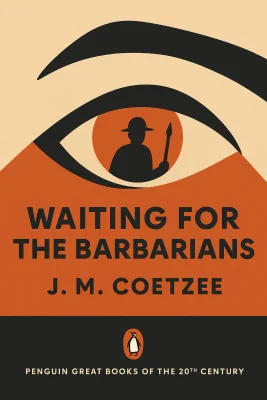
Waiting for the Barbarians
Categories
Fiction, Classics, Historical Fiction, Africa, Literature, Novels, African Literature, Literary Fiction, Nobel Prize, South Africa
Content Type
Book
Binding
Paperback
Year
1999
Publisher
Penguin Books
Language
English
ASIN
0140283358
ISBN
0140283358
ISBN13
9780140283358
File Download
PDF | EPUB
Waiting for the Barbarians Plot Summary
Introduction
In a remote frontier outpost at the edge of the Empire, an aging magistrate watches smoke rise from the reeds where barbarian prisoners once sat in chains. Colonel Joll of the Third Bureau has arrived, his dark glasses reflecting nothing but the certainty of imperial justice. Behind those lenses lies a new kind of warfare—one fought not on battlefields but in windowless rooms where truth is extracted with heated iron and patient cruelty. The magistrate has spent thirty peaceful years administering this desert oasis, settling disputes over irrigation rights and grain taxes. But when Joll's methods leave an old man dead and his daughter broken, something shifts in the magistrate's world. He finds himself drawn to the barbarian girl, her feet twisted by torture, her eyes clouded by the kiss of hot metal. What begins as an act of conscience becomes an obsession that will strip away everything he believes about civilization, justice, and the very nature of Empire itself.
Chapter 1: The Arrival of Authority: Colonel Joll and the Seeds of Cruelty
The stranger's dark glasses catch the desert sun like twin mirrors, reflecting nothing of the man behind them. Colonel Joll moves through the magistrate's office with deliberate precision, his fingers trailing across ledgers that chronicle thirty years of peaceful administration. He speaks of fresh starts and clean pages, but his words carry the weight of iron. The barbarian prisoners squat in the barracks yard, two figures pulled from the endless steppes—an old man and a boy whose arm bears an angry, festering wound. They claim innocence, speaking of seeking a doctor, but Joll sees only the architecture of guilt waiting to be exposed. The magistrate translates their protests, watching the Colonel's face remain as still as carved stone. That night, the magistrate lies on the ramparts listening to silence. No screams pierce the air, no cries echo from the granary where Joll has set up his chambers. The building's thick walls swallow whatever truths are being extracted within. When dawn comes, the old man is dead, his body wrapped in a burial shroud that fails to hide the damage beneath. The boy survives, marked by small precise wounds that speak of careful application rather than wild violence. Joll explains the process with clinical detachment—first lies, then pressure, then more lies, until the moment of breaking when truth finally spills forth. Pain, he suggests, is simply the most reliable pathway to honesty. But the magistrate finds himself haunted by a different equation. Standing over the old man's battered corpse, he realizes that some knowledge carries too high a price, that there are doors which, once opened, can never be closed again. The Empire has planted new seeds in his peaceful oasis, and he can already sense them taking root in the darkness.
Chapter 2: Compassion and Atonement: The Magistrate and the Barbarian Girl
She kneels by the barracks gate like a question mark shaped from shadow and resignation. The barbarian girl's face turns away as the magistrate approaches, her hands gripping crude walking sticks that speak of bones badly healed. Behind her fringe of black hair, her eyes hold a distant quality, as though focused on landscapes he cannot see. In his apartment, she removes the bandages from her feet with mechanical precision. The magistrate stares at the damage—ankles swollen into shapeless masses, toes that will never again feel the earth properly beneath them. She speaks of the fork with casual directness, how they heated it in coals until it glowed, how they held her eyelids open and brought it close enough to sear without quite burning. He begins a ritual that defies his own understanding. Night after night, he fills the basin with warm water and kneads her damaged flesh, working oil into the scars that map her suffering. His hands move with reverence rather than desire, seeking something beyond physical healing. She submits to his ministrations with the patience of someone who has learned to accept whatever comes next. The townspeople whisper and laugh, reducing their strange liaison to crude jokes about aging magistrates and barbarian whores. But in the lamplight, as she sleeps with her ruined feet cradled in his arms, the magistrate feels himself approaching some fundamental truth about complicity and redemption. Her body carries the Empire's signature written in scar tissue and twisted bone. He cannot undo what Joll's methods have inscribed upon her flesh, but he can bear witness to it. In the rhythm of their nightly ablutions, master and victim find themselves bound together by chains more complex than either guilt or forgiveness. She becomes his conscience made visible, a living reminder of the price extracted in Empire's name.
Chapter 3: Journey into the Unknown: Returning the Girl to Her People
Spring arrives with deceptive warmth as the magistrate assembles his expedition—three soldiers and enough supplies for a treacherous journey across the desert's winter-scarred face. He tells himself this is mercy, returning the girl to her people, but his motivations tangle like serpents in his chest. Duty, desire, and something darker drive him beyond the Empire's borders. The desert strips away pretense with surgical precision. Salt flats stretch endlessly beneath copper skies while wind-carved dunes shift like thoughts half-formed. Their horses stumble through terrain that seems designed to test human audacity, and the girl rides with her face wrapped against the stinging sand, a silent accusation wrapped in barbarian furs. When they finally encounter the nomads, the meeting unfolds like a ceremony from another age. The barbarian horsemen materialize from mirages, their weapons ancient but their eyes sharp with intelligence. The magistrate watches the girl speak in her native tongue, her voice animated for the first time since her captivity. She belongs here among these weather-beaten faces and practical hands. The exchange happens with brutal simplicity. Silver changes hands, the girl mounts a barbarian pony, and suddenly she is beyond his reach forever. The magistrate searches his heart for the pain he expected to find, but discovers only emptiness where his obsession once burned. She rides away without looking back, her spine straight with returning dignity. On the journey home, his soldiers grow sullen with unspoken accusations. They have risked their lives for what—an old man's infatuation with a barbarian bed-warmer? But the magistrate tastes something unexpected on the wind: the metallic flavor of freedom. He has finally chosen his own path, even if he cannot yet name where it leads.
Chapter 4: The Empire's Judgment: Imprisonment and Torture
The new regime has transformed his office into a shrine to bureaucratic efficiency. Warrant Officer Mandel sits behind the magistrate's own desk, his handsome face wearing authority like an ill-fitting uniform. Papers accusing the magistrate of treason lie scattered across the polished surface—depositions from his own men describing secret meetings with barbarians and suspicious sympathies. The cell becomes the magistrate's world, a windowless cube where cockroaches emerge at night to explore his aging flesh. He discovers how quickly the body reduces itself to basic needs—food, water, the desperate desire to empty tortured bowels without tearing tissue. Days blur into nights as he learns the democracy of physical degradation. When they finally come for him, Mandel brings the tools of enlightenment—salt water forced down his throat until he vomits and soils himself, his arms wrenched behind his back until shoulders separate with wet pops. They show him the meaning of incarnation, how consciousness becomes simply another organ subject to manipulation and control. The worst moments come not during the sessions but in the spaces between, when he lies in his own filth trying to remember why his principles once seemed worth defending. The Empire's true genius lies not in breaking men but in showing them how easily they can be reduced to meat that dreams of dignity. Yet something stubborn refuses to yield completely. Even as his body betrays him in waves of agony and humiliation, some essential spark continues to insist that torture is wrong, that human dignity exists beyond the reach of heated iron and clever pain. They can remake his flesh, but they cannot quite remake his soul.
Chapter 5: Collapse of Certainty: The Failed Campaign and Abandonment
The messenger arrives lashed upright in his saddle like a grotesque scarecrow, dead for days but still bearing the green and gold standard of Empire. His companion escapes into the reed-brakes, carrying news too terrible for official dispatch. The great expeditionary force has vanished into the desert's maw, swallowed by a landscape that refuses to acknowledge imperial geography. Panic spreads through the settlement like plague. Families pack carts with desperate haste while soldiers loot abandoned houses with the efficiency of men who know their time is short. Warrant Officer Mandel addresses the crowd with promises of temporary withdrawal and spring offensives, but his words carry the hollow ring of official fiction. The magistrate watches from the square as civilization peels away in layers. First the administrators flee with their files and furniture, then the merchants with their portable wealth, finally the soldiers themselves, driving commandeered livestock toward distant safety. Those who remain gather in uncertain clusters, suddenly aware of how thin the veneer of imperial protection has always been. Standing in the ruins of his authority, the magistrate feels something unexpected—relief. The Empire's departure strips away the last illusions about order and security, leaving behind only the fundamental questions of survival. He has become a citizen of nowhere, responsible to nothing but his own conscience. The barbarians remain invisible beyond the walls, perhaps watching, perhaps already departed for their winter grounds. Fear transforms every shadow into an enemy, every sound into approaching doom. Yet the magistrate finds himself oddly hopeful. In the absence of Empire, other possibilities might finally emerge from the desert's patient silence.
Chapter 6: Waiting in Limb: The Frontier Between Empire and Barbarians
Winter descends like a judgment as the abandoned settlement struggles to feed itself. The magistrate has emerged from his cell to find himself thrust into leadership by default—the last imperial official in a place that no longer believes in imperial protection. Children hunt crustaceans in the lake's bitter shallows while adults dig wells and hoard grain against the coming darkness. The barbarians announce their presence through absence—missing livestock, broken irrigation channels, hoofprints in the mud that appear and vanish like accusations. Fear reshapes daily life as mothers call their children inside before sunset and sentries jump at shadows. Yet no barbarian army materializes from the steppes to claim their victory. In his restored apartment, the magistrate tends a small fire and contemplates the poplar slips that once seemed to hold the secrets of vanished civilizations. Now he suspects they contain the same mixture of mundane concerns and existential terror that fills his own thoughts—harvest yields and water levels, birth announcements and death notices, the ordinary texture of human life played out against the backdrop of political collapse. The settlement endures in the space between empires, neither fully conquered nor completely free. Some nights the magistrate dreams of the barbarian girl riding toward the walls with her adopted people, returning not as victim but as herald of a new order. Other nights he imagines her settled in some distant valley, grinding grain and raising children who will never know the weight of imperial chains. But most often he simply sits by his dying fire, listening to the wind's endless conversation with the walls and wondering whether the difference between civilization and barbarism might be nothing more than a matter of perspective. The Empire taught him to see the world through the lens of order versus chaos, but perhaps there are other ways of seeing, other stories that might yet be written in the desert's patient sand.
Summary
In the end, the magistrate finds himself exactly where he began—in a frontier settlement balanced between competing worlds, neither fully civilized nor completely wild. The Empire's withdrawal has revealed the essential fragility of the order he once served, while the barbarians remain as mysterious and distant as ever. He has learned that the distinction between torturer and victim, between imperial citizen and barbarian enemy, depends less on fundamental character than on circumstance and the willingness to inflict suffering in service of abstract principles. The girl he tried to save has vanished beyond the horizon, carrying with her the scars of imperial justice and perhaps the seeds of barbarian revenge. Whether she remembers his clumsy attempts at redemption or dismisses them as another form of colonization remains forever unknowable. The magistrate must live with the ambiguity of his own motives, never certain whether his actions arose from genuine compassion or merely another variety of imperial arrogance. In this space between certainties, between the Empire's confident brutality and the barbarians' patient silence, he discovers the only truth that survives the collapse of civilizations: the fundamental responsibility of human beings to treat one another with dignity, regardless of the flags they serve or the gods they worship.
Best Quote
“Pain is truth; all else is subject to doubt.” ― J.M. Coetzee, Waiting for the Barbarians
Review Summary
Strengths: The review highlights the book's ability to illuminate the complexities of civilization and its impact on human nature. It praises the book's depth despite its brevity and describes it as superb and relatively easy to read. The review appreciates Coetzee's exploration of themes like justice and truth, quoting impactful passages that emphasize these themes. Overall: The reviewer expresses a strong positive sentiment towards "Waiting for the Barbarians," recommending it highly. The book is seen as a profound exploration of human nature and civilization, resonating with contemporary fears and uncertainties. The reviewer encourages readers to appreciate Coetzee's work for its insightful commentary on justice and truth.
About Author

J.M. Coetzee
Coetzee interrogates the complex interplay of colonialism, identity, and human suffering through his incisive narratives, crafting literature that challenges readers to engage with moral and philosophical dilemmas. His exploration of these themes is characterized by a distinctive literary style that employs sparse, clear prose and often incorporates allegory and metafiction. Coetzee’s works, including "Waiting for the Barbarians" and "Disgrace," delve into the tension between history and personal identity, while also reflecting on the ethical responsibilities inherent in post-apartheid South Africa. By blending these thematic concerns with autobiographical elements, as seen in his trilogy "Boyhood," "Youth," and "Summertime," Coetzee provides a unique perspective on personal and collective history.\n\nReaders are drawn to Coetzee's books not only for their narrative depth but also for the broader questions they pose about society and justice. His approach to storytelling invites reflection on the impact of societal change and the human capacity for empathy and ethical reasoning. As an author, Coetzee has been recognized with numerous accolades, including two Booker Prizes and the Nobel Prize in Literature, which underscore his contribution to contemporary literature. This bio encapsulates Coetzee's influence as a writer whose work offers profound insights into both individual and societal dimensions of human experience, making his literature an essential study for those interested in ethical and historical narratives.
Read moreDownload PDF & EPUB
To save this Black List summary for later, download the free PDF and EPUB. You can print it out, or read offline at your convenience.
Waiting for the Barbarians
by J.M. Coetzee
