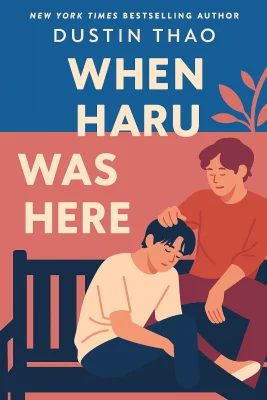
When Haru Was Here
Categories
Fiction, Audiobook, Romance, Young Adult, Fantasy, Contemporary, Magical Realism, LGBT, Queer, Gay
Content Type
Book
Binding
Hardcover
Year
2024
Publisher
Wednesday Books
Language
English
ISBN13
9781250762061
File Download
PDF | EPUB
When Haru Was Here Plot Summary
Introduction
The bell rings like a bicycle warning as seventeen-year-old Eric Ly steps off the platform in Tokyo, lost in a maze of foreign signs and summer heat. He's searching for a café his sister mentioned, but finds himself colliding with destiny instead—a stranger with waves of black hair saves him from an oncoming delivery bike, then leads him through paper lanterns and festival lights to discover the Star Festival, where wishes flutter like white petals from jasmine vines. One year later, Eric stands beneath the marquee of the Chicago Theater, washing dishes in hotel kitchens and waiting tables while his friends scatter to college. His best friend Daniel is dead. His sister Jasmine has moved away. The city feels hollow, drained of color, until Haru appears again—materializing in a café like a memory made flesh, offering origami stars and promises of second chances. But some reunions exist only in the spaces between grief and hope, where paper flowers bloom in the darkness of loss, and love becomes a constellation that guides us home.
Chapter 1: The Ghosts We Carry
Eric's fingers trace the red bracelet around his wrist as he stares at his phone, waiting for a text that will never come. The bracelet is from Tokyo, from that perfect summer day when he met Haru at the Star Festival—before everything went wrong, before the train doors closed between them, before the paper with Haru's phone number flew away in the wind. Now it's senior year, and Daniel should be texting him about their college plans. Instead, Eric finds himself alone on their rooftop, sharing pizza with empty air, watching the same sunset they used to watch together. The city sprawls below them like a circuit board, pulsing with life that feels impossibly distant. "We're the only thing that's real," Daniel used to say, pointing at the glitching stars above Chicago's light pollution. But what happens when even that reality crumbles? Eric clutches the bracelet tighter, remembering Haru's voice: "In case I disappear again." He never imagined Daniel would be the one to vanish first. The rooftop holds too many memories—their first kiss under eleven-eleven wishes, Daniel's laugh echoing off the neighboring buildings, promises of college roommates and shared futures. Eric closes his eyes and pretends Daniel is still there, still planning their escape from this suffocating city. The pretending hurts less than the knowing. When his phone buzzes with a call from Jasmine, Eric lets it ring. Even his sister's voice can't fill the Daniel-shaped hole in his chest. Some ghosts are too heavy to carry, too precious to let go.
Chapter 2: Apparitions in a Chicago Winter
Eric's grief becomes a living thing with sharp teeth and hollow eyes. He skips college applications, ignores his parents' worried glances, and takes a job washing dishes in hotel kitchens just to have somewhere to go that isn't home. The repetitive work—scrubbing, rinsing, stacking—becomes a meditation on loss. Jasmine visits when she can, but college has swallowed her whole. She talks about double majoring, about opportunities, about the life she's building away from home. Eric nods and smiles and feels himself becoming translucent, fading from view. Even Kevin, Daniel's friend who was supposed to help him find work, seems to be moving through life while Eric stands perfectly still. The seasons change. Snow covers Chicago like a burial shroud. Eric finds work at the Chicago Theater, selling tickets from a glass booth that feels like a fishbowl. His coworkers Simon and Alex treat him like entertainment, dressing him up for parties where he doesn't belong, introducing him to people whose names slide off him like water. At one such party, Eric meets Christian—golden-haired, Yale-educated, everything Eric thinks he should want. Christian smells like expensive cologne and possibility. He owns a penthouse with views of the entire city, takes Eric on yacht rides, makes him feel special in ways that should matter. But when Christian whispers, "I don't usually date Asian guys. Consider yourself the exception," the words hit like ice water. Eric says nothing, swallows the hurt, pretends it's a compliment. He's become an expert at pretending.
Chapter 3: Dancing Between Worlds
The café where it all began again sits unchanged—red brick, steamed windows, the bell that sounds like a bicycle when the door opens. Eric finds himself there on a Tuesday afternoon, staring at an empty chair and wondering if grief has finally cracked his mind completely. That's when Haru slides into the seat across from him. He's exactly as Eric remembers—dark hair falling across his eyes, that familiar smile that makes the world tilt sideways. "It's been a long time, hasn't it?" Haru says, as if he hadn't vanished into a Tokyo train station fourteen months ago, as if he hadn't been haunting Eric's dreams ever since. Eric's hands shake as he reaches across the table, needing to touch something solid, something real. Haru's skin is warm, his voice unchanged. He talks about traveling, about finding Eric again, about the paper shop his family owns in Osaka. He folds origami stars from notebook paper and leaves them on Eric's desk like love letters. But something feels different this time. Haru appears and disappears without warning—there at the planetarium, gone when Eric turns around; present in Eric's bedroom, absent when his mother investigates a scream. No one else seems to see him. Simon and Alex look through him like he's made of mist. Christian never acknowledges his presence. Eric stops questioning it. Haru takes him dancing in empty streets where jazz music plays from invisible speakers. They steal boats and float down the Chicago River under impossible stars. They kiss on observation decks while the city spins below them like a snow globe. It's everything Eric wanted and nothing he can hold onto. "You're not really here, are you?" Eric asks one night, watching Haru fold paper roses in the moonlight streaming through his bedroom window. Haru's smile is answer enough.
Chapter 4: The Illusion of Belonging
Eric finds himself caught between worlds—Christian's penthouse parties where he's the token outsider, and Haru's midnight adventures that may exist only in his fractured mind. He dresses in borrowed designer clothes, drinks expensive cocktails, and pretends Christian's casual racism doesn't cut him open every time. At the theater, his coworkers parade him through gallery openings and rooftop bars like a pet project. "You clean up nice," they say, adjusting his collar, teaching him which fork to use. Eric plays along because the alternative—sitting alone in his childhood bedroom, staring at college applications he'll never complete—feels like death. Christian texts at midnight, summoning Eric to his marble palace overlooking the lake. They drink bourbon that burns Eric's throat and make conversation that never goes deeper than surface tension. When Christian finally takes him to bed, Eric closes his eyes and imagines someone else's hands, someone else's whispered promises. "I'm glad you understand what this is," Christian says afterward, already reaching for his phone. Eric nods like he understands anything at all. Meanwhile, Haru appears in stolen moments—on park benches, in empty train cars, standing beneath streetlights like a question mark. He never asks about Christian, never judges Eric's choices. Instead, he offers origami flowers and memories of summer festivals, pieces of a life Eric touched once and lost. "Why can't you stay?" Eric asks, but Haru only smiles and points to the glitching stars above them, the simulation they once believed they controlled.
Chapter 5: Shattered Reflections
The night everything unravels begins with champagne bubbles and Christian's friend Nick leaning too close, his breath hot against Eric's ear. Eric has been drinking to numb the sharp edges of belonging nowhere, and the alcohol makes everything soft and dangerous. Christian abandons him for someone else—another pretty face, another conquest. Eric should have seen it coming. He's always been replaceable, always been the exception that proves the rule. Nick's hands are persistent, his intentions clear, and Eric finds himself stumbling through Lincoln Park at midnight, lost and drunk and utterly alone. That's when Haru appears one last time, solid and concerned and heartbreakingly real. "Let me take you home," he says, but Eric is too angry, too hurt, too tired of being saved by ghosts. "Leave me alone!" Eric screams, the words tearing his throat raw. And Haru does exactly that—vanishes like smoke, like everything else Eric has ever loved. Eric wakes up on a park bench covered in snow, frost forming on his eyelashes, his lips blue with cold. He might have died there if not for a phone call, if not for Kevin's worried voice cutting through the haze of hypothermia and despair. But it's not Kevin who finds him in that moment between sleeping and freezing. It's Jasmine, ethereal and glowing, sitting beside him like a benediction. "Maybe it's time you and I finally talked," she says, and Eric knows—has known for months—that his sister is never coming home from her tour. That the letters arriving at his house are written in past tense. That grief has been eating him alive from the inside out.
Chapter 6: Unfolding the Letters of Truth
The letters are pressed flowers between pages Eric has been too afraid to turn. Jasmine's handwriting flows across cream paper, each envelope dated months before Eric found the courage to break the seals. Her voice emerges from recordings left on an old keyboard, songs she wrote for him when she knew she wouldn't be there to play them in person. Eric finally understands the piano music that's been following him everywhere—not a haunting, but a homecoming. Jasmine's melodies weave through his memories like golden thread, connecting the fragments of a life he's been too afraid to fully live. The film he creates from her music and their shared home videos wins a scholarship, gets accepted into a festival, gives him a reason to point his camera at something other than his own reflection. For the first time in over a year, Eric sees a future that doesn't require pretending or numbing or disappearing. He writes letters of his own—to Daniel, apologizing for the fights they never resolved; to Kevin, acknowledging the family bonds that transcend romantic history; to Jasmine, promising to stop waiting for ghosts and start living for the breathing. His parents, who have been watching their son fade away like an overexposed photograph, finally see him again at the dinner table. They eat together in Vietnamese and English, a bilingual love that needs no translation. Home becomes less like a museum of loss and more like a foundation for building something new. The paper roses Haru left him serve a different purpose now—not promises of return, but reminders of connection. Sometimes love means letting go. Sometimes the most real thing about a person is how they change you, even after they're gone.
Chapter 7: Farewell to Paper Roses
Two years later, Eric steps off a subway platform in Manhattan, where the summer heat reminds him of Tokyo and second chances. He's working as an intern, learning that storytelling takes many forms, that survival sometimes looks like carrying mail up Fifth Avenue and editing videos for marketing campaigns that will never win awards. The city moves like a kaleidoscope around him—colors shifting, patterns forming and dissolving, infinite possibilities reflected in glass towers and subway windows. Eric has learned to move with it instead of standing still, to document the beauty in everyday moments, to trust that some stories are worth telling even when no one is watching. He carries a camera now, not as armor against the world, but as a way of participating in it. Jasmine's letters still arrive occasionally, postmarked from impossible places, reminding him that love is the one thing that survives translation across any distance. When he sees Haru again—really sees him, solid and breathing and picking up a dropped envelope on a Manhattan platform—Eric doesn't question the physics of it. Some reunions transcend explanation. Some people find their way back to each other across time zones and grief and the spaces between what's real and what we need to be real. Haru holds up the washi paper envelope, recognizing his family's handiwork in the delicate fibers. "Your sister visited our shop," he says, and Eric realizes that some connections were always meant to be discovered, that Jasmine and Haru's paths crossed in ways Eric is only now beginning to understand. "Do you want to get coffee?" Eric asks, and Haru's smile contains entire galaxies, paper stars unfolding into constellations that will guide them both home.
Summary
"Echoes of Paper Stars" unfolds as a meditation on the weight of loss and the courage required to keep loving in a world that offers no guarantees. Eric's journey from the rooftops of Chicago to the subway platforms of Manhattan traces the geography of grief—how we create alternate realities to survive unbearable truths, how we learn to distinguish between the ghosts we conjure and the connections that sustain us across any distance. The novel suggests that healing isn't about forgetting or moving on, but about learning to carry our losses like paper stars—delicate, beautiful, and capable of guiding us toward new light. In Eric's final reunion with Haru, we see not just the promise of romance, but the affirmation that some loves transcend the boundaries between memory and possibility, that the people who change us never really leave, and that sometimes the most profound act of faith is simply showing up, again and again, until the world reshapes itself around our willingness to believe in tomorrow.
Best Quote
“It’s funny how some people walk into your life. A few hours ago, we didn’t even know each other. Maybe we’re meant to take the wrong train sometimes.” ― Dustin Thao, When Haru Was Here
Review Summary
Strengths: The book evokes strong emotional responses, particularly related to themes of loss, grief, love, and self-discovery. The emotional impact is significant, with some readers expressing a deep connection to the narrative and its conclusion. The simplicity of the storytelling is noted as effective in conveying the intended emotions. Weaknesses: The narrative is described as chaotic, with unclear relational dynamics and a lack of innovative elements. There is criticism regarding the main character's behavior and the insufficient explanation of key plot elements, particularly concerning the character Haru. The ending is perceived as unsatisfying by some readers. Overall: The book elicits mixed reactions, with some readers deeply moved by its emotional depth, while others are frustrated by narrative clarity and character development issues. It is recommended for those who appreciate emotionally driven stories, though it may not satisfy those seeking clear plot resolutions.
About Author

Dustin Thao
Thao explores the intricacies of human emotion through his contemporary young adult fiction, focusing on themes of grief and connection. His work often incorporates elements of magical realism to create narratives that resonate deeply with readers, particularly young adults. This approach is evident in his debut novel, "You’ve Reached Sam", which tells the poignant story of a girl who discovers she can still communicate with her deceased boyfriend through his cell phone. By blending emotional realism with fantastical elements, Thao provides a framework for understanding loss and the healing process, inviting readers to reflect on their own experiences and emotions.\n\nWhile maintaining a focus on themes of loss and healing, Thao's writing style is characterized by lyrical prose and relatable characters. His stories emphasize first experiences and the lingering impact of the past, capturing the essence of young adult life. Meanwhile, his second book, "When Haru Was Here", continues to delve into the complexity of relationships and personal growth. Thao's method of weaving magical realism with emotional depth offers a fresh perspective on traditional coming-of-age narratives, thereby enriching the reader's engagement with the text.\n\nThe impact of Thao's work extends beyond the pages of his books, as demonstrated by the widespread acclaim and popularity on social media platforms like TikTok. Readers are drawn to his ability to articulate the often unspoken complexities of grief and relationships, making his novels a significant contribution to the young adult genre. This short bio of the author highlights his literary achievements and thematic focus, showcasing why his books resonate so profoundly with audiences seeking emotional connection and understanding.
Read moreDownload PDF & EPUB
To save this Black List summary for later, download the free PDF and EPUB. You can print it out, or read offline at your convenience.
When Haru Was Here
by Dustin Thao
