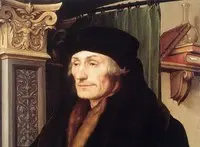
Erasmus
Erasmus of Rotterdam reframes humanist thought by navigating the complex interplay of religious reform and classical scholarship. As a prominent figure during the Northern Renaissance, he sought to reconcile faith with reason, emphasizing the importance of education and ethical conduct. His intellectual pursuits were marked by a commitment to reforming the Church from within, advocating for a return to original Christian doctrines through critical study of classical texts. This approach is evident in his works, such as "In Praise of Folly," where he uses satire to critique societal norms and ecclesiastical practices, while his "Handbook of a Christian Knight" guides individuals toward a virtuous life.\n\nWhile Erasmus never received formal awards in the modern sense, his influence on theological inquiry and humanist values is profound. His efforts to provide accessible theological ideas through his clear and ironic prose have impacted both the Protestant Reformation and the Catholic Counter-Reformation. His translations and editions of the New Testament remain pivotal, promoting a critical examination of religious texts. Readers and scholars benefit from his legacy, which endures as a testament to the power of the written word to inspire reform and challenge prevailing norms. This short bio encapsulates an author whose commitment to dialogue and moderation continues to resonate in contemporary discussions of human agency and divine grace.
Books by Erasmus
In Praise of Folly
Popular Authors

Robin Sharma
5 books

James Clear
2 books

Sarah Knight
4 books

Daniel Goleman
9 books

Stanley D. Rosenberg
1 books

Anthony Scaramucci
1 books


Niall Kishtainy
1 books
J. Richard Gott
1 books

Trevor Moawad
2 books

Mark McNeilly
1 books

Lara Love Hardin
4 books
