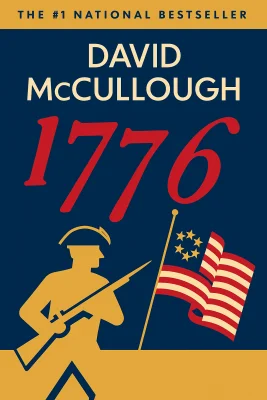
1776
Categories
Nonfiction, History, Politics, Audiobook, Military Fiction, Historical, American History, American Revolutionary War, War, American Revolution
Content Type
Book
Binding
Paperback
Year
2006
Publisher
Simon Schuster
Language
English
ASIN
0743226720
ISBN
0743226720
ISBN13
9780743226721
File Download
PDF | EPUB
1776 Plot Summary
Introduction
# 1776: From Colonial Rebellion to Revolutionary Victory The winter of 1775-1776 found George Washington facing an impossible situation that would test the very foundations of American resolve. His Continental Army, little more than a collection of New England farmers and tradesmen, was camped in the frozen hills around Boston while across the Atlantic, King George III had declared the American colonies in open rebellion and set in motion the largest military expedition Britain had ever launched. What followed was a year that would determine whether the bold words of the Declaration of Independence would become reality or merely the final testament of a failed rebellion. This pivotal year reveals how ordinary people—blacksmiths, merchants, and farmers—transformed themselves into revolutionaries willing to risk everything for an untested idea: that a people could govern themselves without kings or nobles. Through Washington's struggles to forge an army from reluctant volunteers, the Continental Army's near-collapse during the disastrous New York campaign, and the desperate winter crossing of the Delaware, we witness the birth pangs of American independence. The year 1776 demonstrates that the Revolution was not an inevitable triumph, but a series of narrow escapes from disaster, where character and perseverance mattered more than resources, training, or military genius.
Chapter 1: King George's Declaration: The Empire Strikes Back
The year began with King George III's fateful address to Parliament on October 26, 1775, delivered with all the pageantry and power that the British Empire could muster. Riding through London streets lined with 60,000 cheering subjects, the King embodied the wealth and authority of a nation that ruled the seas and commanded respect across the globe. His message to Parliament was unambiguous: the American colonies were in open rebellion, their leaders were traitors, and the full force of British military might would be brought to bear to restore order. George III was no tyrant in the traditional sense, but rather a man of duty who genuinely believed that maintaining the empire's authority was essential for the good of all his subjects, including the Americans themselves. He had never set foot in America, yet he was convinced that the rebellion was the work of a small group of agitators who had deceived the loyal majority. His decision to hire thousands of German mercenaries and deploy the largest fleet ever assembled demonstrated his commitment to ending what he saw as an unnatural and dangerous uprising. The King's speech marked a point of no return, making clear that Britain would use "every means of distressing America" to force submission. This declaration reached the colonies in January 1776, where it was received with rage and burned in public by soldiers who now understood that reconciliation was impossible. The moderate voices that had long hoped for a peaceful resolution were silenced by the reality of royal determination to crush their resistance through overwhelming force. What the King failed to grasp was that his very success in building a global empire had created the conditions for American independence. The colonists had grown prosperous and self-reliant under British protection, developing their own institutions and sense of identity. They enjoyed a higher standard of living than any people in the world, which made them confident in their ability to govern themselves. The King's insistence on absolute submission to parliamentary authority clashed with this colonial experience of practical self-governance and economic success, setting the stage for a conflict that would reshape the world.
Chapter 2: Washington's Challenge: Forging an Army from Farmers
When George Washington arrived in Cambridge in July 1775 to take command of the Continental Army, he found not a military force but a collection of New England farmers and tradesmen who had little understanding of discipline, sanitation, or military organization. The men lived in makeshift shelters, ignored orders when it suited them, and treated their officers more like elected representatives than military commanders. Washington, accustomed to the hierarchical society of Virginia plantation life, was appalled by what he saw as the democratic chaos of Yankee military culture. Yet beneath his initial disgust with New England ways, Washington recognized the raw material of something extraordinary. These were not the dregs of society pressed into service, but property owners and skilled craftsmen who had voluntarily left their homes and livelihoods to fight for principles they believed in. They were resourceful, handy with tools, and accustomed to hardship. Most importantly, they had already proven their courage at Lexington, Concord, and Bunker Hill, where they had stood against British regulars and inflicted devastating casualties. Washington's genius lay not in transforming these citizen-soldiers into European-style automatons, but in channeling their natural strengths while gradually instilling the discipline necessary for effective military action. He understood that this was a political war as much as a military one, requiring him to maintain the support of Congress and the civilian population while somehow forging an effective fighting force from volunteers who could leave whenever they chose. His patient work through the long siege of Boston, dealing with constant shortages of gunpowder, food, and clothing, demonstrated the kind of persistent leadership that would prove essential to ultimate victory. The relationship between Washington and his New England officers, particularly Nathanael Greene and Henry Knox, became the foundation of American military success. These young men, educated by books rather than formal military training, brought fresh thinking to military problems while sharing Washington's total commitment to the cause of independence. Their friendship and mutual respect transcended regional differences and created a unified command structure that could adapt to changing circumstances while never losing sight of the larger political goals of the Revolution.
Chapter 3: Dorchester Heights: The Miracle That Freed Boston
The winter of 1775-1776 tested every aspect of Washington's leadership as his army seemed on the verge of dissolution. Enlistments were expiring, men were deserting in droves to return to their farms and families, and the British remained comfortably ensconced in Boston while the Americans shivered in inadequate shelters around the city. Washington's repeated requests to attack the British positions had been wisely rejected by his council of war, but the stalemate was becoming unbearable for a commander who understood that time was working against the American cause. The solution came from an unexpected source: Henry Knox, a twenty-five-year-old Boston bookseller who proposed the seemingly impossible task of hauling the captured artillery from Fort Ticonderoga across three hundred miles of winter wilderness to Boston. Knox's expedition, undertaken in the depths of winter with primitive transportation, demonstrated the kind of audacious thinking and determined execution that would characterize American military innovation throughout the war. The "noble train of artillery" that Knox delivered included massive cannon weighing thousands of pounds, transported by oxen and sleds through snow-covered mountains and across frozen rivers. The fortification of Dorchester Heights on the night of March 4, 1776, represented everything that was best about the Continental Army's approach to warfare. Unable to dig trenches in the frozen ground, the Americans prefabricated their fortifications and hauled them into place under cover of darkness, along with Knox's heavy guns. The work required the coordinated efforts of thousands of men moving in perfect silence while British cannon roared to mask the sound of their activity. By dawn, an impregnable position commanded both Boston and its harbor, making the British position untenable. General Howe's reaction to this overnight transformation revealed both the strengths and weaknesses of British military thinking. His initial impulse was to attack immediately, despite the obvious parallels to the costly assault on Bunker Hill. Only the intervention of a providential storm prevented what could have been another devastating British victory achieved at enormous cost in casualties. The storm gave Howe time to reconsider and ultimately choose the wiser course of evacuation, demonstrating how even the most professional military forces could be outmaneuvered by creative thinking and bold execution.
Chapter 4: New York Campaign: Independence Raises the Stakes
The British evacuation of Boston in March 1776 marked the end of the first phase of the Revolutionary War and the beginning of a far more dangerous period for the American cause. Washington's army, flushed with success, marched south to New York City, where they would face not a besieged garrison but the full might of the British Empire deployed in a massive amphibious assault. The strategic situation in New York was fundamentally different from Boston, with navigable rivers on multiple sides making the city virtually indefensible against a power that controlled the seas. Washington's decision to defend New York despite these obvious disadvantages reflected his understanding that the Revolution was as much a political struggle as a military one. Congress and the American people expected their army to fight for every major city, and a strategic withdrawal without battle would have been seen as cowardice rather than wisdom. The arrival of the Declaration of Independence in July 1776 raised the stakes even higher, transforming what had been a rebellion seeking reconciliation into a war for complete independence that could only end in total victory or total defeat. The British response to American independence was swift and overwhelming. Admiral Lord Howe's fleet, carrying over 32,000 troops, represented the largest expeditionary force of the eighteenth century and a clear demonstration of British determination to crush the rebellion before it could spread. The sight of hundreds of British ships filling New York harbor was intended to intimidate the Americans into submission, and it nearly succeeded. Many colonists who had supported resistance to British policies now faced the reality that independence meant war against the world's most powerful military force. Yet the arrival of the British fleet also clarified the choice facing Americans in a way that strengthened rather than weakened the independence movement. There could be no middle ground between submission and freedom, no compromise that would preserve American liberties while maintaining British authority. The massive British military presence demonstrated that the empire was prepared to use unlimited force to maintain control, making it clear that Americans would have to fight for their independence or lose it forever.
Chapter 5: Brooklyn's Disaster: Crushing Defeat and Daring Escape
The Battle of Brooklyn on August 27, 1776, represented Washington's first major test as a battlefield commander and nearly ended the Revolution before it had properly begun. British General William Howe, supported by his brother Admiral Lord Howe, executed a masterful flanking maneuver that caught the American forces completely by surprise and inflicted a devastating defeat that could have destroyed the Continental Army entirely. The British night march through Jamaica Pass, led by General Henry Clinton, demonstrated the kind of professional military competence that the Americans would have to match if they hoped to survive against such experienced opponents. Washington's errors in the battle were numerous and nearly fatal. He divided his forces between Manhattan and Brooklyn without adequate means of communication or mutual support, left a crucial pass unguarded despite having surveyed the terrain personally, and placed inexperienced commanders in charge of troops who knew nothing about the local geography. When the British attack came, it unfolded with such speed and precision that most American units were overrun before they could mount effective resistance, leading to massive casualties and the capture of over a thousand prisoners. Yet from this crushing defeat emerged one of the most remarkable episodes in American military history. Washington's decision to evacuate his entire army across the East River in a single night, under the noses of a superior enemy force, required extraordinary courage and meticulous planning. The operation succeeded only because of a combination of factors that seemed almost miraculous: the skill of John Glover's Massachusetts fishermen who manned the boats, a favorable change in wind direction, and a dense fog that concealed the final stages of the retreat until every soldier had reached safety. The successful evacuation from Brooklyn demonstrated that while Washington might lack experience in conventional battlefield tactics, he possessed the kind of strategic thinking and cool judgment under pressure that would prove essential to American survival. More importantly, it showed that the Continental Army could learn from defeat and adapt to circumstances in ways that their more rigid opponents could not. The retreat became a source of pride rather than shame, proof that American citizen-soldiers could outthink and outmaneuver professional European armies when led by commanders who understood both their strengths and limitations.
Chapter 6: Crossing the Delaware: Washington's Desperate Gamble
By December 1776, the Continental Army had reached its nadir. Camped on the western bank of the Delaware River, Washington commanded fewer than 6,000 men, many of whose enlistments would expire with the new year. Across the river, Hessian troops occupied Trenton while British forces controlled most of New Jersey. The rebellion that had begun with such promise seemed on the verge of collapse, with even some members of Congress fleeing Philadelphia as enemy forces approached. Washington understood that only a dramatic success could revive American morale and prevent the complete dissolution of his army. The plan he conceived was audacious in its simplicity: a surprise attack on the Hessian garrison at Trenton on the morning after Christmas, when the enemy would be least prepared for battle. The operation required perfect timing, absolute secrecy, and the kind of desperate courage that comes only from having nothing left to lose. The crossing itself became an epic of endurance and determination. On Christmas night, as a fierce northeaster brought driving snow and sleet, Washington's troops began the treacherous journey across the ice-choked Delaware. John Glover's Marblehead mariners again proved indispensable, using their seamanship to transport not just men but horses and artillery across the turbulent river. The password for the night was "Victory or Death," words that captured the all-or-nothing nature of the enterprise. The march to Trenton tested the army's resolve as severely as any battle. Men without shoes left bloody footprints in the snow, while others collapsed from exhaustion and cold. Two soldiers froze to death during the night march. Yet the army pressed on, driven by Washington's unwavering determination and their own desperate hope that this gamble might succeed where conventional military operations had failed. The crossing represented more than a tactical maneuver; it was an act of faith in the revolutionary cause and in their commander's ability to lead them to victory against overwhelming odds.
Chapter 7: Trenton and Princeton: Turning Defeat into Victory
The Battle of Trenton on December 26, 1776, lasted less than an hour but changed the entire trajectory of the American Revolution. Washington's surprise attack caught the Hessian garrison completely off guard, resulting in a stunning victory that captured nearly 1,000 prisoners while suffering virtually no American casualties. The triumph was as much psychological as military, proving that the Continental Army could defeat professional European soldiers when properly led and motivated. The victory's impact rippled far beyond the battlefield. Throughout the colonies, Americans who had begun to despair suddenly found new hope. Recruiting picked up, militias began to reorganize, and political leaders who had been wavering renewed their commitment to independence. The British, meanwhile, were forced to reconsider their assumptions about American military capabilities and their own invincibility. The professional soldiers who had dismissed the Continental Army as rabble now faced the uncomfortable reality that these citizen-soldiers could fight. Washington followed up his success at Trenton with an even more audacious maneuver. Rather than rest on his laurels, he recrossed the Delaware and positioned his army to strike again. When Cornwallis advanced with overwhelming force to crush the Americans, Washington executed a brilliant night march that bypassed the British army entirely and struck their rear guard at Princeton. The January 3, 1777, victory confirmed that Trenton was no fluke; the Continental Army had become a formidable fighting force capable of outmaneuvering even experienced European commanders. The twin victories transformed Washington's reputation from that of a general who had suffered repeated defeats to a commander capable of strategic brilliance. More importantly, they demonstrated that the Revolution could survive its darkest moments through a combination of inspired leadership, tactical innovation, and the stubborn refusal to accept defeat. The campaigns of late 1776 established the pattern that would ultimately lead to American independence: avoid decisive battles when conditions were unfavorable, strike when the enemy was vulnerable, and never give up hope regardless of how desperate circumstances might appear.
Summary
The events of 1776 reveal the central paradox of the American Revolution: a colonial rebellion that succeeded not through military superiority but through the ability to survive defeat and transform setbacks into opportunities for growth and adaptation. The Continental Army's greatest victories came not from winning battles but from avoiding decisive defeat long enough to convince both Americans and Europeans that independence was achievable. Washington's leadership embodied this strategy of perseverance, demonstrating that in a revolutionary war, the side that refuses to quit ultimately prevails over the side that cannot afford to continue fighting indefinitely. The year 1776 established patterns that would define American national character for generations to come: the willingness to attempt the impossible, the ability to learn from failure, and the conviction that ordinary citizens could accomplish extraordinary things when united by shared principles. These lessons remain profoundly relevant today, reminding us that democratic institutions require constant vigilance and active participation to survive, and that the price of freedom is not just eternal vigilance but the willingness to sacrifice personal comfort for the common good. The founders' example challenges us to match their commitment to principles over convenience, their long-term thinking over short-term gains, and their faith in human potential over cynical acceptance of the status quo.
Best Quote
“The year 1776, celebrated as the birth year of the nation and for the signing of the Declaration of Independence, was for those who carried the fight for independence forward a year of all-too-few victories, of sustained suffering, disease, hunger, desertion, cowardice, disillusionment, defeat, terrible discouragement, and fear, as they would never forget, but also of phenomenal courage and bedrock devotion to country, and that, too they would never forget.” ― David McCullough, 1776
Review Summary
Strengths: The review highlights the book's relevance to contemporary issues in education, particularly the decline in critical thinking due to an overemphasis on standardized testing. The reviewer appreciates McCullough's storytelling and historical detail, as evidenced by their previous enjoyment of his biography on Harry Truman. Overall: The reviewer expresses a strong sentiment that McCullough's "1776" is an important read, especially in the context of current educational challenges. They recommend the book as a means to reconnect with foundational historical events and to counteract the trend of superficial learning. The review suggests that the book is both informative and culturally significant.
About Author

David McCullough
McCullough synthesizes intricate historical narratives to explore pivotal moments in American history, revealing the character and challenges of those who shaped the nation. His works, such as "Truman" and "John Adams," underscore his focus on leadership and the complexity of political life, earning him Pulitzer Prizes for their insightful portrayal of presidential figures. Meanwhile, "The Path Between the Seas" and "Mornings on Horseback" showcase his ability to navigate the intricate web of human ambition and determination, meriting National Book Awards for their detailed accounts of transformative projects and personalities. \n\nThrough a meticulous approach to research and storytelling, McCullough invites readers to deeply engage with history, thus enriching their understanding of the past's influence on present-day society. His books, including "The Greater Journey" and "The Wright Brothers," offer nuanced perspectives on innovation and progress, while "The Johnstown Flood" provides a gripping narrative of human resilience in the face of disaster. His dedication to conveying historical truth through engaging narratives benefits both casual readers and scholars, providing them with a rich source of knowledge and reflection. Celebrated with numerous accolades, such as the National Humanities Medal and the Presidential Medal of Freedom, McCullough's contributions to literature have cemented his place as a vital figure in American historical writing.
Read moreDownload PDF & EPUB
To save this Black List summary for later, download the free PDF and EPUB. You can print it out, or read offline at your convenience.
1776
by David McCullough
