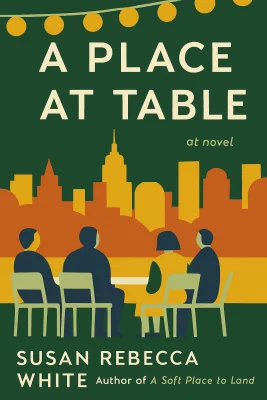
A Place at the Table
Categories
Fiction, Food, Historical Fiction, Book Club, Contemporary, Adult Fiction, Chick Lit, New York, Drama, Womens Fiction
Content Type
Book
Binding
Hardcover
Year
2013
Publisher
Atria Books
Language
English
ASIN
145160887X
ISBN
145160887X
ISBN13
9781451608878
File Download
PDF | EPUB
A Place at the Table Plot Summary
Introduction
# Fragments Left Over: A Tapestry of Lost Connections and Newfound Grace The pecan tree stands like a gallows in the North Carolina woods, its branches heavy with more than fruit. Twelve-year-old Alice Stone watches her brother James cut down the lynched boy, chicken feathers spilling from the corpse's mouth like a grotesque confession. The rope burns James's hands as he lowers the body, but he cannot leave another Black child swaying in the Southern wind. This moment fractures everything—their family, their safety, their understanding of the world's cruelty. Decades later, in 1970s Georgia, another child discovers his own dangerous secret. Bobby Banks tastes his first kiss in a darkened bedroom, only to find his fundamentalist parents standing in the doorway like avenging angels. The ceiling fan stops spinning. Light floods the room. His father's face crumbles with grief and rage. These two souls, separated by generations but united by exile, will find their paths converging in the kitchens of New York City, where food becomes both refuge and revelation, and the fragments of broken lives can be gathered into something whole.
Chapter 1: Roots Torn from Southern Soil: Childhood Trauma and the Great Escape
The zip line stretches between two oak trees in the Banks family backyard, a wire salvation where nine-year-old Bobby can fly above the suffocating expectations of Decatur, Georgia. His mother Edie, former Miss Georgia runner-up, straps his wild brother Hunter to that line when the boy's energy becomes too much to contain. But Bobby never needs restraining. He is the good son, the one who helps Mama in the kitchen, who memorizes Bible verses without being reminded. The cracks begin to show when Bobby befriends Keisha, a sharp-tongued Black girl from his grandmother's neighborhood. She leads him to an abandoned garden where they pick strawberries like forbidden fruit. When Hunter sees them together, his casual cruelty shatters something precious. "Why are you playing with that nigger girl?" The word hangs in the air like a curse. Bobby watches Keisha's shoulders jerk as she pedals away, never to speak to him again. Years pass, and Bobby's difference grows more pronounced. He prefers cooking to football, books to hunting, the company of his beloved Meemaw to the rough camaraderie of boys his age. When he joins the high school track team, he finds his match in Pete Arnold, a Yankee transplant with golden hair and perfect teeth. They run side by side, pushing each other to greater speeds, their friendship deepening into something dangerous and unnamed. The night everything changes, Bobby and Pete attend a laser show at Stone Mountain, drinking beer and playing truth games under the Confederate stars. Back in Bobby's bedroom, with the ceiling fan whirring overhead, Pete's mouth finds his in the darkness. For a few perfect moments, Bobby tastes freedom. Then the fan stops, light floods the room, and his parents stand in the doorway. His father's face crumbles with grief and rage. His mother's eyes go cold as winter stones. Bobby flees to his grandmother's house that night, running through the dark streets of Decatur like a fugitive from his own life.
Chapter 2: Finding Sanctuary in Steel and Stone: Building New Lives in Manhattan
New York City hits Bobby like a slap of cold air when he steps off the Greyhound bus at Port Authority. The year is 1981, and the twenty-one-year-old carries nothing but a suitcase full of shame and a head full of his grandmother's recipes. She died while planting petunias, leaving him five thousand dollars and a one-way ticket to freedom. At her funeral, Bobby sat with his family one last time, tasting her love in the pound cake served with berries and Cool Whip. The residence hotel on the Upper West Side houses dreamers and drifters, young men seeking reinvention in the anonymous sprawl of Manhattan. Bobby's roommate Alex bounces on his bed at three AM, chanting about cocaine highs. The front desk clerk calls Bobby "Mr. Deliverance" because of his thick Georgia accent. Every dollar stretches thin, every meal calculated, every day a small victory against homelessness. But the city also offers possibilities unimaginable in Decatur. Bobby discovers the green market in Union Square, where farmers sell ruby carrots and fingerling potatoes. He learns to navigate the subway, to find beauty in the chaos. When he spots a "Help Wanted" sign at Café Andres, a hidden gem on East 51st Street, he walks into his future without knowing it. Gus Andres, the café's silver-haired owner, hires Bobby as a kitchen assistant. The restaurant is a faded jewel from the 1940s, when southern writers like Truman Capote and James Baldwin gathered in its garden courtyard. Now it survives on nostalgia and the recipes of Alice Stone, Gus's former partner who vanished upstate years earlier. Bobby throws himself into learning her dishes, translating southern comfort into Manhattan sophistication. The New York Times calls him "a dazzling young chef" and suddenly Café Andres has lines out the door.
Chapter 3: Love in the Time of Plague: Passion, Loss, and the AIDS Crisis
Through Gus, Bobby meets Sebastian Goldstein, a curator at the Guggenheim with wild Medusa curls and bug eyes behind thick glasses. Sebastian is twenty years older, worldly and confident, everything Bobby isn't. Their first date at The Bow Tie stretches into hours of conversation. Sebastian introduces Bobby to art and opera, to the rituals of Upper West Side intellectuals, to the possibility that love between men can be something beautiful rather than shameful. They move in together at Sebastian's rent-controlled apartment in the Belthorp, a crumbling palace overlooking Riverside Park. Bobby keeps his studio as a culinary laboratory, perfecting dishes that smuggle southern flavors into cosmopolitan palates. Sebastian's mother Dahlia becomes an unlikely ally, the three of them forming a triangle of affection around Sunday dinners and museum openings. Bobby feels like he is finally becoming himself. But shadows gather at the edges of their happiness. Friends begin disappearing, claimed by a mysterious cancer that seems to target gay men exclusively. Michael, Sebastian's best friend from Princeton, finds a purple lesion on his ankle. Four months later he is dead, his body covered in Kaposi's sarcoma, his mind ravaged beyond recognition. The community Bobby has found is being decimated by an invisible enemy, and no one knows who will be next. The Sunday Bobby discovers the purple lesion on Sebastian's chest, winter arrives early in New York. They rush to Dr. Wilson's apartment, where the diagnosis falls like a death sentence. Sebastian weeps in the back bedroom while Bobby sits frozen in the living room, unable to move until his grandmother's voice whispers in his memory: "Go to him now. He needs you." The monster under the bed has finally revealed itself, and it wears the face of AIDS. Sebastian's decline is swift and merciless, the lesions spreading across his body like a malevolent constellation. Bobby holds vigil through the long nights, learning that love means witnessing the unwitnessable.
Chapter 4: Echoes from Emancipation: Family Secrets Across Generations
Alice Stone's story begins in 1929 in Emancipation Township, North Carolina, a community founded by freed slaves determined to build their own paradise. She and her brother James are inseparable, playing mind-reading games with school chalkboards, sharing secrets that only twins can understand. James has a gift with animals—rabbits follow him home from traps, a pet chicken rides on his shoulder wherever he goes. The night that changes everything starts with a wild sow crashing through the creek. James wants to hunt her, to prove himself to their grandfather who runs the township with quiet authority. But in the woods they find something else—three white men with guns and dogs, laughing about the "lying nigger" they have just lynched. Alice and James hide in the trees, watching the hunters pass below, smelling their sweat and bloodlust. When they find the boy hanging from the pecan tree, chicken feathers stuffed in his mouth, James climbs up and cuts him down. He cannot leave another Black child swaying in the wind like strange fruit. But their grandfather understands the danger—James is too light-skinned, too proud, too likely to challenge the racial order that keeps their community safe. After James dares to demand equal treatment at the white general store, there is no choice. He has to leave. Alice watches her brother disappear into the night, bound for relatives in New York City. She never sees him again, but she carries his memory north when she finally makes her own escape during the Depression. In Manhattan, she finds work as a seamstress, a window dresser, eventually a chef. She meets Gus Andres at a Communist Party gathering, bonding over her blackberry pie and his theatrical flair. Together they create Café Andres, a sanctuary where southern exiles can taste home again. But Alice never stops wondering what happened to James, never stops hoping he might walk through her kitchen door.
Chapter 5: Kitchen Communion: When Food Becomes the Language of Healing
After Sebastian's death, Bobby becomes a ghost haunting the Belthorp. He keeps the apartment exactly as Sebastian left it, sleeping on his sheets, using his toothpaste, finding his hair still caught in the drain. The city moves on around him, indifferent to his grief. He cooks mechanically at the restaurant, no longer innovating, just surviving. The dazzling young chef has been extinguished along with his lover. One frozen December morning, Bobby wanders into Our Lady of Sorrows, drawn by the sound of hymns. The priest with oxygen tubes speaks of comfort, of the need to nurture each other when mothers aren't there to do it. When communion comes, Bobby approaches the altar hungry for grace. But when the priest learns he isn't Catholic, the wafer is snatched from his hands. Once again, he is cast out from the sacred feast, left to wander in the wilderness of his own making. Walking home from his rejection at church, Bobby encounters Alice Stone on Columbus Avenue. She is older now, her hair white as snow, but she carries herself with the same regal bearing he remembers from the green market. They walk together through the bitter cold, and Alice surprises him by apologizing for her rudeness years earlier at that disastrous lunch. She had been jealous of his talent, she admits, struggling with her own transitions and losses. Alice invites Bobby to her apartment on Riverside Drive, a warm oasis filled with the scents of Christmas baking. Her walls are covered with photographs—Truman Capote with outstretched palms, James Baldwin's intense stare, her own family from Emancipation Township. There is her brother James as a boy, the pet chicken on his shoulder, snow falling around them both. She speaks of him matter-of-factly, as if his disappearance were just another fact of history to be endured. They spend the afternoon baking together, Alice teaching Bobby the secrets of angel food cake and lemon curd. When the challah comes out of the oven, Alice tears off a piece of the warm bread and places it in Bobby's cupped palms. "Here," she says. "Take."
Chapter 6: Blood Ties Revealed: The Shocking Truth About Hidden Heritage
Amelia Brighton has spent twenty years perfecting the art of being a Connecticut housewife, crafting elaborate dinner parties and raising two daughters in a house that looks like happiness from the outside. But perfection is exhausting, and her marriage to Cam has become a performance neither of them believes in anymore. When their daughters leave for college, the empty house echoes with unspoken resentments and the sound of Cam's increasingly violent rages. The facade finally crumbles at a dinner party where Amelia discovers her husband's affair with a neighbor, a revelation that arrives with the casual cruelty of a game of Scruples. The truth cuts deeper than betrayal: Cam has been planning his escape for months, and his new lover is already pregnant. Amelia finds herself cast out of the only life she's ever known, forced to confront the woman she's become and the woman she might have been. In her desperation, Amelia turns to her Aunt Kate, a Manhattan book editor who has always represented the road not taken. Kate offers more than shelter; she offers Amelia a job testing recipes for a cookbook written by Bobby Banks, the young chef at Café Andres. It's a small thread, but Amelia grasps it like a lifeline, sensing that her salvation might lie not in reconstructing her old life but in discovering who she really is beneath the ruins. Amelia's first meeting with Alice Stone at Bobby's apartment should have been routine, a simple introduction between collaborators on a cookbook project. Instead, it becomes the moment when carefully buried secrets claw their way to the surface. Amelia notices a photograph on Alice's mantle, a family portrait from the 1920s showing Alice as a young girl standing beside a boy with a chicken perched on his shoulder. The boy's face triggers a memory so profound it makes Amelia's hands shake. The boy in the photograph is her father, Benjamin Brookstone, the man she's known all her life as the son of Italian immigrants. But the evidence is undeniable: her father is James Stone, Alice's brother who chose to pass as white rather than face the limitations of his birth.
Chapter 7: Gathering the Fragments: Creating Family Among the Broken
Alice's reaction to this discovery is volcanic. She has spent sixty years believing her brother was dead, killed by the same hatred that claimed so many others. To learn that he chose whiteness over family, that he built a life on the erasure of everything she represents, feels like a second abandonment. She orders Amelia from her home, refusing to acknowledge the blood tie that connects them. But Bobby, who has become Alice's surrogate son, won't let her turn away from the truth, no matter how much it hurts. The revelation of family secrets forces all three characters to confront the lies they've built their lives around. Alice must decide whether to forgive a brother who chose survival over loyalty. Bobby struggles with his own family's rejection while watching Alice grapple with hers. Amelia faces the challenge of rebuilding her identity from the ground up, no longer certain of her race, her class, or her place in the world. Food becomes their common language, the medium through which they begin to heal. In Alice's kitchen, they test recipes for Bobby's cookbook, each dish carrying stories of the past and hopes for the future. Alice teaches Amelia to make challah bread, the Jewish braids rising slowly in the refrigerator like patience made manifest. Bobby shares his grandmother's pound cake recipe, the one that funded his escape to New York. Amelia contributes her own discoveries, learning that cooking can be an act of love rather than obligation. Through shared meals and shared stories, they begin to understand that family is not just about blood but about choice. Alice slowly opens her heart to the niece she never knew she had. Bobby finds in Alice the unconditional love his own family couldn't provide. Amelia discovers that her mixed-race heritage is not a burden to hide but a gift to embrace. Together, they create a new kind of family, one built on truth rather than pretense, seasoned with forgiveness and served with grace.
Chapter 8: The Feast of Forgiveness: Breaking Bread at the Table of Grace
The story reaches its climax in a small Episcopal church on the Upper West Side, where Bobby and Amelia attend the annual Blessing of the Animals. The sanctuary fills with creatures of all kinds—dogs and cats, birds and reptiles, even a peacock that spreads its magnificent tail in a display of divine audacity. Surrounded by this menagerie of God's creation, they witness a vision of what the world could be if differences were celebrated rather than feared. This moment of grace comes after years of struggle and loss. Bobby has survived the AIDS epidemic that claimed Sebastian and so many others, emerging with a deeper understanding of what it means to be blessed. Amelia has rebuilt her life from scratch, finding work as a cookbook editor and discovering strength she never knew she possessed. Alice has learned to forgive, not just her brother but herself, for the choices that survival sometimes demands. The service culminates in communion, not the exclusive ritual that once rejected Bobby but the inclusive feast that welcomes all who hunger for connection. The priest breaks bread and speaks of gathering up the fragments left over, ensuring that nothing precious is lost. Bobby thinks of Sebastian's hands teaching him to knead dough, of Alice's stories seasoning every meal, of Amelia's courage in claiming her true heritage. As they share the bread and wine, surrounded by the heartbeats of a hundred different creatures, these three souls who began as strangers taste something sweeter than any recipe could produce. They taste forgiveness, acceptance, the possibility of home. In this moment, the fragments of their broken lives are gathered up and made whole, not through the erasure of their wounds but through the sharing of them. The bread is warm in their mouths, rich with the flavor of grace, and for the first time in years, they are no longer hungry.
Summary
In the end, these three wounded souls discover that the hunger for belonging can only be satisfied when we stop hiding who we are and start sharing what we have. Alice learns that her brother's legacy lives on not in the violence that claimed his innocence but in the recipes and stories she passes to a new generation. Bobby finds that God's love cannot be contained in any single church or creed but flows freely through acts of kindness and creation. Amelia discovers that her mixed heritage is not a shameful secret but a bridge between worlds, a testament to love's ability to transcend the boundaries others would impose. Their story reminds us that exile can become pilgrimage, that the very qualities that make us outcasts may be exactly what the world needs most. In a culture that discards the broken and celebrates only the perfect, they gather up the fragments with reverence, knowing that in God's economy, nothing is wasted. Every scrap of love, every moment of grace, every recipe passed from hand to hand becomes part of a larger feast, a communion that transcends the boundaries of family, faith, and time itself. The table where they finally find acceptance is not the one they were born to but the one they choose to claim, set with the finest china of forgiveness and served with the bread of understanding.
Best Quote
“...a profound opportunity to embrace impermanence. How those of us who are renters are perhaps in a better position to recognize that our time here on earth is a borrowed gift. That it's not ours to own, though it is ours to relish. That it's still worth beautifying, even though it's temporary. So paint the walls, plant tomatoes in pots on the fire escape, but don't cling. Because eventually we will all be asked to move on.” ― Susan Rebecca White, A Place at the Table
Review Summary
Strengths: The review highlights the novel's "hauntingly beautiful" storytelling and the memorable impact it leaves on readers. The narrative intricately weaves the lives of three distinct characters—Alice, Bobby, and Amelia—each with compelling backstories and personal growth. The author's language is praised as beautiful and touching, enhancing the emotional depth of the story. The book's ability to transport readers and evoke sensory experiences, particularly through culinary descriptions, is also noted. Weaknesses: The review mentions that the story feels densely packed, with a particular emphasis on Bobby's narrative, potentially overshadowing Alice's intriguing character. The desire for more exploration of Alice's story is expressed. Overall: The reader expresses a strong positive sentiment, recommending the book as a must-read for its captivating storytelling and emotional resonance. The novel is appreciated for its exploration of friendship and personal histories, despite some narrative imbalances.
About Author

Susan Rebecca White
White reframes Southern identity through a literary lens, weaving narratives that confront and dismantle romanticized myths of the American South. Her novels delve into complex themes such as race, gender inequality, and the struggle for social justice, offering readers a nuanced perspective that challenges conventional narratives. By critiquing the "moonlight and magnolias" mythology and the Lost Cause narrative, White's work exposes the underlying racism and oppression these tales often obscure.\n\nIn her books, such as "A Place at the Table" and "We Are All Good People Here", White combines deep character development with sharp social critique. This method creates stories that resonate with readers who seek a deeper understanding of the intricacies of Southern identity and the broader human experience. Her style is marked by careful narrative examination, blending grace with incisive commentary on societal issues, allowing her audience to engage with complex ethical and theological questions.\n\nReaders benefit from White's commitment to telling truer, more complex stories that highlight the interconnectedness of destinies and shared liberation. Her writing serves as a catalyst for reflection on personal and collective narratives, inviting audiences to question and re-evaluate accepted histories. This bio captures her dedication to enriching the literary landscape by focusing on both the personal and social liberation themes woven throughout her acclaimed work.
Read moreDownload PDF & EPUB
To save this Black List summary for later, download the free PDF and EPUB. You can print it out, or read offline at your convenience.
A Place at the Table
by Susan Rebecca White
