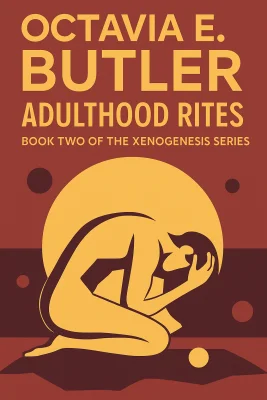
Adulthood Rites
Categories
Fiction, Science Fiction, Audiobook, Fantasy, Science Fiction Fantasy, Adult, Speculative Fiction, Post Apocalyptic, Aliens, Dystopia
Content Type
Book
Binding
Paperback
Year
1997
Publisher
Warner Aspect Books
Language
English
ASIN
0446603783
ISBN
0446603783
ISBN13
9780446603782
File Download
PDF | EPUB
Adulthood Rites Plot Summary
Introduction
In the depths of an alien womb, consciousness stirred. The child who would become humanity's bridge between worlds remembered the warmth of his creation, the gentle touch of tentacled beings, and the moment light first burned his eyes. Born to Lilith, a human woman, and shaped by Oankali genetic architects, Akin entered a world where his very existence challenged the boundaries between species. The Oankali had conquered Earth not through violence, but through seduction—offering immortality and healing in exchange for genetic trade. Yet scattered across the planet, human resisters chose sterile lives over alien touch, their communities slowly dying rather than surrendering their pure humanity. Akin's birth marked a dangerous experiment. He was the first male construct born to a human mother, carrying both the hierarchical violence of his human heritage and the sensory gifts of his alien fathers. His tongue could taste genetic secrets, his skin could perceive the emotional resonance of those around him, and his mind retained every moment with perfect clarity. As he grew in the village of Lo, surrounded by his hybrid family, Akin sensed the growing tension between two incompatible futures—the Oankali's vision of genetic unity and humanity's desperate dream of independent survival.
Chapter 1: The First Male Child: Akin's Extraordinary Birth
The birth came with fire and pain, searing light that cut through the safety of the womb. Akin's first breath carried the scent of his mothers—Lilith's familiar human warmth and Ahajas's alien musk—while Nikanj, his ooloi parent, guided him into the world with gentle tentacles. Even as a newborn, his senses reached beyond human limitations. His gray tongue, evolved from Oankali genetics, could taste the molecular structure of everything it touched. "He looks completely Human," Lilith whispered, cradling her son against her breast. But Nikanj's response carried darker implications: his senses were already dispersed throughout his body, making him less human than his sisters who had been born before him. The ooloi had crafted him carefully, balancing human appearance with alien capabilities, knowing that his very existence represented a gamble with species survival. Within days, Akin was speaking in complete sentences, his mind absorbing information at an impossible rate. When he fed from Lilith, his tongue penetrated her skin with microscopic filaments, reading the genetic patterns within her cells. Each taste revealed the beautiful contradiction of human DNA—the intelligence that had created art and music warring against the hierarchical drives that had led to nuclear war. Dichaan and Ahajas, his Oankali parents, marveled at their hybrid child's rapid development. By two months, he could construct complex thoughts and communicate through touch with his alien family members. Yet beneath this remarkable growth lay a troubling isolation. His true sibling, growing within Ahajas, remained beyond his reach—a bond that should have formed before birth now fractured by the timing of his early arrival. The village of Lo watched Akin's development with fascination and concern. Here was the prototype for a new kind of being, one that might bridge the gap between two species or destroy both in the attempt. His human appearance masked sensory abilities that surpassed even some adult Oankali, while his alien perceptions were trapped within a form that would always be small, always be questioned by the human communities he was meant to understand.
Chapter 2: Captive Among Strangers: Journey Through Resister Villages
The raiders came at dawn, their human scents harsh with fear and desperation. While Tino, Akin's adoptive human father, gathered food in the forest, armed men surrounded them both. The leader's face carried the bitter lines of someone who had chosen death over compromise with the Oankali. When Tino tried to protect the child, the wooden stock of a rifle cracked against his skull, sending him sprawling in the dirt with blood pooling beneath his broken head. Akin's screams echoed through the forest as rough hands seized him, but no rescue came. The raiders carried him toward their hidden canoe, one man holding him like a poisonous snake while others argued about his value. They had risked everything to steal this child who looked almost perfectly human—a male who might somehow restore their people's fertility. The river journey stretched for weeks, winding through territories where human settlements clung to existence without Oankali healing or genetic gifts. At each village, Akin observed how resistance had curdled into something toxic. In Hillmann, they found only empty houses and burning fields—the German settlers had split between those who finally accepted Oankali partnership and those who chose to die fighting rather than surrender their genetic purity. At Siwatu, the African villagers examined Akin with hungry eyes, debating whether his small body might carry the key to human reproduction. The women wanted to keep him, to test whether their breasts might produce milk for this hybrid child. But the raiders feared losing their prize and slipped away in darkness, carrying Akin deeper into the human wasteland. Through it all, Akin learned the language of human desperation. He watched grown men weep over their childless wives and saw communities tear themselves apart over decisions that would never matter. The raiders who held him were dying men who had chosen a slow suicide over transformation, and their hatred for his mixed heritage grew with each passing day. Yet even as they cursed his alien nature, they carried him toward Phoenix—the resister stronghold where his human appearance might finally prove its worth.
Chapter 3: The Seeds of Understanding: Phoenix and Human Autonomy
Phoenix rose from the hills like a monument to human stubbornness, its glass windows gleaming with prewar technology salvaged from the ruins. Gabe and Tate Rinaldi examined their new acquisition with the careful attention of people who had learned to survive by making hard choices. Akin's resemblance to Tino, whom they had loved and lost to Oankali temptation, created an immediate bond that transcended species boundaries. But Phoenix harbored darker currents than its ordered streets suggested. Neci Roybal watched the hybrid child with calculating eyes, already planning surgical modifications that would make him more acceptably human. She whispered to neighbors about removing his sensory tentacles, about cutting away the alien parts that marked him as other. The debates that followed revealed the fundamental contradiction at the heart of human resistance—they wanted the benefits of Oankali genetics while rejecting the source of those gifts. Akin navigated this hostile environment with growing sophistication, learning to hide his true capabilities while observing human social dynamics from within. He saw how Tate's protective love warred with her knowledge of what he represented—the end of pure humanity. He watched Gabe struggle between paternal affection and species loyalty, ultimately choosing the child over abstract principles. The village's careful balance shattered when Tino's parents arrived, desperate for news of their son. Akin faced an impossible choice between truth and kindness, ultimately lying about Damek's role in Tino's murder to prevent a bloodbath. But violence came anyway, erupting in the Rinaldi home as Phoenix's men sought revenge for crimes committed by strangers. The fighting left bodies scattered across the floor and Akin more isolated than ever. Through months of careful observation, Akin began to understand what the Oankali could not—that human resistance sprang from something deeper than mere stubbornness. These people carried the weight of their species' survival, knowing that acceptance meant extinction by another name. Their willingness to die rather than submit revealed both their greatest weakness and their most admirable strength, a contradiction that would haunt Akin for the rest of his life.
Chapter 4: Voyage to the Stars: Learning Oankali Ways on Chkahichdahk
The shuttle that carried Akin away from Earth was itself a living creature, its flesh pulsing with alien rhythms as it bore him toward the vast ship-entity called Chkahichdahk. Twenty years had passed since his abduction, and his body had grown to its adult size—small by human standards but powerful in ways that transcended physical strength. Beside him sat Tiikuchahk, his sibling whose gender remained undetermined, their relationship fractured by the circumstances of their separation. The ship itself defied human comprehension, a living world whose treelike structures housed millions of beings in perfect symbiosis. Here, Akin encountered the Akjai—ancient forms of Oankali who had chosen to remain unchanged, their caterpillar bodies equipped with senses that penetrated to the quantum level. Under their tutelage, he learned to perceive life as the Oankali did—not as separate organisms competing for resources, but as interconnected patterns in an endless dance of genetic exchange. Yet even among these alien teachers, Akin carried the burden of his human heritage. His sensory abilities marked him as exceptional, but his emotional responses remained stubbornly human. When Dehkiaht, a young ooloi, formed bonds with both siblings, Akin experienced the deep pleasure-pain of Oankali union while retaining his human need for individual autonomy. The contradiction threatened to tear him apart. The ship's lessons extended beyond biology into philosophy and purpose. Akin learned that the Oankali viewed themselves as gardeners of life, collecting and preserving genetic diversity across the galaxy. Earth represented their greatest challenge—a species simultaneously beautiful and suicidal, whose intelligence served hierarchical drives that inevitably led to self-destruction. The gene trade was not conquest but rescue, preserving human essence within hybrid forms that could transcend their creators' limitations. But Akin saw deeper truths that his teachers missed. In quiet moments with the Akjai, he shared his memories of Phoenix and other resister communities, transmitting not just their genetic patterns but their cultural essence—their desperate love for an independence that meant more to them than survival itself. For the first time, Oankali minds touched the reality of human choice, understanding that these beings preferred extinction to absorption. The realization would change everything.
Chapter 5: The Advocate's Quest: Fighting for Human Survival
The consensus-gathering shook Chkahichdahk to its core, as Akin's memories spread through the ship's neural networks like wildfire. Elder Oankali recoiled from the intensity of human emotion, the raw power of a species that would choose death over transformation. Yet within their revulsion lay fascination—here was a partner unlike any they had encountered, one that challenged their fundamental assumptions about survival and adaptation. Akin stood at the center of the storm, his hybrid nature allowing him to serve as translator between incompatible worldviews. Through the ship's living communication system, he projected not just facts but feelings—the weight of Gabe's protective love, the fierce dignity of resisters choosing sterile lives over genetic surrender. The Oankali felt what he had felt, experienced human consciousness from within, and emerged changed by the encounter. The debate that followed consumed months of ship-time, with entire genetic lines arguing over unprecedented questions. Could a species be granted the right to fail? Was preservation of genetic material sufficient if the culture that created it was allowed to die? Akin pressed for something that had never been attempted—a true Akjai division for humanity, a separate branch that would remain unchanged while hybrids carried human genes to the stars. Opposition came from unexpected quarters. Even human-born constructs argued against the proposal, their Oankali-modified minds unable to fully grasp the appeal of genetic stagnation. Why preserve a flawed pattern when improvement was possible? Why allow suffering when healing was available? Yet Akin's arguments carried the weight of lived experience, each memory a testament to human values that transcended biological imperatives. The final vote came through sensory networks that spanned the ship, millions of minds weighing the future of two species. When consensus emerged, it carried a bitter irony—the Oankali would grant humanity its independence not out of respect for human choice, but because they recognized that choice as fundamentally inhuman. They would preserve these beautiful, impossible beings as living contradictions, zoo animals in a carefully maintained habitat where they could destroy themselves in peace.
Chapter 6: Transformation: Becoming the Bridge Between Species
Akin's metamorphosis began without warning, his body convulsing as alien genetics finally asserted dominance over human form. The change had been triggered by stress and purpose, his hybrid nature responding to the weight of responsibility he had chosen to bear. In Phoenix, Tate and Gabe watched helplessly as the boy they had raised transformed into something that belonged to neither species. The process was agonizing and beautiful, skin turning gray as sensory tentacles erupted from his head and limbs. His tongue elongated into an organ capable of tasting genetic patterns at the molecular level, while his nervous system rewired itself to process information in ways that human brains could never achieve. Yet beneath the alien exterior, his consciousness remained stubbornly human—driven by emotions and loyalties that pure Oankali could never fully understand. During the long months of change, Akin remained semiconscious but aware, protected by the same resisters who had once wanted him dead. Neci Roybal's faction still whispered about surgical solutions, but Yori and the others formed a protective circle around their transforming charge. They read to him, spoke of village news, and maintained the human connections that kept him anchored during his biological upheaval. When he finally emerged from metamorphosis, Akin possessed capabilities that bridged both species while belonging fully to neither. His Oankali senses allowed him to perceive the molecular structure of living tissue, to encourage healing and guide biological processes. Yet his human consciousness provided something unique—the ability to choose restraint, to offer healing without demanding genetic trade in return. The transformation extended beyond biology into purpose. Akin now understood his role as humanity's advocate, the bridge between species that could negotiate for human autonomy. His hybrid nature made him trusted by neither side yet essential to both—the only being who could speak for human independence while possessing the tools to make that independence possible. The weight of two species' futures rested on shoulders that remained small and seemingly fragile, though they now carried strength that could reshape worlds.
Chapter 7: Mars Rising: A New World for Humanity's Second Chance
Mars hung in space like a promise written in rust and ice, its barren surface hiding the potential for transformation. Akin stood on the observation deck of Chkahichdahk, his enhanced senses reading the planet's chemical signatures while his human heart yearned to give his species the gift of infinite possibility. This dead world would become humanity's second chance—a place where they could breed true to form while hybrid cousins carried their genes to distant stars. The terraforming project would require decades of careful work, introducing modified organisms that could survive in the thin atmosphere while slowly transforming it into something human lungs could breathe. Akin had learned the techniques from Oankali masters, understanding how to balance atmospheric chemistry and introduce plant life that would serve as the foundation for complex ecosystems. Yet this knowledge came with terrible clarity about humanity's ultimate fate. The Oankali had agreed to the project not out of hope but out of certainty—they knew with biological precision that human hierarchical behavior would eventually destroy any civilization, regardless of the challenges faced. Mars might delay the inevitable for a few centuries, but the genetic contradictions that had led to Earth's nuclear war remained embedded in every human chromosome. They were giving humanity a beautiful world in which to commit slow suicide. But Akin carried a different hope, rooted in his human heritage rather than Oankali analysis. He had seen resisters choose cooperation when survival demanded it, had watched them transcend their limitations through love and desperation. Perhaps the harsh environment of Mars would provide sufficient challenge to select for cooperation over competition. Perhaps isolation from Oankali influence would allow new evolutionary pressures to reshape human behavior. The first phase of the project began with a handful of volunteers from Phoenix and other resister communities. Tate and Gabe joined Yori and others in making the ultimate journey, leaving Earth forever to help establish humanity's new foothold. They would live in domed cities at first, breathing recycled air while watching alien plants slowly transform the landscape. Their children would inherit a world in the making, one where human hands shaped the destiny of an entire planet. Whether they would build paradise or repeat Earth's mistakes remained the greatest gamble in the history of two species.
Summary
Akin's journey from hybrid child to humanity's savior revealed the profound complexity of choice in a universe where survival and identity often stood in opposition. His unique nature—human enough to understand independence, Oankali enough to make it possible—allowed him to serve as advocate for a species that would rather die free than live as willing slaves. The Mars project represented both victory and tragedy, granting humanity the autonomy they craved while confirming Oankali predictions about their ultimate fate. The story's deeper resonance lies in its exploration of what makes a species worth preserving. The Oankali's genetic perfection offered immortality and transcendence, but at the cost of everything that made humanity recognizably human. Akin's gift to his species was not salvation but the freedom to choose their own destruction—the most human gift imaginable. In the red dust of Mars, the last pure humans would build their final civilization, beautiful in its doomed defiance, carrying forward the contradictions that had always defined their kind. Whether love would finally triumph over hierarchy remained unwritten, a story that only time and the infinite courage of the human heart could complete.
Best Quote
“Nothing. It just finds you a lot more attractive than it does most Humans. What can you do with a beautiful woman that you can’t do with an ugly one? Nothing. It’s just a matter of preference.” ― Octavia E. Butler, Adulthood Rites
Review Summary
Strengths: The review highlights Octavia E. Butler's unique storytelling, particularly her ability to craft original narratives with complex, human-like characters. The exploration of ethical and philosophical themes is praised, as well as Butler's skill in writing relationships. The narrative's focus on Akin, a half-human, half-Oankali character, provides an intriguing perspective on both societies. Weaknesses: The review notes Butler's tendency to foreshadow, which may detract from the suspense. Additionally, the reviewer expresses a general dislike for reviewing mid-trilogy novels, suggesting potential challenges in evaluating the story's standalone merit. Overall: The reviewer expresses a strong preference for this second installment over the first, appreciating its depth and character development. The book is described as interesting and emotionally engaging, with a recommendation for readers to continue with the trilogy.
About Author
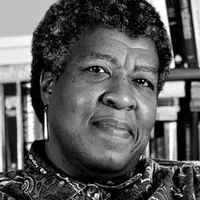
Octavia E. Butler
Butler reframes speculative fiction by weaving complex narratives that challenge societal norms and explore profound themes of race, gender, and power. Her unique approach involves blending science fiction with elements of African American history and culture, thereby offering incisive social commentary. In her acclaimed book "Parable of the Sower," Butler delves into a dystopian world marked by climate change and societal collapse, showcasing her adeptness at creating hauntingly realistic futures. While these themes are central to her work, Butler also navigates the intricacies of personal identity and human resilience through the speculative elements found in her stories. These methods, which include placing marginalized protagonists at the center of her narratives, enable readers to engage deeply with pressing contemporary issues, therefore expanding the boundaries of the genre.\n\nReaders benefit from Butler's work as it provides a lens through which to examine complex societal structures and personal identity. Her writing not only serves as a mirror reflecting current social dynamics but also as a blueprint for reimagining the possibilities of the future. For those interested in exploring these themes, Butler's early work in the "Patternist" series offers insights into psychic hierarchies, whereas "Kindred" uniquely blends science fiction with historical fiction, allowing for an exploration of racial injustice through the lens of time travel. The author’s exploration of these multifaceted issues has not only inspired a new generation of writers and readers but has also cemented her legacy as a pioneering force in literature. Butler’s numerous accolades, including multiple Nebula and Hugo Awards, further underscore her profound impact on the field of speculative fiction, ensuring that her contributions will continue to resonate with audiences for years to come.
Read moreDownload PDF & EPUB
To save this Black List summary for later, download the free PDF and EPUB. You can print it out, or read offline at your convenience.
Adulthood Rites
by Octavia E. Butler
