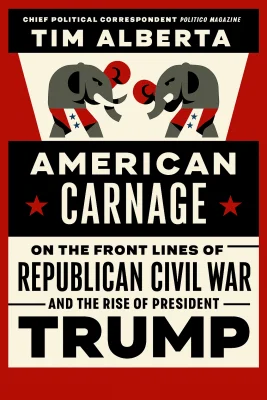
American Carnage
On the Front Lines of the Republican Civil War and the Rise of President Trump
Categories
Nonfiction, History, Politics, Audiobook, Political Science, American, Journalism, Presidents, American History, Government
Content Type
Book
Binding
Hardcover
Year
2019
Publisher
Harper
Language
English
ASIN
006289644X
ISBN
006289644X
ISBN13
9780062896445
File Download
PDF | EPUB
American Carnage Plot Summary
Introduction
The transformation of the Republican Party between 2009 and 2018 represents one of the most consequential political realignments in modern American history. What began as a grassroots protest movement against government bailouts and healthcare reform gradually evolved into something far more profound - a populist revolt that would ultimately reshape the very identity of a major political party. The Tea Party's emergence following Barack Obama's election initially appeared to be a traditional conservative reaction to liberal policies. Yet beneath the surface, deeper currents of cultural anxiety, economic dislocation, and institutional erosion were flowing, creating the conditions for a more radical transformation than anyone could have predicted. This historical account takes readers on a journey through the Republican Party's metamorphosis, examining how established power structures crumbled in the face of insurgent forces. From John Boehner's struggles to maintain control of his congressional caucus to the failed immigration reform that exposed deep cultural divides, and ultimately to Donald Trump's hostile takeover of the party apparatus, we witness how traditional conservative principles gave way to populist grievance and personality-driven politics. The story reveals profound lessons about institutional resilience, the power of media ecosystems, and the enduring tensions between governance and ideological purity that continue to shape American democracy today. For anyone seeking to understand the roots of our current political moment, this exploration offers essential insights into how we arrived here and what might come next.
Chapter 1: The Tea Party Insurgency: Roots of Republican Rebellion (2009-2010)
The seeds of the Republican Party's transformation were planted in the aftermath of Barack Obama's historic victory in 2008. As Democrats celebrated their newfound control of both Congress and the White House, a grassroots conservative movement was brewing beneath the surface. The catalyst came in February 2009 when CNBC commentator Rick Santelli delivered his famous rant from the floor of the Chicago Mercantile Exchange, decrying government bailouts and calling for a modern "Tea Party" to protest the administration's economic policies. Within weeks, this spark ignited protests across the country, with activists donning revolutionary-era costumes and carrying "Don't Tread on Me" flags. What began as scattered demonstrations quickly evolved into a formidable political force. Throughout 2009, Tea Party rallies spread nationwide, drawing thousands of participants united by their opposition to government spending, bank bailouts, and Obama's healthcare reform initiative. These weren't just traditional Republicans – they represented a new breed of conservative activists who viewed the GOP establishment with almost as much disdain as they did Democrats. As former Bush White House official Pete Wehner observed, "There was a shift... Some of it was tied to 9/11. Some of it was tied to economic insecurity. Some of it was tied to a sense of lost culture for a lot of people on the right." The movement gained momentum when Democrats turned to healthcare reform in late 2009. Tea Party activists flooded town halls across the country, confronting Democratic lawmakers with unprecedented hostility. These confrontations, often captured on video and amplified by conservative media, energized the movement and frightened many moderate Republicans. By early 2010, the Tea Party had transformed from street protests to a genuine electoral force, with candidates like Marco Rubio in Florida and Rand Paul in Kentucky defeating establishment-backed Republicans in primaries before winning their general elections. The 2010 midterm elections represented the Tea Party's first major triumph, as Republicans gained 63 House seats in what President Obama called a "shellacking." This victory brought a new breed of Republican to Washington - ideological purists with little interest in compromise or traditional governance. They had been elected to oppose Obama at every turn and viewed negotiation as capitulation. For Republican leaders like John Boehner, who became Speaker after the GOP's sweeping victory, the Tea Party presented both an opportunity and a challenge. The movement had delivered Republicans their largest House majority in decades, but many of these new members arrived in Washington determined to fundamentally change how the institution operated. The Tea Party's rise represented more than just opposition to Obama's policies – it reflected a profound distrust of institutions and elites that had been building for years. Many supporters felt betrayed by a Republican establishment they believed had abandoned conservative principles of limited government and fiscal responsibility during the Bush years. They were angry about immigration, frustrated with endless wars, and resentful of a political class they viewed as disconnected from ordinary Americans. As former Speaker John Boehner would later observe, "What happened to immigration reform? Why not pass that bill?" Rupert Murdoch once asked Eric Cantor. "Rupert," Cantor replied, "Have you watched your network?" By the end of 2010, the battle lines within the Republican Party had been drawn. The establishment maintained control of the party's leadership positions, but the insurgent Tea Party faction had established itself as a powerful force that could no longer be ignored. This internal conflict would define Republican politics for years to come, eventually creating the conditions for an even more dramatic populist uprising that few could have anticipated.
Chapter 2: Institutional Erosion: Party Leadership Under Siege (2011-2014)
When the 112th Congress convened in January 2011, the Republican Party found itself in a paradoxical position: victorious yet deeply divided. John Boehner, the new Speaker of the House, faced the unenviable task of managing a conference that included 87 freshmen, many of whom had campaigned against the very institution they now joined. In his first address to the new members, Boehner tried to set expectations: "Campaigning," he told them, "is different than governing." For many Tea Party freshmen, this distinction was precisely what they had come to Washington to erase. The first major battle came over the federal budget. Having promised to cut $100 billion in their "Pledge to America," House Republicans quickly discovered the practical limitations of governing in a divided system. When Boehner and his leadership team attempted to explain why such a steep reduction wasn't possible midway through the fiscal year, conservatives rebelled. This pattern would repeat throughout 2011: Republican leaders making pragmatic calculations about what could be achieved with Democrats controlling the Senate and White House, while the insurgent wing demanded all-or-nothing approaches. The debt ceiling crisis of summer 2011 crystallized this internal conflict. As the Treasury Department warned of catastrophic consequences if the government defaulted on its obligations, Boehner engaged in secret negotiations with President Obama to craft a "Grand Bargain" that would raise the debt ceiling while implementing significant spending cuts and entitlement reforms. When details of these talks leaked, conservative members and outside groups erupted in fury at the prospect of any compromise. "I don't know that there's any stopping this," Rush Limbaugh told his listeners. "It's up to me and Fox News, and I don't think Fox News is that invested in this." The resulting Budget Control Act satisfied neither side but demonstrated how dysfunction had become the new normal. Behind the scenes, a sophisticated network of outside organizations worked to enforce ideological conformity within Republican ranks. Groups like Heritage Action and the Club for Growth created "scorecards" rating lawmakers' conservative purity, while well-funded super PACs stood ready to primary any Republican who strayed from orthodoxy. This external pressure fundamentally altered the incentive structure for elected officials, making cooperation with Democrats or even Republican leadership a potentially career-ending move. As Boehner later reflected, "When we won the majority in 1994, we barely had talk radio. The only people using the Internet were a couple geeks in Palo Alto. There was no Facebook, Twitter. There was no Breitbart.com. And there was no Fox News." The formation of the House Freedom Caucus in 2013 institutionalized the insurgency within Congress itself. This group of roughly 40 hardline conservatives effectively wielded veto power over Republican leadership by threatening to block legislation that didn't meet their ideological standards. Their crowning achievement came in October 2013 when they forced a government shutdown in a quixotic attempt to defund the Affordable Care Act. Though the shutdown ended after 16 days with Republicans receiving most of the blame, it demonstrated how a determined minority could paralyze the entire federal government. By 2014, the Republican Party had become virtually ungovernable from within. Traditional party mechanisms for maintaining discipline had collapsed, replaced by a chaotic ecosystem where the most extreme voices commanded the most attention and influence. The party establishment, including figures like Senate Minority Leader Mitch McConnell, found themselves increasingly powerless to control their own members or set a coherent agenda. This institutional erosion created the perfect conditions for an outsider figure who could channel the base's anger while bypassing the party's traditional gatekeepers entirely.
Chapter 3: Immigration Reform Failure: The Cultural Divide Deepens (2013)
In the wake of Mitt Romney's defeat in 2012, Republican leaders faced a stark reality: the party's share of the Hispanic vote had plummeted to just 27 percent, down from 44 percent for George W. Bush in 2004. The RNC's post-election autopsy report, officially titled the "Growth and Opportunity Project," made a clear recommendation: embrace comprehensive immigration reform or face extinction in an increasingly diverse America. This push for reform would become the central battleground in the ongoing Republican civil war throughout 2013. The "Gang of Eight" – a bipartisan group of senators including Republicans Marco Rubio, John McCain, Lindsey Graham, and Jeff Flake – unveiled a comprehensive immigration reform framework in January 2013. Their proposal offered a path to citizenship for undocumented immigrants in exchange for enhanced border security and tougher interior enforcement. Initially, the political winds seemed favorable. Conservative pundits like Sean Hannity declared, "We've got to get rid of the immigration issue altogether," while Republican leaders like Eric Cantor announced support for citizenship for undocumented minors brought to America as children. Rubio, the Tea Party darling of 2010, became the face of the reform effort. In a remarkable display of political courage, he called into Rush Limbaugh's show to defend the Gang of Eight plan. After sixteen minutes of Rubio's persuasive rhetoric, the normally combative Limbaugh was practically gushing: "What you are doing is admirable and noteworthy," he told Rubio. The Florida senator embarked on a full-scale charm offensive, visiting conservative media outlets and appearing on seven different Sunday shows in a single day to sell the legislation. But the tide quickly turned against reform. As the bill progressed through the Senate, grassroots opposition mounted. Iowa Congressman Steve King emerged as the face of the anti-immigration movement, warning that for every valedictorian among undocumented youth, "there's another one hundred out there who weigh 130 pounds, and they've got calves the size of cantaloupes because they're hauling 75 pounds of marijuana across the desert." Though condemned by Republican leaders, King's rhetoric resonated with the base. Meanwhile, Texas Senator Ted Cruz, who had defeated an establishment candidate in 2012, positioned himself as the conservative alternative to Rubio on immigration. By June 2013, when the Senate passed the Gang of Eight bill with 14 Republican votes, the backlash had reached fever pitch. House Speaker John Boehner, facing intense pressure from his conference, refused to bring the Senate bill to the floor. The failure of immigration reform revealed a fundamental truth about the Republican Party: the demographic concerns of party strategists were no match for the cultural anxieties of the base. As Eric Cantor observed, "Immigration was a problem for the party, but it wasn't a problem in a lot of these districts." The issue that Republican leaders hoped would help rebuild their party instead became, in Sean Hannity's words, "a career killer." The immigration battle exposed the deepening cultural divide within the Republican coalition. For business-oriented conservatives and party strategists, immigration reform represented a pragmatic necessity in a diversifying America. For the base, however, it symbolized unwelcome cultural change and elite betrayal. This divide would prove impossible to bridge, setting the stage for a candidate who would make opposition to immigration reform the centerpiece of his presidential campaign. The failure of immigration reform in 2013 marked a pivotal moment in the Republican Party's transformation, demonstrating that cultural identity had become more important to many Republican voters than traditional conservative principles or even electoral viability.
Chapter 4: Trump's Hostile Takeover: Capturing the Republican Base (2015-2016)
On June 16, 2015, Donald Trump descended the golden escalator at Trump Tower to announce his presidential candidacy, a moment initially dismissed by political observers as mere celebrity spectacle. His announcement speech, which included the infamous characterization of Mexican immigrants as rapists and criminals, drew immediate condemnation from party leaders and media figures. Yet Trump's candidacy tapped into something profound within the Republican base that establishment figures had either ignored or failed to recognize. His blunt, confrontational style and willingness to violate political norms resonated with voters who felt betrayed by conventional politicians of both parties. The Republican establishment's inability to counter Trump's rise revealed how thoroughly the party's institutional foundations had eroded. Traditional gatekeepers like major donors, elected officials, and conservative media figures found themselves powerless against a candidate who communicated directly with voters through social media and dominated news coverage through provocative statements. Early attempts to attack Trump only seemed to strengthen his appeal among supporters who viewed such criticism as evidence that he was fighting the system on their behalf. As one Trump voter explained, "I was banging my head against a wall because I just wasn't getting the response from a member that made any sense. And I think it was because people were in search of something on this menu of fiscally conservative policy positions that didn't quite mesh with this cultural thing that was lighting the house on fire." What made Trump's rise so remarkable was how thoroughly he rejected Republican orthodoxy. He criticized free trade agreements that had been GOP gospel for decades. He defended Social Security and Medicare, promising not to cut entitlement programs. He condemned the Iraq War as a disaster, breaking with the party's hawkish foreign policy establishment. And perhaps most significantly, he made immigration restriction the centerpiece of his campaign, promising to build a wall on the southern border and make Mexico pay for it. These positions represented a fundamental break with the party's traditional policy agenda but resonated deeply with the cultural anxieties and economic insecurities of working-class white voters. Trump's primary victories defied political gravity. He survived scandals and statements that would have destroyed conventional candidates, from mocking a disabled reporter to suggesting a federal judge was biased because of his Mexican heritage. His Republican rivals found themselves trapped in an impossible dilemma: attack Trump and alienate his growing base of supporters, or ignore him and watch their own campaigns fade into irrelevance. One by one, establishment favorites like Jeb Bush, Marco Rubio, and eventually Ted Cruz fell by the wayside as Trump secured the nomination against the desperate opposition of party elites. The Republican National Convention in Cleveland revealed a party fundamentally transformed. Many prominent Republicans, including both former Presidents Bush, declined to attend. Ted Cruz's refusal to endorse Trump from the convention stage triggered a cascade of boos from delegates, demonstrating how thoroughly the party base had embraced their new standard-bearer. Trump's acceptance speech painted a dark picture of American carnage that required his unique leadership to address, cementing his populist takeover of a party that just four years earlier had nominated Mitt Romney. By the fall of 2016, the transformation was complete. Despite the release of the Access Hollywood tape in October, in which Trump was recorded making vulgar comments about women, the vast majority of Republican officials eventually rallied to his side. This capitulation revealed how thoroughly the party's power structure had been inverted - elected officials now feared the wrath of Trump's base more than they valued their own stated principles. Trump's eventual victory in November, though narrow and dependent on quirks of the Electoral College, validated his hostile takeover and ensured that the Republican Party would never be the same again.
Chapter 5: Governing Through Chaos: Policy vs. Personality (2017-2018)
Donald Trump's presidency began with an inaugural address that shocked Washington with its dark, nationalist tone. Rather than offering traditional calls for unity, Trump described "American carnage" and promised that "from this day forward, it's going to be only America first." Former President George W. Bush reportedly remarked afterward, "That was some weird shit." This rhetoric signaled a fundamental break with Republican orthodoxy on issues ranging from trade to foreign policy, and foreshadowed the tumultuous governance style that would define his administration. The early months of the Trump administration were marked by unprecedented chaos and staff turnover. The president's management style, honed in his family business rather than government, created a West Wing environment of competing power centers and constant infighting. Chief strategist Steve Bannon pushed for nationalist policies while more conventional Republicans like Chief of Staff Reince Priebus attempted to steer the administration toward traditional conservative priorities. This internal conflict played out in policy whiplash, with executive orders often issued without proper vetting or implementation plans. The hastily implemented travel ban, announced just one week into his presidency, created chaos at international airports nationwide and was quickly blocked by federal courts. The failure of healthcare reform in 2017 exposed the fundamental contradiction at the heart of the Republican Party. Despite seven years of promising to repeal and replace the Affordable Care Act, Republicans discovered they had no consensus on what should replace it. The American Health Care Act, championed by Speaker Paul Ryan, satisfied neither the Freedom Caucus, who considered it "Obamacare Lite," nor moderates concerned about coverage losses. After multiple failed attempts, including a dramatic thumbs-down vote from Senator John McCain, the repeal effort collapsed entirely, revealing the party's inability to translate campaign rhetoric into actual governance. By contrast, the passage of tax reform in December 2017 represented the one major legislative achievement of unified Republican government. This traditional Republican priority passed largely because it required less ideological compromise than healthcare reform. Speaker Paul Ryan, who had spent his career advocating for such reforms, declared at the White House celebration: "Something this big, something this generational, something this profound could not have been done without exquisite presidential leadership." The comment highlighted Ryan's strategic decision to overlook Trump's personal behavior in service of achieving long-held conservative policy goals. Foreign policy under Trump represented another dramatic departure from Republican tradition. His "America First" approach alienated longstanding allies while his personal diplomacy with authoritarian leaders like Russia's Vladimir Putin and North Korea's Kim Jong Un alarmed national security professionals. Defense Secretary James Mattis, along with other "adults in the room" like National Security Advisor H.R. McMaster, worked to constrain the president's most disruptive impulses. However, their influence gradually waned as Trump grew more confident in his own judgment and resentful of perceived constraints on his authority. By 2018, the Republican Party had effectively been redefined around the personality and preferences of Donald Trump rather than any coherent set of principles. Congressional Republicans, after initial resistance, largely accommodated themselves to the new reality, supporting the president even when he violated longstanding conservative orthodoxy. The party that had once defined itself by fiscal responsibility now embraced deficit-financed tax cuts and showed little concern for the ballooning national debt. The party that had championed free trade for decades now celebrated tariffs and trade wars. And the party that had positioned itself as a defender of traditional values and character now rallied behind a leader whose personal behavior contradicted those very principles. As Ralph Reed, chairman of the Faith and Freedom Coalition, explained the evangelical support for Trump: "Jimmy Carter sat in the pew with us. But he never fought for us. Donald Trump fights. And he fights for us."
Chapter 6: The Midterm Reckoning: Electoral Consequences of Populism (2018)
The 2018 midterm elections loomed as the first nationwide referendum on the Trump presidency, with Republicans facing an energized Democratic opposition. Rather than running on policy achievements, the president chose to nationalize the election around cultural grievances and immigration fears. His closing argument focused on a migrant "caravan" approaching the southern border, which he characterized as an "invasion" requiring military intervention. This strategy reflected Trump's conviction that base mobilization, rather than persuasion of swing voters, was the path to electoral success. Behind the scenes, the Republican Party continued its transformation into a vehicle for Trump's personal and political interests. Congressional oversight effectively ceased as committee chairs refused to investigate administration scandals or ethical violations. Republican lawmakers who criticized the president, like Senators Jeff Flake and Bob Corker, found themselves isolated within the party and opted for retirement rather than facing primary challenges. Even after the president's disastrous Helsinki summit with Vladimir Putin, where he publicly sided with the Russian leader over American intelligence agencies, Republican criticism remained muted and short-lived. The midterm campaign revealed how thoroughly demographic realignment had reshaped the electoral landscape. College-educated suburban voters, particularly women, abandoned the Republican Party in droves, while rural and working-class white voters became even more solidly Republican. This "class inversion" had been underway for years but accelerated dramatically under Trump. Republican candidates struggled to navigate this new reality, torn between appealing to the president's base and distancing themselves from his more controversial statements to win suburban districts. The results delivered a clear rebuke to the president, with Democrats gaining 40 House seats and reclaiming the majority. The blue wave was powered by unprecedented turnout for a midterm election and featured historic diversity among Democratic candidates. Republicans maintained control of the Senate, largely due to a favorable map of contests in predominantly rural states, but lost ground in every demographic group except white men without college degrees. The election demonstrated the electoral limits of Trump's base-first strategy in a diversifying America. Perhaps most ominously for Republicans, the midterms revealed cracks in the party's electoral foundation. In Texas, Democratic Senate candidate Beto O'Rourke came within 2.5 points of defeating incumbent Ted Cruz in a state no Democrat had won statewide since 1994. Similar warning signs appeared in Arizona and Georgia, where changing demographics threatened long-term Republican dominance. As Congressman Will Hurd, one of the few remaining moderate Republicans, observed after narrowly winning reelection: "If the Republican Party in Texas ceases to look like voters in Texas, there will not be a Republican Party in Texas." The president's response to the midterm losses revealed his grip on the party's identity. Rather than acknowledging setbacks, Trump declared victory based on Senate gains and proceeded to mock defeated Republican candidates who had distanced themselves from him. "Mia Love gave me no love. And she lost," he said of the defeated Utah congresswoman. "Too bad. Sorry about that, Mia." This public humiliation of Republicans who had failed to embrace him personally demonstrated how thoroughly the party had been redefined around loyalty to Trump rather than adherence to conservative principles. By year's end, with the government shut down over border wall funding and Defense Secretary James Mattis resigning in protest over foreign policy differences, the transformation of the Republican Party from a conservative institution to a personalist vehicle appeared complete.
Summary
The transformation of the Republican Party from 2009 to 2018 represents one of the most dramatic political realignments in American history. What began as a fiscally focused Tea Party rebellion against government bailouts and healthcare reform gradually evolved into something far more profound – a populist movement driven by cultural anxiety and economic dislocation. The traditional Republican coalition of business interests, national security hawks, and social conservatives gave way to a new configuration centered on white working-class voters who felt abandoned by both parties' elites. Donald Trump did not create these conditions, but he recognized and exploited them with a political instinct that his rivals lacked. His victory represented not just a rejection of Hillary Clinton but a repudiation of the entire post-Reagan Republican consensus on free trade, immigration, and America's role in the world. This decade-long metamorphosis offers profound lessons about institutional resilience and democratic vulnerability. Political parties serve as crucial mediating institutions in a democracy, filtering popular passions through established norms and procedures. When these guardrails collapse, as they did within the Republican Party, democracy itself becomes more fragile and susceptible to authoritarian impulses. The experience suggests that rebuilding healthy democratic competition requires more than just electoral victories - it demands the reconstruction of parties capable of channeling popular grievances into constructive governance rather than destructive polarization. For citizens concerned about America's democratic future, the challenge lies in distinguishing between legitimate policy disagreements and fundamental threats to democratic norms, supporting leaders who can navigate this distinction while addressing the real economic and cultural anxieties that fueled populism in the first place.
Best Quote
“few trusted advisers, the president confided that he was worried about some interconnected trends taking root in the country—and most acutely within the Republican Party. There was protectionism, a belief that global commerce and international trade deals wounded the domestic workforce. There was isolationism, a reluctance to exert American influence and strength abroad. And there was nativism, a prejudice against all things foreign: traditions, cultures, people. “These isms,” Bush told his team, “are gonna eat us alive.” ― Tim Alberta, American Carnage: On the Front Lines of the Republican Civil War and the Rise of President Trump
Review Summary
Strengths: Alberta's in-depth reporting and detailed narrative stand out, thanks to his extensive interviews with key political figures. A balanced portrayal of events and characters provides a nuanced perspective on the GOP's transformation. Engaging writing style effectively combines personal anecdotes with broader political analysis.\nWeaknesses: The book's density of detail may overwhelm readers unfamiliar with political intricacies. Some readers wish for a deeper exploration of the implications of political shifts on American democracy's future.\nOverall Sentiment: The book is regarded as a significant contribution to contemporary political literature, offering valuable insights into a turbulent period in American politics. The reception is generally positive, with appreciation for its comprehensive and insightful account.\nKey Takeaway: "American Carnage" offers a meticulous examination of the Republican Party's transformation, highlighting the ideological shifts and internal dynamics that led to Trump's rise and the party's evolving identity.
About Author

Tim Alberta
Alberta probes the intricate dynamics of American politics and religion through his writing, aiming to uncover the underlying forces shaping societal changes. Known for his incisive analysis and vivid storytelling, Alberta delves into the ideological rifts within the Republican Party in his notable book "American Carnage," where he explores the shifts leading to President Trump's rise. Meanwhile, his follow-up work, "The Kingdom, the Power, and the Glory," investigates the evolution of American evangelicalism, drawing from Alberta's own background as a pastor's son. These themes reflect his broader commitment to understanding the interplay between power, ideology, and identity.\n\nThrough methodical research and engaging prose, Alberta's books serve as essential reads for those interested in the complexities of contemporary American life. His role as a political journalist, coupled with his experience at publications like The Atlantic and Politico, underscores his authority in the field. For readers, his works offer not just a detailed chronicle of events but also a framework for examining the broader implications of political and religious shifts in America. His insights are particularly valuable for anyone seeking to grasp the nuances of modern political discourse and its impact on the national fabric.\n\nThe author’s accolades, including a National Magazine Award, further cement his position as a leading voice in political journalism. This bio underscores his ability to provoke thoughtful discussion and critical analysis through his writing, making his books indispensable for academics, policymakers, and anyone keen on understanding the driving forces behind today’s headlines. By weaving personal experience with national narratives, Alberta continues to chart the evolving landscape of American society, offering readers both context and clarity in an era of rapid change.
Read moreDownload PDF & EPUB
To save this Black List summary for later, download the free PDF and EPUB. You can print it out, or read offline at your convenience.
American Carnage
by Tim Alberta
