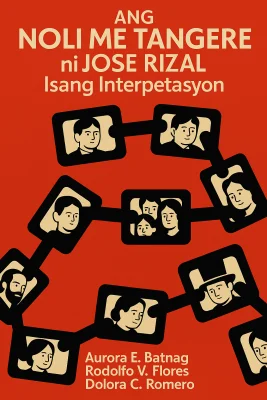
Ang Noli Me Tangere ni Jose Rizal
Isańg interpretation
Categories
Content Type
Book
Binding
Paperback
Year
1987
Publisher
Rex Book Store, Inc.
Language
English
File Download
PDF | EPUB
Ang Noli Me Tangere ni Jose Rizal Plot Summary
Introduction
# Shadows of the Cross: A Colonial Philippine Tragedy The steamship cuts through Manila Bay's dark waters as Crisostomo Ibarra returns from seven years in Europe, his mind sharp with foreign learning but his heart still beating with Filipino blood. The young man stands at the rail watching his homeland emerge from the tropical mist, unaware that his father lies in unhallowed ground, branded a heretic by the very priests who once blessed their family table. In the shadow of Spanish colonial rule, where church bells toll over rice paddies and the Civil Guard patrols with loaded rifles, love and revolution dance on the edge of a knife. The town of San Diego sleeps under the merciless sun, its cobblestones worn smooth by centuries of bare feet and broken dreams. Here, where friars hold court in stone conventos and justice speaks only Spanish, a beautiful girl named Maria Clara waits in her father's house like a flower blooming in poisoned soil. What begins as a homecoming will end in flames, and what starts as innocent love will be tested by the cruel machinery of empire that devours the pure and spits out the broken.
Chapter 1: The Prodigal Son's Return: Ibarra's Awakening to Colonial Reality
The crystal chandeliers blaze in Captain Tiago's Manila mansion as the colonial elite gather to welcome home their prodigal son. Crisostomo Ibarra moves through the crowd with quiet dignity, his European tailoring marking him as different from the bent-backed servants who pour wine and sweep floors. Seven years of foreign education have polished his manners but not prepared him for the venom that waits in familiar faces. Padre Damaso dominates the reception hall like a bloated spider in brown robes, his massive frame shaking with laughter as he regales guests with tales of native ignorance. The Franciscan friar has grown fat on twenty-three years of tropical corruption, his voice booming with the authority of a man who has never been questioned. When young Ibarra politely disagrees with the priest's assessment of Filipino character, Padre Damaso's eyes flash with something approaching hatred. The confrontation erupts with volcanic suddenness. Here stands an educated indio who dares speak as an equal, who has tasted European enlightenment and forgotten his place in the colonial hierarchy. The friar's words cut like blades as he speaks of Ibarra's father, Don Rafael, dead and buried like a dog outside consecrated ground for his dangerous liberal ideas. The revelation strikes the young man like a physical blow, shattering his illusions about Spanish justice and Filipino dignity. Other guests shift uncomfortably as the priest's voice rises, his Spanish accent thick with condescension. Ibarra's measured responses only inflame Padre Damaso further, as if the young man's very existence challenges the natural order of things. The evening's false pleasantries crumble like a facade struck by lightning, revealing the ugly machinery of oppression that grinds beneath colonial society's polished surface. That night, Ibarra stands alone on his balcony overlooking the Pasig River, watching sampans drift like ghosts through the moonlight. The Manila he remembered from childhood has revealed its true face, and beneath the veneer of civilization lies something rotten and cruel that will soon consume everything he holds dear.
Chapter 2: Love Under Siege: Maria Clara and the Price of Beauty
The morning sun beats mercilessly on San Diego's dusty streets as Ibarra returns to claim his inheritance and confront the truth about his father's fate. The town that once echoed with his childhood laughter now seems narrow and oppressive, its houses leaning inward like conspirators sharing deadly secrets. At the Chinese cemetery, an old gravedigger tells him what the priests would never admit—Don Rafael's body was dragged from holy ground in the dead of night, dumped like refuse because his liberal ideas offended Spanish sensibilities. Standing over the unmarked grave, Ibarra makes a vow that will seal his destiny. He will build a school in his father's memory, a monument to enlightenment in this land of shadows. The announcement sends ripples of excitement through the town's oppressed masses and waves of fear through its ruling class, for education is a dangerous weapon when it reaches the wrong hands. In Captain Tiago's garden, beneath flowering vines that perfume the humid air, Maria Clara waits like a vision carved from moonlight and shadow. Her beauty seems almost supernatural to those who glimpse her pale form among the ylang-ylang blossoms, raised in the Santa Catalina convent to possess that peculiar innocence Spanish colonial society demands of its daughters. Their childhood love rekindles instantly, burning brighter for the years of separation, yet even their most tender moments carry the weight of approaching doom. She listens with growing horror as Ibarra tells her of his father's desecration, of the school that has made him enemies, of the dark currents flowing beneath their peaceful town. Her delicate hands tremble as she plays the piano, her voice breaking when she sings the melancholy kundiman that seems to prophesy their separation. There are things she cannot tell him, secrets that would destroy them both if spoken aloud. The pressure builds like steam in a covered pot. Captain Tiago entertains visitors who speak in hushed tones of political necessity and family honor, while Padre Salvi, the new curate with hollow cheeks and burning eyes, whispers of sacrifice in the confessional. Love becomes the currency of survival in a land where even the purest emotions are corrupted by the machinery of empire.
Chapter 3: Seeds of Progress: The School That Threatened an Empire
The groundbreaking ceremony should have been a celebration, a moment when the community united behind progress and enlightenment. Instead, it becomes a theater of hidden malice and carefully orchestrated destruction. The mysterious yellowish man who supervises the derrick construction moves with deliberate precision, his mechanical expertise masking a deeper purpose—to crush Ibarra beneath the very stone meant to symbolize hope. Dignitaries gather as speeches flow about civilization and Spanish benevolence, their words ringing hollow against the grinding of machinery and whispered prayers of those who sense approaching catastrophe. Padre Salvi arrives pale and nervous, his sunken eyes darting like those of a cornered rat as he speaks of tradition and the dangers of secular learning. The crowd watches in fascination as two visions of the future clash under the blazing tropical sun. The elaborate scaffolding rises like a gallows, its pulleys and cables arranged not for construction but for murder. Even the blessed cornerstone, meant to preserve records for future generations, seems more like a tombstone marking the burial of dreams. Death waits in the shadows of the apparatus while the alcalde delivers pompous words about progress and the civilizing mission of Spain. When the cables snap and the derrick collapses in a thunderous crash of splintered wood and twisted metal, only divine intervention saves Ibarra from becoming another casualty of colonial progress. The yellowish man's crushed body serves as a grim reminder that in this land, even acts of charity can become instruments of death. His final words reveal the truth—he was the son of the man Don Rafael once accused of arson, seeking revenge across generations. The school project continues despite the sabotage, but darker forces gather like storm clouds on the horizon. The Civil Guard captain, a brutal man who rules through fear and violence, sees in Ibarra's educational dreams a threat to the established order. Whispers begin to circulate about the young man's true intentions, about revolutionary ideas hidden behind noble words.
Chapter 4: Broken Chains: Sisa's Family and the Machinery of Oppression
In the shadow of San Diego's stone church, Sisa waits through the endless night for her sons to return home. The widow's calloused hands tremble as she prepares their meager meal—three small fish divided between Basilio and little Crispin, her altar boys who serve the demanding Padre Salvi. The kalao bird's mournful cry echoes through the bamboo groves, but still her children do not come. The truth proves more terrible than any mother's worst fears. In the convento's shadowed chambers, young Crispin faces accusations of stealing gold from the church coffers. The boy's protests of innocence mean nothing to the senior sacristan, whose heavy hands and rattan whip speak the only language of justice the colonial system understands. Basilio, barely older, can only watch in horror as his brother disappears into the convento's depths, swallowed by accusations that will destroy their family. When Basilio finally stumbles home, blood streaming from his forehead where a Civil Guard's bullet grazed him, he finds his mother's world already crumbling. The authorities have dragged Sisa through the town like a common criminal while neighbors whisper and point, the shame burning deeper than any physical wound. To be marked as the mother of thieves in a community where reputation is the only currency the poor possess means social death. By dawn, Crispin has vanished entirely, lost in the labyrinthine cruelty of a system that devours children and spits out broken families. The senior sacristan's rage has claimed another victim, his accusations serving as judge, jury, and executioner in the twisted justice of colonial rule. Sisa's mind, unable to bear the weight of such loss, begins its slow retreat into madness. The widow wanders the streets calling for sons who can no longer answer, her broken voice echoing off stone walls that have witnessed centuries of similar tragedies. The townspeople cross themselves and hurry past, recognizing in her madness the reflection of their own helplessness against forces too powerful to resist.
Chapter 5: The Conspiracy Unveiled: False Revolution and True Betrayal
The night air crackles with tension as shadows move through San Diego's narrow streets toward the cemetery. Men gather around the tomb of Ibarra's grandfather, their faces hard with desperation and their hands rough from years of labor under Spanish masters. They speak in whispers of revolution and revenge, of the young master who will supposedly lead them to freedom from colonial oppression. But Ibarra knows nothing of their plans. The conspiracy has been crafted with diabolical precision, using his name and reputation to lure the desperate into a trap that will destroy them all. Lucas, a man scarred by Civil Guard brutality, moves through the crowd like a serpent in paradise, his silver tongue weaving promises of liberation while his true masters watch from the shadows. The attack comes at midnight, swift and savage as a tropical storm. The rebels, armed with bolos and ancient rifles, storm the Civil Guard barracks with the fury of men who have nothing left to lose. But they find their enemies ready and waiting, positioned with the precision that comes only from advance warning. The night explodes in gunfire and screams as the trap springs shut. By dawn, the streets run red with blood and the air thick with smoke. The survivors are dragged before the alcalde in chains, their bodies broken and their spirits crushed by the realization of their betrayal. Under torture, they confess to crimes they never planned, implicating the young master who promised them freedom but delivered only death. In his cell, Ibarra stares through iron bars at the ruins of his dreams. His school lies in ashes, his reputation destroyed, his future measured in the length of rope required for a hanging. The conspiracy has succeeded beyond its architects' wildest hopes, transforming a dreamer into a revolutionary and a patriot into a traitor condemned by Spanish justice.
Chapter 6: Blood on Sacred Waters: Elias's Sacrifice and Ibarra's Escape
The lake lies still as black glass under the Christmas moon, its surface broken only by the gentle wake of a small banca cutting through the darkness. Elias, the mysterious boatman whose past is written in scars and whose future holds only shadows, guides his craft toward the prison where Ibarra awaits execution. His powerful arms work the paddle with silent efficiency, each stroke bringing them closer to a reckoning years in the making. The escape unfolds with desperate precision. Guards fall to Elias's knife, their cries muffled by the night wind that sweeps across the water. Ibarra emerges from his cell like a man awakening from a nightmare, his face gaunt with suffering and his eyes burning with newfound purpose. The gentle dreamer who returned from Europe has died in that prison, replaced by something harder and infinitely more dangerous. As their boat cuts across the lake toward freedom, Elias reveals the terrible truth that binds their fates together. He is the descendant of the man Ibarra's grandfather falsely accused of arson, the heir to a family destroyed by Spanish justice and Filipino complicity. Their blood feud should demand vengeance, yet here he sits, risking everything to save his enemy's grandson because he understands that hatred only breeds more hatred. The pursuit begins at dawn, government boats converging on their position like sharks drawn to blood. Elias makes his choice with the calm certainty of a man who has always known how his story would end. He plunges into the lake's dark waters, drawing the hunters away from Ibarra with his own life as bait, his sacrifice echoing across the water like a prayer for redemption. The rifles crack like thunder, and the water blooms red around his struggling form. Ibarra watches from the safety of the reeds as his savior disappears beneath the surface, taking with him the last link to innocence and hope. The lake that once reflected childhood dreams now holds the body of the man who died for another's freedom, its sacred waters stained with the blood of the pure.
Chapter 7: Behind Convent Walls: The Silencing of Hope and Truth
The bells of Santa Clara convent toll like a funeral dirge as Maria Clara kneels before the altar, her wedding dress replaced by the rough brown habit of a nun. The ceremony of her taking vows unfolds with medieval solemnity, each Latin phrase another bar in the cage that will hold her for the rest of her life. Her beauty, once radiant as tropical sunrise, has dimmed to the pale glow of candlelight in a tomb. The choice that brought her here was no choice at all. A letter in Ibarra's handwriting, written years ago in the innocent passion of youth, had found its way into the wrong hands. The price of its suppression was her hand in marriage to Linares, a weak-chinned Spanish bureaucrat who represented safety and submission. Rather than betray her love or destroy her beloved, she chose the living death of the convent over a marriage that would have killed her soul. Padre Damaso watches from the shadows, his massive frame shaking with suppressed emotion. This is both his victory and his punishment, the preservation of his terrible secret at the cost of his heart. The girl he has protected with such fierce, twisted devotion has chosen exile from the world rather than submit to forces beyond her control. His triumph tastes of ashes in his mouth. The convent walls rise around Maria Clara like the sides of a well, shutting out the world she once knew. Here, in chambers that smell of incense and despair, she learns the true meaning of sacrifice. The other nuns move like ghosts through corridors lit by flickering candles, their faces blank with the resignation of women who have surrendered all hope of earthly happiness. On storm-lashed nights, when the wind howls like the voices of the damned, a white figure can be seen on the convent roof, arms raised to the lightning-torn sky in desperate supplication. The guards below cross themselves and speak in whispers of the mad nun who defies heaven itself in her anguish, but heaven remains as deaf as the Spanish God it represents to the cries of the innocent.
Chapter 8: Ashes of Dreams: The Legacy of a Failed Awakening
The cemetery of San Diego lies shrouded in morning mist as two figures move among the weathered headstones like ghosts seeking rest. Basilio, the sacristan's son whose childhood ended in blood and madness, supports his mother Sisa as she wanders through the maze of crosses and forgotten names. Her mind, shattered by loss and brutality, finds no peace even in this place of eternal rest. The old balete tree spreads its gnarled branches over the tomb of Ibarra's grandfather, its roots drinking deep from soil enriched by generations of the dead. Here, where Spanish bones mingle with Filipino earth, the past and present converge in a moment of terrible clarity. Sisa collapses at the base of the ancient tree, her broken heart finally surrendering to the weight of unbearable sorrow, her last breath a whispered call for children who will never answer. As dawn breaks over the Philippines, Basilio builds a funeral pyre from the wood that was meant for Ibarra's school. The flames rise high into the morning sky, carrying with them the dreams of a generation and the hopes of a nation. In the smoke and ash, the ghosts of the innocent find their only justice, their only peace in a land where mercy has been strangled by the machinery of empire. The survivors scatter like leaves before the wind. Captain Tiago drowns his grief in opium and gambling, his fortune melting away like morning dew. Padre Damaso dies alone in his cell, his massive heart finally broken by the weight of sins that even Spanish absolution cannot wash clean. The town of San Diego returns to its ancient sleep, its brief awakening crushed beneath the iron heel of colonial rule.
Summary
The chains that bound Rizal's characters were forged not merely from iron but from centuries of spiritual and cultural oppression that proved stronger than any physical shackles. Ibarra's noble dreams of progress lay shattered beneath the weight of institutional hatred, while Maria Clara's pure love became another casualty of a system that recognized no loyalty save to its own perpetuation. In Sisa's madness and Elias's sacrifice, in the blood spilled on sacred waters and the tears shed behind convent walls, the true cost of colonial rule stands revealed in all its terrible clarity. Yet in the ashes of the school, in the courage of those who dared to dream of dignity, something new was born that December morning in 1887. The seed of revolution, planted in Spanish soil and watered with Filipino blood, began its slow but inevitable germination. The shadows of colonialism were long and dark, but even shadows must yield to the coming dawn. Rizal's masterpiece stands as both mirror and prophecy, reflecting the Philippines of his time while illuminating the eternal struggle between oppression and human dignity that would soon shake the foundations of empire itself.
Best Quote
Review Summary
Strengths: The review highlights the book's helpfulness and overall quality, indicating that it provides valuable information or insights. Overall: The reader expresses a positive sentiment towards the book, suggesting it is both beneficial and of good quality. The brief comments imply a recommendation for those seeking useful content, although the lack of detailed critique limits the depth of the review.
About Author

Aurora E. Batnag
Batnag considers the intricate relationship between translation and cultural identity in the Philippines, highlighting how linguistic adaptation plays a pivotal role in historical and cultural contexts. Her work as a scholar and translator at De La Salle University focuses on the nuances of Filipino language and literature, drawing attention to the historical significance of translation in the dissemination of Christianity during the Spanish colonial era. By translating works such as Lewis Carroll's "Alice's Adventures in Wonderland" and Natsume Sōseki's "The Three-Cornered World" into Filipino, she bridges linguistic and cultural divides, preserving indigenous nuances while introducing global narratives to a local audience.\n\nHer approach to translation underscores the importance of cultural preservation and adaptation, benefiting academics and students who seek to understand the dynamic interplay between language and identity. Meanwhile, her involvement as president of SALIN and her role as a linguistic specialist at the Komisyon sa Wikang Filipino demonstrate her commitment to fostering a community of translators dedicated to enhancing the accessibility of diverse literary works. This dedication is further reflected in her contributions to projects like the Toyota Foundation Know Your Neighbors Project, which emphasize cross-cultural understanding.\n\nAurora E. Batnag’s contributions extend beyond her translation work, as evidenced by her academic texts such as "Filipino sa Piling Larangan" and her role as an editor at Rex Publishing Company. While she has not received major literary awards, her influence is marked by her commitment to academic and translation endeavors, making her a respected figure in the field of Filipino studies. Her work not only enriches the Filipino literary landscape but also provides valuable insights for readers interested in the intricate connections between language, history, and culture. This bio encapsulates the essence of an author whose efforts significantly impact the way Filipino language and literature are perceived and appreciated.
Read moreDownload PDF & EPUB
To save this Black List summary for later, download the free PDF and EPUB. You can print it out, or read offline at your convenience.
Ang Noli Me Tangere ni Jose Rizal
by Aurora E. Batnag
