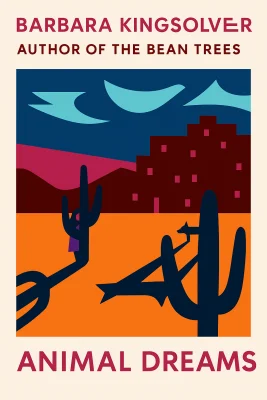
Animal Dreams
Categories
Fiction, Romance, Literature, Adult, Book Club, Contemporary, Novels, Adult Fiction, Literary Fiction, Native American
Content Type
Book
Binding
Paperback
Year
1990
Publisher
Harper Perennial
Language
English
ASIN
0060921145
ISBN
0060921145
ISBN13
9780060921149
File Download
PDF | EPUB
Animal Dreams Plot Summary
Introduction
# Animal Dreams: A Journey Home Through Loss and Love The desert heat shimmers like a fever dream as Codi Noline steps off the Greyhound bus in Grace, Arizona—a woman returning to a place that never felt like home. Fourteen years have passed since she fled this canyon town, and now she's back with two suitcases and a teaching contract, watching her father lose his mind to Alzheimer's while her sister Hallie plants hope in Nicaragua's war-torn soil. The orchards that once defined Grace are dying, their leaves yellowing from mining poison that seeps through the valley like liquid death. But Grace holds secrets deeper than contaminated groundwater. As Codi reluctantly settles into teaching high school biology, she discovers that everything she believed about her family was built on lies. The women of the Stitch and Bitch Club know truths that Doc Homer buried decades ago, and their fight to save the dying river becomes Codi's unexpected path to understanding where she truly belongs. In a town where peacocks wander the streets like exotic ghosts and memory flows like water through generations of women, Codi must choose between the familiar comfort of running away and the terrifying possibility of finally planting roots.
Chapter 1: The Reluctant Return: Coming Home to Grace
The bus wheezed to a stop in Grace just as shadows began their crawl across the canyon floor. Codi Noline emerged into air that tasted of dust and dying things, her tall frame casting a long shadow on cracked asphalt. Fifteen years of exile, and nothing had changed except the trees looked sick. Doc Homer waited in his ancient pickup, hands gripping the steering wheel like he was holding onto something precious that might slip away. Her father had always been a man carved from silence, but now the quiet seemed to have claimed him entirely. As they drove through town, Codi noticed the orchards drooping with yellowed leaves, branches heavy with premature death. "The river's poisoned," Doc Homer said, his voice barely audible above the truck's rattling. "Black Mountain Mining. They've been running acid through their tailings for months." The house on the hill stood like a fortress against the desert, all sharp angles and defensive walls. Inside, everything felt smaller than memory had preserved it. Her childhood bedroom waited like a museum of her former self, filled with books she'd once loved and dreams she'd long since abandoned. That night, lying in her narrow bed, Codi listened to Doc Homer's footsteps following the same pattern they had when she was young. Kitchen to living room to study and back again, like a man pacing a cage. She'd come home because she had nowhere else to go—her relationship with Carlo had collapsed, her medical career had ended in spectacular failure when she walked away from a complicated delivery. Now she was thirty with no career, no home, and no idea what came next. Grace needed a biology teacher. Codi needed a job. It was supposed to be temporary, just long enough to figure out her next escape route. She had no intention of staying in a place that had never wanted her, in the shadow of a sister who was everything she wasn't.
Chapter 2: Poisoned Waters: Discovering the Town's Crisis
Grace High School smelled of chalk dust and teenage desperation, unchanged since Codi's own miserable years there. Her students regarded her with suspicious interest, especially when she wheeled out Mrs. Josephine Nash—a human skeleton she'd rescued from storage and treated with the dignity due someone who had once drawn breath. "We're going to test the river water," she announced, distributing microscopes and sample jars. The teenagers groaned, but their complaints died when they peered through the lenses. Nothing. No protozoans, no algae, no life at all. The water was as sterile as battery acid. The Stitch and Bitch Club met every Tuesday in the American Legion hall, a gathering of women whose hands were never idle and whose tongues could cut glass. Doña Althea presided like an ancient queen, ninety-three years old and sharp as a blade, the last living link to Grace's founding mothers. "The men want to write letters," she said, her voice carrying decades of authority. "Letters to politicians who don't know we exist. But we are not going to disappear quietly." The mining company had been leaching copper from their tailings with sulfuric acid, and the runoff was killing everything downstream. The EPA's solution was worse than the problem—dam the river entirely, leaving the orchards to die of thirst. While the town council talked about lawsuits that might resolve in a decade, the women planned something more immediate. Mrs. Galvez spoke up suddenly, her needlework forgotten. "We make piñatas. Peacock piñatas, beautiful as art. We take them to Tucson, tell people what's happening here." The idea seemed absurd until it didn't. These women were skilled craftswomen, their hands trained by generations of mothers. They could create beauty from paper and paste, carry their story beyond the canyon walls. Each piñata became a prayer made manifest, a piece of Grace's soul wrapped in crepe paper and real peacock feathers donated by Doña Althea's ancient flock.
Chapter 3: Unearthed Heritage: Learning the Truth About Belonging
The cemetery held secrets in its weathered headstones. Walking among the graves with Viola Domingos, Codi discovered names that made her heart stutter—Nolina, carved into stone after stone, almost identical to her own family name. When she pressed for answers, Viola's dark eyes softened with something that might have been pity. "Your mama wasn't from Illinois," Viola said, stirring sugar into her coffee with deliberate precision. "She was Althea Gracela, born right here in this canyon. Her family goes back to the original nine sisters who founded Grace." The words hit Codi like a physical blow. Everything Doc Homer had told them was a lie. They weren't outsiders destined for bigger things—they were Grace's own daughters, their roots running deep into the red soil. The orthopedic shoes, the isolation, the constant message that they were different and better than everyone else, all built on a foundation of deception. "The Nolinas weren't considered good enough for the Gracela family," Viola continued. "Your father spent his whole life trying to prove he was worthy of the woman he loved. Raised you girls to believe you belonged somewhere else because he never felt like he belonged here." That night, Codi knelt beside the Nolina graves, tracing letters worn smooth by desert wind. The peacocks that roosted in the cemetery trees called out in the darkness, their voices wild and mournful. They were descendants of the original birds brought by the Gracela sisters over a century ago, living symbols of the town's strange and beautiful history. When she confronted Doc Homer, he retreated into the fog of his disease, unable or unwilling to explain his deception. But the damage was done. Codi began to see her childhood differently, to understand that her sense of not belonging had been manufactured by a father running from his own shame. The women of the Stitch and Bitch Club weren't just being kind to Doc Homer's daughter—they were taking care of one of their own.
Chapter 4: Seeds of Connection: Finding Love and Purpose
Loyd Peregrina moved through the world with the quiet confidence of a man who knew exactly where he belonged. Half Apache, half Pueblo, he worked as a railroad engineer and lived a life that seemed to Codi both exotic and utterly grounded in ways she had never experienced. They met at a bar where she'd gone to escape the suffocating familiarity of her father's house. Loyd was drinking alone, his long black hair tied with leather, dark eyes holding depths she couldn't fathom. When he asked her to dance, she almost said no. But something about his stillness drew her in. "You're Doc Homer's daughter," he said as they swayed to distant music. "The one who came back." He took her to places she'd never seen despite growing up in Grace—hidden canyons where ancient peoples had built cities in cliffs, ruins where time moved differently than in the modern world. At Kinishba, surrounded by walls that had stood for a thousand years, they made love on grass while his half-coyote dog Jack slept in the shade. "This is what lasts," Loyd told her, touching stone worn smooth by centuries. "Not individual stones, but the knowledge of how to build. How to make a home wherever you are." Codi wanted to believe him, but she'd spent so many years running that staying anywhere seemed impossible. She was like a bird that had forgotten how to land, circling endlessly above a world she could observe but never touch. The peacock piñata expedition to Tucson became a revelation. Twenty-two women in winter coats descended on the city like an army of grandmothers, selling their creations for sixty dollars each to collectors who had no idea they were funding a revolution. Media attention followed swift and merciless, making Grace famous for its refusal to die quietly. But fame was a double-edged sword, and Codi wondered if they had saved their town or simply made its death more public.
Chapter 5: Letters from the War: Hallie's Mission and Sacrifice
Hallie's letters arrived like clockwork every Tuesday, thick envelopes covered with colorful stamps from a world where everything mattered more than it did in Grace. Codi read them hungrily, living through her sister's adventures in Nicaragua where farmers fought to grow food without destroying soil, where every day was a gamble against war and weather. "The cotton fields stretch to the horizon," Hallie wrote in careful script. "Yesterday we lost a tractor to a contra mine. No one was hurt, thank God, but these machines represent hope for harvests that might actually feed people instead of enriching corporations." Hallie had found her calling in the fields around Chinandega, teaching sustainable agriculture to farmers who risked their lives to plant crops that might be destroyed before harvest. She rode a spotted horse named Sopa del Día because horses were too light to trigger the mines that made jeeps deadly. "I met someone," she wrote in December. "His name is Julio and he teaches literacy near the Honduran border. We went on a date to a pesticide safety meeting. I know that sounds ridiculous, but it was perfect." The letters painted a life lived at full intensity, where small victories felt monumental and every loss cut deep. Hallie wrote about children who drank poison stored in Coca-Cola bottles, about a government trying to build something new from centuries of exploitation. "You ask if I'm afraid," she responded to Codi's worried letter. "Of course I'm afraid. But fear isn't the opposite of courage. It's the price you pay for caring about something bigger than yourself." On a Tuesday in January, no letter came. Codi waited by the mailbox like a woman expecting news of her own execution, but the postal worker shook his head and moved on. The following Tuesday brought the same terrible emptiness. When the phone call finally came, Doc Homer answered. Codi found him in the kitchen, receiver dangling from his hand like a broken wing, his face the color of old paper. The woman on the other end spoke rapid Spanish, but Codi caught enough to understand. Secuestrada. Kidnapped. Hallie had been taken from a cotton field near the border, along with several Nicaraguan workers.
Chapter 6: The Weight of Loss: Confronting Death and Memory
The final call came on a Tuesday morning in March, when the desert was showing its first signs of spring. Codi was grading papers when the phone rang with the particular insistence that meant bad news. The voice spoke in careful English, each word chosen with the precision of someone delivering a death sentence. Hallie and seven other prisoners had been found beside a road near the Honduran border, their hands tied behind their backs, their bodies arranged in a neat line facing south toward the country they had died trying to help. "She was shot in the head," the voice continued, clinical in its kindness. "It would have been quick." Codi heard the words but couldn't make them mean anything. Hallie couldn't be dead. Hallie was the one who lived fully, who embraced the world with both arms and refused to let go. Death was for other people, for the cautious and careful, not for someone who had chosen to plant herself in the world's most dangerous soil. The days passed in a haze of unreality. People brought food and flowers and awkward comfort. Doc Homer retreated into his study and didn't emerge, leaving Codi to navigate grief's strange rituals alone. Loyd found her in Hallie's room, surrounded by letters and photographs, trying to reconstruct a life that had ended too soon. "She's not coming back," he said gently, sitting beside her on the narrow bed. "I know that," Codi snapped, but the words came out broken. "Do you? Because you're sitting here like you're waiting for her to walk through that door." The truth was that part of her was still waiting, still listening for Hallie's laugh in the hallway. Death, she was learning, was not an event but a process, a slow recognition that someone essential to your understanding of the world was simply gone. The funeral was held in the Domingos family orchard, under trees that had somehow survived the river's poison. The women came with offerings—toys they claimed Hallie had left in their houses, photographs from school plays, memories of a girl who had touched their lives in ways they were only beginning to understand.
Chapter 7: Choosing to Stay: Embracing Home and Future
The Greyhound ticket to Denver felt like a lifeline in Codi's pocket as she walked through Grace for what she believed would be the last time. Carlo had written from Colorado, offering her a fresh start where no one knew her history, where she could reinvent herself once again as someone who had never lost a sister, never failed at medicine, never loved a man she was too afraid to keep. The mining company had finally capitulated to public pressure, agreeing to clean up the river and abandon their leaching operation. The women had won their war, but victory felt hollow. Grace would survive, but Hallie would never see its orchards bloom again. "You don't have to go," Loyd said as they stood in her childhood bedroom, surrounded by boxes that contained the fragments of a life she was ready to abandon. "This is your home. These people are your family." "I don't have a family anymore," Codi replied, though the words felt like lies. "There's nothing keeping me here." But even as she said it, she knew it wasn't true. There was Emelina, who had become the sister she'd never had. There were her students, who had learned to see the world through the lens of wonder she had given them. There was Loyd, whose love was patient and deep as the desert itself. Most of all, there was the growing certainty that running away would not heal the wound Hallie's death had torn in her heart. She had spent her life believing that movement was the same as progress, that changing locations could change who she was inside. But grief was not a place you could leave behind. The realization came as she stood in the cemetery, placing marigolds on graves of Nolinas she had never known but whose blood ran in her veins. This was where she came from—these weathered headstones and desert winds, these people who had loved her before she was born. She found Doc Homer in his study, surrounded by the chaos of a mind losing its grip on the present. But when he saw her in the doorway, his eyes cleared for a moment. "I'm staying," she told him, the words surprising them both. "I'm going to teach here, and take care of you, and maybe plant a garden." "The artichokes still produce," he said softly. "Every summer they bloom as if their hearts depended on it."
Summary
In the end, it was memory that saved them all—not the kind preserved in books, but the living memory that flowed through Grace's women like water through the canyon, carrying stories and songs and the knowledge of how to survive in a harsh and beautiful world. Codi learned to read the signs her students had always known, discovered that home was not a place you found but a place you made, day by day, choice by choice. The river ran clean again, its memory of poison slowly fading as new water flowed from the mountains. Doc Homer's mind continued to fade, but in lucid moments he told Codi stories of her mother she had never heard, filling gaps in a history she was finally ready to claim. On the Day of All Souls, two years after Hallie's death, Codi climbed to the cemetery with marigolds for her ancestors' graves. The peacocks called from their roosts, voices carrying across the canyon like prayers made audible—descendants of birds brought by the Gracela sisters more than a century ago, living symbols of Grace's refusal to surrender to time or circumstance. Codi placed her hand on her still-flat belly, where new life was beginning to stir. The child would grow up knowing where it came from, rooted in stories that had sustained Grace through drought and flood, love and loss. Memory, she had learned, was not just about the past but about the future, about the stories we choose to tell and retell, about the love we pass down like water flowing from one generation to the next.
Best Quote
“The very least you can do in your life is figure out what you hope for. And the most you can do is live inside that hope. Not admire it from a distance but live right in it, under its roof.” ― Barbara Kingsolver, Animal Dreams
Review Summary
Strengths: The review highlights the book's exploration of self-discovery and personal growth, emphasizing its depth in addressing themes such as loss, community, and family dynamics. The narrative's ability to engage readers with its ambitious themes and relatable characters is praised. The setting and character development are noted as particularly compelling, creating a desire to be part of the story's world. Overall: The reviewer expresses a strong appreciation for "Animal Dreams," recommending it as a profound and reflective read. The book is seen as a valuable experience for those seeking personal reckoning, with its intricate storytelling and thematic richness making it a worthwhile read.
About Author

Barbara Kingsolver
Kingsolver interrogates the complex interplay between humanity and the natural world, weaving her narratives with themes of social justice and environmental responsibility. Her work, including celebrated titles like "The Poisonwood Bible," explores the human condition through the lens of family and community interactions, often set against the backdrop of cultural and ecological diversity. By creating stories that focus on these intricate relationships, Kingsolver challenges readers to reconsider their place within both local and global contexts.\n\nIn her literary journey, Kingsolver has seamlessly blended fiction with nonfiction to emphasize the importance of ecological sustainability and local engagement. "Animal, Vegetable, Miracle" exemplifies her commitment to this cause, documenting her family's year-long endeavor to consume only locally grown food. Her narratives are grounded in a deep understanding of biology and ecology, subjects in which she holds academic degrees. This scientific perspective enriches her storytelling, offering readers an insightful exploration of the world’s ecosystems and humanity’s role within them.\n\nKingsolver’s recognition extends beyond her compelling narratives; she has been honored with prestigious awards such as the Pulitzer Prize for "Demon Copperhead" and has twice received the Women’s Prize for Fiction. Her influence is not only literary but also social, as evidenced by her establishment of the Bellwether Prize to support literature that fosters social change. Readers who seek books that address pressing global issues and explore human experiences through a compassionate and critical lens will find her works both enlightening and transformative.
Read moreDownload PDF & EPUB
To save this Black List summary for later, download the free PDF and EPUB. You can print it out, or read offline at your convenience.
Animal Dreams
by Barbara Kingsolver
