
Being and Nothingness
Categories
Nonfiction, Psychology, Philosophy, Classics, Unfinished, Literature, Theory, 20th Century, France, French Literature
Content Type
Book
Binding
Paperback
Year
2003
Publisher
Routledge
Language
English
ASIN
0415278481
ISBN
0415278481
ISBN13
9780415278485
File Download
PDF | EPUB
Being and Nothingness Plot Summary
Introduction
# Being and Nothingness: A Phenomenological Ontology What does it mean to exist as a conscious being in a world that seems fundamentally indifferent to our presence? This fundamental question drives one of the most influential philosophical works of the twentieth century, where the author constructs a comprehensive theory of human existence that challenges traditional notions of identity, freedom, and authenticity. Through rigorous phenomenological analysis, the work establishes existentialism as a systematic philosophy rather than merely a literary movement. The theoretical framework presented here addresses core questions about the nature of consciousness, the structure of human freedom, and our relationships with others. By examining how we experience ourselves as both subject and object, the author reveals the paradoxical nature of human existence and provides tools for understanding phenomena like self-deception, anxiety, and interpersonal conflict. This ontological investigation offers profound insights into why we often feel alienated from ourselves and how we might achieve more authentic ways of being.
Chapter 1: The For-itself and Consciousness of Self
Human consciousness represents a unique form of existence that cannot be understood through the same principles that govern physical objects. Unlike things in the world that simply are what they are, consciousness exists as "being-for-itself"—a mode of being that is always at a distance from itself, always in question for itself. This fundamental structure means that consciousness can never achieve the solid, self-identical existence of a rock or a table. Instead, it exists in a constant state of self-questioning and self-transcendence. The for-itself emerges through a process of nihilation, where consciousness defines itself precisely by what it is not. When we are conscious of something, we are simultaneously conscious of not being that thing. This creates a fundamental gap or nothingness at the heart of consciousness itself. We cannot pin down consciousness as a definite thing because the moment we try to grasp it, it has already moved beyond whatever definition we might propose. This is why self-knowledge is always elusive—the self that knows is never identical to the self that is known. This structure manifests in everyday experience through what might be called the "translucency" of consciousness. When we are absorbed in reading a book, for instance, we are not primarily aware of our consciousness of reading, but rather of the story itself. Yet this non-reflective awareness of self is always present as a background structure. We are always implicitly aware that it is we who are reading, even when we are not explicitly thinking about ourselves as readers. The temporal dimension of consciousness reveals itself through this structure of self-transcendence. We exist not as static beings but as projects constantly surpassing our current state toward future possibilities. This temporal flow prevents consciousness from ever coinciding with itself in the manner of objects. A stone exists in perfect self-identity, but human consciousness exists as what it was, is not yet what it will become, and can never fully grasp what it currently is. The practical significance of this analysis extends far beyond academic philosophy. Understanding consciousness as for-itself helps explain why human beings experience anxiety, why we struggle with questions of identity, and why we can never achieve complete self-transparency. It reveals that the human condition is fundamentally characterized by a kind of ontological instability—we are beings who must constantly create ourselves without ever having a fixed blueprint for what we should become.
Chapter 2: Bad Faith and the Structures of Self-Deception
Bad faith represents one of the most pervasive and psychologically revealing aspects of human existence. It occurs when we attempt to deny our fundamental freedom by pretending to be something we are not—typically by acting as if we were mere things without choice or responsibility. This self-deception is not simply lying to ourselves; it is a complex structure of consciousness that involves simultaneously knowing and not knowing the truth about our situation. The mechanism of bad faith operates through a peculiar form of double consciousness. We must be aware of our freedom in order to deny it, yet we must also genuinely believe in our denial for the deception to work. This creates what might be called a "metastable" state of consciousness—unstable because it contains contradictory elements, yet persistent because it serves important psychological functions. Bad faith allows us to escape the anxiety that comes with recognizing our radical freedom and responsibility. Consider the famous example of a waiter who over-identifies with his role. He moves with exaggerated precision, performs his duties with theatrical flourish, and seems to embody the very essence of "waiter-ness." Yet this performance reveals rather than conceals his freedom. He is playing at being a waiter precisely because he is not simply a waiter in the way that a stone is simply a stone. His elaborate performance is an attempt to convince himself and others that his identity is fixed and determined, when in fact he is freely choosing to adopt this role. The woman on a first date provides another illuminating example of bad faith in action. When her companion makes romantic advances, she refuses to acknowledge their sexual nature, treating his gestures as purely respectful while simultaneously allowing herself to enjoy their ambiguous quality. She achieves this by dissociating her consciousness from her body, treating her physical responses as mere things while maintaining her mental purity. This allows her to participate in the romantic encounter while denying responsibility for her participation. The analysis of bad faith illuminates why people often resist acknowledging their freedom and responsibility. Recognizing that we are "condemned to be free" can be overwhelming, as it means accepting that we are ultimately responsible for who we become. Bad faith offers a temporary escape from this burden, but at the cost of authenticity and genuine self-understanding. Understanding these structures of self-deception is crucial for anyone seeking to live more authentically, as it reveals the subtle ways we convince ourselves that we have no choice when we actually do.
Chapter 3: Temporality as the Structure of Human Reality
Human consciousness is fundamentally temporal in a way that distinguishes it from all other forms of existence. While objects in the world simply persist through time, human consciousness exists as temporality itself—it is the being through which past, present, and future gain their meaning and structure. This temporal existence is not merely consciousness existing in time, but consciousness as the very foundation of temporal experience. The structure of human temporality involves three interconnected dimensions that cannot be separated from one another. The past represents what we have been, but not in the sense of a collection of dead facts. Rather, the past is what we are in the mode of no longer being it—it forms the factual foundation of our present existence while remaining something we must constantly transcend. We carry our past with us not as a burden but as the material from which we construct our present projects and future possibilities. The present is not a moment of being but rather a flight from what we were toward what we might become. It is pure presence to the world, characterized not by substantial existence but by the act of transcending our factual situation. The present moment gains its meaning only through its relation to our past experiences and future projects. Without this temporal context, the present would collapse into the meaningless immediacy of thing-like existence. The future represents our possibilities—not as predetermined outcomes but as projects we choose to pursue, giving meaning to our present actions and attitudes. We exist toward our possibilities in the mode of not-yet-being them, living in constant anticipation of what we might become. This projective structure means that human beings are fundamentally oriented toward what does not yet exist rather than what is already given. These three temporal dimensions exist in what can be called an "ecstatic" unity, where each dimension points beyond itself toward the others. We understand our present situation only in light of our past and our projected future. Our past gains its significance only through the projects we currently pursue. Our future possibilities are always conditioned by our factual past but never determined by it. This creates a dynamic, self-creating structure where consciousness is always "ahead of itself" and "behind itself" simultaneously. This temporal analysis reveals why human existence feels both continuous and discontinuous, both determined and free. We experience continuity through our ongoing projects and the persistence of our factual situation, yet we also experience radical discontinuity through our ability to choose new projects and reinterpret our past. Understanding temporality as the basic structure of human existence helps explain why we can never achieve complete self-knowledge—we are always in the process of becoming, always projecting ourselves toward possibilities that have not yet been realized.
Chapter 4: Transcendence and the Other
Human consciousness is essentially transcendent, meaning it always exists in relation to what it is not. This transcendence manifests most dramatically in our encounter with other people, who present us with a fundamental challenge to our understanding of ourselves and our world. The existence of others is not simply an empirical fact we discover through observation, but a basic structure of consciousness that shapes our entire experience of reality. The encounter with another person reveals a dimension of existence that cannot be reduced to our own consciousness or to the objects we perceive in the world. When we meet another's gaze, we experience ourselves as being seen and judged by a consciousness that is not our own. This creates what might be called an "ontological shock"—the sudden realization that we exist not only for ourselves but also for others, and that our being-for-others is a fundamental aspect of who we are. The phenomenon of shame provides the clearest evidence of this transformation. When caught in an embarrassing act by another person, we do not simply feel discomfort about our behavior but experience a fundamental shift in our mode of being. Under the gaze of another, we discover ourselves as an object in their world, possessing qualities and characteristics that exist independently of our own self-understanding. This objectification is not merely cognitive but ontological, creating a new dimension of our being that exists for-others. The look of the other creates what the author calls "being-for-others," a mode of existence where we exist simultaneously as subject for ourselves and object for others. This dual existence creates fundamental conflicts in human relationships, as each consciousness seeks to maintain its own subjectivity while inevitably objectifying others. We want to be recognized as free subjects by others while tending to view others as objects in our world. This structure explains the inherent instability of human relationships, which oscillate between attempts to possess the other's freedom and efforts to escape their objectifying gaze. Love represents one strategy for resolving this conflict by seeking to be freely chosen by another consciousness, while masochism and sadism represent alternative approaches to the fundamental problem of intersubjectivity. Each strategy ultimately fails because it attempts to resolve a tension that is constitutive of human existence itself. The analysis reveals that interpersonal conflict is not an unfortunate accident but a structural feature of human relationships. We cannot escape the dimension of being-for-others without retreating from human community entirely, yet we cannot fully control how others see us or eliminate the objectification that their gaze creates. This recognition leads not to cynicism but to a more mature understanding of human relationships that acknowledges both their necessity and their inherent limitations.
Chapter 5: Freedom, Anguish and Authenticity
Human freedom is not a property we possess but the very structure of our existence. We are "condemned to be free" in the sense that we cannot escape the necessity of choosing, even when we choose not to choose. This radical freedom is the source of both human dignity and human anguish, as it places the full weight of responsibility for our lives squarely on our own shoulders. Anguish emerges as the emotional revelation of our freedom. It is not fear of something specific, but rather the dizzying recognition that we are the ultimate source of our own values and actions. When we stand at the edge of a cliff, we may experience anguish not because we fear falling, but because we recognize our freedom to jump. This anguish reveals that there is no predetermined essence or nature that determines what we must do—we are responsible for creating ourselves through our choices. The experience of anguish is thus a form of philosophical insight, a direct encounter with the groundlessness of human existence. Unlike fear, which has a specific object, anguish confronts us with the vertigo of absolute responsibility. We discover that we are the foundation of our own values, that there is no external authority that can relieve us of the burden of choice. This recognition can be both liberating and terrifying, as it reveals the full extent of human freedom and responsibility. Authenticity represents the ideal response to this condition of radical freedom. Rather than fleeing from our freedom through bad faith or conformity, authentic existence involves fully accepting responsibility for our choices and their consequences. This does not mean acting arbitrarily or rejecting all social norms, but rather owning our choices completely, including our choice to adopt certain values or follow certain rules. Authentic existence requires what might be called "lucid engagement"—acting in the world while maintaining clear awareness of our freedom and responsibility. The path to authenticity involves recognizing that we are not predetermined beings uncovering our nature, but self-creating beings who define ourselves through our choices and projects. This insight liberates us from the anxiety of finding our authentic self while simultaneously confronting us with the weight of creating ourselves moment by moment. Authentic existence becomes not a destination but a way of being, characterized by honesty about our freedom and courage in the face of uncertainty. The practical implications of this analysis extend to every aspect of human life. It suggests that personal fulfillment comes not from discovering our "true self" but from creating ourselves through committed action. It implies that moral responsibility cannot be avoided by appealing to external authorities, social roles, or psychological determinism. Understanding freedom as the basic structure of human existence provides a foundation for approaching life's challenges with greater honesty, courage, and self-awareness.
Chapter 6: The Body as Being-for-itself and Being-for-others
The human body occupies a unique position in existence, serving simultaneously as the instrument through which we engage with the world and as an object that others perceive and judge. This dual nature of embodied existence reveals fundamental aspects of what it means to be human, challenging traditional distinctions between mind and body, subject and object, self and other. As lived from within, the body is not an object but rather the very medium of our engagement with the world. We do not typically experience our body as a thing we possess, but rather as the way we are present to our surroundings. When we reach for a cup, we do not first think about our arm and then direct it toward the cup—the cup appears as reachable, and our body responds as a unified field of possibilities. This lived body is characterized by what might be called "transparent functionality"—it disappears into our projects and intentions, becoming visible only when it fails to perform as expected. However, our body also exists for others as an object in their perceptual field. Others see our body as a physical thing with particular characteristics, and their perception of our embodied existence becomes part of who we are. This creates a fundamental tension in embodied existence: we must live our body from within while simultaneously being aware that it appears to others in ways we cannot fully control or predict. The experience of being looked at by another person reveals this tension most clearly—suddenly we become aware of our body as an object, seeing ourselves as we imagine the other sees us. The body-for-others introduces dimensions of experience impossible in solitude. Under the gaze of another, we discover aspects of our physical presence that remain largely invisible to our own direct experience. We learn about our appearance, our gestures, and our impact on others through their responses to our embodied presence. This knowledge comes to us from outside, creating a peculiar form of self-awareness that depends on the mediation of other consciousnesses. This analysis of embodied existence has profound implications for understanding issues of identity, sexuality, social interaction, and self-acceptance. It reveals why we often feel alienated from our own bodies, why physical appearance can become a source of anxiety, and why embodied interactions with others are often charged with complex emotions. The body becomes a site of conflict between spontaneous expression and calculated self-presentation, between lived experience and social appearance. Understanding the body as both lived subjectivity and perceived object helps explain the complexity of human sexuality, the social construction of beauty standards, and the ways in which social oppression often operates through the objectification of bodies. This perspective suggests that a healthy relationship with our embodied existence requires integrating both dimensions—fully inhabiting our lived body while accepting its existence as an object for others, without allowing either perspective to completely dominate our self-understanding.
Summary
The fundamental insight that consciousness exists not as a thing but as a questioning, self-creating activity that is always at a distance from itself, reveals the unique character of human existence and provides a systematic framework for understanding freedom, responsibility, and authentic living. This existentialist analysis offers more than abstract philosophical concepts—it provides practical wisdom for navigating the complexities of human existence. By understanding consciousness as fundamentally free and self-creating, we gain insight into why life often feels both burdensome and meaningful, why relationships are simultaneously necessary and difficult, and why authentic existence requires ongoing courage and commitment. This framework continues to influence psychology, literature, politics, and personal development, offering tools for understanding human behavior and potential that remain relevant for anyone seeking to live with greater awareness, honesty, and purpose.
Best Quote
“It is therefore senseless to think of complaining since nothing foreign has decided what we feel, what we live, or what we are.” ― Jean-Paul Sartre, Being and Nothingness
Review Summary
Strengths: The review highlights the author's deep engagement with Sartre's themes, particularly the duality of being and nothingness. The reviewer appreciates the first part of the book for its articulate expression and acknowledges Sartre's ability to divide complex philosophical ideas into structured sections. Weaknesses: The review criticizes the second part of the book as potentially dangerous for the inexperienced reader, describing it as "mere gibberish" to most. The reviewer suggests that Sartre's personal struggles and contradictions may have influenced the book's content, leading to a disjointed narrative. Overall: The reader expresses a mixed sentiment, appreciating Sartre's intellectual depth but cautioning against the book's complexity and potential misinterpretation. The recommendation is lukewarm, suggesting the book may not be suitable for everyone, particularly those unfamiliar with Sartre's philosophical context.
About Author
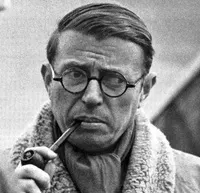
Jean-Paul Sartre
Sartre interrogates the human condition through existentialism, delving into themes of freedom, alienation, and bad faith. By merging narrative artistry with philosophical rigor, Sartre challenges readers to confront the inherent absurdity of existence. His works, such as "Nausea," exemplify this by presenting characters who navigate a world devoid of intrinsic meaning. In this manner, Sartre's books serve as philosophical explorations, compelling audiences to reconsider the ways in which they define their existence and grapple with the absence of divine guidance.\n\nSartre's method involves a meticulous dissection of consciousness and freedom, thereby constructing a framework that highlights personal responsibility amidst a chaotic universe. He adeptly weaves philosophical discourse with storytelling, which enables readers to engage with complex ideas in an accessible format. Whereas many philosophers confine their discussions to abstract theory, Sartre situates his existential inquiries within the lived experiences of his characters. This approach ensures that the reader can readily grasp the implications of existentialist thought, thus fostering a deeper understanding of their own role in shaping meaning.\n\nFor the reader, Sartre's profound insights offer a pathway to greater self-awareness and autonomy. His exploration of existential freedom challenges individuals to confront their own potential for self-deception, inspiring them to live authentically. Consequently, Sartre's works resonate with those seeking to explore philosophical questions about existence and personal agency. Although his rejection of the Nobel Prize underscores his commitment to independence, it is his relentless pursuit of truth through literature that cements his legacy. In summary, Sartre's unique contribution lies in his ability to illuminate existential philosophy through compelling narrative, inviting readers to embark on a journey of introspection and self-definition.
Read moreDownload PDF & EPUB
To save this Black List summary for later, download the free PDF and EPUB. You can print it out, or read offline at your convenience.

Being and Nothingness
by Jean-Paul Sartre
