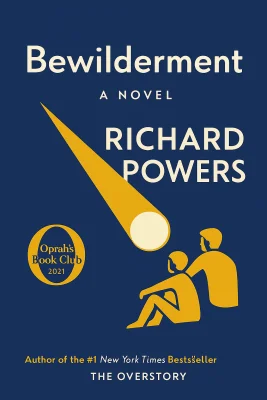
Bewilderment
Categories
Fiction, Nature, Science Fiction, Audiobook, Family, Book Club, Contemporary, Environment, Novels, Literary Fiction
Content Type
Book
Binding
Hardcover
Year
2021
Publisher
W. W. Norton Company
Language
English
ASIN
0393881148
ISBN
0393881148
ISBN13
9780393881141
File Download
PDF | EPUB
Bewilderment Plot Summary
Introduction
In the depths of the Great Smoky Mountains, under a canvas of four hundred billion stars, a nine-year-old boy named Robin pressed his eye to a telescope and asked his father the question that would haunt them both: "But we might never find them?" The boy's voice carried the weight of someone far older, someone who had already learned that the universe was vast and silent, and that his mother would never come home from that icy January night when she swerved to avoid an opossum and died in the collision that followed. Theo Byrne, an astrobiologist who spent his days modeling alien atmospheres and searching for signs of life among distant worlds, found himself facing a more immediate crisis. His son Robin—brilliant, sensitive, and increasingly volatile—was spiraling into rage and despair in the wake of his mother Alyssa's death. When conventional treatments failed and the school system threatened intervention, Theo turned to an experimental neurofeedback therapy that promised to reshape Robin's emotional responses. But the treatment came with an impossible gift: the chance for Robin to experience his dead mother's recorded brain patterns, to feel what she had felt in her moments of deepest joy. As Robin transformed under this neural communion with Alyssa's preserved consciousness, father and son embarked on a journey that would blur the boundaries between science and love, between the vast cosmos Theo studied and the intimate universe of a grieving family trying to find their way back to each other.
Chapter 1: Imagined Worlds: Theo and Robin's Cosmic Refuge
The ritual began the same way every night. Robin would burrow under his covers, eyes bright with anticipation, and wait for his father to transport him beyond the confines of their Madison home to worlds that existed only in Theo's imagination. Tonight it was the planet Dvau, a world tantalizingly similar to Earth but cursed with an unstable wobble that prevented complex life from taking hold. As Theo described the endless cycles of climate chaos that kept Dvau's microbes trapped in eternal simplicity, Robin's face scrunched with concern. "Forever?" the boy asked, his voice carrying that peculiar mix of scientific curiosity and deep empathy that made him so different from his peers. Theo nodded, watching as Robin processed the tragedy of a world that could never quite become what it might have been. These nightly journeys to fictional planets had become their shared language, a way for the astrobiologist father to channel his professional knowledge of exoplanets into stories that helped his troubled son make sense of existence itself. But Robin's questions were growing more sophisticated, more troubling. He wanted to know about the Fermi paradox, about why the universe seemed so empty despite its vastness. His mind, sharp as a blade, cut straight to the heart of cosmic loneliness. When Theo spoke of the billions of potentially habitable worlds scattered across the galaxy, Robin would grow quiet and thoughtful. The boy understood, perhaps better than most adults, that silence could be more terrifying than any answer. The bedtime planets served another purpose beyond entertainment. In the year since Alyssa's death, Robin's behavior at school had become increasingly erratic. He lashed out at classmates, couldn't focus on lessons that bored him, and seemed to carry the weight of the world's suffering on his thin shoulders. The invented worlds gave them both refuge from the mounting pressure of Robin's diagnoses and the school's demands for pharmaceutical intervention. Here, in the space between father and son, they could explore questions too large for any earthly institution to contain. As Theo tucked Robin in and prepared to leave, the boy grabbed his arm with sudden intensity. "Dad," he whispered, "what if we're the only ones who make it? What if everyone else gives up?" The question hung in the air like a challenge, and Theo found himself wondering if his son was still talking about aliens, or if he was asking something far more personal about their own survival in a world that seemed determined to break them both.
Chapter 2: The Troubled Mind: Robin's Struggle in a Broken World
The call from Robin's school came on a Tuesday morning that started like any other. Dr. Lipman's voice carried the practiced authority of someone accustomed to difficult conversations with parents who refused to face reality. Robin had thrown his metal thermos at his friend Jayden's face during lunch, fracturing the boy's cheekbone in a moment of explosive rage that no one could fully explain. The incident was the culmination of months of escalating problems that had school officials questioning whether Robin belonged in a mainstream classroom at all. Theo sat in Dr. Lipman's office, surrounded by certificates and motivational posters, while she laid out the stark reality of their situation. Robin needed help that went beyond what any loving father could provide. The boy's emotional volatility, his hypersensitivity to the world's cruelties, his inability to connect with peers—these weren't character flaws to be managed through understanding and patience. They were symptoms of disorders with names and pharmaceutical solutions, conditions that required immediate intervention before they destroyed his future entirely. The pressure had been building for months. Robin's teachers reported that he would suddenly explode in class over seemingly minor incidents, then retreat into sullen silence for hours. He spoke about extinct species and environmental destruction with an intensity that unsettled adults and alienated children his age. His artwork, once a source of pride, had become increasingly dark and obsessive. He drew dying animals with the precision of a naturalist and the anguish of a mourner, each creature rendered in loving detail as if he could preserve them through the sheer force of his attention. At home, Robin oscillated between periods of manic creativity and devastating crashes that left him curled in corners, banging his head against walls in a desperate attempt to silence the chaos in his mind. Theo watched helplessly as his brilliant, sensitive son disappeared deeper into a world of overwhelming empathy and rage. The boy who had once found wonder in everything now seemed crushed by the weight of existence itself, unable to process a reality where extinction was accelerating and adults seemed powerless to stop it. Dr. Lipman's ultimatum was clear: medicate Robin or face state intervention. The school had documented every incident, every missed day, every sign that Theo was failing as a parent. As winter deepened around them, father and son faced a crossroads that would determine not just Robin's immediate future, but the very nature of who he might become. The boy who spent his nights traveling to imaginary worlds was about to embark on a journey into his own transformed consciousness, guided by the ghost of the mother he had lost and the father who refused to let him go.
Chapter 3: Neural Pathways: Finding Alyssa in the Feedback Loop
Martin Currier's laboratory hummed with the quiet efficiency of cutting-edge neuroscience, a place where the boundaries between mind and machine blurred in service of healing. The neurofeedback researcher had offered Theo an alternative to drugging Robin into compliance: a experimental therapy called Decoded Neurofeedback that could train the boy's brain to achieve emotional states recorded from other subjects. It was revolutionary science disguised as a simple video game, and it represented Robin's last chance to avoid pharmaceutical intervention. The process seemed almost magical in its simplicity. Robin lay in the fMRI scanner, watching dots dance across a screen above his face, learning to move them through pure intention. The artificial intelligence monitoring his neural patterns provided instant feedback, guiding him toward specific emotional configurations with the gentle persistence of a patient teacher. What made this case unique, however, was the template Robin was learning to match: a recording of his dead mother's brain activity, captured years earlier during an experiment in emotional mapping. Currier had preserved Alyssa's neural signature from that long-ago session when she and Theo had volunteered as research subjects, never imagining that the data would someday serve as a bridge between the living and the dead. The recording captured her in a moment of pure ecstasy, a state of joy so profound that it had impressed even the jaded researchers monitoring her brain. Now, through the miracle of modern neuroscience, Robin could learn to inhabit that same emotional landscape, to feel what his mother had felt in her deepest moments of connection to the world. The transformation began almost immediately. After just a few sessions, Robin emerged from the scanner with a lightness that Theo hadn't seen since before Alyssa's death. The boy who had been consuming himself with rage and despair suddenly discovered reserves of calm and wonder that seemed to flow from some inexhaustible inner source. His schoolwork improved, his tantrums ceased, and he began to engage with the world around him with a curiosity that bordered on the mystical. But as Robin's sessions continued, something extraordinary and troubling began to emerge. The boy started displaying knowledge he couldn't possibly have acquired on his own, identifying birds by their calls with Alyssa's uncanny precision, using her gestures and expressions, even humming songs that had been her favorites. When Theo questioned how such specific information could be transmitted through emotional patterns alone, Currier dismissed his concerns with scientific rationalism. Yet the evidence continued to mount that Robin was accessing more than just his mother's feelings—he was somehow communing with the essence of who she had been, drawing from a well of consciousness that transcended the boundaries of individual existence.
Chapter 4: Awakening: Robin's Transformation Through His Mother's Mind
The change in Robin was nothing short of miraculous. Within weeks of beginning the neurofeedback training, the angry, troubled boy who had terrorized his classmates transformed into someone almost unrecognizable. He walked with a new lightness, spoke with gentle authority, and approached the world with an empathy so profound it seemed to extend to every living creature he encountered. Teachers who had once dreaded his presence in their classrooms now marveled at his focus and creativity. The boy who had been on the verge of pharmaceutical intervention was suddenly their most engaging student. But it was outside the classroom that Robin's transformation became truly apparent. He developed an almost supernatural connection to the natural world, identifying birdsongs with the precision of a seasoned ornithologist, sketching wildlife with an artist's eye for detail, and speaking about ecological relationships with an understanding that seemed to flow from direct experience rather than textbook knowledge. When father and son walked through their neighborhood, Robin would stop to examine insects with the reverence of a monk contemplating scripture, his small hands gentle as he relocated creatures that had wandered onto sidewalks where they might be crushed. The neural feedback sessions had unlocked something profound in Robin's developing brain. As he learned to match his mother's recorded patterns of joy and wonder, he began to inhabit a state of consciousness that felt both familiar and utterly new. He spoke of feeling connected to vast networks of life, of experiencing the world through senses that seemed to extend far beyond the boundaries of his individual self. The rage that had once consumed him was replaced by a deep, abiding peace that appeared to be anchored in an unshakeable faith in the fundamental goodness of existence. Theo watched this transformation with a mixture of relief and growing unease. The Robin who emerged from each session seemed to carry traces of Alyssa within him, not just her emotional patterns but her specific knowledge, her particular way of seeing the world, even her characteristic gestures and expressions. When the boy looked at birds, he used his mother's taxonomy. When he comforted others, he employed her precise blend of toughness and tenderness. It was as if the neurofeedback had opened a channel not just to emotional states but to memory itself, allowing Robin to draw from a reservoir of consciousness that should have been impossible to access. As spring arrived and Robin's transformation deepened, Theo found himself grappling with questions that pushed against the boundaries of everything he thought he knew about consciousness, memory, and the nature of individual identity. Was his son simply learning new emotional patterns, or was he experiencing something far more profound—a form of communion with the dead that challenged the fundamental assumptions of materialist science? The boy who had once raged against the world's cruelties now moved through life with a serenity that seemed to flow from a source beyond his own brief experience, and that source felt unmistakably like the woman they had both lost.
Chapter 5: Viral Connection: When Private Grief Becomes Public Spectacle
The video that changed everything started as a simple documentary project. Dee Ramey from Ova Nova had tracked down the pixelated boy from Martin Currier's research presentations, the one whose transformation had become legendary in neuroscience circles. She found Robin and Theo by the shores of Lake Mendota, where the boy was teaching his father to see the underwater world through polarized sunglasses, his voice filled with the quiet authority of someone who had learned to find wonder in the most ordinary moments. What Dee captured on film was something extraordinary: a ten-year-old sage speaking about interconnectedness and loss with the wisdom of someone far older. When she asked Robin how the training felt, he responded with metaphors that seemed to spring from direct experience of cosmic unity. "You know how when you sing a good song with people you like? And people are singing all different notes, but they sound good together?" His explanation of neural feedback as a form of harmony between minds resonated with viewers who were hungry for meaning in an increasingly fragmented world. The viral explosion began when an influencer with millions of followers shared Robin's clip with the simple caption: "If you haven't put your heart through a good mangle yet this morning, try this." Within days, the video of the boy who had learned to feel his dead mother's joy was being shared across every social platform, remix videos were appearing with his words set to haunting music, and strangers around the world were discovering in Robin's serene presence something they hadn't realized they were missing. But viral fame brought unexpected consequences. The same political forces that had been suspicious of the neurofeedback research now had a face to attach to their fears about scientific overreach and the sanctity of human consciousness. Robin's transformation, originally seen as a triumph of therapeutic innovation, became a lightning rod in the culture wars. Conservative commentators denounced the research as an assault on the natural order, while progressive voices hailed Robin as proof that consciousness could transcend individual boundaries. The boy who had found peace through connection to his mother's preserved emotions suddenly found himself at the center of debates he was too young to understand. As Robin's fame spread, the family's privacy evaporated. Journalists showed up at their door, researchers demanded access to study the miraculous case, and government officials began asking uncomfortable questions about the ethics of using a grieving child as an experimental subject. The neurofeedback program that had saved Robin from pharmaceutical intervention was suddenly under federal investigation, threatened with shutdown by authorities who saw in the boy's transformation not healing but dangerous precedent. The private grief that had been transformed into public wonder was about to be crushed by the weight of a world that feared what it could not control.
Chapter 6: Systems Failure: Politics, Science, and the Great Filter
The shutdown came without warning, delivered in the sterile language of bureaucratic authority. The Office for Human Research Protections had determined that the neurofeedback research violated federal guidelines on human subject protection, citing concerns about "integrity, autonomy, and sanctity" that read more like religious doctrine than scientific oversight. Martin Currier's groundbreaking work was suspended indefinitely, leaving dozens of subjects, including Robin, cut off from treatments that had transformed their lives. Theo recognized the political calculus immediately. In an election year marked by unprecedented polarization, Robin had become an inadvertent symbol of everything the ruling party opposed: scientific overreach, environmental extremism, and challenges to traditional notions of human consciousness. The boy who spoke of universal connection and planetary healing represented a threat to a worldview built on separation, domination, and the rejection of inconvenient truths about humanity's impact on the natural world. The timing of the shutdown coincided with a broader assault on scientific inquiry itself. The NextGen Space Telescope, decades in development and representing humanity's best chance to search for life beyond Earth, was cancelled with a presidential tweet dismissing it as the "BIGGEST FRAUD PERPETRATED ON BELIEVERS." The Earthlike Planet Seeker that Theo had spent his career preparing for was abandoned before it could even begin construction. The same forces that feared Robin's transformation were systematically dismantling the infrastructure of discovery, retreating into willful ignorance rather than face the implications of what science might reveal. For Theo, the shutdown represented more than professional disappointment—it was an existential crisis that called into question everything he had dedicated his life to understanding. His models of alien atmospheres would never be tested against real data, his dreams of detecting life among the stars were crumbling along with the telescopes that might have made them reality. The universe that had seemed on the verge of revealing its secrets was receding into darkness, not because of natural limits but because of human choice, the deliberate rejection of knowledge that might demand uncomfortable changes. As Robin's access to the neural feedback was severed, Theo watched his son begin the slow slide back toward the emotional chaos that had nearly destroyed him. The boy who had found peace in his mother's preserved consciousness was being forced to face the world's cruelties with only his own fragile resources. The great filter that prevented civilizations from reaching their potential wasn't some cosmic catastrophe or technological barrier—it was the simple inability to accept truths that challenged comfortable illusions. Watching his son's light begin to dim, Theo understood with devastating clarity why the universe might be silent: not because consciousness was rare, but because intelligence so often chose ignorance over the difficult work of growth.
Chapter 7: The Regression: Losing Robin Again as the Training Ends
The symptoms appeared gradually, like a photograph developing in reverse. The boy who had walked through the world with serene confidence began to stumble over simple tasks, his newfound emotional regulation crumbling like a dam with spreading cracks. Robin's sleep became fitful, his appetite disappeared, and the gentle authority that had marked his transformed personality gave way to familiar patterns of anxiety and rage. Theo watched helplessly as his son slipped back toward the darkness they had fought so hard to escape. Without the neural feedback sessions to reinforce Alyssa's emotional patterns, Robin found himself losing access to the reservoir of peace that had sustained him for months. He described it as forgetting how to remember, as if the specific configuration of consciousness that had allowed him to feel his mother's presence was dissolving beyond his ability to reconstruct. The birdsongs he had identified with perfect confidence now confused him. The gentle empathy that had transformed his relationships with other children hardened into something more brittle and defensive. The boy's regression accelerated when he accidentally discovered news footage of cattle infected with a viral brain disease, their bodies convulsing in confusion as the pathogen destroyed their nervous systems. The images triggered something primal in Robin's restored sensitivity to suffering, sending him into a head-banging frenzy that left him with a grotesque bruise on his forehead. When social workers arrived to investigate reports of possible abuse, they found a child who bore the physical marks of his own anguish and a father struggling to explain how empathy could become a form of self-destruction. The contrast between Robin's peak transformation and his current state was heartbreaking to witness. Where once he had moved through the world with the confidence of someone connected to vast networks of meaning, he now seemed isolated and fragile, his expanded consciousness contracting back into the narrow confines of individual suffering. He spoke longingly of the period when he could feel his mother's presence, when the weight of existence had been shared rather than borne alone. The neural pathways that had been strengthened through months of feedback were weakening, leaving him adrift in an emotional landscape he no longer knew how to navigate. As winter deepened and Robin's condition continued to deteriorate, Theo faced the inevitable conclusion that pharmaceutical intervention might be necessary after all. The experimental therapy that had promised to heal his son without dulling his essential nature had been torn away by political forces beyond their control, leaving them with only conventional treatments that would fundamentally alter who Robin was. The boy who had briefly touched transcendence was being dragged back down to earth by the gravity of his own unmediated pain, and there seemed to be no way to break his fall.
Chapter 8: Across the Final Distance: Finding Connection Beyond Loss
The trip to the Smokies was meant to be a final gift, one last treasure hunt in the mountains where Theo and Alyssa had honeymooned and where their family had found some of its happiest moments. Robin, despite his deteriorating emotional state, threw himself into the search for spring wildflowers with something approaching his old enthusiasm. In the cool mountain air, surrounded by the explosive growth of the season's first blooms, father and son found brief respites from the weight of their grief and the uncertainty of their future. But even in that sacred landscape, the world's brokenness intruded. The pristine stream where Theo and Alyssa had once swum together was now littered with cairns—stacks of rocks built by thoughtless visitors that destroyed the habitat of countless creatures. Robin's reaction to this casual vandalism was swift and decisive: they had to dismantle every tower, restore the stream to its natural state, protect the vulnerable life that humans so carelessly disrupted. It was conservation work that Alyssa would have undertaken without hesitation, and Robin pursued it with desperate intensity. On their final night by the water, as they lay in their tent listening to the mountain's nocturnal symphony, Robin spoke with the clarity that sometimes comes to children on the edge of profound change. He told his father not to worry about the cancelled telescopes, suggesting that inner space might be infinitely larger than outer space, that the universe of consciousness contained mysteries as vast as any cosmic void. His words carried the weight of someone who had briefly experienced the dissolution of individual boundaries, who had tasted the possibility of connection beyond the grave. In the early hours of that final morning, Robin attempted something that would have been unthinkable during his period of transformation: he tried to continue his mother's work by himself, dismantling cairns in the frigid stream without regard for his own safety. When Theo found him, the boy was curled around a boulder in the rushing water, his body temperature dropping toward a point of no return. Despite frantic efforts to warm him, despite the sleeping bag and desperate CPR and screaming for help that never came, Robin slipped away in his father's arms, his last act an attempt to heal a world that seemed determined to destroy itself. The boy who had learned to feel his mother's joy died trying to protect the same creatures she had fought for in life. In those final moments, as consciousness faded from his small body, Robin achieved the connection he had been seeking all along—not through neural feedback or technological intervention, but through the simple act of choosing love over safety, others over self, hope over despair. The universe that had seemed so empty of intelligent life revealed its secret: consciousness was not rare, but courage was, and those who possessed it burned bright and brief as stars, illuminating the darkness for anyone willing to look up and see.
Summary
In the end, Robin Byrne's story became a meditation on connection across the vast distances that separate all conscious beings. His brief experience of his mother's preserved consciousness through neurofeedback offered a glimpse of what might be possible if the boundaries between individual minds could be transcended, if empathy could be shared as easily as information, if the wisdom of the dead could guide the living toward more compassionate ways of being. But his loss also illustrated the fragility of such connections in a world that often seems designed to break them, where political forces can sever the very research that might heal our deepest wounds, where sensitivity to suffering becomes a liability rather than a gift. Theo's ultimate participation in the illegal neurofeedback sessions, his desperate attempt to feel what Robin had felt and maintain some connection to both his wife and son, suggests that love transcends the boundaries of individual existence in ways that science is only beginning to understand. The boy who asked whether inner space or outer space was larger had discovered something profound: the universe of consciousness contains infinities that dwarf even the cosmic voids his father spent his career mapping. In losing Robin, Theo gained access to that expanded awareness, carrying forward the accumulated love of three lives into a future that remains unwritten. The great silence of space may persist, but the connections forged between minds that choose to reach across the darkness ensure that consciousness, however brief and flickering, never truly dies but passes from one vessel to another, an eternal flame in the cosmic night.
Best Quote
“There are four good things worth practicing. Being kind toward everything alive. Staying level and steady. Feeling happy for any creature anywhere that is happy. And remembering that any suffering is also yours.” ― Richard Powers, Bewilderment
About Author

Richard Powers
Powers interrogates the complex relationship between humanity and the technological and natural worlds, weaving intricate narratives that delve into science, philosophy, and environmentalism. His early book, "Three Farmers on Their Way to a Dance", sets the stage for his exploration of history and technology by blending historical fiction with musings on photography. This work marked the beginning of his career shift from computer programming to authorship, spurred by inspiration from a photograph by August Sander. His unique method of employing complex narrative structures enables a profound analysis of modern science and human experience, making his novels compelling to a diverse readership.\n\nThrough titles like "The Gold Bug Variations" and "The Echo Maker", Powers expands on themes of cognitive neuroscience and genetics, examining the effects of these fields on human identity and society. "The Echo Maker", for instance, explores brain trauma and identity while garnering significant acclaim, including the National Book Award. Meanwhile, his Pulitzer Prize-winning book, "The Overstory", illustrates the intricate connections between humans and nature, offering a narrative rich in environmental activism. Such works reflect his continued commitment to themes of interconnectedness, as well as his ability to engage readers intellectually and emotionally.\n\nFor readers seeking a bio rich in intellectual rigor, Powers provides a rewarding experience. His novels serve not only as a deep dive into contemporary issues but also as a reflection on humanity's role within the broader tapestry of life. Those interested in the intersection of science, technology, and the environment will find his work particularly insightful. Beyond literary entertainment, Powers' writing stimulates critical thinking and ethical reflection, proving invaluable to anyone curious about the evolving narrative of human existence.
Read moreDownload PDF & EPUB
To save this Black List summary for later, download the free PDF and EPUB. You can print it out, or read offline at your convenience.
Bewilderment
by Richard Powers
