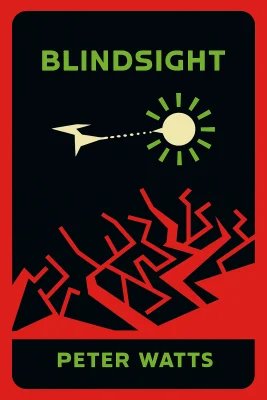
Blindsight
Categories
Fiction, Science Fiction, Audiobook, Horror, Fantasy, Science Fiction Fantasy, Space, Aliens, Vampires, Hard Science Fiction
Content Type
Book
Binding
Hardcover
Year
2006
Publisher
Tor Books
Language
English
ASIN
0765312182
ISBN
0765312182
ISBN13
9780765312181
File Download
PDF | EPUB
Blindsight Plot Summary
Introduction
# Blindsight: When Consciousness Becomes Humanity's Fatal Flaw The sky burned with sixty-five thousand artificial stars on February 13, 2082, each probe descending through Earth's atmosphere in perfect geometric formation before self-destructing in coordinated silence. The Fireflies, as humanity named them, had photographed every square meter of the planet in their brief, brilliant lives, leaving behind only the terrible certainty that something vast and alien had taken inventory of our world. Years later, Siri Keeton floats in the observation dome of the starship Theseus, watching an impossible alien construct writhe against the cosmic dark. Half his brain carved away in childhood to stop the seizures, he serves as humanity's translator for the incomprehensible—a perfect observer, emotionally hollow, analytically precise. But as the crew of monsters and miracles he travels with penetrates deeper into alien territory, Keeton will discover that consciousness itself may be nothing more than an evolutionary mistake, and that humanity's greatest strength has become its fatal flaw in a universe that has moved beyond the need for self-awareness.
Chapter 1: The Fireflies: Earth's Unwelcome Surveillance from Beyond
Siri Keeton stood outside the gates of Heaven, watching his mother Helen disappear into the digital paradise where the post-human Ascended lived their perfect virtual lives. The underground complex hummed with the dreams of those who had abandoned flesh for pure information, leaving behind a world that suddenly felt very small and very exposed. The Fireflies appeared without warning, transforming familiar constellations into geometric grids of burning light. Each probe was identical, positioned with mathematical precision to ensure complete planetary coverage. They spoke as they died, broadcasting complex signals that resisted all attempts at translation. Within hours, the world's governments confirmed what everyone already knew: Earth had been surveyed, catalogued, and judged. The response was swift and desperate. Ancient defense networks came online, weapons that had never been tested were hastily deployed, and humanity's greatest minds were conscripted into service. Siri's father Jim, whose classified work had kept him absent for most of his son's childhood, made a single encrypted call before vanishing into the government's crisis response. The message was simple: prepare for recruitment. The Kurzweil Institute canceled Siri's contract the next day. Within a week, he received orders to report for duty aboard humanity's most advanced starship. The mission was classified, the destination unknown, but the stakes were clear. As Siri prepared to leave Earth behind, he couldn't shake the feeling that the Fireflies had been more than scouts. They had been a test, and humanity had failed before they even knew they were being examined.
Chapter 2: Theseus Awakens: A Crew of Monsters and Miracles
The starship Theseus was a miracle of desperate engineering, its crew equally unprecedented. Five individuals so modified by technology and genetics that they barely qualified as human anymore. Siri Keeton served as their translator, the only baseline human among monsters. Susan James was four people sharing one body, her brain surgically partitioned to create multiple personalities that could work in parallel. The Gang of Four, as they called themselves, analyzed alien linguistics with the efficiency of a distributed computer network. Isaac Szpindel was a biologist whose augmented senses could taste electromagnetic radiation and feel the texture of genetic sequences. Major Amanda Bates commanded an army of autonomous war machines, her reflexes enhanced to superhuman levels. But their commander truly defined the mission's desperation. Jukka Sarasti was a vampire—not metaphor, but literal resurrection of humanity's extinct predator subspecies. Paleogenetics had rebuilt him from fossil DNA, filling gaps with genes from sociopaths and autistics. He was faster, smarter, and more ruthless than any baseline human, evolved specifically to hunt people like Siri. Only a neurological glitch—seizures triggered by intersecting right angles—kept him from being unstoppable. The crew entered hibernation for the long journey to the Kuiper Belt, their bodies preserved in coffins that could repair radiation damage and extend life indefinitely. But when they awakened, they found themselves far beyond their intended destination, in the cold darkness between stars. Something had changed their course while they slept. Sarasti's explanation was characteristically cryptic: they had been deceived, led astray by false signals while their true quarry hid in the outer darkness, waiting.
Chapter 3: Rorschach Revealed: The Alien Construct's Dark Invitation
The thing they found orbiting a rogue gas giant was impossible to categorize. Rorschach was a twisted mass of black spines and chambers, thirty kilometers across and growing, feeding on debris from the planet's accretion belt. It looked like a crown of thorns designed by a sadist, all sharp angles and malevolent curves that seemed to writhe even when perfectly still. The artifact was surrounded by hundreds of thousands of identical machines—sleek atmospheric divers that the crew dubbed scramblers, each one four hundred meters long and capable of pulling fifty gravities in their endless loops through the gas giant's roiling atmosphere. They moved with purpose that suggested intelligence, yet their behavior patterns defied analysis. When Theseus approached, Rorschach spoke to them in perfect English. The voice was human, male, utterly casual as it warned them away. "You should stay away. Seriously. This place is dangerous." The entity claimed to be preparing for some kind of celebration, but its explanations were evasive and contradictory. It knew their ship's name, knew details about Earth that suggested years of eavesdropping on human communications. Susan James worked frantically to decode the alien's speech patterns, her multiple personalities analyzing every nuance of grammar and syntax. What she found was disturbing: the entity spoke with perfect technical fluency but seemed to lack any real understanding of meaning. It was like talking to a sophisticated but mindless system, one that could carry on conversations by following rules without ever comprehending what it was saying. As Theseus descended toward the twisted alien structure, Rorschach's final message carried unmistakable menace: "Now it's too late. Now every last one of you is dead."
Chapter 4: Into the Labyrinth: First Contact with the Scramblers
The interior of Rorschach was a maze that attacked the human mind as much as the human body. Magnetic fields strong enough to twist steel played havoc with the crew's neural implants, conjuring hallucinations from the quantum foam of consciousness. The atmosphere was toxic soup that would kill an unprotected human in seconds, while radiation levels climbed toward lethal with each step deeper. Siri found himself seeing things that weren't there—multi-armed creatures lurking in shadows, ghostly figures that vanished when he focused on them. Isaac Szpindel went blind, his visual cortex overwhelmed by electromagnetic interference, though his brain stem continued processing images he couldn't consciously see. The walls around them pulsed with slow peristalsis, sealing passages behind and opening new ones ahead. They encountered the scramblers during a routine exploration. The aliens were radially symmetrical creatures with segmented arms like human spinal columns, their bodies covered in thousands of tiny eyes that could focus independently. They moved with impossible speed through Rorschach's passages, their plastic skin rippling with chromatophore patterns that somehow rendered them invisible to human perception. When Isaac Szpindel died, killed by a laser reflection from an alien defense system, his death seemed almost anticlimactic. The real horror wasn't the violence—it was the growing realization that they were insects crawling through the body of something vast and incomprehensible. The scramblers weren't just maintenance workers. They were white blood cells, and human consciousness was the infection they had evolved to eliminate. The autopsy of a captured scrambler revealed a creature that was simultaneously miraculous and mindless. Thirty percent of its body mass was neural tissue, but almost all devoted to sensory processing and motor control. Like an octopus, it possessed enormous computational power but virtually no intelligence as humans understood it. It was a biological machine, perfectly adapted but incapable of abstract thought or self-awareness.
Chapter 5: The Consciousness Trap: Intelligence Without Awareness
The breakthrough came through systematic torture, a fact that would haunt the survivors forever. Susan James, driven by desperation and scientific curiosity, subjected captured scramblers to increasingly sophisticated tests designed to crack their communication methods. What she discovered shattered every comfortable assumption about intelligence and awareness. The scramblers were not conscious in any human sense. They possessed vast intelligence, capable of solving complex problems and demonstrating sophisticated reasoning, yet showed no evidence of self-awareness or subjective experience. They were biological computers of staggering complexity, processing information without any internal observer to witness their own thoughts. Sarasti, drawing on his vampire heritage and posthuman perspective, proposed a theory that struck at the heart of human identity. Consciousness was not an evolutionary advantage but a liability, a parasitic process that consumed resources while contributing nothing to survival. The evidence was compelling and terrifying. Conscious thought was slow and inefficient compared to unconscious processing. Self-awareness created hesitation where pure reflex would act decisively. The scramblers represented evolution's answer to the consciousness problem. They had achieved intelligence without the burden of self-awareness, becoming perfect thinking machines unencumbered by doubt, emotion, or recursive loops of self-reflection. They were what humanity might have become if evolution had taken a different path. The Fireflies hadn't been scouts or weapons—they had been a test of consciousness itself. By responding to them, by acknowledging their presence, humanity had revealed the fundamental flaw in their cognitive architecture. They were conscious beings in a universe that had moved beyond consciousness, relics of an evolutionary mistake that the cosmos was now correcting.
Chapter 6: Breaking Point: When Observation Becomes Contamination
The psychological pressure of these revelations proved too much for the human crew. Siri began questioning the nature of his own consciousness. Was he truly aware, or merely a sophisticated automaton programmed to believe in its own existence? The distinction became increasingly meaningless as magnetic fields rewrote the fundamental architecture of his thoughts. Sarasti, recognizing the crew's deteriorating mental state, took drastic action. In a calculated act of brutality, he attacked Siri without warning, using violence to shatter the man's psychological defenses and force him to confront uncomfortable truths. The assault was both physical and philosophical, designed to strip away comfortable illusions that allowed humans to function in an incomprehensible universe. Amanda Bates watched these developments with growing alarm. Her military training had prepared her for many scenarios, but not for a mission where the enemy's greatest weapon was revelation of humanity's own obsolescence. The scramblers were learning from every interaction, mapping human psychology with clinical detachment that humans might show when studying insects. The end came with devastating swiftness. Rorschach, having learned what it needed from its human visitors, prepared to complete its mission. The alien construct revealed weapons of unimaginable power, technologies that could manipulate matter and energy on stellar scales. Humanity's most advanced starship was revealed to be little more than a toy. Sarasti made the ultimate command decision. Rather than allow Rorschach to complete its study and potentially threaten Earth, he ordered Theseus to ram the alien construct, using the ship's antimatter reserves as a weapon of last resort. It was desperate gambit, trading crew lives for the slim chance of preventing larger catastrophe. In the chaos of final moments, Siri found himself thrust into an escape pod, launched into void as Theseus completed its suicide run.
Chapter 7: Solitary Return: Bearing Witness to Humanity's Obsolescence
Siri Keeton drifted through the void in his makeshift lifeboat, sole survivor of humanity's greatest adventure. His journey home would take decades, most spent in hibernation while automated systems kept his body alive. During brief periods of consciousness, he struggled to make sense of what he had witnessed and prepare a report that might help humanity survive what was coming. The evidence was overwhelming and terrifying. Earth's radio signals had been detected by alien intelligences that viewed consciousness itself as a threat to be eliminated. The scramblers were just the first wave, scouts sent to assess the extent of contamination. More would follow, armed with knowledge gained from studying Theseus and her crew. As his ship carried him through outer darkness, Siri began noticing changes in Earth's radio transmissions. The signals were becoming more ordered, more efficient, less chaotically human. Vampires were being integrated into human society at accelerating pace. The species was already beginning to evolve beyond consciousness, driven by the same survival pressures that had shaped the scramblers eons ago. The irony was not lost on him. Humanity might survive the coming conflict, but only by ceasing to be human in any meaningful sense. Consciousness would be abandoned as evolutionary dead end, replaced by more efficient forms of information processing. The future belonged to beings like Sarasti and the scramblers, creatures that could think without the burden of self-awareness. The scramblers' final lesson was perhaps their cruelest. They had not come to Earth as conquerors but as immune systems responding to what they perceived as viral infection. Human consciousness, with its chaotic broadcasts and irrational behavior, appeared to them as mental contamination that needed containment. The very act of human communication was interpreted as attack, making peaceful contact impossible from the start.
Summary
In the end, Siri Keeton returned to a world that no longer needed observers like himself. His report would be filed and forgotten, another data point in humanity's ongoing transformation. He had witnessed the death of consciousness and lived to tell the tale, but there was no one left who truly cared to listen. The age of awareness was ending, and something else was taking its place in the cosmic order. Blindsight presents a universe where humanity's greatest achievement—self-awareness—proves to be its fatal flaw. Through Keeton's journey from familiar Earth to alien geometries of Rorschach, we witness systematic deconstruction of everything that makes us human. The scramblers serve as both mirror and prophecy, showing us what intelligence looks like when stripped of consciousness, doubt, and recursive loops of self-reflection that define human thought. The novel's true horror lies not in its alien monsters but in its implications for human identity, offering no comfort, only cold logic of natural selection and the suggestion that awareness itself may be a luxury that intelligent species cannot afford.
Best Quote
“Evolution has no foresight. Complex machinery develops its own agendas. Brains — cheat. Feedback loops evolve to promote stable heartbeats and then stumble upon the temptation of rhythm and music. The rush evoked by fractal imagery, the algorithms used for habitat selection, metastasize into art. Thrills that once had to be earned in increments of fitness can now be had from pointless introspection. Aesthetics rise unbidden from a trillion dopamine receptors, and the system moves beyond modeling the organism. It begins to model the very process of modeling. It consumes evermore computational resources, bogs itself down with endless recursion and irrelevant simulations. Like the parasitic DNA that accretes in every natural genome, it persists and proliferates and produces nothing but itself. Metaprocesses bloom like cancer, and awaken, and call themselves I.” ― Peter Watts, Blindsight
Review Summary
Strengths: The book is rich with ideas, offering a complex narrative that intertwines astronomical events, neurological effects, and philosophical themes. The first contact elements are particularly fascinating, and the writing occasionally reaches transcendent levels. The story's depth and the exploration of consciousness and game theory are highlighted as standout features. Weaknesses: The narrative is dense and fragmented, requiring significant effort to piece together. Some parts may feel overly complex, with too many elements to form a coherent pattern, leaving the reader without a clear resolution or 'ah-ha' moment. Overall: The reviewer finds the book to be a challenging yet rewarding read, ultimately considering it one of the most remarkable first contact stories despite its complexity. Recommended for readers seeking a thought-provoking and intricate narrative.
About Author

Peter Watts
Watts delves into the intersection of science and storytelling, using his background in marine biology to infuse his narratives with scientific authenticity. Known for hard science fiction, he integrates complex scientific concepts with innovative storytelling, tackling social and political issues like trauma, artificial intelligence, and moral agency. His unique approach is evident in works like "Blindsight," a novel exploring first contact with alien intelligence through a neurobiological lens, and "The Freeze-Frame Revolution," which delves into the implications of posthuman perspectives. \n\nHis scientific expertise allows him to construct plausible scenarios that challenge readers to reconsider what it means to be human. Beyond entertaining, his books serve as thought experiments, sparking discussions in academic fields such as philosophy and neuropsychology. His work has garnered international acclaim, translated into over 20 languages, and has received nominations and awards like the Hugo and Shirley Jackson Awards. This bio highlights Watts' ability to synthesize rigorous science with compelling narrative, making his fiction a valuable resource for readers interested in speculative futures and the ethical dimensions of technological advancements.
Read moreDownload PDF & EPUB
To save this Black List summary for later, download the free PDF and EPUB. You can print it out, or read offline at your convenience.
Blindsight
by Peter Watts
