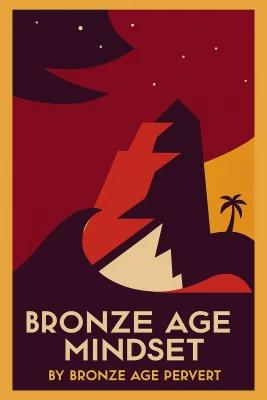
Bronze Age Mindset
Categories
Nonfiction, Self Help, Psychology, Philosophy, History, Politics, Audiobook, Society, Cultural, 21st Century
Content Type
Book
Binding
Kindle Edition
Year
2018
Publisher
Language
English
ASIN
B07DJQ89TD
File Download
PDF | EPUB
Bronze Age Mindset Plot Summary
Introduction
The sun was setting over a forgotten beach, painting the horizon with hues of amber and gold. As I sat on the warm sand, watching a young man practice ancient spear-throwing techniques against the backdrop of crashing waves, I was struck by the stark contrast between his raw, passionate existence and the sterile, sanitized life most of us lead today. This scene perfectly captures the essence of what awaits you in these pages - a journey into a primordial understanding of human potential that modern society has tried to domesticate out of existence. This book challenges our conventional wisdom about what constitutes a good life and a functioning society. Through provocative stories and philosophical reflections, it invites us to question whether our modern comforts have come at the cost of our vitality. The author argues that beneath the veneer of civilization lies a more authentic mode of being - one characterized by strength, beauty, and the heroic pursuit of excellence. As you explore these ideas, you may find yourself reconsidering fundamental assumptions about human nature and your own untapped potential for greatness.
Chapter 1: Flame of Life: Instinct vs Domestication
In the opening sections of the book, the author shares a vivid observation of animal behavior that illuminates the true nature of life. He describes witnessing a gathering of small birds near a massive waterfall, a place where birds had returned for countless generations, having witnessed the rise and fall of human civilizations. As the weather shifted slightly, causing water spray to create rainbows in the sunlight, the birds became ecstatic. They emerged from rock crevices and performed intricate aerial acrobatics through the mist and rainbows, glorying in their physical abilities and the beauty of the moment. The author compares this to Homer's description of geese, cranes and swans glorying "in the power of their wings" before landing with "a great clang" on the Skamandrian plain. He notes that modern evolutionary psychologists might try to explain this behavior through the lens of survival or reproduction, but such explanations miss something essential. When witnessing this behavior firsthand, we recognize it as not wholly alien to human experience. In our happiest moments, when free to act according to our nature, we too experience this kind of exuberance that has nothing to do with mere survival. This observation leads to a critical insight: life in abundance naturally tends toward luxury, waste, and exuberance. The most noble animals refuse to breed in captivity, and many will choose death when trapped. This directly contradicts the reductive view that all life merely strives for survival and reproduction. The author argues that these facts reveal something profound about animal nature - and by extension, human nature - that modern biology often overlooks or misinterprets. The book posits that what evolutionary biologists call "adaptations" actually represent something more mysterious - a spontaneous correspondence between organism and environment that cannot be explained by random mutation alone. There appears to be an inherent intelligence within living things, uncanny and demonic, whose workings and aims remain obscure to us. Our own intelligence is merely a crude approximation of this primordial will that organizes matter into increasingly complex and beautiful forms. Through these observations about animal behavior, the author reveals his central theme: the flame of life is fundamentally about the struggle for ownership of space, for the development of inborn powers. When free from the pressure of mere survival, higher organisms seek mastery over their environment not primarily to reproduce, but to develop their innate capacities to their fullest potential. Reproduction comes later, as a side effect of this overflow of strength and vitality - not as the primary purpose of existence.
Chapter 2: The Iron Prison: Modernity's Constraints
The author describes a profound psychological experience that reveals the essence of modern constraint. Walking alone at night, he found himself outside a nightclub attached to a cinema that doubled as a pornographic theater during the day. Inside, an elderly man attempted to grope him, security guards with terrible breath intervened, and in the lobby, a loose vampire bat had somehow flown in. Outside on the street, a woman was defecating in the middle of the road, and at an intersection, he saw a driver with no head, causing him to enter a state of vertigo and fugue. This surreal sequence illustrates what the author calls "the madness behind things" - his belief that the real world differs significantly from what appears in waking life. This hidden reality isn't abstract or philosophical but immanent and twisted, without moral significance comprehensible to humans. When this reality occasionally reveals itself, it appears as a demonic and violent madness underlying ordinary existence. The author believes this is what Heraclitus meant when speaking of all things being one and all things being fire. The book then explores how modern society functions as an "Iron Prison" that constrains human vitality. The author describes how the entire environment of contemporary life is "owned space" - territory already claimed and regulated by hidden powers. A perceptive child realizes this around age six or seven, sensing the futility of developing genuine mastery over one's environment when all space is already controlled by unseen forces. This realization breeds contempt for those who don't see this subjection and who accept the breaking of their spirit that begins at this young age. This concept of "owned space" is central to the author's critique of modernity. He argues that humans are naturally territorial beings who need to expand and conquer space to develop their innate powers. When this drive is thwarted, as it is in modern society, various pathologies emerge. The author provocatively suggests that modern homosexuality and other identity formations can be understood as responses to this fundamental thwarting of natural development - reinterpretations of a spiritual alienation as a sexual one. The author believes this state of constraint isn't accidental but consciously crafted by hidden wardens. These powers remain deliberately obscured, making open challenge impossible. He suspects that behind the superficial orderliness of modern civilization lies a "floating world" or "dark ocean" where the true rulers move freely while maintaining the illusion of control and safety for the masses. This clandestine realm once had more entry points through various subcultures, but these have been systematically closed off. What makes our modern prison particularly suffocating is that there seems to be no escape - the system has become ubiquitous, intrusive, and all-encompassing. The author suggests that this world of illusion and constraint is maintained by a hidden power that feeds on human suffering, revealing the profound spiritual and existential crisis at the heart of modern civilization.
Chapter 3: Men of Power: Heroes and Warriors
The author recounts the extraordinary life of Alcibiades, an Athenian nobleman whose exploits far exceed anything imaginable in our time. Imagine a modern politician - someone like Mitt Romney, but with genuine charisma - who leads a nation to war against India, then is recalled home to face accusations of conducting Satanic rituals and defacing national monuments. Instead of returning, he flees to Russia, becomes Putin's advisor, seduces Putin's wife, then escapes to China where he rises to political prominence, before finally ending up in Afghanistan living with tribesmen in a mud fortress, where American special forces eventually find him charging at them in glorious black-and-gold armor. This was Alcibiades - a man who excelled everywhere despite the profound differences between ancient cultures. He was a devotee of Eros, carrying a shield emblazoned with the god of erotic passion wielding a thunderbolt, scandalizing older men. This symbolized his devotion to the irrepressible life force, showing that no law or word of man would stand in his way. In Alcibiades, we see the embodiment of the "demonic fire" that bursts out in certain men and lays low the cities of mankind, exposing all pretense. The book then shifts to describe Clearchus, a Spartan general sent to assist Byzantium. Rather than following orders, he invited the city's prominent men to a meeting where he had them all hanged, taking their property and seizing sovereignty. When Sparta sent forces to remove him, he fought fiercely before escaping by night with the treasury. In Persia, rather than enjoying his ill-gotten wealth, he raised a mercenary army and led bold enterprises until he was betrayed and killed. Similarly, Agathocles rose from humble beginnings to become top general in Syracuse, where he invited the senate and notables to a meeting and had his soldiers kill them all. He then defeated the Carthaginians by landing in Africa and ruled in great glory. These men exemplify what it means to truly "let loose" - to live unbounded by petty inhibitions or others' opinions. The author contrasts these ancient heroes with modern billionaires like Gates, Zuckerberg, and Bezos, who despite their wealth remain dependent men. "When your happiness and wealth depends on the force of arms of another, you're not really your own man...nor can you enjoy the greatest delights in life," he writes. True power, in the author's view, comes from physical sovereignty, not mere wealth. In examining these historical figures, the book reveals a fundamental truth about power and greatness: the men of the Bronze Age mindset saw political office not as an end in itself, but as a means to self-overcoming and self-perfection. They sought to turn themselves into living works of art, to unleash their full potential regardless of social constraints. While their actions often appeared monstrous to others, they represent a form of excellence that transcends conventional morality - the unrestrained pursuit of personal greatness that lies at the heart of all truly extraordinary human achievement.
Chapter 4: Youth in Ascent: Freedom and Friendship
The author tells the story of Hippocleides, an exceptionally handsome Greek youth who traveled with many others to Sicily to compete for the hand of a wealthy autocrat's daughter. The father tested the suitors in athletics, wit, conversation, and other abilities - demonstrating how the Greek aristocracy valued biological quality in marriage arrangements rather than mere political or financial advantage. Hippocleides was becoming the favorite until, at the final party, he became drunk and began dancing on the table, eventually performing upside down on his hands, moving his legs in ways that exposed himself. When the father told him he had "danced himself out of a marriage," Hippocleides famously replied: "Hippocleides doesn't care." This anecdote captures the essence of the Greek aristocratic spirit - a divine carelessness and freedom from constraint that modern people would find shocking. Hippocleides went to Sicily to display his excellence and biological superiority, not to ingratiate himself or secure an advantageous match. His indifference to gain or loss exemplifies what the ancient Greeks most admired - the ability to act from an overflow of vitality rather than from calculation or fear. The author connects this to another famous story - when Alexander the Great approached Diogenes the Cynic, who was sunbathing, and asked what he could do for him. Diogenes simply replied, "Stand out of my sun." Alexander later remarked that if he had not been Alexander, he would have wished to be Diogenes. This divine carelessness stands in stark contrast to the anxious, status-seeking behavior of modern intellectuals and public figures. The book then explores the crucial importance of male friendship in Greek culture. Strong bonds between men were the foundation of all great political achievements and acts of freedom. In Thebes, Epaminondas and Pelopidas reformed the state and established the famous "Sacred Band," an elite military unit of close friends who would never waver in courage before each other. In Athens, friends Harmodius and Aristogeiton overthrew tyranny through their schemes and bravery. The author emphasizes that these intense friendships were not necessarily sexual, as modern interpreters often assume. The model was the relationship between Achilles and Patroclus - a bond so powerful that Achilles chose a short, glorious life and beautiful death over a long, inglorious existence when his friend was killed. This form of friendship transcends ethics or duty; it is a pleasure between two men that enables them to accomplish great deeds together. In our modern world, the author laments, true friendship has been undermined. Boys in school are forbidden from forming real bonds, fraternities are effectively banned, and scouting movements are forced to accept women. Men are deluded into thinking their wives can be their best friends, while fearing that male friendships might be misinterpreted as sexual. Yet the author insists that nothing prevents us from recovering this form of friendship if we simply follow our natural desires: "All you need to do is give in to desire for great things."
Chapter 5: The Sea Peoples: Piracy and Adventure
The author recounts the remarkable exploits of Pedro de Alvarado, a red-blond Spanish knight who served as Cortés's right-hand man in the conquest of Mexico. The Aztecs called him Tonatiuh, "child of the Sun," and believed he had divine origins. Alvarado was known for his boundless courage, carelessness, and cruelty - once massacring Aztec nobles in the Great Temple during a banquet for no apparent reason. In battle, he would charge into enemies who outnumbered him hundreds to one, targeting their decorated lieutenants and spreading fear through the multitudes. What makes Alvarado truly exemplary, in the author's view, is that even after becoming governor of vast territories (modern Guatemala and Honduras), he showed no interest in ruling them. He merely extracted whatever wealth he could and continually planned new adventures and conquests. Right before his death, he was organizing an expedition to conquer China and the Spice Islands. "This man was a born pirate," the author declares, "a nemesis to civilization." He knew his nature as a "beast of prey" and never pretended to be anything else, giving him a magnetic charisma that attracted even those he oppressed. The narrative then shifts to modern examples of this piratical spirit - Bob Denard, a French soldier court-martialed for burning down a bar who later became a mercenary adventurer in Africa. His greatest achievement was overthrowing the government of the Comoros four times, with France repeatedly sending special forces to dislodge him. Denard once said, "It's important never to be 'ambitious.' Men of 'ambition' are losers. Act and feel like a winner and good things, friends, and victory will come." He gained wives and properties "by the power of his hand." The author also mentions "Mad Mike" Hoare, an Irish-English dandy who led elite mercenary units in Africa, remaining "brutal and cool-headed" in conflicts where he was outnumbered thousands to one. Both men exemplify the Bronze Age spirit surviving into modern times. More recently, Executive Outcomes - a mercenary company that ended Sierra Leone's civil war and threatened to establish a new order across Africa - demonstrates that the potential for conquest and adventure still exists. These modern examples prove that the "Bronze Age Mindset" can flourish even in our controlled world. The author predicts that as the "great Leviathan" of modern civilization falters, opportunities for such adventures will become more frequent. The coming "age of barbarism" will belong not to gangbangers or unwashed hordes, but to "clean-cut middle-class and working-class vets" with military experience. Those who think oligarchs will control these men forever should "look to the fortunes of the Sforzas," remembering that "money is no match for force of arms combined with charm." For the author, these piratical figures represent life at its most authentic - free from artificial constraints, driven by innate desire for expansion and mastery of space. Their stories remind us that beneath the veneer of civilization, the primal impulse for adventure and conquest remains a powerful force that can never be fully suppressed, and will inevitably resurface when systems of control begin to weaken.
Chapter 6: The Path Forward: Breaking Free
The author shares a deeply personal observation about his approach to experiencing freedom in a constrained world. He describes how he loves walking through crowded city streets during daylight hours while completely intoxicated, carrying what appears to be iced tea but is actually filled with alcohol. This state of "great enthusiasm and energy powered by liquor" allows him a special form of freedom as he accosts strangers and experiences the world without inhibition. During these episodes, he wonders what life would be like if one could feel this euphoria perpetually without consequences. This reflection leads him to consider whether there might exist people who experience only one specific, intense emotion continuously - pure anger, a specific kind of joy, or even a particular type of sadness. Such a being, experiencing only one emotional state with maximum intensity, would be "a monster, or a god, or in any case he would be possessed by a god." This thought experiment illuminates the author's belief that modern life dulls our emotional range and intensity, keeping us in a state of anxious mediocrity. The narrative then transitions to more practical considerations about how individuals might break free from modern constraints. The author distinguishes between different approaches based on individual circumstances and talents. For those inclined toward conventional politics, he advises studying successful nationalist movements like those led by Trump, Orban, and others. These figures succeed by addressing immediate threats without alienating ordinary people with extreme rhetoric. "Let the normies have their normal lives," he counsels, "and paint our enemies as the crazies...which they are." For those seeking more direct action, the author recommends forming social movements rather than explicitly political ones. He envisions groups dedicated to promoting "nature, beauty, physical fitness, the preservation of high traditions of literature and art." These organizations might engage in hiking, wilderness preservation, martial arts training, local welfare projects, and eventually claiming public spaces in cities. By positioning themselves as promoters of health, beauty, and natural living, such groups could build goodwill while offering an implicit critique of modern degradation. The author also emphasizes the power of humor and pranks as political tools. Examples like the "It's OK to be white" stickers demonstrate how simple actions can force opponents to reveal their true nature. All such activities should aim to "make the enemy look ridiculous" by exposing their authoritarianism, stupidity, and corruption. He strongly cautions against violence or threatening rhetoric, which plays into the hands of those who wish to suppress dissent. Perhaps most importantly, the author stresses the value of friendship in pursuing these goals. "The friends you make are more important, far more important, than the girlfriends or wives you'll have," he writes. The friendships formed in struggle for a higher cause can "lift you out of the dreadful gravity of this turgid world of shades." Rather than seeing family formation as a political statement, he encourages readers to pursue their broader mission alongside like-minded companions. Through these various approaches, the author outlines a path forward that balances practical action with deeper spiritual renewal - ways to preserve one's vitality while working to create conditions for a more authentic existence in the future.
Chapter 7: Final Arrows: Warnings and Wisdom
The author describes an ambitious vision for the future that he calls "The Star of the Covenant." He foresees a time when "the Leviathan will not be able to hold itself together" and nations will escape the global slave project currently being promoted. However, he believes the aftermath will be unsatisfying, as people will likely return to a "peaceful and sheep-like existence" requiring protection from repeating their mistakes. In this scenario, superior individuals will eventually find each other and establish fortresses "on the edge of the civilized world, in the tropics," from where they will watch the seas. These enclaves will develop their physical powers and war-making abilities, offering defense to nations for a price and occasionally sending "a great demagogue into the peoples, when this becomes necessary." From these eagle's nests, they will pursue scientific projects freed from concerns about comfort or entertainment, while maintaining networks of emissaries throughout the nations. Before this vision can materialize, however, the author warns that a difficult transitional period awaits. He speaks of a necessary "great down-going" where a select few must descend into the underworld of vice to understand and ultimately transform the foundations of the corrupt system. "To gain a true hold on the foundations of this trash-world," he writes, "a certain group among the right will have to descend in this inferno." This brotherhood would not merely observe but actively participate in and intensify vice - running "brothels and gambling-houses," producing pornography, and fully immersing themselves in this shadow realm while maintaining their higher purpose. Their aim would be to "intensify vice, to stir up demonic passions, to sow total confusion in the heart of the beast." By exposing and magnifying the contradictions inherent in the system, they would accelerate its collapse. The author acknowledges this path is suitable for very few and requires extraordinary mental and spiritual resources. These individuals must form bonds "made of titanium" to withstand the corruption they immerse themselves in. He imagines them as "knights of the spirit" who, while descending into darkness, keep their eyes fixed on "the great North Star" - never forgetting their ultimate purpose or the way back to the light. This extreme vision reveals the author's belief that conventional methods of resistance are insufficient against the all-encompassing nature of modern control systems. The corruption has become so pervasive that it must be confronted on its own terms, using its own weapons. Only by understanding and mastering the underworld can one truly challenge the powers that rule through it. As this brotherhood works from below, the author envisions others working from above - creating the fortresses and developing the capabilities that will eventually provide refuge and new possibility. Together, these complementary approaches would create the conditions for a profound transformation, a return to more authentic and vital forms of human existence.
Summary
Throughout this provocative journey, we've encountered a radically different perspective on human potential and societal development. At its core, the Bronze Age mindset represents an understanding that true life emerges not from comfort, safety, or mere survival, but from the passionate pursuit of excellence, beauty, and power. The author has shown us, through historical and modern examples alike, that genuine vitality springs from embracing rather than suppressing our deeper instincts - particularly the drive to master our environment and develop our innate capacities to their fullest. The central message speaks to those who feel stifled by modern constraints: there are pathways to greater authenticity, even within our highly regulated world. Whether through physical development, formation of genuine friendships, creation of alternative social movements, or strategic political action, individuals can begin reclaiming their sovereignty. The most profound insight may be that freedom isn't primarily an external condition but an internal orientation - a willingness to pursue one's highest aspirations with divine carelessness, refusing to be limited by others' expectations or conventional morality. Like Hippocleides dancing upside down or Alcibiades defying every boundary, we glimpse the possibility of living beyond the prison of others' opinions, guided instead by our own star.
Best Quote
“Chimp in state of nature never jerks off, but in captivity he does, wat does this mean? In state of nature he’s too busy, to put plainly. He is concerned with mastering space: solving problem of life in and under trees, mastering what tools he can, mastering social relations in the jockeying for power and status. Deprived of this drive to development and self-increase he devolves to pointless masturbation, in captivity, where he senses he is in owned space and therefore the futility of all his efforts and all his actions. The onanism of modern society is connected with its supposed “hyper-sexualization” and its infertility. It’s not really hyper-sexualization, but the devolution of the spirit to the lassitude of a diffuse and weak sexuality.” ― Bronze Age Pervert, Bronze Age Mindset
Review Summary
Strengths: The review highlights the book's subtle humor and intellectual depth, particularly its Nietzschean influences and references to classical literature. The writing is described as brave, incisive, and witty, with a unique blend of brilliance and eccentricity. The book's ability to provoke thought and challenge societal norms is also praised. Weaknesses: The review does not explicitly mention any weaknesses, though it implies that the book's complexity and esoteric references may not be accessible to all readers. Overall: The reader finds "Bronze Age Mindset" to be a compelling and refreshing read, blending intellectual depth with humor. It is recommended for those interested in challenging societal norms and exploring philosophical themes, particularly within the Alt-Right context.
About Author

Bronze Age Pervert
Yarvin explores the intersections of politics and power, using his writing as a vehicle to interrogate the dynamics of influence in contemporary society. He is speculated to have been a point of contact for Steve Bannon in the White House, illustrating his connection to political circles and the impact his ideas may have in real-world governance. His work is often seen as a direct and distilled interpretation of themes that others, like Jordan Peterson, suggest more subtly. Therefore, Yarvin provides readers with a clearer and more concentrated insight into these philosophical debates.\n\nCore themes in Yarvin's work include authority, masculinity, and societal structures. By drawing parallels between historical and modern figures, he invites readers to question established norms and consider alternative power dynamics. His approach contrasts with that of his contemporaries, offering a more direct engagement with these complex topics. As a result, readers interested in political theory and cultural critique find Yarvin's writing a compelling addition to the discourse.\n\nThe author’s influence extends beyond the written word, as indicated by his role as a thought leader to thousands online. His potential leadership of a spiritual reawakening, as suggested in media analyses, demonstrates his reach and the transformative effect his ideas may have on followers. This short bio summarizes how Yarvin's books and online presence make him a significant figure for those seeking a deeper understanding of political philosophy and its practical applications.
Read moreDownload PDF & EPUB
To save this Black List summary for later, download the free PDF and EPUB. You can print it out, or read offline at your convenience.
Bronze Age Mindset
by Bronze Age Pervert
