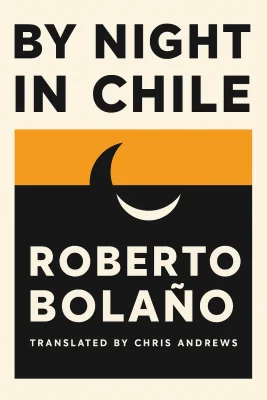
By Night in Chile
Categories
Fiction, Historical Fiction, Literature, Contemporary, Novels, 21st Century, Spanish Literature, Literary Fiction, Latin American Literature, Latin American
Content Type
Book
Binding
Paperback
Year
2005
Publisher
New Directions
Language
English
File Download
PDF | EPUB
By Night in Chile Plot Summary
Introduction
Father Sebastián Urrutia Lacroix lies dying, propping himself on one elbow as memories flood his fevered mind. The Chilean priest and literary critic faces his final reckoning, haunted by accusations from a mysterious "wizened youth" who appeared at his door one storm-lit night, hurling insults and demanding answers. As Chile's political landscape shifts beneath his feet, Father Urrutia must confront the choices he made in service to literature, faith, and power. Through the smoky salons of Santiago's intellectual elite and the secret corridors of military authority, this is the confession of a man who believed himself above reproach. Yet as democracy crumbles and rises again, as friends disappear and reappear in shadow, the dying priest discovers that silence can be as damning as speech, and that the pursuit of literary immortality demands a price few are willing to acknowledge.
Chapter 1: The Shadow of Farewell: A Young Priest Enters Literary Society
Young Father Urrutia Lacroix stepped into the gilded world of Chilean letters through the towering figure of Farewell, the nation's most celebrated literary critic. The meeting occurred in a gentleman's club, where Farewell's imposing presence filled the room like a bird of prey surveying its domain. His gray English suit and gold cuff links spoke of refinement, while his penetrating blue eyes seemed to weigh the young priest's literary aspirations. When Urrutia confessed his desire to follow the path of criticism, Farewell's hand fell heavy as iron upon his shoulder. "In this barbaric country," Farewell declared, "the critic's path is not strewn with roses." Yet something in the earnest seminarian's manner moved the great man, and he extended an invitation to his estate, Là-bas, named after a work by Huysmans. The journey to Là-bas proved transformative. The young priest found himself aboard a rickety carriage pulled by mismatched horses, crossing the desolate village of Querquén where birds cried "quién, quién, quién" like interrogators. The estate itself sprawled like a literary fortress, its walls lined with inscribed volumes from Chile's greatest writers, each bearing dedications to their critical patron. It was there, under moonlight in the estate's gardens, that Urrutia first encountered Pablo Neruda. The great poet stood beside a bronze equestrian statue, intoning verses to the night sky while the young priest watched in rapture from the shadows. This moment crystallized Urrutia's literary baptism, though it came with complications he couldn't yet fathom. Farewell's hand found his belt in the darkness, speaking of medieval troubadours while the priest trembled between poetry and peril. The weekend at Là-bas concluded with elaborate dinners where Chile's literary elite gathered around Farewell's table. Urrutia absorbed their conversations about Góngora's knotty verses and the obligations of the literary life, while Farewell's knowing glances suggested initiation into mysteries beyond mere criticism. As the priest departed on the return train to Santiago, he carried with him both the blessing and burden of entry into Chile's cultural pantheon.
Chapter 2: Falcons and Facades: The European Mission
Years later, as a respected critic writing under the pseudonym H. Ibacache, Father Urrutia found himself trapped in spiritual malaise. The yellow streets of Santiago seemed to mock him as he wandered aimlessly, consumed by a boredom so profound it threatened his very faith. Salvation arrived in the unlikely forms of Mr. Raef and Mr. Etah, mysterious businessmen who claimed to operate an import-export firm dealing in tinned clams. The proposal they offered seemed divinely ordained: a mission to Europe to study church preservation techniques, funded by the Archiepiscopal College. Father Urrutia would travel for up to a year, documenting methods to protect sacred buildings from decay. The stipend was generous, the intellectual freedom complete, and the timing perfect for a priest desperate to escape his spiritual desert. The voyage aboard the Donizetti restored his passion for reading as the ship carved through Atlantic waters. In the vessel's oak-paneled reading room, surrounded by the smell of sea and solitude, Urrutia rediscovered his literary instincts. The clickety-clack of waves against the hull became a rhythm for prayer and contemplation, carrying him toward what he believed would be professional redemption. Upon reaching Europe, however, the mission revealed its peculiar nature. From Pistoia to Turin, Strasbourg to Avignon, Father Urrutia encountered a network of falcon-wielding priests. These ecclesiastical falconers had discovered that birds of prey could eliminate the pigeons whose droppings were corroding ancient stones. Each parish had its hunting falcon: Turk in Pistoia, Othello in Turin, Xenophon in Strasbourg, Ta Gueule in Avignon. The sight of cassocked priests launching deadly birds into cathedral skies struck Urrutia as both absurd and profound. In Burgos, he met the dying Father Antonio, whose falcon Rodrigo had become a burden to the priest's conscience. "Pigeons are the earthly symbol of the Holy Spirit," Antonio whispered on his deathbed. That night, Urrutia released Rodrigo into the Spanish darkness, watching the bird disappear forever among the ancient stones and medieval shadows.
Chapter 3: Chile's Darkening Sky: Witnessing the Fall of Democracy
Father Urrutia returned to a Chile transformed by political upheaval. The comfortable certainties of his literary world now seemed fragile as protesters filled the streets and shortages marked daily life. From his window, he watched Santiago's glow and wondered what madness had seized his countrymen. The election of Salvador Allende in 1970 struck the priest like a personal blow, sending him fleeing to Farewell's house in the night. He found the aging critic making desperate phone calls to poets who wouldn't answer. Neruda's line was busy, Nicanor Parra's engaged, their usual literary circle scattered by political winds. Farewell collapsed into his chair, declaring books nothing but shadows while outside their window the real shadows of Santiago's citizens rushed past in endless procession. The old man spoke of multiplicity of readings, of whores like meteorites, of a tree that might be two profiles or a tomb split by an angel's sword. As Chile descended into chaos, Father Urrutia sought refuge in the Greeks. He methodically worked through Homer and Thales, Xenophanes and Zeno, while around him the nation nationalized its copper mines and welcomed Fidel Castro. The ancient texts provided anchor in a world gone mad, their measured cadences drowning out the sound of pot-banging protests and revolutionary fervor. The priest's literary criticism continued even as his country crumbled. He reviewed books by authors who might soon flee into exile, maintained his columns while death squads and terrorists stalked the streets. When a tank regiment attempted a coup, when Allende's aide-de-camp was assassinated, when nearly half a million marched in the president's support, Father Urrutia kept his finger marking his place in Thucydides, waiting for the storm to pass. On September 11, 1973, the bombing of La Moneda palace ended the experiment with socialism. Father Urrutia watched from his window as helicopters crossed the crystal-clear sky, then knelt to pray for Chile and all its children, living and dead. When he called Farewell, the old critic's voice crackled with vengeful joy: "I'm dancing a jig." The priest felt a profound calm descend, as if the nation had awakened from a nightmare into what he hoped would be healing light.
Chapter 4: Teaching Marxism to Monsters: Secret Lessons for the Junta
The mysterious Mr. Raef and Mr. Etah reappeared in Father Urrutia's life like emissaries from a shadow world. They arrived at his breakfast table with a proposal so audacious it left the priest speechless: would he teach a course on Marxism to some "gentlemen we're all deeply indebted to in this country"? The delicate nature of the mission required absolute discretion, they emphasized, and the pupils would be Chile's most illustrious patriots. When they revealed the students' identities, Father Urrutia's breath caught. General Pinochet, Admiral Merino, General Leigh, and General Mendoza - the entire military junta that now ruled Chile. The priest found himself swept into a surreal arrangement where he would illuminate Marx and Engels for the men who had just destroyed Chilean socialism. His role would be to help them understand their enemies' thinking, to map the ideological terrain they had conquered. The classes took place in a blindingly white room in a house in Las Condes, where uniformed guards remained invisible but ready. Father Urrutia arrived in his cassock like a dark flag among the shimmering uniforms, his black cloth absorbing the spectrum of military colors. They discussed the Communist Manifesto and The Eighteenth Brumaire while the general in dark glasses took notes, sometimes appearing to doze off while gripping his propelling pencil. General Pinochet proved the most engaged student, walking with the priest through moonlit gardens while discussing The Origin of the Family, Private Property and the State. The general spoke proudly of his own three published books on military matters, contrasting his scholarship with the supposed ignorance of previous presidents. "I've published countless articles," he declared, "even in North America, translated into English." His hand rested on the priest's knee as he emphasized his dedication to learning. The curriculum centered on Marta Harnecker's Basic Elements of Historical Materialism, a Chilean Marxist's textbook that the generals studied with military thoroughness. They gossiped about Harnecker's personal life, speculating whether she worked for Cuban intelligence while parsing her explanations of class struggle. After ten classes, General Pinochet dismissed Father Urrutia with cold protocol, leaving the priest to drive home through Santiago's geometric streets, questioning whether he had served his country or corrupted his soul.
Chapter 5: The House of María Canales: Literature's Deadly Soirées
With curfews emptying Santiago's nights, writers and artists desperately sought gathering places where conversation could flow until dawn. María Canales provided salvation in the form of a sprawling house on the city's outskirts, where literary soirées bloomed twice weekly in defiance of martial law. She was young, pretty, and ambitious to join Chile's cultural elite, married to an American named Jimmy Thompson who worked for an import-export firm. Father Urrutia became an occasional visitor to these gatherings, occupying his favored corner chair near the staircase while whiskey flowed and poets recited. María proved a generous hostess, serving empanadas and encouraging the free exchange of ideas that the political climate had made precious. Her two young sons would appear briefly in pajamas before being whisked upstairs by their Mapuche nanny, little Sebastián with his unsettling blue eyes that seemed to see too much. The priest found himself drawn particularly to his namesake, the elder boy whose pale face and withdrawn manner suggested distress beyond a child's normal range. When he tried to hold the boy, the indigenous nanny would snatch him away with surprising force, as if protecting the child from contamination. Yet María spoke proudly of both sons' intelligence and development, describing them as wonderfully inquisitive and bold. As months passed, Father Urrutia noticed oddities about the house. No military patrols ever investigated the noise and lights that blazed through curfew hours. Jimmy Thompson disappeared for weeks at a time on mysterious business trips. The house itself seemed designed like a crossword puzzle, with passages leading to passages and rooms that opened onto rooms in bewildering profusion. One night, a drunken playwright lost his way searching for the bathroom. He stumbled through empty corridors and down forgotten stairs until reaching the basement's furthest room. There, illuminated by a single bulb, lay a naked man tied to a metal bed, blindfolded and breathing with difficulty. The playwright shut the door silently and returned to the party without speaking, but the image would haunt Chile's literary community for years to come. The revelation that would eventually surface was simple and terrible: María Canales had been hosting her cultural salon above her husband's torture chamber.
Chapter 6: The Judas Tree: Reckoning with Complicity and Silence
The truth about Jimmy Thompson's work emerged slowly, like a corpse rising from deep water. Chile's transition to democracy brought investigations that revealed María Canales's husband as a key DINA agent who had used their basement for interrogating political prisoners. While writers gathered upstairs discussing metaphysical poetry, suspected subversives were being tortured in the rooms below. The house had been a detention center disguised as a literary salon. Father Urrutia visited María after her world collapsed, finding her alone in the decaying mansion while Jimmy lived safely under American protection. The garden had turned wild, windows were dirty, and furniture had disappeared as creditors circled. She spoke bitterly of journalists who wanted to discuss politics rather than her literary aspirations, of friends who had abandoned her, of Jewish landowners seeking to demolish her house of horrors. When she offered to show him the basement, Father Urrutia recoiled in disgust. Yet her parting words haunted him as he drove back through Santiago's twilight: "That's how literature is made in Chile." The priest understood she meant not just in Chile, but everywhere that writers gathered while history's machinery ground human beings to dust in adjacent rooms. Literature had always been made in the shadow of power, sustained by the willful blindness of those who preferred beauty to truth. The priest's dreams filled with Father Antonio's falcon Rodrigo and visions of the Judas Tree, a leafless monument to betrayal rooted in Chile's rich black earth. He remembered his own complicity, teaching Marxism to the generals who would use that knowledge to hunt their enemies more effectively. The distinction between literature and politics, between art and atrocity, had dissolved in the democracy's aftermath like morning mist over Santiago's yellow streets. Years passed as Father Urrutia watched his literary generation age and die, their reputations fading like sunset over the Cordillera. Farewell's funeral procession moved through Santiago's refrigerated streets while the priest wondered what had become of Chilean letters. The wizened youth's accusations echoed in his memory, demanding accountability from those who had chosen comfort over courage, silence over speech, in the years when choosing might have mattered.
Chapter 7: The Wizened Youth: Facing the Mirror of Judgment
As Father Urrutia lies dying, the identity of his accuser becomes terrifyingly clear. The wizened youth who appeared at his door that storm-lit night, hurling accusations of collaboration and cowardice, may have been no external judge but his own conscience made manifest. In fevered delirium, the priest confronts the possibility that he has been arguing with himself all along, that the "wizened youth" represents the moral clarity he abandoned in pursuit of literary respectability. The priest's bed seems to drift on swift waters while faces from his past flash before him at vertiginous speed: the writers he championed, the generals he instructed, the tortured prisoners whose cries he never heard. María Canales had spoken truly when she declared that literature was made through willful blindness to adjacent suffering. Every cultural achievement had been built on foundations of compromise and complicity. Father Urrutia's final hours are consumed by the recognition that his pursuit of literary immortality led him through chambers of moral darkness. His teaching of Marxism to Chile's military rulers, his attendance at salon parties above torture chambers, his silence about atrocities committed by those he served - all represented choices made in service to a system that valued cultural refinement over human dignity. The storm of excrement he envisions approaching represents both literal death and metaphorical judgment. His careful reputation, his scholarly achievements, his position as arbiter of Chilean taste - all will be swept away by the truths he spent decades avoiding. The wizened youth's accusations were not external persecution but internal recognition of what he had become: a priest who had forgotten his vows, a critic who had lost his moral compass, a man who had chosen comfort over courage when history demanded witness. In his final moments, Father Urrutia understands that literature's true test is not aesthetic beauty but moral courage. The writers who fled Chile, who sacrificed comfort for conscience, who spoke truth to power despite personal cost - they achieved the immortality he sought through compromise. His confession becomes a warning about the seductive power of institutions that offer respect in exchange for silence, influence in return for complicity.
Summary
Father Sebastián Urrutia Lacroix dies as he lived: caught between competing loyalties that ultimately revealed his moral bankruptcy. His journey from idealistic young seminarian to literary authority traces Chile's own path through political upheaval, showing how easily intellectual pursuits become divorced from ethical imperatives. The priest's collaboration with both the cultural establishment and military dictatorship demonstrates literature's capacity for both transcendence and complicity, often simultaneously. The "wizened youth" who torments the dying priest represents not external judgment but internal recognition of choices made and unmade. In pursuing literary immortality through institutional favor rather than moral courage, Father Urrutia discovered that reputation built on compromise crumbles when history demands accounting. His final confession serves as both personal reckoning and national allegory, revealing how a country's cultural elite can become accomplices to atrocity through the simple mechanism of willful blindness. The true horror lies not in active evil but in the educated classes' capacity to maintain aesthetic discussions while torture chambers operate in adjacent rooms, to teach oppressors about their victims' ideology, to host literary salons above human suffering. Chile's literature, like its history, was written in blood that polite society preferred not to acknowledge, creating a cultural legacy as morally compromised as it was intellectually sophisticated.
Best Quote
“As time goes by, as time goes by, the whip-crack of the years, the precipice of illusions, the ravine that swallows up all human endeavour except the struggle to survive.” ― Roberto Bolaño, By Night in Chile
Review Summary
Strengths: The review highlights the novel's unique narrative style, likening it to Thomas Bernhard's work, and praises its ability to maintain tension akin to a horror novel. It commends Bolaño's blending of prose and poetry, and his skill in using allegory and metaphor to critique Chile's political climate. The novel's ability to juxtapose elements to create a powerful narrative impact is also noted. Overall: The review conveys a highly positive sentiment, recommending "By Night in Chile" as a masterful work that combines literary brilliance with political satire. It suggests the novel is a compelling and insightful exploration of Chilean history and politics through a unique and engaging narrative style.
About Author

Roberto Bolaño
Bolaño charts a literary landscape that delves into the complexities of human obsession and moral ambiguity, often embedding these themes within a tapestry of intricate narratives and multifaceted characters. He first emerged as a poet, deeply connected to the avant-garde infrarrealista movement he co-founded in Mexico, yet his shift to fiction in the 1990s marked a significant turning point in his career. This transition, prompted by a desire to provide for his family, resulted in a series of critically acclaimed works. His novels, such as "The Savage Detectives" and the posthumously published "2666," blend genres and perspectives, employing non-linear storytelling and multiple narrators to create a rich literary universe.\n\nThe author's books, recognized for their complex narrative structures, offer readers a profound exploration of the intersection between literature and lived experience. Bolaño's use of diverse voices and layered plots invites readers to engage deeply with his stories, thereby enhancing their understanding of the thematic depth within his work. "The Savage Detectives" won prestigious awards like the Herralde Prize, demonstrating his impact on Spanish and Latin American letters. Meanwhile, his short story collections, including "Llamadas telefónicas" and "Putas asesinas," further solidify his reputation for literary innovation.\n\nThis bio highlights Bolaño’s commitment to literary exploration and the recognition he received, underscoring how his work resonates with audiences who appreciate narrative complexity and thematic richness. His ability to weave intricate stories has left a lasting impression on the literary world, drawing in readers and scholars alike with its dazzling depth and provocative themes.
Read moreDownload PDF & EPUB
To save this Black List summary for later, download the free PDF and EPUB. You can print it out, or read offline at your convenience.
By Night in Chile
by Roberto Bolaño
