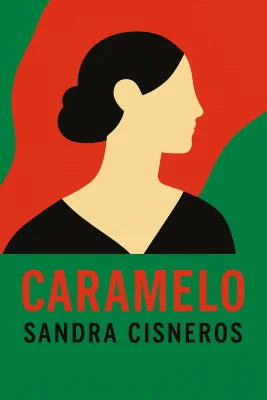
Caramelo
Categories
Fiction, Audiobook, Historical Fiction, Book Club, Contemporary, Novels, Adult Fiction, Literary Fiction, Latinx, Latin American
Content Type
Book
Binding
Paperback
Year
2003
Publisher
Vintage
Language
English
ASIN
0679742581
ISBN
0679742581
ISBN13
9780679742586
File Download
PDF | EPUB
Caramelo Plot Summary
Introduction
# Caramelo: Threads of Memory Woven Across Borders The caramelo rebozo lies folded in darkness, its candy-colored stripes holding secrets that span three generations and two countries. When seven-year-old Celaya Reyes first glimpses the shawl in her grandmother's Mexico City armoire, she cannot know it will become the thread connecting her family's fractured history—a history written in revolution, migration, and the endless dance between love and abandonment. In the sweltering summer of 1966, the Reyes family makes their annual pilgrimage from Chicago's South Side to the house on Destiny Street, where the Awful Grandmother rules with iron authority and the Little Grandfather shuffles through rooms thick with memory. But this summer will be different. As family secrets begin to unravel like pulled stitches, young Celaya discovers that every story has multiple versions, every truth casts its own shadow, and the rebozo she covets carries the weight of dreams deferred and promises broken across borders both geographical and emotional.
Chapter 1: The Annual Pilgrimage: Between Two Worlds
Three cars caravan south through the Texas heat like a procession of pilgrims seeking absolution. Uncle Fat-Face's white Cadillac leads the way, followed by Uncle Baby's green Impala, with Father's red station wagon bringing up the rear. Inside each vehicle, the Reyes clan endures the ritual migration that defines their summers—fleeing Chicago's industrial grime for the promise of Mexico City, where the Awful Grandmother waits like a spider in her web of memory and manipulation. Seven-year-old Celaya presses her face against the window, watching America blur past in a fever dream of truck stops and billboards. Her six brothers—Rafa, Ito, Tikis, Toto, Memo, and Lolo—fill the cramped backseat with their noise, their Spanish and English mixing like oil and water. Father grips the steering wheel with the concentration of a man carrying precious cargo, while Mother fans herself with a road map, muttering complaints about the heat that no one acknowledges. This annual exodus has become sacred ritual, a reverse migration where success in America means nothing without the blessing of the matriarch who rules from her crumbling colonial mansion. The three Reyes brothers and their families make this pilgrimage every summer, carrying suitcases full of American goods and hearts heavy with the weight of expectation. They are neither fully Mexican nor fully American, suspended between two worlds like dust motes dancing in desert air. The house on Destiny Street receives them like a fever breaking. The Awful Grandmother emerges from the shadows of the courtyard, her black dress absorbing light, her eyes calculating as they inventory each grandchild for signs of American corruption. Behind her shuffles the Little Grandfather in his bedroom slippers, a gentle man diminished by decades of marriage to a woman who hoards love like currency. The servants scatter like startled birds as the Chicago relatives invade with their loud voices and foreign expectations, transforming the quiet house into chaos.
Chapter 2: Roots of Revolution: Narciso's Legacy and Soledad's Sacrifice
The Little Grandfather's stories emerge in fragments, whispered during siesta hours when the Awful Grandmother retreats to her room and the house settles into temporary peace. Narciso Reyes speaks of his youth during the Mexican Revolution, when he polished his military boots with the fervor of a boy who believed dying for his country was the highest honor. But revolution, he tells Celaya, has little patience for boyish dreams of glory. During the Ten Tragic Days of 1913, when President Madero's government crumbled in bullets and betrayal, seventeen-year-old Narciso found himself assigned not to heroic battles but to the grim task of burning corpses in Mexico City's streets. The smell of charred flesh and the sight of children among the dead shattered his romantic notions of war. Standing against an execution wall, waiting for bullets that never came, he felt his lung collapse from pure terror. The doctors removed three of his ribs, leaving him with a hole in his chest that would whistle for the rest of his life. His mother Regina, a fierce woman who had clawed her way up from servant to merchant during the chaos of war, made the decision that would echo through generations. She shipped Narciso north to Chicago, to the ramshackle upholstery shop of his disgraced Uncle Old, a man who had fled Mexico with stolen army payroll and never looked back. In Chicago's South Side, among the dust and horsehair stuffing of furniture repair, Narciso learned that exile was just another word for opportunity. But the young man who returned to Mexico City after the revolution was different from the boy who had left. The jazz clubs and speakeasies of Chicago had offered pleasures Mexico's rigid society never allowed, and Narciso carried that hunger back with him like a virus. When he met Soledad, a servant girl with eyes like little houses and a heart full of longing, he saw not a woman to love but a problem to solve. She was pregnant, abandoned, desperate—and he was a man who had learned that salvation could be purchased with the currency of respectability.
Chapter 3: Border Crossings: Inocencio's Journey and Celaya's Birth
Twenty-three years later, Narciso's son Inocencio inherited his father's restless spirit and his grandmother's talent for reinvention. A philosophy student more interested in examining life than living it, Inocencio possessed the dangerous combination of intelligence and impracticality that marked him as either a future poet or future failure. When his university grades threatened to expose him as the latter, he chose the path his father had taken a generation before—he ran north. The journey through Texas proved transformative in ways he hadn't anticipated. Working in Memphis coffin factories, shucking oysters in Little Rock, washing dishes in Philadelphia, Inocencio discovered that America had a particular hunger for young Mexican men willing to disappear into its machinery of war and labor. When police officers in Memphis escorted him to an army recruitment office, he understood that his wandering had led him exactly where the country needed him to go. The Pacific theater taught Inocencio lessons his father's revolutionary stories had never conveyed. He witnessed atrocities that made Mexico's civil war seem quaint, but he also learned something Narciso never had—that survival wasn't just about enduring violence, but about maintaining dignity in its face. When the war ended and he finally reached Chicago, he carried the quiet authority of someone who had seen the world's capacity for both cruelty and unexpected kindness. At a South Side dance hall, he met Zoila Reyna, a factory worker whose heart had been recently shattered by a smooth-talking theater owner's son. She was suspicious of Inocencio's courtly manners and his habit of calling her "mi reina," but something in his melancholy eyes convinced her that his gentleness wasn't performance. Their courtship unfolded in the spaces between factory shifts and family obligations, two displaced souls finding comfort in shared exile. Celaya arrived in 1958 as an unwelcome surprise to a father expecting his seventh son. But disappointment transformed into obsession the moment Inocencio looked into her face and saw his own features reflected back—the same sad eyes, the same stubborn chin, the same expression of someone perpetually on the verge of either laughter or tears. While her six brothers learned to fend for themselves in the rough democracy of shared bedrooms, Celaya became the center of her father's universe, treated like visiting royalty in their cramped Chicago apartments.
Chapter 4: The Grandmother's Reign: Secrets and Family Mythology
The Awful Grandmother rules her Mexico City household with the iron fist of someone who has survived revolution, widowhood, and the daily humiliations of raising children who prefer their American lives to her Mexican wisdom. Soledad Reyes earned her authority through decades of sacrifice, and she wields it like a weapon against anyone who threatens her position as the family's emotional center. Her annual summer visits from her Chicago sons become elaborate productions of guilt, manipulation, and fierce love. She spends months preparing for their arrival, stocking the house with their favorite foods, arranging rooms with military precision, and crafting stories designed to remind them of their obligations to her and to Mexico. But the grandmother's power rests on increasingly shaky foundations. Her sons have American wives, American mortgages, and American dreams that pull them further from her orbit each year. The tension crystallizes around the caramelo rebozo, locked away in her walnut armoire like a prisoner. When Celaya discovers the shawl during one of her explorations, its candy-colored stripes flowing like liquid silk, the grandmother's violent reaction reveals the fragility beneath her authoritarian facade. The rebozo represents everything Soledad has lost—her youth, her beauty, her dreams of a different life—and she guards it with the desperation of someone protecting her last treasure. The stories she tells about the rebozo change with each telling. Sometimes it belonged to her mother, sometimes to a mysterious aunt, sometimes to a woman whose name she refuses to speak. Celaya learns to read between the lines, to catch the glances that pass between adults when they think no one is watching. The family mythology is built on half-truths and wishful thinking, each generation adding new layers to the fiction. But secrets have a way of surfacing like bodies in a river. During a family argument that erupts over dinner, the grandmother finally reveals what everyone else already knows—that Narciso's heart belongs to another woman, that his marriage to Soledad was duty disguised as love. The revelation shatters the family's careful pretense, leaving them stranded with nowhere to hide from the truth that has been stalking them for decades.
Chapter 5: Migration and Displacement: From Chicago to San Antonio
The Little Grandfather's death changes everything. His sudden heart attack on a Mexico City freeway, surrounded by an absurd avalanche of plastic brooms, marks the end of an era and triggers another migration. The Awful Grandmother's decision to sell the house on Destiny Street and move to the United States surprises everyone, including herself. But widowhood has revealed the extent of her isolation in a Mexico City that no longer feels like home. The logistics of this final migration prove more complex than anyone anticipated. The grandmother's accumulated possessions—furniture, photographs, religious artifacts, and the carefully preserved caramelo rebozo—must be sorted, packed, or abandoned. Each object carries its own weight of memory, and the process of deciding what to keep and what to leave behind becomes a painful reckoning with the past. For Celaya, now fourteen and caught between childhood and adolescence, the move represents both loss and possibility. She is leaving behind the Mexico of her summers, the place where her father's stories took root in her imagination, but she is also escaping the suffocating expectations that defined her visits to Destiny Street. The family's destination—San Antonio, Texas—was chosen more for its real estate prices than its cultural significance, but the city's position on the border makes it perfect for a family that has never quite belonged to either country. The house on El Dorado Street greets them with the particular sadness of other people's abandoned dreams. Each room tells the story of previous owners' failures and compromises, and the Reyes family must somehow transform this patchwork of additions and repairs into something resembling home. Father sets up his upholstery shop on Nogalitos Street, determined to build something new from the ruins of the old, while Mother tends her rescued rosebushes like they're the last living things from their previous life. But Texas proves to be its own kind of exile. The Mexican-Americans here view the Reyes family with suspicion—too Mexican for the Anglos, too American for the Mexicans. Celaya finds herself caught in the middle, her Chicago accent marking her as an outsider in a place where she should belong. The caramelo rebozo makes the journey wrapped in an old pillowcase, its candy-colored stripes faded but intact, its unfinished fringe still waiting for someone to complete the pattern that was started so many years before.
Chapter 6: First Love and Awakening: Celaya's Coming of Age
Ernesto Calderón arrives in Celaya's life like a gentle earthquake, shifting everything she thought she knew about herself. He's not the kind of boy who would turn heads—too short, too earnest, with thick glasses and a laugh that could shatter windows. But when he looks at Celaya, she sees herself reflected as someone worthy of love, someone whose thoughts and dreams matter beyond her role as daughter and granddaughter. Their romance unfolds in the spaces between family obligations and teenage rebellion. Ernesto plays guitar badly but with such passion that Celaya finds herself falling in love with his imperfections. He speaks to her in Spanish that tastes like honey and promises, telling her she's his life, his eyes, his soul. The intensity frightens and thrills her in equal measure, awakening desires she doesn't fully understand but knows she must hide from her family. But love at fifteen is a dangerous thing, especially when you're a Mexican daughter with a father who sees threats to your virtue in every boy's smile. Celaya and Ernesto begin to plan their escape—not just from parental disapproval, but from the narrow confines of their prescribed lives. They dream of Mexico City, of marriage, of a future where they can love each other without shame or secrecy. The plan they hatch is both romantic and reckless. Ernesto will "steal" her, as tradition demands, taking her to Mexico City where they'll marry and return as husband and wife, forcing their families to accept their union. It's a story as old as Mexico itself, but Celaya believes their love is strong enough to rewrite the ending. When they finally run away, crossing the border with hearts full of hope and pockets full of borrowed money, she feels like the heroine of her own telenovela. But real life has a way of editing out the happy endings. In Mexico City, surrounded by the chaos of a city that has grown beyond recognition, Celaya discovers that love is not enough to overcome the practical realities of poverty, family disapproval, and her own unfinished childhood. The romantic gesture becomes a nightmare of homesickness and regret, and she finds herself calling home, begging for forgiveness and rescue.
Chapter 7: Ghosts and Revelations: Confronting Hidden Truths
The Awful Grandmother refuses to stay dead. She appears to Celaya at the most inconvenient moments—during math class, while brushing her teeth, in the middle of the night when the house creaks with settling dreams. Her presence carries the smell of fried meat and unfulfilled desires, a reminder that some stories refuse to end with death. At first, Celaya thinks she's losing her mind. The stress of the failed elopement, the weight of family secrets, the confusion of adolescence—surely these visitations are just her imagination working overtime. But the grandmother's appearances become more frequent and more demanding. She has unfinished business, and she's chosen Celaya as her earthly representative. The ghost reveals truths that the living never dared speak. She tells Celaya about Candelaria, the servant girl who was actually Father's half-sister, born from Narciso's youthful indiscretion that the family buried beneath layers of silence and shame. She explains how jealousy and loneliness drove her to reveal family secrets at the worst possible moments, planting seeds of discord that grew into decades of resentment. But the grandmother's most devastating revelation is about herself—how she remains trapped between worlds, unable to cross over to whatever comes next because she carries too much guilt, too much unfinished love. She needs forgiveness from those she's wronged, and she needs someone to tell her story with compassion instead of condemnation. The caramelo rebozo, she finally admits, was never hers to begin with—it belonged to Narciso's true love, the woman whose name she could never bear to speak. Celaya begins to understand that she's inherited more than just the family's physical features. She's become the keeper of their stories, the one who must weave together all the broken threads into something that makes sense. The grandmother's ghost isn't a haunting—it's a responsibility, a calling to become the family's voice and conscience.
Chapter 8: Weaving the Tapestry: Inheritance of Memory and Story
In the end, Celaya learns that every family is a story told in multiple voices, each narrator adding their own color to the weave. The Awful Grandmother, no longer awful in death, finds her peace through Celaya's understanding. Father's secrets lose their power to wound once they're brought into the light. Mother's anger softens into something approaching forgiveness as she recognizes her own role in the family's mythology. The caramelo rebozo becomes more than just a shawl—it's a metaphor for how lives intertwine, how the threads of individual stories create a pattern larger than any single narrative. Celaya understands now that she's both the product of these stories and their author, responsible for weaving them together in ways that honor both truth and love. The rebozo's unfinished fringe no longer represents incompletion but possibility—the understanding that some stories are meant to continue, to be taken up by new hands and carried forward. Father's heart attack serves as a wake-up call for the entire family. Lying in the hospital bed, connected to machines that beep out the rhythm of his mortality, he looks smaller than Celaya has ever seen him. The man who once seemed invincible is revealed to be as fragile as anyone else, held together by will and stubbornness and the love of his family. His recovery becomes a celebration of survival, and he decides to mark it with an elaborate anniversary party—thirty years of marriage, though everyone knows it's been fewer. The party becomes a gathering of the scattered tribe. Relatives arrive from Mexico, Chicago, and points between, each carrying their own version of family history. The dance floor fills with three generations moving to the same music, their steps weaving patterns of connection and continuity. As Father takes Celaya's hand for a waltz, she understands that she's inherited more than just his features and his temper—she's become the family's memory keeper, the one who will carry their stories forward into whatever comes next.
Summary
The caramelo rebozo remains unfinished, its fringe still tangled with the dreams and disappointments of the women who have owned it. Like the Reyes family itself, it is a work in progress, beautiful in its imperfection, valuable not for what it represents but for what it promises—that stories, like the people who tell them, can survive any migration, any transformation, any attempt to reduce them to simple truths. Celaya stands at the threshold between her family's past and her own future, holding in her hands the threads of a narrative that spans continents and generations. She has learned that identity is not something you inherit but something you create, stitch by stitch, story by story, from the materials of memory and the possibilities of imagination. The family's migration from Mexico to Chicago to San Antonio mirrors the larger story of displacement and belonging that defines the Mexican-American experience, but it's also uniquely theirs, marked by the specific joys and sorrows that make every family's journey singular. The rebozo will remain unfinished, but the story it represents continues to unfold, as rich and complex as the candy-colored stripes that give it its name.
Best Quote
About Author

Sandra Cisneros
Cisneros probes the intricacies of cultural identity and belonging through her evocative prose, infusing her narratives with a rich tapestry of the Chicana experience. Her writing often delves into the themes of identity and social injustice, drawing from her own upbringing in a vibrant Mexican-American community in Chicago. By weaving personal and cultural histories into her work, Cisneros captures the nuanced struggle between Mexican and Anglo-American cultures, thus providing a profound commentary on the immigrant experience. This commitment to exploring multifaceted identities is evident in her celebrated book "The House on Mango Street," where lyrical storytelling meets social critique to paint an enduring portrait of adolescence amid cultural dislocation.\n\nIn her storytelling, Cisneros employs a bilingual narrative style that reflects her dual heritage, using English and Spanish to enrich her thematic explorations. This approach not only enhances the authenticity of her characters but also amplifies the voices of marginalized communities within her work. Moreover, her literary repertoire includes diverse genres, such as poetry and children's literature, which showcases her versatility and commitment to reaching a broad audience. For instance, "Caramelo" and "Woman Hollering Creek and Other Stories" expand on themes of familial ties and personal empowerment, while her poetry collections like "Bad Boys" reveal a deep empathy for her subjects. Through these varied methods, Cisneros offers her readers a mirror to their own identities and a beacon of cultural understanding.\n\nReaders of Cisneros's work gain not only literary enjoyment but also a deeper understanding of cultural and social dynamics. Her books serve as educational tools that resonate with audiences across different backgrounds, fostering empathy and awareness of the immigrant narrative. The author's impact extends beyond literature, as her social advocacy and the founding of the Macondo Foundation illustrate her dedication to supporting socially conscious writers. Her numerous accolades, including the American Book Award and the National Medal of Arts, underscore her significant contributions to American literature, confirming her role as a luminary who enriches the cultural conversation with every page.
Read moreDownload PDF & EPUB
To save this Black List summary for later, download the free PDF and EPUB. You can print it out, or read offline at your convenience.
Caramelo
by Sandra Cisneros
