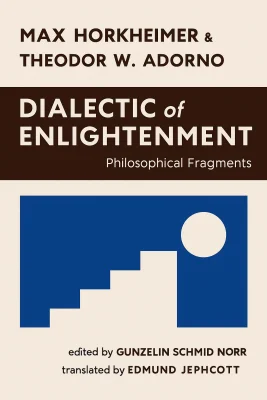
Dialectic of Enlightenment
Philosophical Fragments
Categories
Nonfiction, Philosophy, History, Politics, Classics, Sociology, German Literature, Academic, Cultural, Theory
Content Type
Book
Binding
Paperback
Year
2007
Publisher
Stanford University Press
Language
English
ASIN
0804736332
ISBN
0804736332
ISBN13
9780804736336
File Download
PDF | EPUB
Dialectic of Enlightenment Plot Summary
Introduction
# Dialectic of Enlightenment: How Reason Becomes Domination The modern world confronts us with a disturbing paradox: the very forces of reason and scientific progress that promised to liberate humanity from superstition and natural bondage have themselves become instruments of unprecedented domination and control. This contradiction lies at the heart of our contemporary predicament, where advanced technological societies exhibit forms of barbarism that surpass even the darkest periods of human history. The rational systems designed to enhance human freedom have instead created new mechanisms of manipulation that operate through the willing participation of their victims. This investigation employs a dialectical method that reveals how concepts and social forces contain within themselves the seeds of their own transformation into their opposites. By tracing the historical development of enlightenment thinking from its emancipatory origins through its current manifestations in mass culture and administrative control, we can understand how the tools of liberation become instruments of oppression. This analysis challenges readers to recognize the mythological elements that persist within our supposedly rational civilization and to consider what genuine critical thinking might require in an age where reason itself has become suspect.
Chapter 1: The Paradox of Progress: Enlightenment's Self-Defeating Logic
Enlightenment emerged with the noble aspiration of freeing humanity from the twin tyrannies of natural necessity and social superstition. The project promised that systematic rational inquiry would replace blind faith with knowledge, arbitrary authority with reasoned deliberation, and helpless submission to natural forces with technological mastery. Yet this emancipatory program contained within itself a fatal contradiction that would ultimately transform liberation into a more sophisticated form of enslavement. The transformation begins with enlightenment's conception of knowledge as power over nature. While this instrumental approach proves remarkably successful in advancing human control over the physical world, it gradually extends its logic to encompass human beings themselves. The same analytical methods that enable scientific prediction and technological manipulation are applied to social organization and individual behavior. People become objects of study and control rather than subjects capable of self-determination. This process accelerates under the conditions of industrial capitalism, which discovers in rational organization the perfect mechanism for maximizing efficiency and profit. The factory system represents the triumph of enlightened rationality applied to human activity, yet it reduces workers to interchangeable components in a vast productive machine. The division of labor that enables unprecedented material abundance simultaneously fragments human experience and eliminates the possibility of meaningful work. The culture that emerges from this rationalized society exhibits a peculiar form of regression disguised as progress. Mass entertainment, standardized education, and bureaucratic administration operate according to principles as rigid and unquestionable as any religious dogma. The difference is that these new forms of authority present themselves as purely objective and scientific, making resistance appear not merely rebellious but irrational. The ultimate irony of this development is that the society produced by enlightened rationality begins to exhibit the very characteristics that enlightenment originally sought to eliminate: blind obedience to authority, superstitious thinking, and the sacrifice of individual welfare to collective demands. The promise of autonomy through reason becomes instead a more efficient system of heteronomy, where individuals willingly submit to forces they neither understand nor control.
Chapter 2: From Myth to Rationality: The Hidden Continuity of Domination
The relationship between mythological thinking and rational enlightenment proves far more complex than the simple opposition typically assumed. Rather than representing successive stages in human development, myth and reason reveal themselves as dialectically interrelated forms of consciousness that share fundamental structural similarities. Both seek to impose order on chaotic experience through systematic explanation, and both involve the domination of nature and human beings in service of collective survival. Ancient mythological systems already contained proto-rational elements in their attempts to understand and control natural forces through narrative explanation and ritual practice. The transition from animistic beliefs to organized pantheons reflected the development of more systematic forms of thought that paralleled emerging social hierarchies. Even the most primitive magical practices involved a kind of experimental thinking about causal relationships and effective techniques for achieving desired outcomes. Conversely, modern rational thought retains mythological elements that become visible once we examine its underlying assumptions and social functions. The belief in inevitable progress, the faith in technological solutions to human problems, and the worship of efficiency and productivity function as contemporary myths that organize collective life and individual consciousness. Scientific theories become rigid dogmas when they are removed from critical examination and transformed into unquestionable authorities. The concept of sacrifice provides a crucial link between ancient and modern forms of consciousness. Primitive sacrificial rituals involved a kind of bargaining with natural forces, an attempt to control the uncontrollable through symbolic exchange and ritual substitution. Modern rational calculation operates according to a similar logic, treating all values as commensurable and all relationships as potentially exchangeable. The sacrifice of immediate pleasure for future gain, the subordination of individual needs to systematic requirements, and the acceptance of present suffering for promised benefits all follow this sacrificial pattern. The development of abstract thinking represents both an enormous advance in human capabilities and a profound loss of connection to concrete experience. While abstraction enables generalization, prediction, and systematic control, it also involves the suppression of everything particular and qualitative in human experience. The capacity to manipulate symbols and concepts becomes divorced from understanding their human significance, leading to forms of technical expertise that lack wisdom or moral insight.
Chapter 3: The Culture Industry: Manufacturing Consciousness Through Mass Media
Modern mass entertainment and information systems have evolved into a comprehensive apparatus for manufacturing consciousness rather than merely reflecting or enriching human experience. This culture industry operates according to the same principles as material production: standardization, efficiency, and the systematic creation of artificial needs that can be reliably satisfied through consumption. The result is not genuine culture, which emerges from authentic human expression and community life, but pseudo-culture designed to integrate individuals into existing power structures. The standardization process extends far beyond the obvious similarities between different entertainment products to encompass the very forms of cultural expression and individual response. Popular films, television programs, and musical recordings are manufactured according to proven formulas that guarantee predictable audience reactions. This pseudo-individualization creates the appearance of diversity and choice while ensuring that all options lead to the same outcome: the reproduction of passive, compliant consumers who mistake their manipulation for freedom. The culture industry achieves its effects not through crude propaganda or explicit censorship, but through the subtle manipulation of perception and desire. By controlling the range of available images, narratives, and emotional responses, it defines the boundaries of what seems possible or desirable. Alternative ways of living and thinking are not explicitly forbidden but simply rendered invisible or ridiculous. The result is a form of voluntary conformity that feels like personal choice but actually represents the internalization of external constraints. Perhaps most insidiously, the culture industry transforms the capacity for critical reflection into another form of entertainment. Serious social and philosophical questions become the subject of talk shows and documentary programs that provide the illusion of engagement without the substance of genuine inquiry. The audience feels informed and sophisticated while remaining fundamentally passive and uncritical. This pseudo-critical consciousness may be more effective than outright censorship in preventing genuine opposition to existing arrangements. The psychological effects of this cultural manipulation extend beyond individual consciousness to reshape the very structure of human personality. When the symbolic resources through which people make sense of their world are controlled by commercial interests, the capacity for independent thought and authentic emotional response begins to atrophy. Individuals become increasingly dependent on external authorities for guidance about what to think, feel, and desire, losing touch with their own authentic needs and creative possibilities.
Chapter 4: Instrumental Reason: The Eclipse of Critical Thinking
The form of rationality that has come to dominate modern civilization differs fundamentally from the critical reason that originally inspired the Enlightenment project. While critical reason sought to question assumptions, challenge authority, and expand human understanding, instrumental reason focuses solely on the efficient achievement of given ends without examining the validity or desirability of those ends themselves. This transformation has profound implications for human freedom and the possibility of genuine social progress. Instrumental reason operates by reducing all qualitative distinctions to quantitative measurements that can be manipulated through technical procedures. Complex human situations are analyzed in terms of costs and benefits, inputs and outputs, risks and opportunities. This approach proves enormously powerful for solving technical problems and coordinating large-scale activities, but it systematically eliminates precisely those aspects of experience that give life meaning and value: questions of justice, beauty, truth, and human dignity cannot be answered through instrumental calculation. The dominance of instrumental thinking affects not only how institutions operate but how individuals understand themselves and their relationships with others. Personal decisions are increasingly made according to strategic considerations rather than ethical principles or authentic desires. Education becomes job training, relationships become networking opportunities, and even leisure activities are evaluated in terms of their contribution to personal advancement or social status. The result is a form of alienation that penetrates to the very core of human identity. This eclipse of critical thinking has political consequences that extend far beyond individual psychology. When citizens can no longer distinguish between genuine and manipulated information, or between authentic and manufactured needs, democratic participation becomes meaningless. The forms of democracy may be preserved, but the substance—informed deliberation about common concerns—disappears. What remains is a system of managed consent in which popular opinion is shaped by the same techniques used to market consumer products. The institutional structures that emerge from this process exhibit a peculiar form of rationalized irrationality. Bureaucratic organizations operate according to perfectly logical internal procedures while pursuing goals that may be fundamentally destructive or meaningless. The same administrative apparatus that can efficiently deliver social services can also implement policies of systematic oppression with equal precision and effectiveness. The technical rationality of the means becomes divorced from any rational consideration of the ends.
Chapter 5: Antisemitism as Civilization's Pathological Projection
The persistence of antisemitism throughout Western history reveals something essential about the internal contradictions of civilized society itself. Rather than representing merely an unfortunate prejudice that can be overcome through education and tolerance, antisemitism functions as a systematic projection of the tensions and anxieties generated by the civilizing process. The figure of the Jew becomes a repository for everything that civilized society must repress in itself: particularity against universality, sensuous experience against abstract thought, traditional community against modern individualism. This projection serves multiple psychological and social functions that help maintain the stability of an inherently unstable system. On the individual level, antisemitism allows people to disown the aspects of themselves that have been sacrificed to social conformity and rational self-control. The antisemite can express forbidden desires and resentments by attributing them to Jews, thereby maintaining a sense of moral superiority while indulging in precisely the behaviors that are supposedly being condemned. On the social level, antisemitism provides a false solution to real contradictions within the economic and political system. When social tensions reach a breaking point, the figure of the Jewish conspirator offers an explanation that preserves the legitimacy of existing institutions while channeling popular anger toward a vulnerable minority. This scapegoating mechanism allows the system to maintain stability by sacrificing a part of itself, much like ancient societies used ritual sacrifice to restore social harmony after periods of crisis. The economic dimension of antisemitism reveals how rational analysis can be distorted to serve irrational purposes. The complex processes of capitalist exploitation are simplified and personalized through the identification of Jews with the circulation sphere of the economy, allowing the real sources of economic oppression to remain hidden while popular anger is directed toward visible intermediaries. This mechanism demonstrates how the tools of social analysis can be weaponized to obscure rather than illuminate the true structure of social relations. The most disturbing aspect of modern antisemitism is its systematic and bureaucratic character. The Nazi genocide was not a spontaneous outburst of popular hatred but a carefully organized administrative process that utilized the most advanced techniques of modern civilization. This reveals that the potential for such systematic dehumanization is built into the structure of rational administration itself, which treats human beings as abstract categories and statistical units rather than concrete individuals with inherent dignity and rights.
Chapter 6: Technology and Administration: The Reification of Human Relations
The technological transformation of modern society represents both the culmination of enlightenment's project of rational mastery and its ultimate betrayal of human values. Technology, which was supposed to serve human needs and expand human capabilities, has instead become an autonomous force that reshapes human relations according to its own mechanical logic. This process of technological reification transforms qualitative human experiences into quantitative data points that can be processed, analyzed, and manipulated by administrative systems. The reification process operates through the systematic translation of human activities into forms compatible with mechanical processing and bureaucratic control. Work is broken down into standardized tasks that can be performed by interchangeable workers or automated systems. Communication is reduced to information transfer that can be optimized for efficiency and monitored for compliance. Even intimate relationships are increasingly mediated by technological systems that shape the possibilities for human connection according to algorithmic logic rather than human needs. This technological mediation of human experience has profound consequences for individual consciousness and social relations. When human activities are organized according to technological imperatives rather than human purposes, people begin to experience themselves and others as objects to be manipulated rather than as subjects capable of genuine encounter. The result is a form of alienation that penetrates deeper than traditional economic exploitation, affecting the very core of human identity and relationship. The administrative apparatus that emerges from this process exhibits the same paradoxical character as other aspects of rationalized society: it operates with perfect internal logic while serving fundamentally irrational ends. Bureaucratic organizations can efficiently process vast quantities of information and coordinate complex activities, but they do so by reducing human beings to abstract categories and statistical averages. The particular needs and circumstances of individuals disappear within the universal requirements of systematic administration. The tragedy of technological reification lies not in technology itself, but in the social relations that determine how technological capabilities are developed and deployed. Under different social arrangements, the same technological tools that now serve to dominate and control human beings could potentially be used to expand human freedom and creativity. However, the current trajectory toward total administration becomes increasingly difficult to reverse as technological systems become more complex and pervasive, creating new forms of dependence that make alternative arrangements seem impossible to imagine or achieve.
Chapter 7: Recovering Critical Reason: Beyond Instrumental Rationality
Despite its internal contradictions and historical failures, the Enlightenment tradition contains resources that remain essential for human emancipation. The problem lies not in reason itself but in the reduction of reason to its merely instrumental functions. A critical recovery of enlightenment's promise requires distinguishing between the liberating potential of rational thought and the oppressive uses to which it has been put by existing power structures. This recovery must begin with the recognition that reason cannot be separated from its social and historical context. The forms that rational thinking takes are inevitably shaped by the material conditions and power relations within which they develop. Under conditions of domination and exploitation, even the most sophisticated rational systems will tend to reproduce and legitimize existing inequalities. A genuinely critical reason must therefore include reflection on its own social conditions and political implications. The path forward involves neither a rejection of rational thought nor an uncritical embrace of its current forms, but a dialectical approach that preserves reason's critical edge while acknowledging its limitations and potential for abuse. This means maintaining the Enlightenment commitment to questioning authority and challenging superstition while recognizing that reason itself can become a form of authority that must be questioned. It requires developing forms of thinking that can hold contradictions in tension rather than resolving them prematurely through false syntheses. Perhaps most importantly, a critical recovery of enlightenment must reconnect rational thought with the concrete experiences and needs of human beings rather than abstract principles or institutional imperatives. This does not mean abandoning systematic thinking but ensuring that such thinking serves human flourishing rather than technical efficiency or administrative control. The goal is not to eliminate the tensions between universal and particular, rational and emotional, individual and social, but to find ways of living creatively within these tensions rather than being destroyed by them. Such a transformation would require fundamental changes in how knowledge is produced, distributed, and applied in contemporary society. Educational institutions would need to foster critical thinking rather than technical training, media organizations would need to serve public understanding rather than commercial interests, and political systems would need to enable genuine democratic participation rather than managed consent. While these changes may seem utopian given current conditions, they represent the only alternative to the continued development of rationalized barbarism disguised as progress.
Summary
The central insight emerging from this analysis reveals that the crisis of modern civilization stems not from insufficient rationality but from reason's separation from its own critical and emancipatory purposes. When rational thinking becomes purely instrumental, serving power rather than truth, it generates the very irrationalities and forms of domination it was meant to overcome. This recognition points toward the possibility of a more reflective form of rationality that can acknowledge its own limitations while maintaining its commitment to human freedom and dignity. The value of this investigation lies not in providing easy solutions to contemporary problems but in clarifying the deeper structures that generate those problems. By understanding how enlightenment contains the seeds of its own reversal, we can begin to imagine forms of rational thought and social organization that might avoid repeating the same destructive patterns. This work remains essential for anyone seeking to understand why modern societies, despite their unprecedented technical capabilities, seem increasingly unable to address their most fundamental challenges or fulfill their promises of human liberation.
Best Quote
“As naturally as the ruled always took the morality imposed upon them more seriously than did the rulers themselves, the deceived masses are today captivated by the myth of success even more than the successful are. Immovably, they insist on the very ideology which enslaves them. The misplaced love of the common people for the wrong which is done to them is a greater force than the cunning of the authorities.” ― Theodor Adorno, Dialectic of Enlightenment: Philosophical Fragments
Review Summary
Strengths: The review highlights the intriguing perspective of Horkheimer and Adorno as refugees analyzing the rise of fascism through philosophical discussions. It notes the development of a theoretical framework and exploration of social and economic phenomena. Weaknesses: The review criticizes the book for being biased and one-sided due to the authors' Jewish background and Marxist influences. It suggests that this limits their approach to the complex issue of fascism's rise. Overall: The review presents a critical view of "Dialectic of Enlightenment," acknowledging its interesting perspective but questioning its objectivity. The reader may find the book insightful yet limited by its perceived biases.
About Author

Max Horkheimer
Horkheimer reframes critical theory as an exploration of the intersections between reason, ideology, and societal structures. By blending Marxist social philosophy with empirical research, Horkheimer's approach diverges from traditional Marxism, focusing on consciousness transformation rather than direct political activism. This shift in perspective, evident in his seminal essay "Traditional and Critical Theory," offers a nuanced critique of modern capitalism and its impacts on society. Meanwhile, his collaboration with Theodor Adorno in "Dialectic of Enlightenment" delves into the paradoxes of enlightenment thought, marking a pivotal point in 20th-century social philosophy.\n\nHorkheimer's method combines rigorous philosophical inquiry with interdisciplinary analysis, incorporating cultural, psychological, and aesthetic dimensions. This multifaceted approach, highlighted in his work "Eclipse of Reason," interrogates the decline of rationality as a guiding principle in modern society. His analytical style provides a trenchant examination of the power dynamics within ideologies, offering readers profound insights into societal complexities. For those interested in the critical evaluation of modernity and capitalism, Horkheimer’s work serves as an indispensable resource, challenging them to question established narratives.\n\nReaders benefit from Horkheimer’s incisive critiques as they navigate the intricacies of human society and the forces that shape it. His works encourage a deeper understanding of the ideological underpinnings that influence contemporary life. Scholars in social philosophy and related fields find his theories essential for developing a critical lens, while his ideas resonate with anyone seeking to comprehend the interplay between reason, power, and societal change. This short bio underscores Horkheimer's enduring legacy as a pivotal figure whose theoretical contributions continue to inspire and provoke critical thought across disciplines.
Read moreDownload PDF & EPUB
To save this Black List summary for later, download the free PDF and EPUB. You can print it out, or read offline at your convenience.
Dialectic of Enlightenment
by Max Horkheimer
