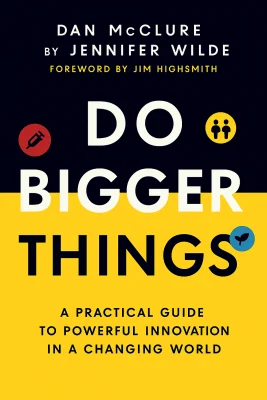
Do Bigger Things
A Practical Guide to Powerful Innovation in a Changing World
Categories
Business, Nonfiction, Leadership, Entrepreneurship
Content Type
Book
Binding
Kindle Edition
Year
2024
Publisher
Greenleaf Book Group Press
Language
English
ASIN
B0CTKQMWZJ
ISBN13
9781639080700
File Download
PDF | EPUB
Do Bigger Things Plot Summary
Introduction
The lights dimmed as Jenny entered the makeshift command center nestled within a refugee camp on the outskirts of Kathmandu. Just weeks after a devastating 7.8 magnitude earthquake had torn through Nepal, she found herself coordinating teams that were desperately trying to bring order to chaos. What struck her wasn't just the scale of destruction, but how the most effective solutions weren't coming from single organizations working alone. Instead, they emerged when diverse groups—local community leaders, international aid workers, technology specialists, and government officials—worked together in new and unexpected ways. This pattern of success through interconnected solutions wasn't unique to disaster zones. Whether in thriving businesses disrupting industries or community organizations solving local challenges, the most powerful innovations came from people who saw beyond singular problems to create entire ecosystems of change. Throughout this journey, we'll explore how ecosystem innovators tackle complex problems by assembling different pieces—people, organizations, technology, and resources—into solutions that work in the real world. You'll discover practical methods to create powerful innovations that can scale quickly, adapt to changing environments, and deliver lasting impact in a messy, fast-moving world.
Chapter 1: The Power of Ecosystem Thinking: Stories of Transformative Innovation
In India, a staggering 12 million people suffer from blindness, with approximately 45 percent of cases caused by cataracts—a condition that requires surgery to correct. For decades, this seemed like an insurmountable problem. Conventional thinking suggested that more money, more doctors, or more hospitals would solve the crisis. But these piecemeal approaches consistently failed to address the scale of the challenge. Then came Aravind Eye Care System with a fundamentally different approach. Instead of focusing on a single aspect of the problem, they created an entire ecosystem specifically designed to eliminate needless blindness. At the heart of their innovation was a revolutionary process where nurses handled most non-surgical tasks—taking vitals, conducting eye tests, and preparing patients—while doctors focused exclusively on performing cataract surgeries, one after another. With this assembly-line approach, doctors completed six to eight surgeries per hour instead of the standard one. But Aravind didn't stop there. They invested in local production of inexpensive replacement lenses, established satellite treatment facilities across the country, and implemented unique training programs. Half of their patients receive services for little or no cost, yet their surgical outcomes consistently match or exceed those of the UK's National Health Service—at one-thousandth of the cost. Similar ecosystem innovations have transformed other industries. When Dollar Shave Club entered the razor market dominated by Gillette for over a century, they didn't just create a better razor. They reimagined the entire shaving ecosystem by eliminating traditional retail distribution, embracing viral online marketing, and implementing a direct-to-consumer subscription model. Within five years, they had captured enough market share to sell for $1 billion to Unilever. In Sub-Saharan Africa, Solar Sister tackled two intertwined challenges: lack of electricity access for over 600 million people and limited economic opportunities for women. Their ecosystem approach provides women entrepreneurs with solar-powered products, business training, and community support networks. These entrepreneurs then sell clean energy technology to their communities, simultaneously bringing reliable electricity to remote areas and creating sustainable income for themselves. What links these diverse success stories is their approach to innovation. Rather than creating a single solution or fixing one specific problem, these innovators designed complete ecosystems where many different parts—people, technology, organizations, and resources—work together in new ways. This is the essence of ecosystem innovation: seeing beyond individual parts to create powerful, interconnected solutions that can transform industries, communities, and lives.
Chapter 2: Choreographers: The Visionaries Who Lead Ecosystem Change
When twin cities Laredo (USA) and Nuevo Laredo (Mexico) faced dramatically different COVID-19 vaccination rates—70% versus 7%—a critical situation emerged. Despite having surplus vaccines in Texas that would soon expire, political realities prevented them from being transported across the border. The challenge seemed insurmountable: how could these life-saving vaccines reach the people who desperately needed them just across the Rio Grande? Dr. Victor Treviño, who led the Laredo Health Authority, saw beyond the apparent barriers. Rather than accepting the conventional limitations, he collaborated with the Mexican consulate general, Laredo fire chief, and health director to create an innovative solution. They arranged buses to pick up people from Nuevo Laredo and bring them to the center of the bridge between the two countries. There, medical teams would quickly move through each bus, administering vaccinations using shallow plastic tubs suspended from their necks. The buses would return for another group, and by March 2022, about 200,000 doses had been administered to Nuevo Laredo residents. This remarkable achievement wasn't driven by a massive budget or new technology. It came from Dr. Treviño's ability to see the big picture, build bridges across boundaries, and orchestrate diverse participants toward a shared goal. He was functioning as what we now recognize as an ecosystem innovation "choreographer"—someone who can envision a new way of working and bring together the many pieces needed to make it happen. Choreographers possess five distinctive talents. They practice big-picture thinking, seeing across entire challenges rather than focusing on narrow pieces. They excel at crosscutting bridge-building, working horizontally across traditional boundaries and silos. They employ strategic rule-breaking, challenging conventional constraints when necessary. They embrace adaptive problem-solving, taking action despite uncertainties. And they are powerful storytellers, able to paint compelling visions that bring others along on creative journeys. Interestingly, most choreographers come to the role without formal training. They tend to be generalists with diverse experiences rather than specialists in one field. Their resumes often display a "fruit salad" of seemingly unrelated roles and education. This diversity of knowledge becomes their strength—it provides them with more "Lego blocks" to work with when creating new ecosystems. In traditional organizations, choreographers often struggle for recognition. They may be labeled with familiar but ill-fitting titles like "product manager" or "innovation coach." Without clear roles that value their unique abilities, they may find themselves hiding their talents or feeling constrained by structures designed for more specialized functions. Yet as complex challenges continue to mount in our fast-changing world, organizations increasingly need these crosscutting, big-picture thinkers who can orchestrate meaningful change in messy environments.
Chapter 3: Five Sources of Power: Why Ecosystem Innovation Works
When Brian Chesky and Joe Gebbia decided to rent out three air mattresses on the floor of their San Francisco loft during a design conference in 2007, they couldn't have imagined they were launching what would become a global hospitality revolution. Today, Airbnb has over six million active listings worldwide—more than the top five hotel brands combined—and is valued at over $68 billion. How did they achieve such extraordinary success? By tapping into five fundamental sources of power that make ecosystem innovation so effective. First, ecosystem innovators have access to lots of building blocks—the vast array of "Legos" available in the world. Airbnb's founders didn't create new houses or invent travel; they recognized existing underutilized assets (spare bedrooms and empty apartments) and connected them with people seeking affordable accommodations. They added a technology platform, a rating system to foster trust, and insurance services to create a complete ecosystem. By drawing from diverse resources already existing in the world, they built something powerful without having to create each piece themselves. Second, ecosystem innovations harness built-in motivations. Unlike mechanical systems where every part blindly performs its function, ecosystems involve people and organizations with different goals and needs. This diversity of motivation becomes a strength. Airbnb hosts want to earn income from unused space, travelers seek authentic local experiences at reasonable prices, and cleaning services want steady work. Each participant receives rewards that matter to them personally, creating a self-sustaining system powered by everyone's natural motivation. Third, ecosystem innovators excel at rule-breaking. Rather than accepting constraints of existing systems, they change the rules to create new possibilities. Airbnb didn't have to build hotels or maintain properties during low seasons. They completely reimagined how hospitality could work, bypassing the enormous capital investments and rigid standardization that limited traditional hotel chains. This allowed them to offer greater variety, flexibility, and growth potential than incumbents could match. Fourth, ecosystem innovations create magical synergies—effects greater than the sum of their parts. When Airbnb travelers stay in local neighborhoods, they patronize nearby restaurants. As restaurants thrive, more open, attracting more travelers, who book more Airbnb stays. These positive feedback loops naturally amplify value throughout the ecosystem without requiring additional investment from any single participant. Finally, ecosystem innovations possess adaptive flexibility. Unlike rigid systems that break under pressure, ecosystems can bend and evolve. Airbnb has continuously expanded its offerings, adapted to different regulations across hundreds of thousands of localities, and even repurposed its network during crises through Airbnb.org, providing free emergency housing to refugees and disaster victims. This flexibility allows ecosystem innovations to thrive in changing environments where more rigid solutions would fail. The remarkable power of ecosystem innovation comes from embracing complexity rather than fighting against it. By weaving together diverse parts in ways that create sustainable value for all participants, ecosystem innovators can build solutions that scale rapidly, adapt to change, and solve problems that seem impossibly difficult when approached with traditional methods.
Chapter 4: Drawing the Map: Understanding Today's Challenges and Opportunities
During the global COVID-19 pandemic, there was an urgent need to vaccinate people worldwide. Media coverage often focused on specific problems—more vaccines, faster production, better distribution—suggesting that if one particular issue could be solved, the entire crisis would be resolved. But reality proved far more complex. Consider what happened in Chad. In June 2021, one hundred thousand doses of the Pfizer COVID-19 vaccine were delivered to the African nation. Five weeks later, only six thousand had been administered, with the remaining doses at risk of spoiling. According to the New York Times, "Some countries, like Chad, cannot move Pfizer doses outside major cities." The challenge wasn't just about having vaccines; it required an entire functioning ecosystem of community educators, medical staff, transportation, cold storage, and government coordination—all working together during a pandemic. This example highlights why ecosystem innovators approach problems differently. Rather than immediately focusing on one specific issue, they first step back to see the bigger picture—how all the parts of the current situation work (or don't work) together. This broader view reveals interconnections that narrow problem-solving approaches miss. To capture this big picture, ecosystem innovators often create what's called a "current ecosystem map"—a visual representation of how the world currently works in their area of interest. When Jenny was working with organizations addressing child malnutrition in South Sudan, the team initially focused on a narrow technology solution: digital tablets for volunteers to track malnourished children. But by mapping the entire ecosystem—from children and caregivers to community volunteers, health facilities, training programs, and funding sources—they discovered different opportunities that better matched their capabilities. Drawing an ecosystem map doesn't require extensive research or weeks of workshops. It can start with a simple sketch showing the main participants and how they connect. The map evolves as more insights are gathered, eventually creating a shared understanding that helps everyone see beyond obvious symptoms to the underlying patterns of the challenge. This mapping process also changes how innovators think about problems and opportunities. Rather than asking "What's the one most important problem to solve?" they explore multiple interconnected challenges and possibilities. Take Uber's disruption of the taxi industry. Their success wasn't just about creating a ride-hailing app. They addressed numerous interconnected issues: predictable scheduling of rides, keeping riders out of bad weather while waiting, flexible shifts for drivers, better utilization of vehicles, bypassing expensive taxi permits, and serving neighborhoods outside city centers. By seeing and understanding these interconnections, ecosystem innovators can identify opportunities that others miss. They don't need to know every detail—just as you can hear the melody of a song without knowing every note, you can grasp the essential patterns of how things work without analyzing every element. This big-picture thinking lays the foundation for creating innovations that address complex challenges more effectively than narrow, piecemeal approaches ever could.
Chapter 5: Designing the Future: Creating Complete Solutions That Matter
Thomas Edison is often credited with inventing the lightbulb, but in reality, he was just one of many inventors who created versions of this technology. What set Edison apart wasn't the bulb itself but his understanding that a lone invention would be useless without an entire ecosystem supporting it. While others focused solely on perfecting bulb designs, Edison built the Edison Illuminating Company to generate and distribute electricity, laying the foundation for a complete electrical ecosystem that could power not just lightbulbs but countless other innovations. This is the essence of designing the future through ecosystem innovation: creating a complete vision of how a new system could work, with all its interconnected parts. Rather than developing a collection of fragmented solutions that address individual problems, ecosystem innovators imagine an entire future ecosystem where all components work together to create something transformative. The process begins by drawing inspiration from multiple sources: current trends changing what's possible, new models from other fields, untapped resources left on the sidelines, emerging technologies, and unmet needs that existing systems can't address. For example, when reimagining transportation through electric vehicles (EVs), a simple future ecosystem might include manufacturers producing EVs, consumers buying them, and charging stations to power them. But a more complete vision would also consider who builds and operates charging infrastructure, how renewable energy gets integrated, and whether tax incentives might accelerate adoption. A crucial test for any future ecosystem design is whether it's both complete and compelling. Are there any pieces missing that would prevent it from working? Do all participants have sufficient motivation to play their part? In the 1950s, Hollywood studios tried to counter television's threat by introducing 3D movies. They created films, trained cinematographers, and distributed special glasses to viewers—but failed to ensure reliable synchronization between the dual projectors needed for the 3D effect. This one missing piece rendered the entire ecosystem ineffective, leading Variety to declare "3D Looks Dead" by 1954. Ecosystem innovators also look for ways to amplify their designs through feedback loops and synergies. For instance, increasing EV production volumes can lower manufacturing costs, which reduces prices, driving more sales, further increasing volumes in a virtuous cycle. Elon Musk's "secret" Tesla master plan explicitly leveraged this dynamic: build an expensive sports car first, use that money to build a more affordable car, then use those profits to create an even more affordable model. Perhaps most importantly, future ecosystem designs must ensure that "everyone gets a pony"—that all participants receive benefits that matter to them. When designing an EV future, for example, it's not enough to consider only the benefits for early adopters. What about people who can't afford new electric cars? What happens to fossil fuel workers? Effective ecosystem designs address these trade-offs explicitly, creating sustainable value for diverse participants rather than simply shifting burdens from one group to another. Through this thoughtful design process, ecosystem innovators create complete visions of the future that can guide collaborative action. These designs aren't rigid blueprints but rather flexible frameworks that will evolve through implementation. They provide direction without dictating every detail, allowing for adaptation as the ecosystem develops in the real world.
Chapter 6: The Journey of Thin Slices: Building Ecosystems Step by Step
Years ago, Dan was part of a team pioneering online car sales in the United States. Their vision was ambitious: create a complete ecosystem for purchasing vehicles digitally from start to finish. But instead of trying to build every component perfectly before launch, they took a more pragmatic approach. They limited their initial offering to a couple thousand cars in just two models and colors. While their customer-facing website was fully functional, the backend systems weren't complete. Each time an order came in, the project director would print the form and literally run up the stairs to deliver it to staff who would manually enter the information into existing systems. This approach—implementing innovations through a series of "thin slices"—is how successful ecosystem innovators bring their visions to life. A thin slice combines multiple interconnected parts of your future ecosystem to create something that works in the real world, even if simplified or incomplete. Each slice builds on previous ones, progressively creating more of your complete innovation. Consider Irina, who owned a tutoring service facing competition from a large national chain. She envisioned a new ecosystem where she would connect international tutors with students via video calls, offering instruction in students' native languages. This was a complex innovation with many unknowns: Would students want this service? Which languages would be most in demand? Where would she find qualified tutors? How would payment across international boundaries work? Rather than trying to analyze every detail before starting or building the entire system at once, Irina designed her first thin slice: finding a few Vietnamese-speaking students and connecting them with one or two international tutors. This allowed her to test core assumptions quickly while still delivering real value to participants. She could answer critical questions about demand and practical operations without massive investment or risk. Each thin slice serves three important purposes. First, it answers important questions about how your innovation works in practice, generating knowledge that guides further development. Second, it "puts bricks in the wall"—creating components of your future ecosystem that you can build upon, rather than throwaway prototypes that must be rebuilt later. Third, it delivers early wins that demonstrate value and maintain momentum with stakeholders and participants. Ecosystem innovators also design their thin slices to work around barriers and limitations. They might improvise temporary solutions, leverage existing collaborations, or create thinner slices when resources are constrained. For example, Irina might partner with an existing tutoring service in Vietnam to quickly access instructors for her first thin slice, rather than building her own international recruiting operation from scratch. When planning a journey of thin slices, start by identifying the biggest questions and challenges your innovation faces. Then design slices that address these issues while still delivering tangible results. Early slices should focus on core assumptions and major risks, with later slices building toward your complete vision. This creates a flexible roadmap that shows stakeholders how you'll progressively build and test your innovation. This approach differs fundamentally from traditional project planning, which tries to analyze and specify everything upfront. It also differs from purely exploratory innovation, which may lack direction and structure. The journey of thin slices provides both strategic guidance and adaptability—allowing you to confidently build ambitious innovations in complex, changing environments while managing risks through continuous learning and adjustment.
Chapter 7: Act, Learn, Adapt: Managing Risk in a Fast-Changing World
Imagine arriving at a hotel in an unfamiliar city, excited to visit a renowned restaurant across town. The hotel concierge provides detailed turn-by-turn directions, promising they'll get you there perfectly. But a few blocks into your journey, you encounter unexpected construction and road closures. With your carefully prescribed route disrupted, you become hopelessly lost. Now imagine a different scenario: a second concierge simply points you toward the tall television tower with blinking red lights next to your destination. With this landmark in view, you can adapt your route around obstacles, take interesting detours, and still confidently reach your goal. Which approach better matches the reality of navigating a complex, changing environment? This contrast illustrates the fundamental challenge of implementing ecosystem innovations. Traditional project management assumes we can plan everything in detail and then execute perfectly. But when working with interconnected people, organizations, and technologies in fast-changing environments, no amount of analysis can anticipate every challenge or opportunity. Instead, successful ecosystem innovators embrace a cycle of acting, learning, and adapting. The act-learn-adapt cycle begins with taking action through your thin slices. Each implementation reveals how your innovation actually works in practice—showing unexpected problems and opportunities that no amount of planning could have predicted. You then learn from these experiences, intentionally gathering insights about what's working and what isn't. Finally, you adapt your approach based on this new knowledge, making changes to everything from implementation details to your overall ecosystem design. When Irina launched her international tutoring service, she might discover that while students valued native-language instruction, one-on-one tutoring was too expensive for many. Rather than abandoning her innovation, she could adapt by offering lower-cost group sessions or pre-recorded courses. This flexibility—the ability to respond to real-world feedback—is what allows ecosystem innovations to succeed where rigid plans often fail. To maximize this adaptability, ecosystem innovators intentionally design for flexibility. They create modular components that can be reconfigured, establish standard interfaces that make connections easier, store changeable elements as data rather than building them into fixed structures, and delay binding decisions until absolutely necessary. For example, instead of printing brochures that need constant updating, Irina could list her tutoring offerings on a website that can be quickly modified as services evolve. Throughout implementation, ecosystem innovators measure three distinct aspects of their progress. First, they track success—whether the innovation is delivering valuable outcomes for all participants. Second, they monitor progress—how they're advancing through their journey of thin slices. Third, they assess performance—how efficiently their teams are working. These measurements help maintain support and guide adjustments as the innovation evolves. Perhaps the most powerful aspect of this approach is that it transforms failure from a terminal event into a learning opportunity. When you encounter problems, you don't give up; you adapt. Investor Sam Altman affectionately calls successful innovators "cockroaches"—tenacious individuals who persist through setbacks, continually adapting until they succeed. This resilience, combined with strategic vision and practical implementation, is what allows ecosystem innovators to tackle complex challenges that traditional approaches can't solve. In our fast-changing world, the ability to learn and adapt isn't just a nice addition to your innovation toolkit—it's the essential capacity that turns ambitious visions into real-world impact. By embracing the act-learn-adapt cycle, you can navigate the inevitable uncertainties of complex challenges while steadily building toward your larger goals.
Summary
Throughout this journey, we've explored how ecosystem innovators tackle complex challenges by seeing beyond individual problems to create interconnected solutions that work in the real world. From Aravind Eye Care restoring sight to millions in India, to Solar Sister empowering women entrepreneurs while bringing electricity to remote villages, to everyday choreographers like Dr. Treviño finding creative ways to get vaccines across borders—these innovators succeed by assembling diverse "Lego blocks" into complete systems where all participants benefit. The power of ecosystem innovation isn't reserved for a special few. You already have access to the three things you need to make a meaningful impact: the ability to punch above your weight by leveraging resources beyond your direct control, a world of diverse talent and capabilities to draw from, and ever-expanding technological possibilities to incorporate into your solutions. Whether you're addressing business challenges, community needs, or global problems, you can apply the practices we've explored—mapping current systems, designing complete future ecosystems, implementing through thin slices, and continuously adapting as you learn. The only true barriers to your success are not having the right tools and never trying. Now that you have the tools, the next step is yours. What world do you dream of creating? What challenge matters enough to claim your attention and energy? Your journey as an ecosystem innovator begins with that choice.
Best Quote
Review Summary
Strengths: The book's exploration of systems thinking stands out as a key strength, offering profound insights into tackling complex challenges. Actionable insights and real-world applicability are particularly noteworthy, providing a practical framework for leaders and teams. The inclusion of examples and case studies enriches the content, illustrating principles in diverse contexts.\nWeaknesses: Some readers find the content dense, which can be overwhelming or challenging to digest. A clearer presentation with more concise explanations or summaries is desired by some to aid comprehension. The assumption of familiarity with systems thinking may limit accessibility for certain audiences.\nOverall Sentiment: The general reception is positive, with the book being lauded for its insightful approach to innovation and complexity. It is considered a valuable resource for enhancing problem-solving skills in a rapidly changing environment.\nKey Takeaway: Embracing complexity and uncertainty as opportunities for growth and innovation is crucial, as traditional linear approaches often fall short in addressing today's multifaceted problems.
About Author

Dan McClure
Dan McClure is a system strategist and innovation expert. He is the co-founder of Innovation Ecosystem, a consultancy that helps organizations tackle "wicked problems." McClure specializes in complex system change, working with aid agencies, governments, and commercial enterprises to redesign how they operate in a volatile world.\n\nHe is the author of Do Bigger Things: A Practical Guide to Powerful Innovation in a Changing World. McClure distinguishes between "product innovation" (making a better widget) and "system innovation" (changing how the world works). He argues that today's challenges require the latter. His work offers a choreography for navigating complexity, helping leaders see the big picture and intervene in ways that create lasting structural change.
Read moreDownload PDF & EPUB
To save this Black List summary for later, download the free PDF and EPUB. You can print it out, or read offline at your convenience.
Do Bigger Things
by Dan McClure
