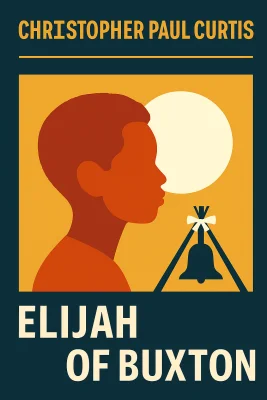
Elijah of Buxton
Categories
Fiction, Audiobook, Historical Fiction, Young Adult, Historical, African American, Childrens, Middle Grade, Canada, Juvenile
Content Type
Book
Binding
Hardcover
Year
2007
Publisher
Scholastic Press
Language
English
ASIN
0439023440
ISBN
0439023440
ISBN13
9780439023443
File Download
PDF | EPUB
Elijah of Buxton Plot Summary
Introduction
In the quiet settlement of Buxton, Canada West, where escaped slaves had found sanctuary, eleven-year-old Elijah Freeman carried a burden no child should bear—he was the first person born free in this haven of hope. While other children played at being abolitionists and slavers, Elijah's world was about to collide with the brutal reality of human bondage that lay just across the border. When a mysterious preacher arrived with tales of stone-throwing gifts from Jesus and promises of easy money, Elijah's simple life began to unravel. What started as innocent fascination with a charismatic stranger would lead the boy into the darkest corners of America, where chains rattled in hidden stables and freedom was measured in heartbeats. The child who once threw up on Frederick Douglass would soon discover that some journeys strip away innocence forever, leaving only the choice between courage and cowardice.
Chapter 1: The Fragile Boy of Buxton: Life in Freedom's Haven
The snake lay coiled in the dirt between young Elijah Freeman and his destiny, its presence transforming a simple afternoon into another reminder of why the adults called him fragile. In the settlement of Buxton, where former slaves had carved freedom from Canadian wilderness, being fragile was the worst thing a boy could be. "It's just a garden snake, 'Lijah," his mother Sarah said, kneeling beside the terrified eleven-year-old who had scattered his fishing gear in his haste to escape. "Lord knows you got to quit running from every little thing that moves." But Elijah's trembling wasn't about the snake—it was about the weight of expectations in a place where courage was currency. Buxton thrived because its residents had risked everything for liberty. These were people who had walked through swamps with dogs baying behind them, who had hidden in root cellars while slave catchers prowled above. They had earned their freedom with blood and determination. Elijah, however, had been born free. He carried no scars from shackles, bore no memories of the lash. His only claim to fame was an embarrassing encounter with the great Frederick Douglass, when as a baby he had vomited on the famous abolitionist during a celebration. The incident had become settlement legend, another mark of his supposed frailty. His father Spencer watched from the porch, whittling with the patient resignation of a man who loved his son but worried about his backbone. "Sarah, the boy's gonna have to learn to face things head-on. World ain't gonna coddle him forever." The settlement's rules were simple: everyone worked, everyone contributed, everyone stood ready to defend their neighbors. When the Liberty Bell rang its brazen song across the fields, it meant another soul had reached sanctuary. Elijah had heard that sound dozens of times, had watched hollow-eyed refugees stumble into town with stories that made grown men weep. Yet here he was, trembling at a harmless snake while his parents exchanged those worried glances that spoke of disappointment and fear for his future. In a place where strength was survival, fragility was a luxury no one could afford.
Chapter 2: Lessons in Trust and Betrayal: The Preacher's Deception
The Right Reverend Deacon Doctor Zephariah Connerly the Third arrived in Buxton like smoke—impressive, mysterious, and leaving everyone slightly unsettled. Unlike the settlement's residents, who wore their histories of bondage like invisible badges, the Preacher carried himself with the swagger of a man who had never bowed to anyone. He found Elijah studying strange tracks in a garden—long, sinuous marks that had puzzled the boy and his friend Cooter. With theatrical flair, the Preacher examined the mysterious impressions, his face growing grave. "Lord, have mercy," he whispered, then louder: "Hoop snakes! I warned them to check the new arrivals more carefully." The Preacher's tale unfolded like a nightmare. These weren't ordinary serpents, he explained, but deadly creatures from the American South that could form circles with their tails in their mouths, rolling after prey like deadly wheels. Their bite caused victims to swell for seven days before exploding, leaving only the head intact to watch the horror unfold. Elijah's blood ran cold as the Preacher painted pictures of rolling death, of venomous wheels pursuing helpless victims across moonlit fields. The man's pearl-handled pistol gleamed at his hip, lending credibility to his wild claims. "If I'm ever bitten," the Preacher declared solemnly, "you must promise to shoot me dead rather than let me suffer such an end." But Elijah's mother saw through the deception with the sharp eyes of someone who had survived real monsters. "Ain't nothing in the world worth being that afraid of, son," she told her trembling boy later. "That man ought to be ashamed, filling children's heads with such nonsense." The lesson cut deeper than snake fangs. In demonstrating the power of lies wrapped in authority, the Preacher had revealed something crucial about trust and manipulation. He had shown how easily fear could be weaponized, how a silver tongue could make the impossible seem real. What Elijah didn't yet understand was that this lesson in deception was merely preparation for betrayals that would shatter more than childhood innocence.
Chapter 3: Dreams Stolen: Mr. Leroy's Desperate Quest
Mr. Leroy was a machine made of flesh and bone, his axe singing through Canadian timber with mechanical precision. For four years, he had worked dawn to dusk, saving every penny to buy his family's freedom from the plantation hell he had escaped. His wife, his son Ezekial, his daughter—they remained in Kentucky, property to be bought and sold while he split logs and counted coins. The rhythm of his work was Buxton's heartbeat: chop-breathe-pull-chop, a percussive prayer that echoed across the settlement. Other men rested on Sundays; Leroy worked harder. Other men spent evenings talking; Leroy sharpened his tools by lamplight. The scars on his hands told stories of splinters and blisters, but his eyes held something more dangerous—hope measured in dollars and cents. When Mrs. Holton's tragedy struck—news that her husband had been whipped to death trying to escape back to his family—she made a decision that changed everything. The widow approached Leroy with a wooden box containing twenty-two hundred dollars in gold, the money she had saved to buy her husband's freedom. "You need this more than me now," she said simply. The hardest man in Buxton collapsed like a felled tree, weeping into the dirt as four years of iron discipline crumbled. The gold meant his family could be free within months instead of years. It meant his son Ezekial would never feel the overseer's whip, that his daughter would never be sold away like livestock. But desperation makes men vulnerable to predators who speak in honeyed words about quick solutions and certain success. The Preacher materialized beside Leroy's joy like a shadow across sunlight, speaking of contacts in Michigan, of reliable white abolitionists who could arrange everything discreetly. "Brother Leroy," the Preacher said, his smile bright as his silver pistol, "the Lord rewards good works. Let me help you get what you deserve." That word—deserve—should have been warning enough. In Elijah's father's philosophy, it was a snake-word that always preceded a bite. But hope can be more blinding than fear, and Leroy clutched his golden dreams too tightly to see the trap closing around them.
Chapter 4: Journey into Darkness: Crossing the Border of Freedom
The ferry to Detroit cut through waters that divided more than geography—they separated hope from heartbreak, freedom from bondage, innocence from bitter knowledge. Elijah pressed against the rail, watching Canada shrink behind them, unaware that he was crossing a threshold from which there would be no return unchanged. Mr. Leroy had died clutching his chest on a dirt road in Michigan, his final words a desperate plea for someone to retrieve his stolen gold from the slave catchers' stable. The Preacher lay dead too, hanging like a grotesque scarecrow in that same building, punishment for cheating at cards and losing everything he had stolen. The stable stood at the edge of a logging town, its exterior innocent as any barn. But inside, the air thick with fear and human misery told a different story. Five escaped slaves sat chained to the walls—a woman named Chloe clutching her baby daughter, her husband Kamau, and three other African men whose names would never be recorded in any freedom song. The chains weren't merely metal—they were the physical manifestation of a system that reduced human beings to property. Each link represented generations of stolen lives, of children sold away from mothers, of dreams crushed under the weight of bondage. Elijah had played at being an abolitionist countless times, imagining heroic rescues and dramatic escapes. Reality tasted of desperation and smelled of defeat. These weren't the grateful, smiling freed slaves of childhood games. They were broken people whose spirits had been systematically destroyed, who had run toward freedom only to find themselves one hour short of the Canadian border. "Boy," Chloe whispered, her voice carrying the weight of impossible choices, "you see how much my baby loves you?" The question seemed nonsensical—the infant was too weak to love anyone. But in Chloe's eyes, Elijah glimpsed something that would haunt him forever: a mother's willingness to sacrifice everything, even the truth, to save her child from a lifetime of chains.
Chapter 5: Chains and Conscience: The Face of True Slavery
The stable revealed slavery's true face—not the sanitized version from textbooks, but the raw reality of human beings reduced to inventory. Chloe's baby girl barely clung to life, her tiny frame ravaged by the journey that had brought them so close to freedom before capture. The men bore wounds from the slave catchers' dog, their bodies marked by violence that was casual, efficient, and utterly dehumanizing. Elijah offered water with trembling hands, watching grown men weep at this simple kindness. In Buxton, water was abundant, taken for granted. Here, it was precious as gold, rationed by captors who saw their prisoners as livestock to be maintained, not people to be cared for. The youngest captive, barely older than Elijah himself, clung to the boy's hand with desperate gratitude. His tears had carved channels through the grime on his face, and his chains rattled with each sob. This child had likely never known freedom, had probably been born into bondage only to taste liberation briefly before losing it again. "You can't save us," Chloe told him with brutal honesty. "These chains don't come off with wanting. These slave catchers know their business." The Preacher's corpse hung at the stable's far end, testament to what happened to those who crossed professional kidnappers. His silver tongue had earned him a violent death, his pearl-handled pistol useless against men who lived by different rules than civilization acknowledged. But Chloe had claimed that pistol, and in her hands it represented something more complex than simple vengeance. She spoke in coded language about her baby's future, about choices that defied comprehension. When she praised how much the infant "loved" Elijah, she was speaking a mother's desperate mathematics—calculating the difference between a life in chains and no life at all. The weight of understanding settled on Elijah's shoulders like lead. This wasn't adventure or heroics. This was witnessing the machinery of human trafficking, seeing how easily people could disappear into a system that measured lives in dollars and cents.
Chapter 6: The Weight of Choice: A Child's Impossible Decision
Understanding came like lightning—sudden, brilliant, and devastating. When Chloe spoke of her baby's love for Elijah, she wasn't describing infant affection. She was offering her daughter a chance at the one thing she herself would never have: freedom through sacrifice that transcended biology. "My ma," Elijah heard himself lie, "she lost a baby that looked just like yours. Been mourning in black ever since, saying she'd give anything for another little girl to raise." The words tumbled out in elaborate fiction about his mother's grief, about how seeing this baby might heal a woman's broken heart. Each lie felt like swallowing poison, but Chloe's eyes blazed with something brighter than hope—they held desperate love making calculations no parent should have to make. "Your poor ma," Chloe whispered, understanding perfectly the language they were speaking. "She sure has raised a fine boy. A fine, fine boy." The baby girl—Hope, her mother called her, though her father's name for her was Too-mah-ee-nee—seemed to sense the gravity of the moment. She wrapped tiny fingers around Elijah's thumb with surprising strength, as if already learning to hold tight to the hand that would carry her to safety. Kamau, her father, held his daughter one final time, whispering African words that sounded like prayers or blessings or both. His tears mixed with blood from the wounds the slave catchers had given him, but his voice remained steady as thunder when he thanked the boy who would steal his daughter's heart to save her life. "She full-blood African," Chloe said through her tears. "Her pa say he use to be a king. And I believe him." The six-shooter felt impossibly heavy in her hands as she spoke of tomorrow's dawn, when the slave catchers would return to drag their human cargo south. Her smile was terrible in its serenity—a mother's final gift to ensure her daughter would never wear chains. Elijah understood then that some rescues require more courage than heroes possess, and some loves demand sacrifices that break the hearts they're meant to save.
Chapter 7: Carrying Hope: The Long Road Home
The ferry back to Canada carried more than passengers—it transported a future stolen from the jaws of slavery, wrapped in a baby's blanket and renamed Hope. Elijah held Too-mah-ee-nee against his chest, feeling her heartbeat against his ribs like a captured bird learning to trust new hands. Behind them, Michigan disappeared into morning mist, but the memory of that stable would never fade. The sounds of chains and weeping, the smell of fear and desperation, the sight of human beings reduced to property—these would echo in his dreams for years to come. He had left Buxton as a fragile boy playing at adventures. He returned as something else entirely. The baby stirred in his arms, tiny fingers grasping at his hair with unconscious trust. She didn't understand that she was crossing from bondage to freedom, that the invisible line drawn by the Detroit River separated her from a lifetime of chains. She knew only warmth and safety, the steady rhythm of his heartbeat promising protection. As Canadian shores grew larger, Elijah practiced the welcome ritual he had witnessed dozens of times. "Look at that sky!" he whispered to Hope, pointing toward clouds painted gold by sunrise. "Ain't that the most beautiful sky you ever seen?" She smiled and spit up on his shirt, making him laugh despite the weight of what he carried. This tiny girl represented more than survival—she was proof that sometimes the deepest love requires the hardest choices, that freedom's price is often paid by those who will never taste it themselves. The Liberty Bell would ring for Hope Too-mah-ee-nee when they reached Buxton, its bronze voice announcing another soul delivered from bondage. But Elijah knew the real victory belonged to a woman named Chloe, who had transformed despair into sacrifice, chains into wings, and certain death into uncertain hope. In his arms, the future slept peacefully, dreaming whatever dreams come to those who have been loved enough to be given away.
Summary
Hope Too-mah-ee-nee grew up in Buxton knowing only freedom, raised by Mrs. Brown, whose mourning clothes gave way to colors again as she found purpose in nurturing a child who bore the features of distant Africa and the strength of parents who chose love over possession. The baby thrived in Canadian soil, her laughter echoing where her mother's chains had never rattled, her feet running free across land that recognized no masters. Elijah Freeman never spoke of fragility again. The boy who had trembled at garden snakes had carried human cargo across the border between worlds, had witnessed love so fierce it demanded the ultimate sacrifice. He kept Chloe's story locked in his heart alongside the names she had whispered in that terrible stable, understanding finally that courage isn't the absence of fear—it's the willingness to act despite terror, to choose hope even when hope seems impossible. In the end, the first child born free in Buxton had learned that freedom's greatest lesson isn't about escape from chains, but about the invisible bonds of responsibility that connect one human heart to another across any distance, any border, any barrier that hatred might construct.
Best Quote
“Doggone it all!” ― Christopher Paul Curtis, Elijah of Buxton
Review Summary
Strengths: The review highlights the originality of the plot and the exceptional character development, noting that the story of Eli, the first free-born black child of Buxton, is engaging and memorable. The audiobook is praised as a great read, and the book's ability to provoke discussion among young readers is emphasized. The lessons within the story are described as poignant and impactful. Weaknesses: The review does not explicitly mention any weaknesses in the narrative or writing style. However, it suggests that the dialect used in the novel may challenge younger readers. Overall: The review conveys a positive sentiment, recommending the book for mature readers or as a family read-aloud to facilitate discussion of its themes. It is suggested for readers aged 13 and above.
About Author

Christopher Paul Curtis
Curtis delves into the intricacies of African American life in mid-20th century America, using the vibrant backdrop of Flint, Michigan, as a significant influence in his storytelling. His books delve into themes such as racism, poverty, and segregation, often through the eyes of African American boys. Curtis’s narrative style combines humor with serious subject matter, a method that brings historical realities into sharp focus while maintaining relatability for young readers. This unique approach is evident in works like "Bud, Not Buddy," where Curtis draws inspiration from his own familial history, embedding personal and cultural authenticity into his stories.\n\nBeyond his narrative techniques, Curtis's literature serves as a powerful tool for education. His ability to present historical injustices through engaging storytelling makes his work invaluable in educational settings, where his books are often included in literature curricula. The author’s early book, "The Watsons Go to Birmingham – 1963," is a prime example, recognized for its excellence with a Newbery Honor and the Coretta Scott King Honor Award. By incorporating humor and profound themes, Curtis creates a compelling narrative that enlightens readers about the past and encourages empathy and understanding.\n\nCurtis's commitment to literacy extends beyond his writing. Through initiatives like the Nobody but Curtis Foundation, he aims to improve literacy levels among children and young adults across North America and Africa. His impact is not only evident in his accolades, such as being the first African American man to win the Newbery Medal, but also in his contributions to the literary world and society at large. This bio captures Curtis’s journey as an influential figure in children’s literature, whose works resonate with readers and educators alike, fostering a deeper understanding of cultural and historical contexts.
Read moreDownload PDF & EPUB
To save this Black List summary for later, download the free PDF and EPUB. You can print it out, or read offline at your convenience.
Elijah of Buxton
by Christopher Paul Curtis
