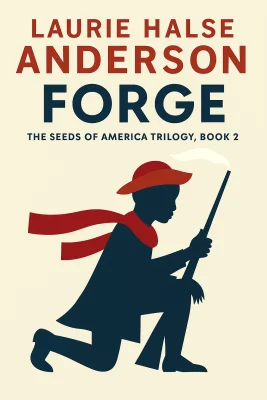
Forge
The Seeds of America Trilogy, Book 2
Categories
Fiction, Historical Fiction, Young Adult, Historical, African American, American Revolutionary War, Childrens, War, Middle Grade, American Revolution
Content Type
Book
Binding
Audible Audio
Year
2020
Publisher
Listening Library
Language
English
ASIN
B08N5CF8BV
File Download
PDF | EPUB
Forge Plot Summary
Introduction
The bitter wind of January 1778 carried the sound of ten thousand men learning what freedom truly costs. At Valley Forge, Pennsylvania, the Continental Army huddled in hastily-built huts, their breath freezing as they slept on straw that had long since rotted beneath them. Among them was Curzon, a young black soldier who had fought at Saratoga and survived the hell of British prisons, only to discover that liberty came with its own chains. When his former master James Bellingham arrived at camp claiming ownership, Curzon's world tilted on its axis. Stripped of his uniform and his freedom in a single court-martial, he found himself serving not his country but the very man who had betrayed his trust. Yet in the depths of this new bondage, an unexpected reunion awaited—Isabel, the scarred girl who had once rowed him to freedom across an icy river, now wore an iron collar around her neck. Their paths had twisted through different hells to converge again in this crucible of war, where the forge of revolution would test not just armies, but the very souls of those caught between slavery and liberty.
Chapter 1: The Crucible of Battle: Curzon's Return to Arms
The morning mist still clung to the ravine when Curzon heard the crack of musket fire echoing through the New York wilderness. He had been searching for the road to Albany since dawn, cursing the wagon driver Trumbull who had cheated him of wages and left him wandering these godforsaken woods with nothing but stolen spoons in his haversack. A British soldier stumbled into the clearing, chased by a gap-toothed rebel boy barely old enough to shave. The redcoat's hands shook as he tried to reload his musket while the young Patriot fumbled with his powder horn. Death hung between them like smoke from a cold fire, and Curzon knew that in seconds, one of these boys would be screaming his last breath into the October air. Without thinking, he hurled a rock at the British soldier, throwing off his aim just as the trigger pulled. The rebel boy's musket roared in response, tearing open the redcoat's belly in a spray of blood and torn cloth. The dying man's screams filled the forest as his life poured out onto the fallen leaves, his boots twitching in the final spasms of agony. "I'm Ebenezer Woodruff," the boy gasped, wiping vomit from his chin. "You saved my life." The sound of cannon fire rolled across the hills like thunder, and Eben's eyes blazed with sudden purpose. "The whole army's marching. If we win today, it could end the war." Curzon felt something stir in his chest—a compass needle swinging toward a destination he couldn't name. He took the dead soldier's musket, its stock slick with blood, and followed the boy toward the sound of battle. Behind them, the British soldier's sightless eyes stared at the sky, and crows began to gather in the trees above his corpse.
Chapter 2: Valley of Trials: Winter's Brutal Tempering
The log city of Valley Forge rose from the Pennsylvania mud like a fever dream of desperation. Ten thousand soldiers, their feet leaving bloody tracks in the snow, hammered together a camp that would either forge them into an army or serve as their collective grave. Curzon found himself among the men of the Sixteenth Massachusetts, sharing a crude hut with Eben and four others, their breath visible even indoors as they huddled around fires that gave more smoke than heat. Sergeant Caleb Woodruff, Eben's uncle, taught them the brutal mathematics of survival. One dull axe to build a sixteen-foot hut. Firecake made from flour and water, baked on hot stones until it could break a rat's teeth. The daily roll call that counted the living, the sick, and those who would never answer again. When they had no meat, they gnawed on strips of leather. When they had no leather, they made soup from bones and bark. The cold was a living thing that crawled into their bones and nested there. Curzon watched men lose toes to frostbite, saw them wrap their feet in rags and keep marching. The lucky ones had shoes; the unlucky left crimson footprints in the snow. At night, six men slept in bunks stacked like cordwood, their bodies pressed together for warmth that never quite came. Yet something remarkable began to happen in that frozen wasteland. Baron von Steuben arrived with his dog and his curses, teaching them to move as one body across the muddy parade ground. "Soldiers who march together make an army of steel," he shouted, his fist raised against the winter sky. Slowly, the ragged collection of farmers and craftsmen began to transform into something harder, sharper. They were being forged in the fires of suffering, hammered into a weapon that could cut the chains of empire. But the hammer was not yet finished with them. In the bitter January cold, Uncle Sergeant's axe slipped, biting deep into his ankle. The bone splintered like kindling, and the field surgeon's saw finished what the blade had started. Eben held his uncle's hand as fever took him, and they buried him in unmarked ground where the British spies couldn't count their dead.
Chapter 3: Chains Reforged: Recaptured by Bellingham
Spring brought more than melting snow to Valley Forge—it brought James Bellingham, Curzon's former master, riding among a congressional committee like a specter from a buried past. Recognition flashed between them across the muddy parade ground, and Curzon felt the earth shift beneath his feet. The man who had once promised him freedom now wore the hungry smile of a creditor come to collect. "This lad used to serve me," Bellingham announced to the assembled officers, his voice cutting through the morning air like a blade. "I thought he died in the British prison." But there was no warmth in his greeting, only the cold calculation of a merchant appraising his property. Within hours, Curzon found himself shackled and dragged before a military court, his service to the Continental Army reduced to a clerical error. The judges sat behind their table like three ravens perched on a gallows beam. Bellingham spun his lies with the practiced ease of a man who had made his fortune trading in human flesh. He had never promised freedom, he claimed. The boy had enlisted illegally, stealing the army's bounty while still bound in servitude. When Curzon tried to speak the truth, the judges demanded proof he could not provide. Two votes against one. The gavel fell like the crack of a whip, and Curzon's world collapsed into its component parts: slave, property, thing. As they dragged him from the courtroom, his legs barely carrying him, he caught a glimpse of his former comrades watching from the crowd. Eben's gap-toothed face was twisted with helpless rage, but there was nothing any of them could do. The law had spoken, and the law knew only the color of his skin and the contents of Bellingham's purse. That night, as he lay chained in a wagon beside barrels of flour, Curzon stared up at stars that no longer seemed to shine with the light of freedom. The revolution had betrayed him as surely as any king, and he understood now that liberty was not a gift to be given but a prize to be seized. In the darkness, he began to plan.
Chapter 4: Embers of Hope: Reunion with Isabel
Moore Hall squatted in the Pennsylvania countryside like a fortress of genteel tyranny, its windows glowing with candlelight while servants scurried through corridors that reeked of privilege and pipe smoke. Curzon found himself thrust back into the familiar hell of service, polishing boots and serving wine while Bellingham entertained congressmen and generals with tales of his patriotic sacrifice. But it was in that same house that fate delivered its cruelest joke. She entered the dining room carrying a tea tray, her face a mask of studied indifference, and for a moment Curzon thought his eyes had conjured her from pure longing. Isabel—taller now, harder, with new lines of pain etched around her eyes. The scar on her cheek had faded but not disappeared, a brand that marked her as surely as the iron collar hidden beneath her neck cloth. They had been children when they escaped together across the frozen Hudson, rowing toward a freedom that proved as illusory as morning mist. Now they were something else—survivors who had learned that hope was a luxury they could no longer afford. Isabel's eyes met his across the crowded room and slid away without recognition, but he caught the slight tremor in her hands as she set down the tray. Gideon, Bellingham's other servant, watched their reunion with the calculating gaze of a man who collected secrets like coins. He was smooth and educated, fluent in French and Italian, and Curzon saw how Isabel's face softened when the older boy spoke to her. Here was competition of a different sort, a battle for influence fought with whispered words and stolen glances rather than muskets and bayonets. In the small hours before dawn, when the house slept and the dying fire cast dancing shadows on the kitchen walls, Isabel finally spoke to him. "You're still stubborn," she said, her voice carrying the weight of all the miles they had traveled apart. "And you're still vexing." But there was something else in her tone—a note of desperate relief, as if she had been holding her breath for months and could finally exhale. They were prisoners again, but at least they were prisoners together.
Chapter 5: Hammered by Circumstance: Surviving Moore Hall
The iron collar around Isabel's neck was Bellingham's masterpiece of cruelty, a device that announced her bondage to the world while the small brass bells attached to it tinkled like wind chimes when she walked. "The ladies find the sound delightful," she explained with bitter irony as Curzon stared in horror at the metal band that had rubbed her skin raw. The lock was cunningly made, and Bellingham wore the key on a cord around his neck like a talisman. Winter deepened around Moore Hall, and with it came the endless parade of officers and politicians who treated the house like their private club. Curzon served their meals and cleaned their chambers while listening to their debates about the war's progress. France had entered the conflict as America's ally, they said, and the British were growing desperate. But these strategic discussions felt distant and abstract when weighed against the immediate reality of survival. Gideon proved to be more dangerous than any British spy. He whispered poisonous suggestions in Isabel's ear, speaking of escape plans and freedom while his eyes lingered on the curve of her neck above the iron collar. Curzon saw through his smooth words to the predator beneath, but Isabel seemed drawn to Gideon's worldly sophistication and his promises of a new life beyond the reach of masters and overseers. The nights were the worst, when Curzon lay in his drafty shed behind the kitchen and listened to the wind howling through the eaves like the voices of the damned. Through the thin walls, he could hear the gentlemen drinking and laughing, their conversation a constant reminder of the gulf between those who owned and those who were owned. Sometimes he dreamed of his friends at Valley Forge, wondering if they still kept a place for him in their ranks or if they had forgotten him entirely. But always, his thoughts returned to Isabel and the impossible puzzle of her freedom. The collar was more than metal and lock—it was a symbol of everything wrong with a world that could speak of liberty while keeping human beings in chains. If he could solve that puzzle, if he could find a way to break those bonds, then perhaps there was still hope for both of them.
Chapter 6: The Final Casting: Breaking Free and Rejoining the Fight
May brought warm breezes and the scent of possibility to Moore Hall, along with news that set Curzon's heart racing like a war drum. Lafayette was leading troops out of Valley Forge—Poor's brigade among them, which meant Eben and the others were finally marching to war. The knowledge that his friends were moving while he remained trapped felt like a blade twisting in his chest. The opportunity came when Bellingham demanded a late-night bath, stripping away his clothes and the cord that held the precious key. As his former master soaked in the copper tub, Curzon pressed the key into soft candle wax, creating an impression that might—if luck and skill combined—become the tool of Isabel's liberation. The deception required nerves of steel and perfect timing, but the alternative was a lifetime of servitude. Their stolen moments together became lessons in desperation. They heated lead musket balls over the kitchen fire and poured the molten metal into a sand mold, trying to cast a duplicate key that might fool the lock around Isabel's neck. It was crude work, more hope than technique, but it was all they had. The key that emerged from their makeshift foundry was rough and barely resembled its original, yet it represented something more valuable than gold—the possibility of choice. Gideon's sudden appearance shattered their careful plans like a stone through glass. He had returned from his mysterious errands with a horse and grand promises, urging Isabel to flee with him into the night. But when she stepped into the darkness, something inside her rebelled. The ghosts that had guided her before—spirits she claimed to sense but not see—withdrew their blessing from the escape. She returned to the kitchen as dawn broke, choosing uncertainty with Curzon over false promises with a smooth-talking stranger. The moment of truth came when Bellingham discovered their plot and confronted them with a pistol in his shaking hands. But the weapon was empty, his threats as hollow as his promises of freedom. In the struggle that followed, it was Isabel who brought the shovel crashing down on his skull, and Curzon who finally turned the real key in the lock of her collar. The iron band fell away like shed skin, and for the first time in months, she could touch her own throat without feeling the weight of bondage. They bound Bellingham with his own chains and left him secured in the barn, a fitting reversal that would have amused them if they had time for such luxuries. Instead, they ran toward the sound of marching feet and the promise of an army that might—just might—make room for two more soldiers in the ranks. Behind them, the collar's key sank beneath the waters of Valley Creek, and ahead lay the uncertain road to whatever freedom they could seize with their own hands.
Summary
The forge of Valley Forge had done its work on more than just the Continental Army. In that crucible of cold and hunger, Curzon and Isabel were hammered into something harder than they had been before—not just survivors, but fighters who understood that liberty could not be granted by others but must be claimed through will and courage. Their reunion in bondage became the catalyst for a different kind of revolution, one fought not on battlefields but in the shadowed corners of a war where the color of one's skin could determine whether freedom was a birthright or an impossible dream. As they disappeared into the ranks of Lafayette's departing troops, their story became part of the larger tapestry of America's birth—a reminder that the revolution was never just about throwing off the chains of distant kings, but about breaking every chain that bound the human spirit. The iron collar lay rusting at the bottom of Valley Creek, but the courage it had tried to contain marched on with the army, carried in the hearts of two young people who had learned that sometimes the greatest battles are fought not for nations, but for the simple right to choose one's own destiny. In their flight toward an uncertain future, they embodied the revolutionary spirit that no proclamation could grant and no master could truly own.
Best Quote
“This camp is a forge for the army; it's testing our mettle. Instead of heat and hammer, our trials are cold and hunger. Question is, what are we made of?” ― Laurie Halse Anderson, Forge
Review Summary
Strengths: The book effectively intertwines historical events with original plot development, maintaining reader interest. Laurie Halse Anderson's writing is engaging, making historical fiction appealing even to those who typically do not enjoy the genre. The novel provides accurate and vivid descriptions of the Revolutionary War, particularly the harsh conditions at Valley Forge, and captures the idealism and courage of young colonial fighters. Weaknesses: The reintroduction of Isabel is perceived as awkward and her relationship with Curzon feels rushed and underdeveloped. Some plot elements, such as revelations, are not fully explored. Overall: The review reflects a generally positive sentiment towards "Forge," appreciating its historical accuracy and engaging narrative. It is recommended for fans of historical and young-adult fiction, despite some character development issues.
About Author

Laurie Halse Anderson
Anderson reframes historical and contemporary narratives to address pressing social issues, delving into themes of trauma, identity, and resilience. Her literary works, such as the groundbreaking "Speak", examine difficult subjects like sexual violence with both emotional depth and intellectual rigor, thereby providing a platform for survivor advocacy and encouraging discussions on intellectual freedom. Through novels like "Chains" and the recently acclaimed "Rebellion 1776", she connects past and present struggles for justice and equality, resonating with young readers seeking meaning and truth in a complex world.\n\nWhile Anderson's career began with journalism and children's literature, her transition into young adult fiction marked a significant shift in her exploration of darkly radiant realism. This approach is evident in works like "Wintergirls" and "Shout", where she combines stylistic precision with unflinching honesty to navigate themes of pain, love, and social class. As an advocate against censorship, she actively champions intellectual freedom, having been recognized by the National Coalition Against Censorship. Her books, selling over eight million copies worldwide, continue to impact readers by fostering empathy and understanding, making her a vital voice in literature.\n\nIn recognition of her contributions, Anderson has received numerous honors, including the prestigious Astrid Lindgren Memorial Award. This accolade, often regarded as the Nobel Prize for Children's Literature, underscores her influence and dedication to storytelling that enlightens and empowers. For those exploring the intersections of history, identity, and social justice, Anderson's books offer not just stories, but a lens through which to view and understand the world.
Read moreDownload PDF & EPUB
To save this Black List summary for later, download the free PDF and EPUB. You can print it out, or read offline at your convenience.
Forge
by Laurie Halse Anderson
