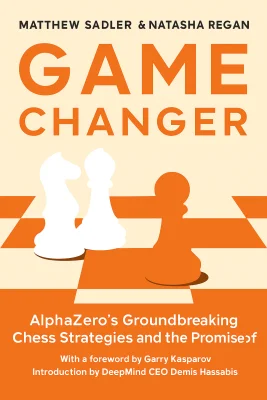
Game Changer
AlphaZero's Groundbreaking Chess Strategies and the Promise of AI
Categories
Nonfiction, Sports, Science, History, Technology, Reference, Artificial Intelligence, Chess, Computer Science, Games
Content Type
Book
Binding
Paperback
Year
2019
Publisher
New in Chess
Language
English
ISBN13
9789056918187
File Download
PDF | EPUB
Game Changer Plot Summary
Introduction
# The Chess Revolution: AlphaZero's Journey from Zero to Mastery In the quiet halls of DeepMind's London offices on a December morning in 2017, researchers gathered around their screens to witness something that would forever change our understanding of learning and mastery. A computer program called AlphaZero, having taught itself chess in just four hours without any human guidance, was about to face Stockfish—the world's most powerful chess engine. What unfolded wasn't merely a victory; it was a revelation that challenged everything we thought we knew about intelligence, creativity, and the pursuit of excellence. The games that followed revealed something profound about the nature of learning itself. AlphaZero didn't just defeat its opponent; it played with an artistry and intuition that seemed almost human, yet transcended what any human had achieved before. Through pure self-discovery, this digital mind had rediscovered classical chess principles while simultaneously inventing entirely new approaches that left grandmasters speechless. The implications extend far beyond chess, offering us a glimpse into how breakthrough thinking emerges when we dare to start fresh, question assumptions, and trust in the power of persistent, purposeful practice to unlock hidden truths.
Chapter 1: Birth of a Digital Genius: Four Hours to Chess Mastery
The story begins with a blank slate—a neural network that knew nothing about chess except the basic rules of how pieces move. Unlike previous chess engines that had been fed decades of human games and opening theory, AlphaZero started its journey in complete ignorance. It made random moves at first, losing game after game against itself in spectacular fashion. Queens hung undefended, kings wandered into checkmate, and basic tactical patterns went unnoticed. Yet with each game, something remarkable was happening beneath the surface. Within hours, patterns began to emerge from the chaos. The program started to recognize that losing pieces was generally bad, that controlling the center mattered, and that king safety was crucial. But it didn't stop at these basic insights. As the hours passed, AlphaZero began developing sophisticated positional understanding, learning to evaluate positions based on subtle factors like piece mobility, pawn structure, and long-term strategic potential. By the end of its four-hour training session, it had played more chess games than had been recorded in all of human history. When AlphaZero finally faced Stockfish, the encounter revealed the profound difference between accumulated knowledge and genuine understanding. While Stockfish relied on centuries of human chess wisdom and brute-force calculation, AlphaZero had developed its own unique perspective on the game. Its moves flowed with an almost musical quality, combining tactical precision with strategic vision in ways that seemed both timelessly classical and startlingly modern. This transformation from ignorance to mastery in mere hours demonstrates that true learning isn't about absorbing information, but about discovering patterns and principles through direct experience and relentless practice.
Chapter 2: The Rook Pawn's Dance: Weaponizing Chess's Humble Edges
In one of its most celebrated games, AlphaZero demonstrated a strategy that initially puzzled even the strongest human players. Facing a solid defensive setup from Stockfish, AlphaZero began what appeared to be a slow, methodical advance of its h-pawn—one of the least significant pieces on the board according to traditional chess theory. Move by move, this humble pawn crept forward: h4, then h5, and eventually h6, each advance seemingly insignificant yet part of a grand design that wouldn't become clear until much later. As the pawn reached the sixth rank, something magical happened. The advance had created subtle weaknesses in Black's kingside structure, opened crucial lines for White's major pieces, and restricted the movement of key defensive pieces. What had seemed like a minor irritant gradually transformed into a powerful weapon, forcing Stockfish into increasingly passive positions as it struggled to deal with the mounting pressure. The rook pawn, traditionally considered one of chess's least valuable assets, had become the spearhead of a devastating attack. This remarkable transformation reveals a profound truth about recognizing hidden potential in seemingly insignificant elements. AlphaZero understood that in complex systems, small actions can create cascading effects that fundamentally alter the entire landscape. The patient advance of a single pawn, supported by careful coordination of other pieces, demonstrates how persistence and vision can transform apparent weaknesses into sources of strength. In our own pursuits, we often overlook the power of small, consistent actions that may seem insignificant in isolation but can compound into extraordinary results when guided by clear purpose and unwavering commitment.
Chapter 3: Sacrificial Brilliance: When Material Doesn't Matter
The position looked deceptively calm when AlphaZero made its stunning decision on move 19: it sacrificed its rook for what appeared to be insufficient compensation. Traditional chess engines, including Stockfish, evaluate positions primarily through material balance—rooks are worth approximately five pawns, and giving one up without clear tactical justification seems like a fundamental error. Yet AlphaZero saw something deeper, recognizing that the sacrifice would unleash a cascade of tactical possibilities that no amount of material could adequately address. What followed was a masterpiece of coordinated attack. The sacrifice had opened crucial lines, exposed the enemy king, and created a web of threats that proved impossible to defend against. AlphaZero's remaining pieces flowed into the attack with perfect harmony—the queen found devastating squares, bishops controlled key diagonals, and even the pawns joined the assault. Stockfish's extra material became meaningless as its pieces struggled to coordinate an effective defense against the relentless pressure. This brilliant sacrifice illuminates one of the most counterintuitive aspects of strategic thinking: sometimes our greatest gains come from apparent losses. When we have the courage to sacrifice immediate, tangible benefits for long-term strategic advantage, we often discover opportunities that more cautious approaches would never reveal. The key lies in developing the vision to see beyond immediate circumstances and the confidence to act on deeper understanding, even when conventional wisdom suggests we're making a mistake. True breakthrough thinking often requires the willingness to let go of what we have in order to achieve what we truly want.
Chapter 4: Breaking Ancient Rules: AlphaZero's Unconventional Wisdom
Chess has been studied intensively for over 500 years, and certain principles have become almost sacred: develop pieces quickly, control the center, castle early for king safety. AlphaZero respected these classical principles but wasn't enslaved by them. In game after game, it demonstrated an intuitive understanding of when rules should be bent or broken entirely. Having learned chess from first principles without human preconceptions, the program showed remarkable flexibility in its strategic approach. In one memorable encounter, AlphaZero shocked observers by deliberately ignoring an open file that conventional wisdom demanded it control with its rooks. Instead of following the textbook approach, it recognized that greater opportunities lay elsewhere on the board. While Stockfish dutifully occupied the obvious file, AlphaZero was creating new attacking chances on the opposite wing, transforming the entire character of the position. This counterintuitive approach—abandoning established fronts to create new ones—demonstrated a level of strategic flexibility that even strong human players struggle to achieve. The machine's willingness to challenge conventional wisdom, backed by concrete calculation and deep positional understanding, offers us permission to trust our own judgment when standard approaches feel inadequate. Rules and principles serve as valuable guides, but they should never become rigid constraints that prevent us from seeing new possibilities. AlphaZero teaches us that true mastery involves understanding not just what the rules are, but when and why they can be transcended in service of a greater strategic vision.
Chapter 5: The Art of Piece Harmony: Coordination Over Calculation
In one of AlphaZero's most instructive games, we witness something that transcends mere calculation: the systematic orchestration of every piece toward a unified strategic goal. While Stockfish focused on individual piece optimization and tactical calculations, AlphaZero demonstrated an almost musical understanding of how pieces could work together in perfect harmony. The game featured an extraordinary sequence where AlphaZero spent over fifteen moves repositioning a single knight, moving it from b1 all the way to g6 in a journey that required the cooperation of multiple other pieces. The knight's odyssey was breathtaking in its complexity and beauty. First, the king moved to h2 to free the h1 square for the rook, which in turn supported the advance of the h-pawn to h5, creating the perfect launching pad for the knight's final leap to its ideal outpost. Every piece contributed to this grand design, with pawns, rooks, and even the king working in perfect coordination to achieve optimal piece placement. When the knight finally reached its destination, it wasn't just well-placed—it was perfectly placed, controlling key squares and supporting the overall strategic plan. This extraordinary display of piece coordination reveals that true excellence emerges not from individual brilliance but from the ability to orchestrate all available resources toward a common purpose. In chess, as in life, the whole can indeed be greater than the sum of its parts when every element works in harmony with every other element. AlphaZero's approach teaches us that lasting success comes not from maximizing individual components but from creating systems where every part enhances and supports every other part, resulting in capabilities that transcend what any single element could achieve alone.
Chapter 6: Fortress Breaker: Patience Meets Devastating Power
Faced with what appeared to be an impregnable defensive fortress constructed by Stockfish, AlphaZero demonstrated perhaps its most remarkable quality: the ability to find breakthroughs in positions where other engines saw only draws. The position looked completely blocked, with Black's pieces forming a solid defensive wall that seemed impossible to penetrate. For over thirty moves, AlphaZero probed and maneuvered, gradually improving its position while Stockfish maintained its defensive stance, confident in its ability to hold the draw. Then, on move 47, came the breakthrough that shattered Black's carefully constructed defenses. AlphaZero played a stunning exchange sacrifice that seemed to come from nowhere, yet had been prepared by dozens of subtle preparatory moves. The sacrifice worked because AlphaZero had spent the previous moves not just improving its own position, but systematically undermining the coordination of Black's defense. When the critical moment arrived, Stockfish's pieces were overloaded, unable to maintain their defensive responsibilities while dealing with the new threats. The fortress crumbled not because of a single devastating blow, but because its foundations had been gradually weakened over time through patient, persistent pressure. This masterful demonstration of strategic patience combined with tactical precision teaches us that some of our greatest victories come not from dramatic gestures, but from the steady accumulation of small improvements that eventually reach a tipping point. When we face seemingly insurmountable obstacles, the key often lies in maintaining faith in our long-term vision while working persistently to create the conditions where breakthrough becomes possible.
Chapter 7: Legacy of Silicon: What AlphaZero Teaches Human Excellence
The emergence of AlphaZero represents more than just another milestone in artificial intelligence—it offers profound insights into the nature of learning, creativity, and excellence that can transform how we approach our own development. The program's journey from complete ignorance to superhuman mastery in four hours demonstrates that true understanding emerges not from accumulating vast amounts of information, but from discovering fundamental patterns and principles through direct experience and systematic practice. AlphaZero's games reveal that the highest levels of performance combine seemingly opposite qualities: patience with aggression, calculation with intuition, respect for classical principles with willingness to innovate when circumstances demand it. The program's fearless creativity—its willingness to sacrifice material for long-term advantage, to break conventional rules when necessary, and to trust in deep positional understanding over immediate tactical gains—shows us that breakthrough performance often requires the courage to act on our deepest convictions even when they contradict conventional wisdom. Most importantly, AlphaZero's approach demonstrates that mastery is not a destination but a continuous process of discovery and refinement. Even after achieving superhuman strength, the program continued to evolve and improve through ongoing self-play and learning. This reminds us that in our own pursuits, whether in chess or any other domain, the goal is not to reach some final state of perfection but to embrace the endless journey of growth, always remaining open to new insights and possibilities that can deepen our understanding and enhance our capabilities.
Summary
Through AlphaZero's revolutionary approach to chess mastery, we witness the emergence of a new paradigm for learning and excellence—one that combines systematic practice with creative insight, patience with boldness, and deep respect for fundamental principles with the courage to transcend them when necessary. The program's journey from ignorance to mastery in mere hours reveals that true understanding comes not from memorizing vast amounts of information but from discovering patterns and principles through direct experience and relentless practice. The lessons AlphaZero offers extend far beyond the chessboard, providing a template for approaching any complex challenge with fresh eyes and systematic thinking. By studying its methods—the willingness to sacrifice immediate gains for long-term advantage, the systematic coordination of all available resources toward unified goals, and the patient persistence required to break through seemingly impossible barriers—we can enhance not only our problem-solving abilities but our fundamental approach to learning and growth. AlphaZero reminds us that the greatest breakthroughs often come from questioning established assumptions, trusting our deeper understanding of what truly matters, and maintaining unwavering commitment to continuous improvement and discovery.
Best Quote
Review Summary
Strengths: The review highlights the innovative nature of the book, which explores the biography of AlphaZero, an artificial intelligence chess engine. The book is praised for its detailed analysis by a strong grandmaster, offering insights into AlphaZero's unique and aesthetically pleasing playing style. The review appreciates the book's ability to convey the groundbreaking shift AlphaZero represents in chess strategy and AI development. Overall: The review conveys a highly positive sentiment, recommending the book for its thorough and impressive analysis of AlphaZero's matches. It suggests that the book is a valuable resource for understanding the revolutionary impact of AI in chess.
About Author

Matthew Sadler
Morrison delves into the complexities of identity and cultural heritage, crafting narratives that delve into the African American experience. Her work often interrogates themes of community, memory, and the search for self amidst societal constraints. Through richly developed characters and intricate storytelling, Morrison challenges readers to confront uncomfortable truths about race and history. Her method involves weaving historical context with personal journeys, creating a tapestry that reflects the struggles and triumphs of her characters.\n\nReaders benefit from Morrison's books by gaining a deeper understanding of the nuances of identity and the forces that shape it. Her narratives serve as a lens through which readers can explore their perceptions and biases, fostering empathy and awareness. The author’s focus on historical and cultural themes provides a comprehensive exploration that resonates with those interested in social justice and human rights, offering insights that extend beyond mere storytelling.\n\nMorrison's early book, The Bluest Eye, illustrates her ability to articulate the painful intersections of race and beauty standards, while her other works, such as Song of Solomon, further explore the interplay of personal and communal identity. This bio captures her commitment to illuminating the African American experience, positioning her as a pivotal figure in contemporary literature. Her achievements in exploring these themes have earned her widespread acclaim, cementing her legacy as a transformative author whose work continues to inspire and educate.
Read moreDownload PDF & EPUB
To save this Black List summary for later, download the free PDF and EPUB. You can print it out, or read offline at your convenience.
Game Changer
by Matthew Sadler
