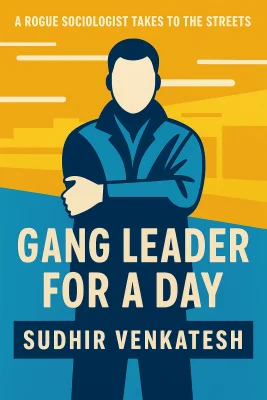
Gang Leader for a Day
A Rogue Sociologist Takes to the Streets
Categories
Nonfiction, Psychology, Biography, Economics, Memoir, Sociology, True Crime, Social Science, Book Club, Crime
Content Type
Book
Binding
Hardcover
Year
2008
Publisher
Penguin Press
Language
English
ISBN13
9781594201509
File Download
PDF | EPUB
Gang Leader for a Day Plot Summary
Introduction
Picture a graduate student from an affluent California suburb walking into one of America's most notorious housing projects with nothing but a clipboard and a questionnaire asking "How does it feel to be black and poor?" What happens next defies every academic protocol and challenges our deepest assumptions about poverty, community, and survival in urban America. When sociologist Sudhir Venkatesh embarked on what was supposed to be a standard survey research project in Chicago's Robert Taylor Homes, he had no idea he was about to spend the next decade immersed in a world that would fundamentally transform his understanding of life in the inner city. This remarkable journey takes us beyond statistics and stereotypes into the complex human reality of one of America's most misunderstood communities. Through extraordinary access to gang leaders, tenant activists, and struggling families, we discover how people create meaning, build relationships, and survive against overwhelming odds. The result is an eye-opening exploration that reveals the profound humanity and intricate social structures that exist within America's most marginalized neighborhoods.
Chapter 1: How Does It Feel to Be Black and Poor
The first question on Sudhir's survey seemed straightforward enough, but when he posed it to a group of young men in a darkened stairwell of a Chicago housing project, their reaction was immediate laughter followed by something much more serious. The gang members who had detained him overnight weren't just amused by the academic's naive inquiry—they were offended by its presumptions. "I'm not black," responded J.T., the charismatic gang leader who would become Sudhir's guide into this hidden world. "I'm a nigger. Niggers are the ones who live in this building. African Americans live in the suburbs." This jarring encounter revealed the first of many uncomfortable truths about academic research on poverty. The standard sociological tools—multiple-choice surveys and statistical analysis—seemed woefully inadequate for capturing the lived reality of people whose daily existence defied the neat categories that scholars preferred. The young men in that stairwell weren't interested in being reduced to data points about urban pathology. They had complex identities, sophisticated understanding of their circumstances, and their own ways of making sense of their place in American society. What struck Sudhir most profoundly was J.T.'s final assessment of his questionnaire: "You ain't going to learn shit with this thing." The gang leader understood something that the graduate student was only beginning to grasp—that real understanding required presence, patience, and a willingness to abandon preconceived notions. J.T.'s alternative suggestion was simple but revolutionary: "You should hang out, get to know what they do, how they do it. No one is going to answer questions like that. You need to understand how young people live on the streets." This moment of recognition would transform not only Sudhir's research methodology but his entire worldview. The sterile distance of traditional sociology gave way to something far messier but infinitely more honest—a commitment to understanding people on their own terms rather than through the lens of academic theory.
Chapter 2: First Days on Federal Street
J.T.'s invitation to "hang out" led Sudhir into the Robert Taylor Homes, a sprawling complex of high-rise buildings that housed nearly 30,000 people in what was essentially a city within a city. Walking through these buildings for the first time, Sudhir encountered a world that defied every stereotype he'd absorbed about public housing. Yes, there was poverty and danger, but there was also community, entrepreneurship, and an intricate social order that governed daily life. The buildings themselves told a story of architectural hubris and urban planning failure. Designed in the 1950s with the best intentions, they had become isolated towers that concentrated poverty while cutting residents off from the broader city. Yet within these concrete walls, families had created homes, children played in the courtyards, and neighbors looked out for one another with a fierce loyalty that suburban America had largely forgotten. J.T. served as both tour guide and protection for Sudhir's explorations. As they walked through the lobbies and climbed the stairwells, it became clear that the young gang leader wielded considerable authority in these buildings. But this wasn't the random violence and chaos that media reports suggested—it was a carefully managed system with its own rules, hierarchies, and codes of conduct. J.T. conducted weekly surveys of his territory, checking on drug sales, mediating disputes, and ensuring that daily life proceeded with minimal disruption. What fascinated Sudhir was how J.T. positioned himself not just as a criminal entrepreneur but as a community leader. He spoke of "helping others" and frequently donated money to local programs and families in need. This apparent contradiction—between lawbreaking and community service—would become a central puzzle in understanding how social order emerged in spaces that mainstream society had largely abandoned. The complexity of life in Robert Taylor challenged every simple narrative about urban poverty. These weren't just victims or villains, but human beings navigating impossible circumstances with creativity, dignity, and remarkable resilience.
Chapter 3: Someone to Watch Over Me
As Sudhir spent more time in the projects, he began to understand the intricate web of relationships that made community life possible. At the center of this web were powerful women like Ms. Bailey, the building president whose authority rivaled that of any gang leader. Ms. Bailey controlled access to apartments, mediated conflicts, and served as the unofficial mayor of her building. Her office was a constant hub of activity where tenants came seeking everything from help with their rent to intervention in domestic disputes. The relationship between Ms. Bailey and J.T. revealed the complex negotiations that shaped daily life in Robert Taylor. While they represented different sources of power—she derived authority from her elected position and connections to city agencies, he from his control of the local drug trade—they often found themselves working together rather than in opposition. When problems arose that the police wouldn't handle or the housing authority couldn't solve, these unlikely allies pooled their resources to maintain order and protect residents. One particularly revealing incident involved Taneesha, a young woman who had been brutally beaten by her boyfriend. When the ambulance failed to respond and the police didn't come, Ms. Bailey organized a group of residents to track down the perpetrator and deliver their own form of justice. This vigilante response wasn't born from a preference for violence but from the harsh reality that formal institutions of protection simply didn't function in their community. Sudhir witnessed Ms. Bailey directing this improvised militia with the skill of a seasoned commander, demonstrating that survival in the projects required constant improvisation and self-reliance. The incident forced him to confront uncomfortable questions about justice, authority, and the price of abandonment by mainstream institutions. When society fails to provide basic protections, communities will create their own—and those alternatives may not conform to middle-class sensibilities about law and order. These experiences revealed how residents of Robert Taylor had developed sophisticated systems of mutual aid and collective security that operated parallel to, and sometimes in conflict with, official institutions. Their methods were often morally ambiguous, but they reflected a deep commitment to community survival that deserved recognition rather than condemnation.
Chapter 4: Gang Leader for a Day
J.T.'s bold challenge to Sudhir—"If you think it's so easy, you try it"—led to one of the most extraordinary experiences in the history of sociological research. For a single day, the graduate student would attempt to manage a crack-dealing operation that generated thousands of dollars in revenue and involved hundreds of people across Chicago's South Side. What seemed like a reckless experiment became a masterclass in the complexity of underground economic management. The day began at dawn with T-Bone, the gang's treasurer, presenting a series of management dilemmas that required immediate attention. Gang members needed to be assigned to clean up after a wild party in one of the buildings—a task that none of them wanted but that was essential for maintaining good relationships with tenant leaders. Disputes between drug dealers had to be adjudicated, with careful attention to precedent and fairness. Relationships with local store owners required delicate negotiation to balance protection services with reasonable fees. As the day progressed, Sudhir accompanied J.T. on visits to dozens of sales locations throughout the city, witnessing the meticulous attention to detail required to manage such a complex operation. Each site had to be monitored for police activity, customer complaints, and potential conflicts with rival gangs. Sales directors submitted detailed reports on weekly revenues, and J.T. cross-referenced their accounts with intelligence from his network of informants to detect any discrepancies or deceptions. The most challenging moment came when Sudhir was required to settle a dispute between two gang members over missing money. The established protocol called for physical punishment, but Sudhir's middle-class sensibilities rebelled against violence. His attempt to find a compromise solution revealed both his fundamental outsider status and the harsh realities of maintaining discipline in an organization that operated outside the law. By day's end, Sudhir had gained profound respect for J.T.'s managerial skills while also understanding the enormous psychological burden of leadership in such a world. Every decision carried the potential for violence, every relationship was shadowed by the possibility of betrayal, and every day brought new threats that required constant vigilance and adaptation.
Chapter 5: Ms. Bailey's Neighborhood
While J.T. commanded attention through his charisma and control of the drug trade, Ms. Bailey wielded a different but equally formidable form of power as the elected building president. Her small office served as the nerve center for a complex web of services, favors, and negotiations that kept her building functioning despite the chronic neglect of the Chicago Housing Authority. From her desk, she arranged everything from apartment repairs to job referrals, mediating disputes and solving problems that would challenge any municipal government. Ms. Bailey's approach to leadership was both more subtle and more comprehensive than J.T.'s. Where he ruled through a combination of fear and largesse, she relied on an intricate system of reciprocal obligations and carefully managed relationships. Tenants who received her help understood that they owed her loyalty and support, while those who crossed her might find themselves facing eviction notices or other bureaucratic harassment. One winter emergency revealed the full scope of Ms. Bailey's capabilities. When the Wilson family's front door literally fell off its hinges during a brutal Chicago cold snap, the housing authority was completely unresponsive to their desperate calls for help. Ms. Bailey immediately sprang into action, arranging for gang members to provide security while she worked her network of contacts to expedite a replacement door. The solution required bribes, favors, and creative bureaucratic maneuvering, but within days the family had both a new door and restored heat. The episode illustrated both Ms. Bailey's remarkable resourcefulness and the moral ambiguity of her methods. She genuinely cared about her tenants' welfare and was willing to use any means necessary to help them, but her assistance came at a price that not everyone could afford. Those without money or connections might find themselves waiting indefinitely for help, while Ms. Bailey's favorites received prompt attention. This system of personalized governance emerged from necessity rather than choice, filling the vacuum left by ineffective public institutions. Ms. Bailey and leaders like her had become indispensable intermediaries between their communities and the outside world, using whatever tools were available to meet their people's basic needs. Their methods might seem corrupt by conventional standards, but they reflected a pragmatic adaptation to circumstances that left few alternatives for effective action.
Chapter 6: The Hustler and the Hustled
After years of observation, Sudhir decided to conduct a systematic study of the underground economy that flourished within Robert Taylor. What he discovered was an intricate network of enterprises that generated income, provided services, and created employment opportunities for hundreds of residents. From car repair and hair styling to food service and childcare, people had created their own economic system that operated entirely outside the formal market. The study revealed fascinating patterns in how different hustlers organized their work and relationships. Women tended to focus on service businesses that built on traditional domestic skills—cooking, cleaning, childcare, and personal services. Men gravitated toward manual labor, car repair, and various forms of arbitrage that involved buying and selling goods. Both groups developed sophisticated strategies for managing risk, avoiding detection by authorities, and building customer loyalty. One of the most successful hustlers was Cordella, an elderly woman who had transformed her apartment into a thriving candy store. Her living room was stacked with boxes of sweets that she sold to neighborhood children, but her real expertise lay in understanding the complex social dynamics of the building. Cordella had once been a madam who organized parties and managed prostitutes, and she used those same organizational skills to create legitimate business opportunities. The underground economy wasn't just about individual entrepreneurship—it was also about collective survival strategies that helped families weather crises and emergencies. Networks of women shared cooking, childcare, and transportation responsibilities, creating informal insurance systems that provided security when formal institutions failed. These arrangements required constant negotiation and adjustment, but they enabled families to maintain stability despite extreme poverty. Sudhir's research revealed that virtually everyone in Robert Taylor was involved in some form of hustling, whether as a primary source of income or as a supplement to welfare benefits. Far from being passive recipients of government aid, residents were active economic agents who displayed remarkable creativity and resilience in generating income and solving problems. However, when Sudhir shared his findings with J.T. and Ms. Bailey, the consequences were swift and harsh. Both leaders immediately began taxing the hustlers he had identified, claiming their cut of previously hidden income streams. The incident forced Sudhir to confront his own role as a hustler who extracted information from vulnerable people, and it permanently damaged his relationships with many residents who felt betrayed by his apparent collaboration with the very authorities they sought to avoid.
Chapter 7: Black and Blue
The relationship between residents and police in Robert Taylor was far more complex and troubling than Sudhir had initially understood. While some officers like Reggie genuinely tried to serve the community with integrity and creativity, others saw the projects as a source of easy money and victims who wouldn't be believed if they complained about abuse. Officer Jerry epitomized this latter category, regularly extorting money from residents and beating those who couldn't or wouldn't pay. Sudhir witnessed Jerry's methods firsthand when he observed the officer breaking down an apartment door and brutally beating a father in front of his family. The message was clear: residents were expected to pay protection money to avoid harassment, and those who refused would face violent consequences. What made these encounters particularly disturbing was the casual nature of the violence and the complete absence of any accountability or oversight. The police raids on gang parties revealed another dimension of the relationship between law enforcement and the drug trade. Rather than making arrests, groups of officers would burst into celebrations, rob everyone present, and disappear with bags of cash and jewelry. These operations had the veneer of law enforcement but functioned more like armed robbery, with the officers keeping the proceeds for themselves. When Sudhir tried to discuss these incidents with other police officers, the responses ranged from denial to rationalization. Some argued that gang members made more money than cops and deserved to be brought down to size. Others claimed that unconventional methods were necessary to combat an unconventional enemy. A few, like Reggie, admitted that corruption existed but insisted they didn't participate in it personally. The corruption wasn't limited to individual officers—it reflected a systemic breakdown in the relationship between law enforcement and the community. Police saw residents as either criminals or potential victims, but rarely as citizens deserving protection and service. Residents, in turn, learned to rely on their own resources for security and justice, creating parallel systems of authority that sometimes conflicted with official law enforcement. This mutual alienation had tragic consequences for public safety and community development. Without legitimate police protection, residents were vulnerable to predatory behavior from both criminals and corrupt officers. The resulting climate of fear and mistrust made it nearly impossible to build the kind of cooperative relationships that effective policing requires.
Chapter 8: The Stay-Together Gang
As the demolition of Robert Taylor became inevitable, residents faced the daunting prospect of finding new homes in a hostile housing market with little assistance from the Chicago Housing Authority. Dorothy Battie, a longtime resident and informal community leader, recognized that families would have a better chance of survival if they could relocate together and maintain their mutual support networks. Her "Stay-Together Gang" represented both a practical strategy and a powerful affirmation of community solidarity. Dorothy's plan was elegantly simple: identify a core group of families who had demonstrated their ability to help one another, find a stable neighborhood with affordable housing, and coordinate their moves so they could continue providing mutual aid in their new location. She began with Cherry, a young mother who worked part-time and attended night school, reasoning that her stability would provide an anchor for the other families. The obstacles Dorothy faced revealed the systematic barriers that prevented successful relocation. Unscrupulous landlords discriminated against families from public housing, housing authority officials demanded bribes for processing applications, and even family members sometimes sabotaged relocation efforts out of jealousy or self-interest. Dorothy had to navigate all of these challenges while also managing the complex interpersonal dynamics of the families she was trying to help. Despite her determination and skill, Dorothy was able to successfully relocate only four of the twelve families on her original list. Some were derailed by family crises, others by encounters with the criminal justice system, and still others by the simple difficulty of finding decent housing they could afford. Princess lost her apartment when her brother and uncle tried to use it as a drug-dealing location, while Marna was imprisoned for stabbing an abusive boyfriend. The partial success of Dorothy's efforts highlighted both the potential for community-based solutions and the structural constraints that limited their effectiveness. Her success rate was actually better than that of the expensive social service agencies contracted by the housing authority, but it came at enormous personal cost and required skills that few people possessed. Dorothy's story illustrated the profound human consequences of urban renewal policies that destroyed communities without providing adequate support for the transition to new neighborhoods. When the projects were finally demolished, most former residents found themselves scattered across the city in equally poor and dangerous areas, having lost the social networks that had sustained them through decades of hardship and neglect.
Summary
This remarkable journey into America's urban underworld reveals truths that challenge our most basic assumptions about poverty, community, and human resilience. Through years of patient observation and relationship building, we discover that what appears from the outside to be chaos and dysfunction actually represents a complex social order created by people who refuse to be defeated by impossible circumstances. The residents of Robert Taylor—gang leaders and grandmothers, entrepreneurs and activists—demonstrate that survival in the face of abandonment requires extraordinary creativity, cooperation, and moral flexibility. Their methods may not conform to middle-class sensibilities, but their commitment to community and mutual aid offers powerful lessons about the human capacity for adaptation and solidarity. Rather than passive victims of structural forces, these are active agents who created meaning and opportunity within the constraints of their circumstances. Their stories remind us that behind every stereotype lies a complex human being deserving of understanding, respect, and the chance to tell their own story on their own terms.
Best Quote
“I'm not sure I'm ready for another big research project just yet," I said. Oh Yeah?" he said, handing me one of the beers. "What else you going to do? You can't fix nothing , you never worked a day in your life. The only thing you know how to do is hang out with niggers like us." I nearly choked on my beer when he summarized my capacities so succinctly - and, for the most part accurately.” ― Sudhir Alladi Venkatesh , Gang Leader for a Day: A Rogue Sociologist Takes to the Streets
Review Summary
Strengths: The book offers an engaging portrayal of gang life, highlighting the author's personal experiences and the human side of gang members. The narrative provides a unique perspective by depicting individuals in a heroic light, which adds depth to the sociological exploration. Weaknesses: The review notes a lack of detailed exploration, with broad descriptions that leave the reader wanting more in-depth insights into the personalities and their families. The book's approach leans more towards gonzo journalism rather than pure sociology, which may not meet the expectations of readers seeking a traditional sociological analysis. Overall: The reader appreciates the book's engaging narrative and unique perspective but is left desiring more detailed exploration. The book is recommended for those interested in a personal and somewhat unconventional look at gang life, though it may not satisfy those seeking a rigorous sociological study.
About Author

Sudhir Venkatesh
Venkatesh interrogates the hidden dynamics of urban environments by exploring the clandestine economies and social fabrics that define marginalized communities. His work, rooted in ethnographic study, illuminates the often overlooked aspects of urban life, especially within African American public housing communities. For instance, his acclaimed book "Gang Leader for a Day" offers a vivid narrative of his immersive experiences within Chicago's gang culture, seamlessly blending rigorous sociological analysis with compelling storytelling. Meanwhile, his earlier work, "Off the Books," delves into the informal economies that sustain the urban poor, demonstrating his commitment to understanding the complexities of urban poverty without resorting to stigma.\n\nHis method involves deeply immersive ethnography, characterized by narrative depth and analytical precision, which allows readers to engage with complex social issues on a human level. By combining personal anecdotes with broader societal critiques, Venkatesh humanizes the lived experiences of marginalized populations, offering insights that resonate with both academic and general audiences. His contributions to major publications like The New York Times and appearances on platforms such as NPR further amplify his impact as a leading voice in urban studies.\n\nThrough his scholarly endeavors, Venkatesh extends his exploration beyond the written word, notably through documentaries like "Dislocation," which aired on PBS. His research has not only garnered accolades, such as the C. Wright Mills Award for "Off the Books," but also inspired broader discussions on public policy and human rights. For readers and scholars alike, his work provides a nuanced understanding of the intricacies of urban life and the underground economies that quietly sustain them, reaffirming his pivotal role in contemporary sociological discourse.
Read moreDownload PDF & EPUB
To save this Black List summary for later, download the free PDF and EPUB. You can print it out, or read offline at your convenience.
Gang Leader for a Day
by Sudhir Venkatesh
