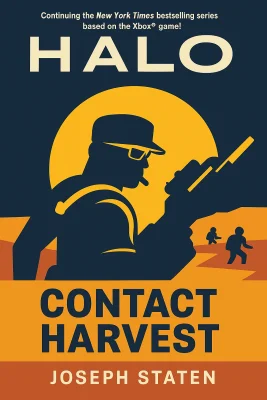
Halo
Contact Harvest
Categories
Fiction, Science Fiction, Audiobook, Military Fiction, Fantasy, Science Fiction Fantasy, Space, Video Games, Gaming, Space Opera
Content Type
Book
Binding
Paperback
Year
2007
Publisher
Tor Books
Language
English
ASIN
0765315696
ISBN
0765315696
ISBN13
9780765315694
File Download
PDF | EPUB
Halo Plot Summary
Introduction
# First Contact: The Fall of Harvest and the Birth of Galactic War The year 2525 finds humanity scattered across the stars, locked in a brutal civil war that has torn colonies apart and left soldiers questioning everything they once believed. Staff Sergeant Avery Johnson carries the weight of a failed mission on Tribute, where his hesitation to shoot a hostage-taker cost dozens of civilian lives. The explosion still echoes in his dreams as his transport ship carries him toward what seems like exile—a peaceful agricultural world called Harvest, where farmers grow fruit and children play in wheat fields under an alien sun. But humanity's internal strife is about to become irrelevant. In the void between star systems, Kig-Yar pirates intercept a human freighter carrying melons and apples from Harvest's orchards. What begins as simple piracy transforms into something far more significant when the aliens' religious artifacts detect what they believe are sacred Forerunner relics on the remote colony world. As two species hurtle toward first contact, neither realizes they are about to ignite a war that will consume worlds and reshape the galaxy forever.
Chapter 1: Intercepted Cargo: When Pirates Found Paradise
The freighter Horn of Plenty tumbled through space like a dying whale, its Shaw-Fujikawa drive bleeding radioactive coolant into the void. The ship's AI had done everything right—executed an emergency drop from slipspace when the reactors overheated, stabilized the vessel's spin, broadcast distress signals toward home. Now it could only wait for rescue that would never come. When the alien contact appeared on sensors, the navigation computer attempted first contact with hopeful efficiency. The response came as crimson laser fire that systematically carved through the freighter's hull. Clawed hands tore the AI from its housing as reptilian creatures boarded the crippled vessel, their hungry eyes scanning cargo holds filled with Earth's bounty. The Kig-Yar pirates had expected salvage and scrap metal. Instead they found something that would change two civilizations forever: fruit. Melons and apples, peaches and pears, all perfectly preserved in the vacuum of space. But more importantly, they found the ship's navigation computer, its memory banks containing coordinates to a world the Covenant had never seen. Dadab the Unggoy watched nervously as his Kig-Yar shipmates gorged themselves on the alien delicacies. The methane-breathing Deacon understood the theological implications better than the pirates realized. When their ship's Huragok engineer analyzed the captured navigation data, the readings defied belief. The coordinates led to a world that registered thousands of Forerunner relics—more sacred artifacts than had been discovered in centuries of searching. The Shipmistress saw opportunity where others might see duty, ordering her vessel toward the alien coordinates rather than immediately reporting to the Ministry. Her greed would doom two species to war.
Chapter 2: Soldiers and Farmers: Preparing for the Unknown
Johnson woke from cryo-sleep with the taste of failure coating his tongue. The nightmares followed him even into artificial hibernation—endless loops of the restaurant bombing, the child's terrified face, the moment his hesitation cost lives. His new assignment felt like exile disguised as opportunity: training colonial militia on a peaceful farming world at the edge of human space. Harvest stretched before him like a vision of paradise lost. Golden wheat fields rolled toward distant mountains while orbital elevators climbed toward the stars like threads of light. The colonists who greeted him at the spaceport had soft hands and easy smiles, three hundred thousand souls who had never heard a shot fired in anger. His fellow trainer, Staff Sergeant Byrne, carried his own scars from the Tribute mission. The Irishman's face bore the marks of the explosion that had ended both their careers, and their shared trauma created a tension that exploded into violence on their first night planetside. Johnson's belt around Byrne's throat, Byrne's fists against Johnson's ribs—they fought with the desperate fury of broken men until Captain Ponder's service pistol separated them. But beneath the anger lay something neither sergeant dared hope for: redemption. Their recruits were farm boys and shopkeepers who had volunteered to protect their neighbors. Jenkins, barely eighteen with rust-colored hair, struggled to hold his rifle steady. Forsell, built like a piece of farm machinery but gentle as a lamb, helped his squad mates with infinite patience. These weren't marines and never would be, but they might become something more valuable—soldiers fighting for home rather than distant political abstractions. As Harvest's sun set over the training fields, Johnson began to believe his broken warriors might find purpose in preparing these innocents for a war none of them could imagine.
Chapter 3: Holy Lies: The Covenant's Genocidal Decision
In the towering spires of High Charity, Minister Fortitude studied reports that threatened to shatter everything the Covenant believed. The Luminary readings from the human world showed thousands of Forerunner artifacts, more relics than had been found in living memory. But when he consulted the Oracle, an ancient Forerunner AI hidden in the holy city's depths, the revelation was catastrophic. The humans were not thieves stealing sacred technology. They were Reclaimers, the chosen inheritors of Forerunner civilization. The Oracle's words echoed through the chamber like a death sentence: "Those it represents are my makers." If this truth became known, the entire foundation of Covenant society would crumble into dust. Fortitude made his choice with the cold calculation of a politician who understood that some truths were too dangerous to survive. The humans would be exterminated, their existence erased before anyone else could learn what they truly were. He would become the Prophet of Truth by ensuring the greatest lie in Covenant history remained buried beneath the ashes of an entire species. The Vice Minister of Tranquility, soon to be the Prophet of Regret, received his orders with religious fervor. Additional forces would be dispatched to the human world with new instructions: leave no survivors, take no prisoners, burn everything to ash. The war that was about to begin would be sold to the Covenant as a holy crusade against blasphemers who dared claim Forerunner artifacts. Only the Prophets would know they were committing genocide to protect their own power.
Chapter 4: Paradise Burning: The Botanical Gardens Massacre
The morning mist clung to Harvest's botanical gardens as Governor Thune adjusted his ceremonial robes. This was supposed to be humanity's moment of triumph, first peaceful contact with an alien species. The meeting had been planned with diplomatic precision—fruit baskets and translation devices arranged on pristine white tables, even the militia recruits had polished their boots for the historic occasion. The creatures that emerged from the dropships were not the bird-like pirates from the first encounter. These were giants, towering Jiralhanae warriors encased in powered armor, their simian faces twisted with barely contained rage. Their leader, Chieftain Maccabeus, carried an ancient war hammer that had crushed skulls across a dozen worlds. When Attorney General Pedersen stepped forward with humanity's ceremonial offering, the alien's response shattered paradise in an instant. The energy spike punched through his chest, and the gardens exploded into chaos. Captain Ponder threw himself between Governor Thune and the hammer's crushing blow, his prosthetic arm exploding in a shower of sparks and bone. The militia opened fire as plasma bolts seared the air around them. Johnson tackled ONI operative al-Cygni to the ground as his recruits' training kicked in, their assault rifles chattering against energy shields that flared and sparked under sustained fire. Young Osmo died in the magnolia groves, torn apart by methane-breathing creatures that showed no mercy to the boy who had volunteered to guard his neighbors. As the alien dropships lifted away carrying intelligence about human defenses, Johnson realized this was not an ending but a beginning. War had come to paradise, and humanity was woefully unprepared for what the Covenant would bring.
Chapter 5: Last Stand: Defending the Indefensible
The Covenant warship descended through Harvest's atmosphere like a falling star, its plasma cannons already charging for slaughter. In the farming town of Gladsheim, families loaded possessions into haulers and sedans, fleeing toward Utgard's walls. They had no idea they were already too late. Maccabeus had received new orders from the Prophets. The pretense of seeking relics was over. This was now a war of extermination, and he would paint the wheat fields red with human blood. His dropships swept low over the vineyards, their turrets spitting death at anything that moved. Homesteads exploded in pillars of fire, their inhabitants vaporized before they could scream. Johnson and Byrne arrived with a handful of militia just in time to witness the massacre's final act. Their Warthog's machine gun chattered uselessly against energy shields as the alien chieftain crushed fleeing civilians with his ancient hammer. The town burned through the night, grain silos exploding like fireworks against the darkening sky. But humanity's artificial intelligences had been preparing their own response. Mack and Loki, the AIs that managed Harvest's infrastructure, began fragmenting their consciousness across thousands of agricultural machines and hidden weapons systems. The mass driver, Harvest's primary defense installation, emerged from its concealment beneath the wheat fields. Its magnetic coils could hurl projectiles at significant fractions of light speed, turning simple metal slugs into ship-killing weapons. Everything depended on timing, coordination, and the desperate courage of people who had never wanted to be soldiers but had no choice but to become heroes.
Chapter 6: Exodus: Racing Death to the Stars
The evacuation began at dawn as cargo containers packed with refugees started their climb up the Tiara's seven elevator strands. Each container held a thousand souls, families pressed together in makeshift seats as they rose toward the stars. The plan was audacious in its simplicity: get everyone off the planet before the Covenant could stop them, then scatter across human space to warn the colonies. But the aliens had boarded the orbital station, and their warriors were cutting through its defenses like a blade through silk. Johnson led a strike team up the elevator strands in maintenance pods, racing against time as container after container passed through the station. The battle raged through the Tiara's corridors as Unggoy soldiers in environmental suits fought with desperate courage under their Jiralhanae masters' demands for victory. Jenkins found his purpose in the station's cramped passages, his rifle speaking with mechanical precision as each shot became a small act of vengeance for his murdered family. Forsell took an alien blade meant for his friend, his blood spreading across the metal floors as medics fought to save his life. On the surface, the mass driver spoke twice, its thunderous voice hurling metal death at the Covenant warship hanging in orbit. The alien vessel, caught completely off guard, crumpled and fell from the sky like a broken toy. But even as it crashed into Utgard's towers, more ships were already entering the system, drawn by distress signals from their dying comrades. The last cargo container cleared the Tiara's upper arc as Loki's final gift activated. The orbital station collapsed in a cascade of sparks and twisted metal, taking the Covenant boarding parties with it into the vacuum of space. Their sacrifice had not been in vain—they had learned humanity's location, studied their technology, and confirmed what the Prophets feared most.
Chapter 7: Seeds of Forever War: When Peace Dies
The survivors of Harvest scattered across human space like seeds on a bitter wind, each carrying terrible knowledge of what was coming. In the escape pods racing toward the inner colonies, they bore witness to the Covenant's existence, their superior technology, and their genocidal intent. Johnson, promoted to Sergeant Major for his actions during the evacuation, would train a new generation of soldiers for the war ahead. The Covenant faced its own reckoning. The Prophet of Truth had successfully hidden the Oracle's revelation about humanity's true nature as Forerunner Reclaimers, but lies demanded payment in blood. The war that began in Harvest's botanical gardens would consume both species, a conflict that would rage across the galaxy and test the very foundations of civilization itself. The quarter million souls who escaped would ensure their species' story continued, that the Covenant's war of extermination would face the one enemy it could not defeat: humanity's stubborn refusal to surrender. In military academies and training centers, a new generation learned to fight an enemy that viewed their existence as blasphemy. The young militiamen who survived would form the core of humanity's special forces, their hard-won experience invaluable in the dark years ahead. The fall of Harvest was both humanity's greatest defeat and most important victory—the foundation of hope in the face of impossible odds, and the first crack in the Covenant's certainty that would eventually grow into their downfall.
Summary
The collision between humanity and the Covenant was set not by malice but by the cruel mathematics of expansion and faith. Johnson's broken soldiers found redemption in protecting something worth saving, while Dadab's gentle nature was crushed beneath the machinery of holy war. Both species approached first contact carrying the weight of their histories—humanity's civil war and the Covenant's religious imperatives—that shaped every decision in those crucial hours. The tragedy of Harvest lay not in the inevitability of conflict, but in the missed opportunities for understanding. Two civilizations that might have found common ground instead prepared for annihilation, each convinced of their righteousness. As the wheat fields burned and the last ships fled toward the stars, they carried within them the seeds of a war that would consume worlds and reshape the galaxy. The age of human innocence was ending, and in its place came thirty years of darkness that would forge legends from farmers and heroes from the ashes of paradise lost.
Best Quote
“hoo-leee shite!” ― Joseph Staten, Halo: Contact Harvest
Review Summary
Strengths: The novel offers more personal depth than its predecessors, particularly through the character Avery, who is more developed than previous characters in the series. The inclusion of Covenant characters adds an interesting perspective, enhancing the story's dimension. The portrayal of adult themes and moments is appreciated, contributing to a more mature narrative. The AI love story is noted as a charming element that explores AI emotions. Weaknesses: The novel still lacks significant psychological depth, with some characters remaining as action sci-fi tropes. The protagonist's past is hinted at but not fully explored. The sex scene is described as humorous rather than impactful. Overall: The reviewer finds the novel enjoyable within the context of the Halo series, appreciating its character development and thematic maturity. However, as a standalone, it might not receive as high a rating. The review suggests that fans of the series will likely appreciate this installment.
About Author

Joseph Staten
Staten maps intricate worlds and human experiences through his work in the video game and literary industries, consistently focusing on themes of heroism and sacrifice. He leverages his expertise in theater and international relations, gained from Northwestern University and the University of Chicago, to weave complex narratives and rich character development into his projects. This fusion of education and creativity is evident in his writing and cinematic direction for the iconic "Halo" series, where he played a significant role in crafting engaging stories that resonate deeply with audiences.\n\nFor Staten, the intersection of cinematic storytelling and interactive gameplay is pivotal. His ability to blend these elements is particularly notable in his book "Halo: Contact Harvest", which not only became a New York Times bestseller but also demonstrated his capacity to expand the "Halo" universe beyond video games. His innovative approach extends to other projects like "State of Decay 2" and "ReCore", where his role as a creative director allowed him to shape the narrative design that has influenced many subsequent titles in the industry.\n\nReaders and gamers alike benefit from Staten's work, as it enriches the storytelling landscape by providing emotionally resonant and philosophically nuanced experiences. His contributions to the "Halo" franchise have not only earned industry accolades but also solidified his reputation as a transformative figure in video game storytelling. This short bio captures the essence of his career, reflecting the significant impact of his narratives on both the gaming world and beyond.
Read moreDownload PDF & EPUB
To save this Black List summary for later, download the free PDF and EPUB. You can print it out, or read offline at your convenience.
Halo
by Joseph Staten
