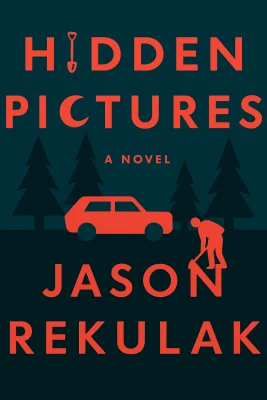
Hidden Pictures
Categories
Fiction, Audiobook, Horror, Mystery, Thriller, Adult, Book Club, Suspense, Paranormal, Mystery Thriller
Content Type
Book
Binding
Hardcover
Year
2022
Publisher
Flatiron Books
Language
English
ISBN13
9781250819345
File Download
PDF | EPUB
Hidden Pictures Plot Summary
Introduction
Mallory Quinn thought she had found salvation in the perfect suburb of Spring Brook, New Jersey. Eighteen months clean from heroin, the former track star turned nanny was ready for a fresh start caring for five-year-old Teddy Maxwell in their pristine Victorian home. But beneath the manicured lawns and coffee shops lurked something darker than addiction—something that spoke through a child's innocent drawings. When Teddy's artwork began depicting scenes of violence and death, featuring a mysterious woman named Anya, Mallory dismissed it as an overactive imagination. The boy's parents, Ted and Caroline Maxwell, were equally skeptical of their new nanny's concerns about ghostly presences and supernatural communications. Yet as the drawings grew more detailed and disturbing, revealing the story of a woman dragged through forests and buried in unmarked graves, Mallory realized she was witnessing something impossible: the dead were using small hands to tell their truth.
Chapter 1: The Recovering Soul and the Perfect Family
Mallory Quinn's fingers trembled as she signed the employment contract, not from withdrawal but from hope. The guest cottage behind the Maxwell home looked like something from a fairy tale, with its rustic wood siding and white picket fence. After months in Safe Harbor, a recovery house in Philadelphia, this felt like paradise. Ted Maxwell, a trim engineer in his fifties, led her through the main house while five-year-old Teddy peered shyly from behind doorways. Caroline, a VA hospital psychiatrist with flowing blonde hair, radiated the kind of warmth that made broken people feel whole again. They spoke carefully around Mallory's history—the car accident that killed her sister, the descent into opioids and heroin, the long climb back to sobriety. "We believe in second chances," Caroline said, pressing a mug of herbal tea into Mallory's hands. The kitchen gleamed with stainless steel appliances and fresh flowers, everything Mallory had dreamed of but never possessed. Teddy emerged from his hiding spot with a drawing of a white rabbit, the paper covered in careful crayon strokes. His artwork decorated the refrigerator like badges of childhood innocence. When he smiled at Mallory, revealing the gap where a tooth had recently fallen out, she felt something shift inside her chest—a maternal instinct she hadn't known existed. The job seemed straightforward: morning activities, lunch, quiet time, swimming in the backyard pool. Ted worked from home, managing websites for corporate clients. Caroline left early for the hospital, trusting Mallory with the most precious thing in their world. As she unpacked her few belongings in the cottage that first night, Mallory whispered a prayer of gratitude to the darkness. She had no way of knowing that Teddy's quiet time involved conversations with someone who had been waiting in that cottage for over seventy years.
Chapter 2: Disturbing Lines from Invisible Hands
The drawings started innocently enough. During afternoon quiet time, while Mallory cleaned downstairs, Teddy would emerge from his bedroom with fresh artwork—stick figures playing in forests, simple houses under smiling suns. His parents praised his creativity, and Mallory dutifully added each masterpiece to the refrigerator gallery. But something changed in his third week at the house. The drawings grew darker, more sophisticated. Where once there had been wobbly circles for heads, now there were detailed faces with expressions of fear. The stick figures became fuller, more human, and they were no longer playing. "Who taught you to draw like this?" Mallory asked, studying a picture of a woman being dragged through what looked like a dense forest. "Anya showed me," Teddy said matter-of-factly, reaching for another crayon. Caroline laughed when Mallory mentioned the imaginary friend that evening. "Every child has one. It's perfectly normal." But her smile tightened when she saw the latest drawing—a woman at the bottom of a deep hole, dirt raining down on her face. Ted was less diplomatic. "These are disturbing, Mallory. Maybe we should limit his art supplies." Yet the drawings continued, appearing on Mallory's cottage porch in the morning, tucked under rocks as if delivered by invisible hands. Each depicted the same woman—tall, athletic, with long dark hair—in increasingly desperate situations. Running through forests. Struggling against unseen attackers. Calling out in what appeared to be anguish. When Mallory pressed Teddy about Anya, his responses grew evasive. He claimed she visited during quiet time, when his parents thought he was napping. She spoke in whispers, he said, and sometimes she cried. Most unsettling of all, he insisted she wasn't imaginary. "She's real," he whispered one afternoon, glancing toward his bedroom. "She just can't let grown-ups see her."
Chapter 3: Searching for Annie in the Shadows
Mitzi lived next door in a ramshackle house that stuck out among Spring Brook's pristine facades like a broken tooth. The elderly woman draped herself in crystals and claimed to read auras for paying clients, but her bloodshot eyes and unsteady gait suggested other pursuits. When Mallory approached her with Teddy's drawings, Mitzi's reaction was immediate and electric. "Annie Barrett," she breathed, studying the sketches with shaking hands. "I haven't heard that name in decades." The story poured out over bitter coffee in Mitzi's cluttered kitchen. In 1948, a young artist named Annie Barrett had lived in Mallory's cottage, using it as a studio while staying with her cousin George. One December morning, George found the cottage splattered with blood but no body. Annie had simply vanished, leaving behind only rumors and local ghost stories. "Kids used to dare each other to peek in your windows," Mitzi said, her voice dropping to a whisper. "We called it the Devil House." That night, Mallory researched obsessively on her new tablet, finding no trace of Annie Barrett online. But Mitzi's friend Adrian, a college student whose father ran the local landscaping company, promised to help. His mother worked at the Spring Brook library and had access to historical archives that might hold answers. Meanwhile, the drawings multiplied. They appeared not just on Mallory's porch now, but inside her locked cottage, pinned to her refrigerator by magnets that shouldn't have been there. The chronology seemed deliberate—a woman painting by a lake, a child chasing a rabbit, the same child lost and frightened, then the violence that followed. Each morning, Mallory would find Teddy with charcoal smudged on his fingertips, though he swore he remembered nothing about drawing in the night. When she set up a baby monitor to record his quiet time, the video glitched and skipped, showing only fragments of the boy's body convulsing as his hand moved across paper without his conscious control. The smell in his bedroom grew stronger too—an acrid stench that reminded Mallory of death and made her eyes water. Caroline blamed bedwetting, but Mallory knew better. Something was using that room as a doorway between worlds.
Chapter 4: Credibility Crumbling: Truth in Question
The confrontation came on a sweltering July evening. Mallory had spread the drawings across the pool deck, trying to arrange them in chronological order, when Ted and Caroline returned from work early. Their faces went pale as they studied the collection—nearly two dozen images depicting what appeared to be a murder, body disposal, and burial. "Where did these come from?" Caroline demanded, her usual warmth replaced by clinical coldness. "Teddy's been—" "Teddy is five years old," Ted interrupted. "These drawings show advanced technique, sophisticated understanding of light and shadow. You expect us to believe a kindergartener drew these?" The accusation hung in the air like smoke. Caroline's psychiatric training kicked in as she studied Mallory's defensive posture, the way she clutched at the drawings like evidence in a trial. "Have you been taking your medications? Attending meetings?" "I'm not using," Mallory said, but even she could hear how desperate she sounded. They subjected her to a drug test that night, the humiliation of urinating into a cup while Caroline watched. The results came back clean, but it didn't matter. The Maxwells had made up their minds about their unstable nanny and her elaborate fantasies. "False memories are common among addicts," Russell, Mallory's sponsor, explained when she called him in tears. "Your brain creates elaborate stories to avoid dealing with trauma." But Russell hadn't seen Teddy's eyes roll back in his head as his hand moved independently across paper. He hadn't felt the presence that watched from dark corners of the cottage. He hadn't smelled the stench of decay that followed wherever Anya walked. Adrian believed her, though. His mother had found records at the library—not of Annie Barrett, but of Anne Catherine Barrett, a young woman who'd arrived from Europe after World War II. The details were sparse, but they painted a picture of a tragic figure whose disappearance had shaken the small community. "We need to contact her directly," Adrian said. "Find out what she's trying to tell us." Against her better judgment, Mallory agreed to one last desperate gamble.
Chapter 5: Masks Falling: The Maxwell Deception
The séance took place in Mallory's cottage on a humid Thursday night. Mitzi arrived with her wooden spirit board and an arsenal of crystals, while Adrian watched Teddy at the pool. The session started promisingly—the planchette moved beneath their fingers, spelling out words in what appeared to be Hungarian. But before they could decipher the message, everything went wrong. Mitzi accused Mallory of pushing the device, of manufacturing the entire supernatural encounter for attention. The old woman stormed out, leaving Mallory alone with her doubts and the increasingly disturbing reality that perhaps everyone was right—perhaps she was losing her mind. The breaking point came the next afternoon. Mallory awoke from an unexpected nap to find the Maxwells' den walls covered in elaborate drawings, her hands stained with charcoal. She had no memory of creating the artwork, but there was no other explanation. Ted and Caroline stood in the doorway, their faces mixing pity with horror. "You left our son alone for four hours," Caroline said quietly. "I can't trust you with him anymore." As they terminated her employment, Adrian arrived for their planned dinner date. The look on his face when he learned the truth about Mallory's addiction—not the sanitized version she'd fed him about being a Penn State track star, but the ugly reality of heroin needles and halfway houses—cut deeper than any withdrawal she'd endured. But it was Teddy's reaction that destroyed her. The boy who had once run to greet her now cowered behind his mother, fear replacing the love that had once shone in his eyes. In trying to save him from whatever haunted their house, Mallory had become the monster in his story. She packed her belongings that night, expecting Russell to collect her in the morning. The cottage felt different now—emptier, as if whatever presence had occupied it had finally moved on. Maybe that was for the best. Maybe everyone would be safer with her gone. She had no idea that Caroline Maxwell was already preparing one final drawing session.
Chapter 6: Desperate Flight Through Hayden's Glen
Mallory jerked awake to find herself bound to a chair, her mouth stuffed with cloth. Caroline stood in the cottage kitchen, preparing a syringe filled with what she claimed was heroin cut with enough fentanyl to kill a horse. But this wasn't random violence—it was the conclusion of a carefully orchestrated plan that had begun three years earlier. The truth spilled out in Caroline's confession. She and Ted had never lived in Barcelona. They'd spent their sabbatical at Seneca Lake in upstate New York, where Caroline encountered a young Hungarian immigrant named Margit Baroth painting landscapes while her two-year-old daughter played nearby. When the child wandered into the forest, Caroline had followed—not to help, but to steal. "I rescued that child," Caroline insisted, her voice steady as she prepared the fatal injection. "Margit was a negligent mother who ignored her daughter for hours." But Margit had found them in the woods. The confrontation had ended with Caroline using her stun gun, then strangling the young mother when the electrical shock wasn't enough. Ted had buried the body while Caroline transformed Flora Baroth into Teddy Maxwell, cutting the girl's hair and dressing her in boys' clothes. For three years, they'd lived in rural West Virginia, slowly convincing their stolen child that she was a boy, that they were her real parents. But Margit's spirit had followed them, manifesting in the child's bedroom, using small hands to tell the story of her murder through drawings that Caroline burned as soon as she found them. The move to Spring Brook was supposed to be a fresh start, but the ghost came with them. That's when Caroline hit upon the perfect solution—hire a recovering addict as a nanny, someone whose credibility could be easily undermined when the supernatural activity intensified. As Caroline prepared to plunge the syringe into Mallory's arm, Ted burst through the door. But his rescue attempt came too late—his wife had already made up her mind that everyone who knew the truth had to die. The gunshots that followed echoed through the quiet suburb like thunder, shattering the peaceful façade that had hidden three years of deception.
Chapter 7: Reunions and Necessary Distance
The police found Mallory and Teddy in Hayden's Glen, both covered in blood but alive. Caroline lay dead at the base of an old oak tree, killed by the broken arrow that Teddy—or rather, Margit possessing Teddy—had driven through her throat. Ted died from his gunshot wounds on the cottage floor, his final act an attempt to save the nanny he'd grown to love. In the chaos that followed, Mallory made a crucial decision. She confessed to killing Caroline in self-defense, taking responsibility for the violence to protect Teddy from the truth of what his real mother's spirit had done through his body. The boy remembered nothing of the possession, only waking up in the creek with no understanding of how he'd gotten there. The investigation that followed unraveled the Maxwells' elaborate deception. DNA tests confirmed that Teddy was actually Flora Baroth, the missing daughter of József and Margit Baroth. Her father, who had spent three years believing his family was dead, drove through the night from his goat farm in upstate New York to reclaim his child. The reunion was bittersweet. Flora had no memory of her life before the Maxwells, no recollection of her real parents or her Hungarian heritage. She had been thoroughly transformed into Teddy, and the journey back to her true identity would take years of patient therapy. Adrian drove Mallory back to Philadelphia, where Russell waited with his characteristic blend of tough love and unwavering support. The media attention was intense but brief—another true crime sensation that faded when newer horrors captured the public's imagination. A year later, Mallory attempted to visit Flora at her father's farm. The little girl, now dressed in flowing dresses with long braided hair, politely accepted gifts but showed no recognition of her former nanny. She had cousins to play with now, animals to tend, a normal childhood to reclaim. As Mallory prepared to leave, Flora ran after her with one final drawing—a simple picture of two figures holding hands under a sunny sky. It was signed with a name Mallory hadn't heard in months: Anya. The Hungarian word for mother, lovingly inscribed by a daughter who had finally found her way home.
Summary
In the pristine suburbs where secrets grow like weeds beneath manicured lawns, Mallory Quinn learned that some ghosts refuse to rest until their stories are told. The cottage that had seemed like salvation became a conduit for truth, channeling the desperate voice of a murdered mother through the innocent hands of her stolen child. Flora Baroth—disguised as Teddy Maxwell for three years—had been the perfect medium, her young mind open to the spirit that followed wherever she went. The Maxwells' elaborate deception crumbled not through police work or investigation, but through the persistence of maternal love that transcended death itself. Margit Baroth had waited patiently in shadows and whispers, gathering strength until the moment came to protect both her daughter and the recovering addict who had stumbled into their supernatural tragedy. Mallory returned to Philadelphia carrying more than just the weight of what she'd witnessed. She carried the knowledge that healing takes many forms—sometimes through meetings and sponsors and careful steps toward sobriety, and sometimes through the fierce love of a mother who refuses to let evil triumph. In Spring Brook's carefully maintained perfection, she had found something more valuable than redemption: she had found the strength to save a child, even at the cost of her own carefully rebuilt life. Some ghosts, she learned, are not there to haunt us but to guide us toward the truth we're strong enough to bear.
Best Quote
“We don’t know how much our bodies can endure until we make cruel demands of them.” ― Jason Rekulak, Hidden Pictures
About Author

Jason Rekulak
Rekus maps the intricate landscapes of personal transformation through his novels, creating stories that resonate with readers by delving into themes of mystery and self-discovery. His writing often features characters facing significant turning points, prompting them to navigate complex emotional landscapes. This thematic focus is vividly portrayed in "Hidden Pictures," where the blending of supernatural elements with psychological depth encourages readers to ponder the unseen forces that shape our lives. Meanwhile, "The Impossible Fortress" invites readers to reminisce about the past, blending nostalgia with coming-of-age trials, illustrating how formative experiences mold identity.\n\nBy employing a distinctive narrative style that interweaves humor and suspense, Rekus crafts stories that not only entertain but also invite introspection. His ability to ghost-write for diverse projects during his tenure as Publisher of Quirk Books showcases his adaptability and skill in engaging varied audiences. This experience enriches his novels, allowing him to explore multifaceted characters and intricate plots with authenticity and flair. As a result, his works captivate a wide range of readers, from those seeking thrilling narratives to others interested in exploring deeper emotional and psychological themes.\n\nIn this bio, Rekus's role as both a creative storyteller and a keen observer of human nature is emphasized, making his work particularly relevant to readers who appreciate character-driven plots. His upcoming book, "The Last One at the Wedding," promises to continue this exploration, offering insights into relationships and personal growth. For those intrigued by the intersection of reality and imagination, Rekus's novels provide a compelling reading experience, making a lasting impact on their understanding of the complexities of human nature.
Read moreDownload PDF & EPUB
To save this Black List summary for later, download the free PDF and EPUB. You can print it out, or read offline at your convenience.
Hidden Pictures
by Jason Rekulak
