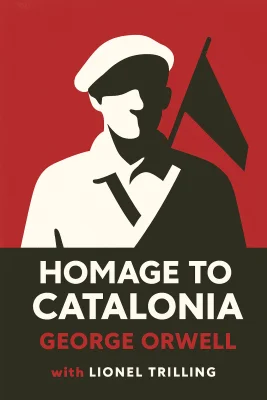
Homage to Catalonia
Categories
Nonfiction, Biography, History, Memoir, Politics, Classics, Literature, War, Spain, Spanish Civil War
Content Type
Book
Binding
Paperback
Year
1980
Publisher
Harcourt, Inc.(Harvest Book)
Language
English
ASIN
0156421178
ISBN
0156421178
ISBN13
9780156421171
File Download
PDF | EPUB
Homage to Catalonia Plot Summary
Introduction
In the winter of 1936, a young Englishman stepped off a train in Barcelona and found himself in a city unlike any he had ever imagined. The working class was in control, revolutionary flags flew from every building, and the very air seemed to vibrate with the promise of social transformation. What began as a journey to fight fascism would become something far more complex—a firsthand witness to one of the most tragic and revealing conflicts of the twentieth century. This personal account illuminates three profound historical questions that continue to resonate today: How do revolutionary movements fragment and destroy themselves even as they face existential threats? What happens when international ideological conflicts play out on local battlegrounds, turning civil wars into proxy battles between global powers? And perhaps most importantly, how does the individual conscience navigate the treacherous waters of political loyalty when survival itself depends on choosing sides in an increasingly polarized world? Through the eyes of someone who lived in the trenches, walked the streets during urban warfare, and barely escaped with his life, we see not just the grand sweep of history, but the human cost of ideological purity in times of crisis.
Chapter 1: Revolutionary Barcelona: First Impressions of a Transformed City
In December 1936, Barcelona presented a sight that seemed to belong more to utopian dreams than to European reality. The city had been transformed by six months of revolution, and the evidence was everywhere—from the red and black flags of the anarchists draped across seized buildings to the revolutionary slogans scrawled on every wall. Churches had been gutted and their religious imagery destroyed, while the hammer and sickle marked territories now under workers' control. What struck visitors most profoundly was not just the physical transformation, but the social revolution that had turned the normal order of Spanish society upside down. Waiters and shopkeepers looked customers directly in the eye, treating them as equals rather than superiors. The formal address "usted" had given way to the familiar "tu," and "comrade" had replaced "señor" in daily conversation. Tipping was forbidden by law, private motor cars had been commandeered for collective use, and the traditional markers of class distinction had seemingly evaporated overnight. The revolutionary atmosphere was intoxicating but fragile. Behind the facade of working-class solidarity, deeper tensions were already emerging. The food shortages, the bread queues stretching for hundreds of yards, and the improvised nature of much revolutionary organization hinted at the challenges ahead. More ominously, many of the well-to-do bourgeoisie had not fled or converted to socialism—they were simply lying low, disguising themselves as proletarians until the political winds shifted. This was revolution as social experiment, a genuine attempt to create what one observer called "a sort of temporary working model of the classless society." The militias operated on principles of equality, with officers and privates drawing the same pay and sharing the same hardships. Yet even in these heady early days, the seeds of future conflict were visible to those who looked closely. Different political factions controlled different buildings and neighborhoods, each with their own vision of what the revolution should ultimately achieve. The unity of the anti-fascist cause would soon be tested by these competing ideologies, transforming Barcelona from a symbol of revolutionary hope into a battleground where former comrades would fight each other with the same intensity they had once reserved for their fascist enemies.
Chapter 2: The POUM Militia: Life and Combat on the Aragon Front
Life in the trenches of the Aragon front bore little resemblance to the dramatic battles that filled newspaper headlines. For months on end, the war settled into a grinding stalemate where the primary enemies were not fascist bullets but cold, hunger, lice, and crushing boredom. The militiamen found themselves posted on hilltops hundreds of yards from enemy positions, engaged in what amounted to a deadly form of camping rather than conventional warfare. The conditions were almost medieval in their primitiveness. Men slept in dugouts carved into limestone cliffs, their rifles often dating back to 1896 and frequently jamming after a few shots. There were no adequate medical supplies, insufficient ammunition, and a chronic shortage of everything from tobacco to soap. The Spanish standard of marksmanship was so poor that, as one participant wryly observed, "it takes a thousand bullets to kill a man, and at this rate it would be twenty years before I killed my first Fascist." More men were wounded by accidental discharges and equipment malfunctions than by enemy action. Yet within this apparent military farce, something remarkable was taking place. The militia system, whatever its tactical shortcomings, was creating a unique form of military democracy. Orders were given "as comrade to comrade," not as superior to inferior, and the absence of military hierarchy created an atmosphere of genuine equality that extended far beyond mere protocol. Men who might never have spoken to each other in civilian life found themselves bound together by shared hardship and common purpose. The static nature of the front paradoxically allowed for unexpected moments of human connection across enemy lines. Fascist and Republican sentries would sometimes sing to each other across no-man's land in the pre-dawn hours, and there were occasions when both sides seemed more interested in survival than in killing. The real weapon of the war, it turned out, was often not the rifle but the megaphone, as both sides attempted to convert their opponents through propaganda shouted across the trenches. This civilized approach to warfare reflected a peculiarly Spanish sensibility—even in the midst of civil war, there remained traces of the country's essential humanity. These months of static warfare, tedious as they seemed at the time, would later appear as a golden age of revolutionary possibility, before the larger forces of international politics and ideological purification began to tear the anti-fascist coalition apart.
Chapter 3: Political Divisions: Communists, Anarchists and the Struggle for Control
By early 1937, the initial unity of the anti-fascist forces was rapidly dissolving into a bitter struggle for political control that would prove as decisive as any military campaign. At the heart of this conflict lay fundamental disagreements about the nature and timing of the revolution, disagreements that reflected larger international tensions between Stalin's Soviet Union and its various ideological opponents. The Communist Party, backed by Soviet arms and advisors, advocated a policy of "the war first, the revolution afterwards." They argued convincingly that radical social transformation would alienate middle-class allies and foreign sympathizers, making victory over Franco impossible. Their strategy was to postpone revolutionary changes until after military victory, focusing instead on creating a disciplined, conventional army that could match fascist forces in efficiency and firepower. This position attracted many supporters, particularly among those who had grown weary of revolutionary chaos and longed for effective leadership. Opposing them were the anarchists and the POUM, who insisted that "the war and the revolution are inseparable." They argued that without the promise of genuine social transformation, the working classes would lose their motivation to fight and die for what would amount to merely another capitalist government. More ominously, they suspected that the Communists' call to postpone revolution was actually a strategy to prevent it altogether—to use the war as an excuse to eliminate revolutionary elements and create a Soviet-style dictatorship. The conflict was intensified by the Soviet Union's position as virtually the only source of modern weapons for the Republic. This gave the Communists enormous leverage, as other political parties found their militias systematically deprived of arms while Communist-controlled units received the latest Soviet equipment. The contrast was stark and deliberate: while POUM militiamen at the front carried obsolete rifles and went without basic equipment, Communist police forces in the rear were equipped with modern weapons and vehicles. What made this struggle particularly tragic was that it diverted energy and attention from the war against Franco at the very moment when unity was most crucial. International observers watched in bewilderment as the Spanish Republic seemed determined to fragment itself along ideological lines, apparently more concerned with doctrinal purity than with survival. The stage was being set for an internal conflict that would prove as devastating to the anti-fascist cause as any military defeat, demonstrating how revolutionary movements can become their own worst enemies when faced with the choice between pragmatic unity and ideological consistency.
Chapter 4: The May Fighting: Street Battles in Barcelona
The fragile truce between Barcelona's competing political factions shattered on May 3, 1937, when Civil Guards attempted to seize control of the city's telephone exchange from the anarchist workers who had operated it since the beginning of the war. What followed was three days of street fighting that transformed the revolutionary capital into an urban battlefield, with former allies shooting at each other from behind hastily constructed barricades. The fighting revealed the depth of the political divisions that had been festering beneath the surface of anti-fascist unity. Within hours of the first shots, the city had split along factional lines, with anarchists and POUM supporters controlling the working-class suburbs while Communists and government forces held the center. Barricades rose overnight as civilians tore up cobblestones and commandeered buildings, creating a maze of defensive positions that turned familiar streets into deadly no-man's lands. The intensity of the conflict was matched by its apparent senselessness. Unlike the clear-cut struggle against fascism, this was a war of confusion and accusation, where yesterday's comrades became today's enemies based on subtle political distinctions that outsiders found incomprehensible. Men who had fought side by side against Franco's forces now found themselves shooting at each other over questions of revolutionary timing and Communist influence. The tragic irony was not lost on participants, who repeatedly expressed the feeling that they were trapped in "a lunatic asylum." More disturbing than the fighting itself was the propaganda war that accompanied it. Communist newspapers immediately branded the conflict as a "Trotskyist revolt" orchestrated by fascist agents, while anarchist publications described it as a Communist coup attempt. The truth, as usual in such situations, was far more complex than either side's propaganda suggested. Most participants were ordinary workers responding to immediate provocations rather than conspirators following some master plan. The May fighting marked the end of Barcelona's revolutionary experiment and the beginning of a systematic counter-revolution. When government troops from Valencia finally restored order, they brought with them a new political reality in which the Communists had effectively won control of the anti-fascist coalition. The brief glimpse of a classless society was over, replaced by the more familiar hierarchy of a conventional state at war. The tragedy was not just the lives lost in these pointless street battles, but the destruction of the revolutionary dream that had originally inspired so many to take up arms against fascism.
Chapter 5: Suppression and Escape: The Crushing of the POUM
The aftermath of the May fighting brought a wave of political persecution that revealed the true nature of the new order in Republican Spain. The POUM was declared an illegal organization, its leaders arrested, and its supporters hunted down in a campaign of repression that would have been familiar to observers of Stalin's purges in the Soviet Union. What had begun as a war against fascism was now devouring its own children. The scale and ruthlessness of the crackdown was breathtaking. Within days, virtually every member of the POUM's executive committee was in prison, along with hundreds of ordinary party members and foreign volunteers who had committed no crime other than belonging to the wrong political organization. Wounded militiamen were dragged from hospital beds, wives were arrested as hostages when their husbands could not be found, and even children were swept up in the net of suspicion that now encompassed anyone with "Trotskyist" connections. The charges against the POUM were as fantastic as they were unprovable—espionage, communication with Franco by radio, collaboration with the Gestapo. These accusations followed the pattern of Stalin's show trials, complete with confessions that were never produced and evidence that evaporated under scrutiny. The Spanish government itself would later repudiate these charges, with ministers admitting that the arrests had been carried out by Communist-controlled police acting without official authorization. For those caught in this web of paranoia and persecution, survival required a combination of luck, quick thinking, and the help of friends willing to risk their own safety. The atmosphere of fear was so pervasive that former comrades passed each other on the street without acknowledgment, afraid that any sign of recognition might mark them for arrest. Hotels and boarding houses became dangerous traps, as proprietors were required to report suspicious guests to the police. The experience of escaping from Barcelona provided a final, bitter lesson in the nature of the conflict that had consumed the Spanish Republic. At the frontier, the same forces that had once welcomed international volunteers were now desperately trying to prevent them from leaving—not out of any desire to keep them fighting fascism, but to prevent them from telling the world what they had witnessed. The revolution had indeed devoured its children, leaving behind only the hollow shell of a cause that had once inspired genuine hope for human liberation. Those who escaped carried with them not just their lives, but the responsibility to bear witness to one of history's most tragic examples of how noble ideals can be corrupted by the very forces they seek to oppose.
Summary
The Spanish Civil War stands as one of history's most devastating examples of how revolutionary movements can fragment and destroy themselves even while facing existential threats from external enemies. At its core, this conflict reveals the tragic tension between ideological purity and practical necessity, between the dream of perfect revolution and the reality of political compromise. The war began with genuine popular enthusiasm for social transformation, but gradually devolved into a series of internal power struggles that ultimately served the interests of neither democracy nor socialism, but rather the forces of reaction and authoritarianism. The deeper lesson of this experience transcends the specific circumstances of 1930s Spain and speaks to enduring questions about political solidarity, international intervention, and the corruption of revolutionary ideals. First, we must recognize that in times of crisis, the pursuit of ideological perfection often becomes the enemy of practical progress—movements that cannot tolerate internal disagreement are doomed to tear themselves apart. Second, the role of external powers in shaping domestic conflicts remains a critical factor in modern politics, as foreign agendas inevitably distort local struggles and impose alien frameworks on indigenous movements. Finally, the ultimate test of any political cause lies not in its theoretical purity but in its ability to maintain basic human decency under pressure—a test that too many movements, regardless of their noble origins, continue to fail when faced with the intoxicating temptations of power and the paranoid logic of political survival.
Best Quote
“All the war-propaganda, all the screaming and lies and hatred, comes invariably from people who are not fighting.” ― George Orwell, Homage to Catalonia
Review Summary
Strengths: The review highlights George Orwell's accessible and conversational writing style, which is appreciated by the reader. Orwell's ability to convey how his experiences in the Spanish Civil War influenced his personal and political beliefs is noted as interesting. Weaknesses: The review criticizes the book for its repetitive and uneventful detailing of trench life, which the reader finds tedious. Additionally, Orwell's explanation of the political landscape and history of the conflict is described as convoluted and packed with information, making it difficult to follow. Overall: The reader expresses a mixed sentiment towards "Homage to Catalonia," appreciating Orwell's writing style but finding the content less engaging compared to his other works. The book is recommended with reservations, particularly for those interested in Orwell's perspective on the Spanish Civil War.
About Author
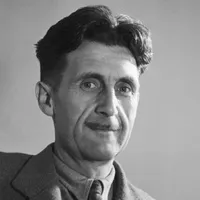
George Orwell
Orwell probes the intricate dynamics of power and social justice through a lens sharpened by personal experience and historical context. Known for his unwavering critique of authoritarianism and advocacy for democratic socialism, Orwell's works delve into the oppressive mechanisms of totalitarian regimes, as vividly portrayed in "Nineteen Eighty-Four." His early roles as a colonial police officer in Burma and his voluntary immersion into poverty informed his perspective, contributing to a body of work rich in political and social critique. This duality—an eye for societal truths rooted in lived experience—enables Orwell to expose the fragility of freedom, whether in allegorical or dystopian narratives.\n\nIn addition to his celebrated novels, Orwell's lesser-known book "The Road to Wigan Pier" sheds light on the harsh realities of working-class life in industrial England, complementing his exploration of social injustices. Meanwhile, essays such as "Shooting an Elephant" reflect on imperialism's moral complexities. Through clear and precise prose, Orwell engages with profound questions, situating his narratives in a broader discourse on power and liberty. This approach not only challenges readers to contemplate the societal forces shaping their lives but also underscores the perennial relevance of his themes in contemporary political thought.\n\nReaders across generations benefit from Orwell's work as it transcends mere storytelling to offer critical insights into the human condition. His writings encourage critical reflection on the current state of society, serving as a stark reminder of the consequences of unchecked authority and the erosion of individual liberty. As a result, his legacy endures, inviting both academic and casual readers to reflect on the intersection of power, truth, and freedom in their own lives. Through his incisive prose and insightful commentary, Orwell remains an essential figure in literature and political discourse, ensuring his continued influence and relevance.
Read moreDownload PDF & EPUB
To save this Black List summary for later, download the free PDF and EPUB. You can print it out, or read offline at your convenience.
Homage to Catalonia
by George Orwell
