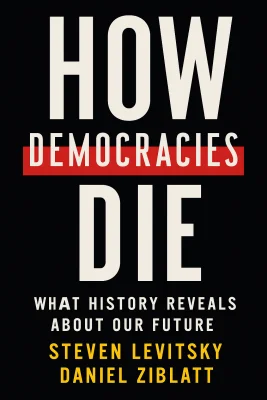
How Democracies Die
What History Reveals About Our Future
Categories
Nonfiction, Philosophy, History, Politics, Audiobook, Sociology, Social Science, Society, Political Science, Book Club
Content Type
Book
Binding
Hardcover
Year
2018
Publisher
Crown
Language
English
ISBN13
9781524762933
File Download
PDF | EPUB
How Democracies Die Plot Summary
Introduction
Democracy's demise rarely arrives with dramatic fanfare—no tanks rolling through capital cities, no uniformed generals seizing power in midnight coups. Instead, it withers quietly, incrementally, through the methodical erosion of the unwritten rules that hold democratic societies together. This fundamental misunderstanding of how democracies actually collapse has left citizens and leaders across the world unprepared for the subtle but devastating assault on democratic institutions unfolding in our time. The traditional markers of democratic breakdown—military interventions, constitutional crises, obvious authoritarianism—have given way to a more insidious form of institutional decay. Elected leaders now dismantle democracy from within, using legal mechanisms and democratic procedures to concentrate power, silence opposition, and rewrite the rules of political competition. This transformation demands a new framework for understanding democratic fragility, one that recognizes the critical importance of behavioral norms and the dangerous consequences when political actors abandon the informal guardrails that make constitutional systems function effectively.
Chapter 1: The Vulnerability of Democratic Systems to Authoritarian Leaders
The specter of authoritarianism haunts democracies not through external conquest but through internal subversion. Democratic systems possess an inherent vulnerability: they depend upon the good faith participation of political actors who could, if they chose, exploit democratic institutions for antidemocratic ends. This paradox lies at the heart of contemporary democratic breakdown, where the very openness and procedural fairness that define democracy create opportunities for its destruction. Authoritarian leaders emerge within democratic contexts by mastering the art of appearing legitimate while systematically undermining legitimacy itself. They often begin as outsiders, positioning themselves as champions of "the people" against corrupt elites, using populist rhetoric to build mass support while quietly planning institutional capture. Their success depends not on revolutionary upheaval but on exploiting the gray areas, ambiguities, and unwritten conventions that every democratic system requires to function. The vulnerability becomes acute when democratic institutions lack sufficient safeguards against norm-breaking behavior. Constitutional provisions alone cannot protect democracy; they must be reinforced by shared understandings of appropriate conduct, mutual respect among political competitors, and institutional restraint. When these informal guardrails weaken, formal rules become weapons in partisan warfare rather than neutral arbiters of political competition. Historical patterns reveal that democratic breakdown often follows a predictable sequence: polarization leads to norm erosion, which enables institutional capture, which facilitates the concentration of power in the hands of those willing to abandon democratic constraints entirely. The process appears gradual and legal, making it difficult for citizens to recognize the threat until damage has already been done.
Chapter 2: Institutional Gatekeeping: The Critical First Line of Defense
Democratic survival depends crucially on effective gatekeeping—the process by which established political institutions screen out potentially dangerous candidates before they can capture power. Political parties, in particular, serve as democracy's first line of defense, wielding the responsibility to identify and exclude those whose commitment to democratic norms appears questionable or whose authoritarian tendencies pose risks to institutional stability. Effective gatekeeping requires parties to balance two competing imperatives: democratic representation of their voters' preferences and institutional protection against antidemocratic forces. This tension becomes particularly acute when popular candidates exhibit authoritarian characteristics, forcing party leaders to choose between short-term electoral advantage and long-term institutional preservation. The quality of this screening process often determines whether democracies survive or succumb to authoritarian capture. Traditional gatekeeping mechanisms operated through party establishments that maintained significant control over candidate selection and campaign resources. These insider networks, while often criticized as undemocratic, provided peer review functions that helped identify candidates lacking the temperament, experience, or commitment necessary for democratic leadership. The gradual weakening of party organizations and the rise of primary elections have democratized candidate selection but also reduced institutional filtering capacity. The collapse of gatekeeping creates dangerous openings for extremist figures who might otherwise remain marginalized. When parties fail to maintain standards, when media coverage rewards sensationalism over substance, and when voters become sufficiently alienated from established institutions, the barriers protecting democracy from internal threats begin to crumble. The resulting institutional vulnerability can persist long after specific electoral contests conclude. Modern democracies must therefore strengthen their gatekeeping mechanisms while maintaining democratic legitimacy—a complex challenge that requires rebuilding institutional capacity, restoring public trust in democratic processes, and creating new forms of accountability that can adapt to changing political environments without abandoning core democratic principles.
Chapter 3: The Subversion Playbook: How Elected Autocrats Undermine Democracy
Elected autocrats follow remarkably similar strategies in dismantling democratic institutions, employing what can be understood as a systematic playbook for legal authoritarianism. Unlike traditional dictators who seize power through force, contemporary autocrats work within existing legal frameworks, using constitutional mechanisms and democratic procedures to concentrate power and eliminate opposition. This approach proves particularly effective because it maintains an appearance of legitimacy while systematically eroding democratic substance. The playbook operates through three primary strategies. First, autocrats capture the referees—independent institutions like courts, election commissions, and law enforcement agencies that serve as neutral arbiters of political competition. Through strategic appointments, institutional reorganization, and legal manipulation, they transform these bodies from independent watchdogs into partisan instruments of power consolidation. Second, they systematically sideline key players who might challenge their authority. Opposition politicians face harassment through legal persecution, media outlets encounter economic pressure and regulatory challenges, and civil society organizations find their activities restricted through new laws and administrative obstacles. The goal is not necessarily to eliminate opposition entirely but to weaken it sufficiently that meaningful challenge becomes impossible. Third, autocrats rewrite the rules of political competition to lock in their advantages. Electoral laws change to favor incumbent parties, campaign finance regulations create uneven playing fields, and constitutional amendments alter the basic structure of democratic competition. Each change appears modest and legally justified, but collectively they transform democracy into a system where opposition victory becomes virtually impossible. The effectiveness of this approach lies in its incremental nature and legal veneer. Citizens may recognize individual steps as problematic but struggle to perceive the cumulative threat to democratic governance. By the time the pattern becomes clear, institutional defenses have often been sufficiently weakened that resistance becomes extremely difficult. The playbook's success depends on exploiting the gap between formal democratic procedures and the informal norms that make those procedures function democratically.
Chapter 4: Guardrails of Democracy: Mutual Toleration and Institutional Forbearance
Democratic stability rests not merely on constitutional architecture but on two fundamental behavioral norms that serve as democracy's soft guardrails: mutual toleration and institutional forbearance. These unwritten rules of political conduct prove as essential to democratic survival as formal constitutional provisions, yet they remain largely invisible until their erosion threatens the entire system. Mutual toleration requires political competitors to accept each other as legitimate participants in democratic governance, even when they disagree fundamentally on policy questions. This norm transforms what could become existential conflicts into routine political competition, allowing parties to alternate in power without treating electoral defeat as catastrophic. When mutual toleration prevails, political opponents remain rivals rather than enemies, and democratic transitions occur peacefully because all parties accept the legitimacy of electoral outcomes. Institutional forbearance involves the voluntary restraint of institutional prerogatives—choosing not to use all available legal powers when doing so would damage democratic norms or escalate political conflict. Legislative majorities could theoretically paralyze government through endless investigation, executives could govern entirely through emergency powers, and courts could micromanage political decisions, but forbearance prevents such institutional warfare. This norm ensures that the competitive elements of democracy do not overwhelm its collaborative requirements. These norms reinforce each other in virtuous cycles but can also deteriorate together in vicious ones. When parties view each other as illegitimate threats to the nation, they become more willing to abandon institutional restraint to prevent their opponents from governing. Conversely, when institutional combat escalates, it reinforces perceptions that political opponents pose existential dangers requiring extraordinary responses. The strength of these guardrails varies significantly across political systems and historical periods. They tend to weaken during times of intense polarization, rapid social change, or economic crisis, precisely when democratic institutions face their greatest stress. Understanding and strengthening these norms represents one of the most crucial challenges facing contemporary democracies, as formal institutions alone cannot preserve democratic governance when the informal rules that animate them collapse.
Chapter 5: The Unraveling of American Democratic Norms
American democracy's soft guardrails have been deteriorating for decades, long before recent political upheavals brought norm erosion into public consciousness. This gradual unraveling began in the 1980s and accelerated through subsequent decades, transforming American political competition from a system characterized by mutual respect and institutional restraint into one increasingly marked by partisan warfare and norm violation. The transformation manifested first in changes to political rhetoric and strategy, as politicians began treating electoral competition as total war rather than legitimate democratic contest. Traditional boundaries between acceptable and unacceptable political behavior gradually shifted, normalizing tactics that previous generations would have considered beyond the pale. Legislative processes became weapons of partisan advantage, judicial appointments turned into ideological battles, and basic governmental functions became hostages to political brinkmanship. Technological and institutional changes accelerated norm erosion by altering the incentive structures facing political actors. Changes in primary election systems, campaign finance rules, and media environments created new pressures for extreme positions and confrontational behavior. Politicians discovered that norm-breaking behavior could generate media attention, energize partisan bases, and provide tactical advantages over opponents still operating within traditional constraints. The erosion proved asymmetric, with one party abandoning established norms more extensively than the other, but the effects rippled throughout the entire political system. As one side escalated tactics, pressure mounted for responses in kind, creating cycles of retaliation that further weakened institutional constraints. Each norm violation established precedents for future escalation, gradually expanding the boundaries of acceptable political behavior. The consequences extended beyond immediate partisan conflicts to affect the fundamental operation of democratic institutions. Government shutdowns became routine negotiating tactics, confirmation processes turned into partisan battlegrounds, and basic administrative functions faced constant political interference. The resulting institutional dysfunction both reflected and reinforced public cynicism about democratic governance, creating conditions ripe for further norm breakdown.
Chapter 6: Polarization as Democracy's Greatest Threat
Political polarization represents the underlying pathology that drives democratic norm erosion and institutional breakdown. Unlike policy disagreements or partisan competition, which can be healthy for democratic systems, extreme polarization transforms politics from a collaborative enterprise into existential warfare, undermining the foundational assumptions that make democratic governance possible. Contemporary American polarization operates on multiple dimensions simultaneously, combining ideological, social, cultural, and geographic divisions into reinforcing patterns of mutual antipathy. Parties have become not just political organizations but identity groups, with membership involving comprehensive worldviews, social networks, and cultural commitments that extend far beyond policy preferences. This multidimensional sorting creates political divisions that feel personal and fundamental rather than merely tactical or temporary. The polarization proves particularly dangerous because it undermines the shared commitment to democratic rules and procedures that enables peaceful competition and transition. When political opponents become perceived enemies threatening the nation's core values and future survival, the incentives for respecting democratic norms disappear. If the other side's victory represents an existential threat, then any tactics necessary to prevent that victory become justifiable, including the abandonment of democratic constraints. Racial and cultural changes have intensified polarization by activating deep-seated identities and anxieties that transcend traditional political categories. As American society becomes more diverse and traditional hierarchies shift, political competition increasingly involves conflicts over fundamental questions of national identity, belonging, and cultural authority. These struggles prove far more difficult to resolve through normal democratic processes than disputes over taxes, spending, or regulation. The media environment and technological changes have amplified polarization by creating information ecosystems that reinforce rather than challenge partisan perspectives. Citizens increasingly consume news and information from sources that confirm their existing beliefs, while social media algorithms promote engaging content that often emphasizes conflict and outrage over nuanced understanding or compromise.
Chapter 7: Navigating the Crisis: How to Defend Democracy Without Breaking It
Defending democracy against authoritarian threats requires strategic approaches that strengthen rather than weaken democratic institutions and norms. The temptation to fight fire with fire—to abandon democratic constraints in order to defeat antidemocratic forces—often proves counterproductive, escalating conflicts and further eroding the norms that democratic survival requires. Effective defense strategies must operate on multiple levels simultaneously. Institutional resistance through courts, legislatures, and established democratic procedures provides crucial checks on authoritarian overreach while maintaining legitimacy and public support. Civil society mobilization creates pressure for accountability and demonstrates public commitment to democratic values, but it must avoid tactics that could be used to justify authoritarian crackdowns or that alienate potential allies. Coalition building represents perhaps the most critical element of democratic defense, requiring alliances that transcend traditional political boundaries and bring together diverse groups united in defending democratic institutions. Such coalitions must be broad enough to isolate extremist forces while deep enough to sustain long-term resistance to authoritarian pressures. Building these alliances often requires setting aside immediate policy disagreements to focus on preserving the institutional framework within which those disagreements can be resolved peacefully. The response to antidemocratic behavior must also address the underlying conditions that enable authoritarianism to flourish. Economic inequality, social fragmentation, institutional dysfunction, and cultural resentment create fertile ground for authoritarian appeals. Sustainable democratic defense therefore requires not just resisting immediate threats but rebuilding the social and economic foundations that support democratic governance. Long-term democratic health depends on reconstructing the norms and practices that enable competitive democracy to function effectively. This reconstruction cannot simply restore previous arrangements but must adapt democratic institutions and practices to contemporary conditions while preserving their essential democratic character. The challenge involves creating new forms of mutual toleration and institutional forbearance suitable for diverse, polarized societies.
Summary
The central insight emerging from this analysis reveals that democracy's survival depends less on constitutional architecture than on the behavioral norms and informal guardrails that make formal institutions function democratically. When mutual toleration and institutional forbearance erode, even well-designed constitutional systems become vulnerable to authoritarian subversion through legal means. The gradual nature of this erosion makes it particularly dangerous, as citizens and institutions often fail to recognize the threat until democratic damage has become severe and potentially irreversible. Contemporary threats to democracy require responses that strengthen rather than weaken democratic norms, even when facing opponents who have abandoned those constraints. The path forward demands rebuilding social trust, reconstructing institutional guardrails, and creating new forms of democratic cooperation adapted to diverse, polarized societies. Success in this endeavor will determine not only the fate of individual democratic systems but the future of democratic governance as a viable model for organizing complex modern societies.
Best Quote
“One of the great ironies of how democracies die is that the very defense of democracy is often used as a pretext for its subversion. Would-be autocrats often use economic crises, natural disasters, and especially security threats—wars, armed insurgencies, or terrorist attacks—to justify antidemocratic measures.” ― Steven Levitsky, How Democracies Die: What History Reveals About Our Future
Review Summary
Strengths: The review highlights the book's strong historical analysis and substantial research by genuine scholars Levitsky and Ziblatt. It appreciates the authors' examination of democratic transitions to authoritarian regimes across various countries and their identification of clear signals indicating such shifts. The book's contemporary agenda is seen as relevant and necessary for understanding political dynamics in 2018. Overall: The reviewer expresses a positive sentiment towards "How Democracy Dies," valuing its scholarly approach and contemporary relevance. The book is recommended for its insightful analysis of democratic erosion, particularly in the context of the 2016 U.S. election.
About Author

Steven Levitsky
Levitsky investigates the intricate dynamics of political systems, focusing on democratization, authoritarianism, and the impact of weak institutions. His academic career, notably at Harvard University, reflects a deep engagement with Latin American politics. Through his critical analysis of political parties and hybrid regimes, Levitsky has significantly contributed to the understanding of how informal institutions shape political landscapes, offering insights that challenge traditional perspectives.\n\nLevitsky's major works, including "How Democracies Die" and "Competitive Authoritarianism," co-authored with Daniel Ziblatt and Lucan Way respectively, provide a comprehensive look at the fragility and resilience of democratic institutions. These books draw from historical and contemporary examples to illustrate how democracies can erode from within and how authoritarian elements persist in hybrid regimes. His clear, accessible writing style makes complex political theories understandable for both academics and the general public, encouraging a broader discussion on the future of democracy.\n\nReaders, especially those interested in political science and Latin American studies, gain valuable insights from Levitsky’s work. His research is not only academically rigorous but also practically relevant, offering policymakers strategies to address challenges facing democracies today. Levitsky's influence extends beyond academia through his contributions to prominent international publications, shaping both scholarly and public discourse. His recognition, including awards from the American Political Science Association, underscores his impact on the field.
Read moreDownload PDF & EPUB
To save this Black List summary for later, download the free PDF and EPUB. You can print it out, or read offline at your convenience.
How Democracies Die
by Steven Levitsky
