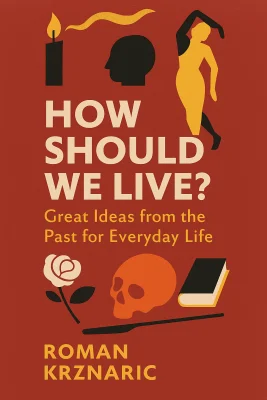
How Should We Live?
Great Ideas from the Past for Everyday Life
Categories
Nonfiction, Self Help, Psychology, Philosophy, History, Religion, Reference, Sociology, Essays, Historical
Content Type
Book
Binding
Hardcover
Year
2013
Publisher
BlueBridge
Language
English
ISBN13
9781933346847
File Download
PDF | EPUB
How Should We Live? Plot Summary
Introduction
Throughout human history, societies have grappled with a fundamental tension: how to balance our tribal instincts with our capacity for universal empathy. From ancient religious teachings that first articulated compassion beyond tribal boundaries to modern global networks that connect billions across continents, this struggle has defined much of our collective journey. The story of this evolution reveals surprising connections between seemingly disparate historical periods - how ancient Buddhist concepts of compassion echo in modern human rights declarations, or how medieval guild brotherhoods foreshadowed aspects of modern social welfare systems. As we navigate an increasingly interconnected yet divided world, understanding this historical tension offers valuable perspective. By examining how past societies balanced local attachments with broader obligations, we gain insights into addressing our own challenges of global cooperation and cultural identity. This exploration takes us through revolutionary moments when human consciousness expanded beyond tribal boundaries, as well as devastating periods when those boundaries hardened into conflict. For anyone seeking to understand how we might build bridges across today's divides while honoring our need for community, this journey through history's echoes provides both cautionary tales and inspiring possibilities.
Chapter 1: Ancient Foundations: Religious Empathy Across Civilizations (800 BCE-200 CE)
Between 800 BCE and 200 CE, a remarkable transformation in human consciousness occurred across multiple civilizations simultaneously. Historians often call this period the "Axial Age," when great spiritual teachers like Buddha in India, Confucius in China, and the Hebrew prophets developed revolutionary ideas about compassion and ethical behavior that transcended tribal boundaries. These teachings emerged during a time of significant social upheaval, as early empires expanded and traditional tribal structures were disrupted. In India, Buddhism introduced the concept of "karuna" (compassion) as a central virtue. The Buddha taught that all beings suffer and deserve compassion, directly challenging the rigid caste system of his time. His radical proposition that spiritual awakening comes through understanding others' suffering created a new moral framework extending beyond family or clan. Meanwhile in China, Confucius developed his philosophy of "ren" (benevolence), teaching that humans should treat others with the same consideration they would want for themselves. This principle became the foundation of Confucian ethics that would guide Chinese society for centuries. In the Mediterranean world, the Hebrew tradition contributed concepts like "chesed" (loving-kindness) and the biblical injunction to "love the stranger, for you were strangers in the land of Egypt" - a remarkable command asking people to use their own historical experience of vulnerability as a basis for treating others with dignity. What makes these ancient religious foundations so significant is how they challenged the prevailing tribal morality of their time. In a world where loyalty to one's clan was paramount, these teachings suggested a radical idea: that the circle of moral concern should extend to all humanity. As the Buddha said, "Just as a mother would protect her only child at the risk of her own life, even so, cultivate a boundless heart towards all beings." This universal empathy represented a profound evolutionary development in human consciousness, though its implementation would prove challenging throughout subsequent history. These ancient religious traditions established empathy not merely as a personal virtue but as a social and political principle. They suggested that societies should be organized around compassion for the vulnerable - an idea that would later influence everything from medieval charity to modern human rights frameworks. While imperfectly realized, these ideals created a moral foundation that would influence subsequent civilizations across millennia. The language and concepts they developed - compassion, loving-kindness, benevolence - provided humanity with a vocabulary for discussing moral obligations that transcend self-interest. The tension between tribal loyalty and universal compassion established during this period would become a recurring theme in human affairs. As societies grew more complex, this tension would manifest in new ways - from medieval debates about obligations to strangers versus kin, to modern questions about national sovereignty versus global cooperation. The Axial Age religions did not resolve this tension but rather brought it into conscious awareness, creating a moral framework that continues to challenge us to expand our circle of concern beyond those who look, think, and believe as we do.
Chapter 2: Medieval Communities: Brotherhood Beyond Blood (500-1400)
The medieval period, spanning roughly from the fall of the Roman Empire to the early Renaissance (500-1400 CE), witnessed the development of new forms of community that expanded human bonds beyond family ties. As Roman institutions collapsed across Europe, monasteries emerged as centers of learning, spirituality, and community life. The Rule of St. Benedict, written in the 6th century, created a framework for monastic communities based on principles of shared property, mutual care, and collective worship. These monasteries preserved classical knowledge while developing new forms of communal living that would influence Western civilization for centuries. Beyond monastery walls, medieval society organized itself around intricate bonds of mutual obligation. The feudal system, for all its hierarchical rigidity, was fundamentally based on reciprocal relationships between lords and vassals. Lords provided protection and land; vassals offered loyalty and service. This system, while deeply unequal, nevertheless recognized that even the most powerful depended on others. Similarly, the medieval guild system created brotherhoods of craftsmen who shared knowledge, maintained quality standards, and cared for members in times of hardship. These guilds were not merely economic organizations but fraternal communities with religious and social dimensions, providing support for widows and orphans of deceased members and establishing some of the first forms of social insurance. Religious brotherhoods and confraternities became another important expression of community during this period. These voluntary associations of laypeople gathered for worship, mutual aid, and charitable works. They established hospitals, cared for orphans, and provided burial services for members. In Florence alone, over 200 such confraternities existed by the 14th century, creating networks of support that extended beyond family ties. As one medieval chronicler noted, "They visit the sick, bury the dead, and perform other works of mercy, not only for their brothers but for many others in need." The medieval period also saw the emergence of towns and cities as distinct communities with their own identities and governance structures. City charters granted urban communities certain rights and freedoms, while town councils managed local affairs. Citizens developed strong attachments to their urban communities, evidenced by the construction of magnificent cathedrals and town halls that expressed civic pride. The medieval saying "Stadtluft macht frei" (city air makes you free) reflected how urban communities offered alternatives to feudal obligations and new possibilities for social organization based on commerce and craft rather than land and birth. While modern observers often focus on the hierarchical aspects of medieval society, this period actually developed sophisticated understandings of community interdependence. The concept of the "common good" (bonum commune) emerged as a central principle in medieval political thought, suggesting that society should be organized to benefit all members, not just the powerful. As Thomas Aquinas wrote, "In a well-ordered community, the common good takes precedence over individual good." This principle would later influence modern concepts of citizenship and social welfare. The medieval experience demonstrates how humans can create meaningful communities beyond blood ties - through shared values, work, worship, and mutual aid. These medieval forms of brotherhood provided models for balancing individual needs with collective welfare that would influence later social developments, from labor unions to modern welfare states. While we should not romanticize the inequalities and exclusions of medieval society, its emphasis on mutual obligation and community interdependence offers valuable perspective for our increasingly individualistic modern world.
Chapter 3: Enlightenment's Challenge: Reason Transforming Tradition (1650-1800)
Between 1650 and 1800, a remarkable intellectual revolution swept across Europe and America, challenging centuries of traditional authority with the power of human reason. This period, known as the Enlightenment, emerged in the aftermath of devastating religious wars that had torn Europe apart, prompting many to question whether religious dogma should continue guiding human affairs. Thinkers like John Locke, Voltaire, and Mary Wollstonecraft developed new approaches to understanding the world and organizing society that would fundamentally transform Western civilization. The scientific method became a powerful model for Enlightenment thinking. Isaac Newton's discoveries demonstrated that the universe operated according to rational, discoverable laws rather than divine whim. This scientific approach spread to other domains of knowledge, with thinkers like Adam Smith applying rational analysis to economics and Denis Diderot attempting to compile all human knowledge in his Encyclopedia. The underlying assumption was revolutionary: that human reason, rather than tradition or revelation, should be the ultimate authority in determining truth. As Immanuel Kant famously defined the Enlightenment: "Mankind's exit from its self-incurred immaturity. Immaturity is the inability to use one's own understanding without the guidance of another." In England, John Locke articulated revolutionary ideas about natural rights and government by consent, arguing that political authority should derive from the people rather than divine right. His "Two Treatises of Government" (1689) proposed that humans possess inherent rights to life, liberty, and property that no government could legitimately violate. Meanwhile in France, Voltaire championed religious tolerance and freedom of expression, famously declaring, "I disapprove of what you say, but I will defend to the death your right to say it." His contemporary Montesquieu developed the concept of separation of powers, which would profoundly influence constitutional systems worldwide. Women played crucial roles in the Enlightenment, despite facing significant barriers. Salons hosted by women like Madame Geoffrin in Paris became essential forums where Enlightenment ideas were discussed and refined. Female thinkers made important contributions, with Mary Wollstonecraft's "A Vindication of the Rights of Woman" (1792) applying Enlightenment principles to gender relations. She argued that women, like men, possessed reason and therefore deserved equal rights and education - a radical proposition that challenged centuries of tradition regarding women's roles. The Enlightenment's impact extended far beyond philosophical debates, inspiring revolutionary political changes. The American Revolution explicitly drew on Enlightenment principles, with Thomas Jefferson incorporating Lockean concepts of natural rights into the Declaration of Independence. The French Revolution similarly attempted to rebuild society on rational principles rather than traditional hierarchies, though it would ultimately demonstrate the challenges of implementing Enlightenment ideals in practice. Both revolutions, despite their differences, represented attempts to create political systems based on reason rather than tradition. Perhaps the Enlightenment's most enduring legacy was its faith in progress through reason. Thinkers like the Marquis de Condorcet believed that applying rational analysis to social problems could lead to continuous improvement in the human condition. This optimistic vision - that humanity could use reason to overcome superstition, tyranny, and suffering - continues to shape modern approaches to education, governance, and social reform. Though later generations would recognize the limitations of pure rationalism, the Enlightenment's core insight - that critical thinking can challenge unjust traditions - remains a powerful force in human affairs.
Chapter 4: Industrial Revolution: Technology Reshaping Society (1760-1840)
The Industrial Revolution, beginning in Britain around 1760 and spreading across Europe and North America by the early 19th century, represented the most profound transformation in human life since the development of agriculture. For millennia, human societies had relied primarily on muscle power - human and animal - for production. The harnessing of steam power changed everything, creating unprecedented capabilities for manufacturing, transportation, and eventually communication that would reshape not just economies but the very fabric of human communities. The revolution began in the textile industry, where inventions like the spinning jenny, water frame, and power loom dramatically increased productivity. A skilled spinner using a traditional spinning wheel might produce one thread at a time; with James Hargreaves' spinning jenny, they could produce eight threads simultaneously, and later models produced even more. Similar technological advances transformed other industries, from iron production to mining. The development of the steam engine by James Watt in the 1760s provided reliable power that wasn't dependent on water wheels or windmills, allowing factories to be built anywhere and fundamentally changing the relationship between humans and their environment. These technological changes triggered profound social transformations. Millions of people moved from rural areas to rapidly growing industrial cities like Manchester, Birmingham, and eventually Chicago and Pittsburgh. Traditional agricultural communities, where families had lived for generations following seasonal rhythms, gave way to urban environments characterized by factory whistles and mechanical timetables. As one contemporary observer noted, "Time itself became a commodity" to be bought, sold, and measured with increasing precision. The factory system created new forms of discipline, with workers expected to maintain consistent productivity for specified hours - a radical departure from traditional work patterns that followed natural cycles of light, weather, and seasons. The Industrial Revolution generated unprecedented wealth but distributed it unevenly. Factory owners and industrialists amassed fortunes that would have been unimaginable in previous eras. Middle-class professionals - engineers, managers, accountants - emerged to run increasingly complex enterprises. Meanwhile, many workers experienced harsh conditions, working 14-hour days in dangerous environments for subsistence wages. Children as young as five or six worked in mines and factories. Friedrich Engels described Manchester's working-class districts as places where "human beings live in crowded and unclean caves, not in houses." These conditions sparked new forms of political consciousness and organization, as workers began forming associations to demand better wages and conditions. By the 1830s, more organized movements emerged, including early trade unions and political movements like Chartism in Britain, which demanded democratic reforms. These movements represented attempts by ordinary people to shape the industrial system rather than simply be shaped by it. They drew on older traditions of community solidarity while developing new forms of collective action suited to industrial society. As one Chartist leader declared, "We are millions, and our unity can make us irresistible." These early labor movements would eventually lead to significant reforms in working conditions, hours, and wages, though often after decades of struggle. The Industrial Revolution fundamentally transformed human relationships - with nature, with time, with work, and with each other. Traditional communities based on personal relationships and shared traditions gave way to more anonymous urban environments where economic relationships predominated. Yet humans proved remarkably adaptable, creating new forms of community through labor unions, mutual aid societies, and urban neighborhoods. The tension between technological progress and human wellbeing established during this period continues to shape our relationship with technology today, as we navigate the benefits and disruptions of our own digital revolution.
Chapter 5: World Wars: Destruction and Reconciliation (1914-1945)
The period encompassing the two World Wars (1914-1945) represents one of the most devastating chapters in human history, yet also contains remarkable stories of reconciliation and rebuilding. World War I erupted in 1914 after decades of imperial competition, nationalist sentiment, and militarization among European powers. What began as a regional conflict following the assassination of Archduke Franz Ferdinand quickly escalated into global warfare involving 32 nations and their colonial possessions. The introduction of new technologies - machine guns, poison gas, tanks, aircraft - made this conflict uniquely destructive, claiming approximately 20 million lives and leaving a generation traumatized. The war shattered the old European order. Four empires collapsed: the German, Austro-Hungarian, Ottoman, and Russian. The Bolshevik Revolution, born partly from war-weariness, established the world's first communist state. The Treaty of Versailles attempted to create a new international order, establishing the League of Nations as a forum for peaceful dispute resolution. However, the treaty's punitive measures against Germany, combined with economic instability culminating in the Great Depression, created conditions for further conflict. As French Marshal Ferdinand Foch presciently remarked about the Versailles Treaty, "This is not peace. It is an armistice for twenty years." World War II proved even more catastrophic, claiming over 70 million lives between 1939 and 1945. Nazi Germany's genocidal policies resulted in the Holocaust, the systematic murder of six million Jews and millions of others deemed undesirable. Japan's imperial expansion brought brutal occupation to much of East and Southeast Asia. The development and use of atomic weapons against Hiroshima and Nagasaki introduced the possibility of human self-extinction through nuclear warfare. By war's end, much of Europe and Asia lay in ruins, with countless cities destroyed, economies shattered, and populations traumatized. Yet from this devastation emerged remarkable efforts at reconciliation and rebuilding. The Marshall Plan provided over $13 billion (equivalent to about $143 billion today) to rebuild Western European economies, recognizing that prosperity and democracy were interconnected. Former enemies Germany and Japan were helped to establish democratic governments and rebuild their economies. International institutions including the United Nations, World Bank, and International Monetary Fund were created to promote cooperation and prevent future conflicts. The Universal Declaration of Human Rights, adopted in 1948, established a global standard for human dignity that transcended national boundaries. Perhaps most remarkable were the personal acts of reconciliation that occurred after these conflicts. German Chancellor Willy Brandt's spontaneous kneeling at the Warsaw Ghetto memorial in 1970 acknowledged German responsibility for Nazi crimes. Japanese-American reconciliation included formal apologies and reparations for internment during World War II. Truth and Reconciliation Commissions in countries like South Africa attempted to heal societal wounds through acknowledgment rather than retribution. These efforts reflect a profound insight: that sustainable peace requires not just institutional arrangements but emotional and moral healing between former enemies. The World Wars period demonstrates both the depths of human capacity for destruction and our remarkable ability to rebuild and reconcile. It shows how tribal identities can be manipulated to justify atrocities, but also how humans can transcend those divisions to create more inclusive communities. The institutions and norms established after these conflicts - from the United Nations to human rights frameworks - represent attempts to expand our circle of moral concern beyond national boundaries. While imperfect, they reflect the hard-won wisdom that our survival depends on balancing national interests with global cooperation - a lesson that continues to challenge us today.
Chapter 6: Global Connectivity: Cold War to Digital Age (1945-Present)
The period from 1945 to the present has witnessed unprecedented global connectivity, fundamentally transforming how humans interact across national, cultural, and physical boundaries. Following World War II, the world divided into competing blocs led by the United States and Soviet Union. Yet even as political systems competed, technological developments were creating new forms of connection that would ultimately transcend these divisions and reshape human society on a global scale. The Cold War itself, despite its dangers, contained important elements of global integration. Arms control agreements like the Limited Test Ban Treaty (1963) and later the Strategic Arms Limitation Treaties represented unprecedented cooperation between rival superpowers. International organizations like the United Nations provided forums where nations could address shared challenges from refugee crises to disease outbreaks. The space race, though born from Cold War rivalry, created shared human experiences that transcended political boundaries. When Soviet cosmonaut Yuri Gagarin became the first human in space in 1961, his achievement was recognized worldwide. Similarly, the Apollo moon landing in 1969 was watched by an estimated 600 million people globally. As Apollo 8 astronaut Bill Anders expressed after photographing the famous "Earthrise" image, "We came all this way to explore the moon, and the most important thing is that we discovered the Earth." Economic globalization accelerated dramatically during this period. The creation of the General Agreement on Tariffs and Trade (later the World Trade Organization) reduced trade barriers, while technological advances in shipping - particularly containerization - dramatically lowered transportation costs. Multinational corporations expanded their operations across borders, creating global supply chains where a single product might contain components from dozens of countries. This economic integration created new forms of interdependence, with prosperity increasingly tied to international cooperation rather than national self-sufficiency. The fall of the Berlin Wall in 1989 and subsequent collapse of the Soviet Union removed major barriers to global integration. Former communist countries joined the global economy, while ideas and people moved more freely across previously closed borders. International travel increased exponentially, with global tourist arrivals growing from 25 million in 1950 to over 1.4 billion by 2019. These physical movements were accompanied by cultural exchanges that created new hybrid identities and perspectives. As anthropologist Arjun Appadurai noted, "More persons throughout the world see their lives through the prisms of the possible lives offered by mass media in all their forms." The digital revolution that began in the late 20th century created unprecedented possibilities for human connection. The development of the internet, originally a Cold War project to maintain military communications during nuclear war, evolved into a global network connecting billions of people. The World Wide Web, created by Tim Berners-Lee in 1989, transformed the internet into an accessible platform for information sharing. Social media platforms later enabled direct person-to-person connections across vast distances. By 2020, over 4.5 billion people - nearly 60% of humanity - had internet access, creating the most extensive communication network in human history. These developments have created both opportunities and challenges for human empathy and community. On one hand, global connectivity has enabled remarkable collaboration on shared problems, from scientific research to environmental protection. It has allowed people to form communities based on shared interests rather than just geographic proximity. On the other hand, this connectivity has revealed deep tensions between global and local identities, between technological possibility and human psychology. The same digital tools that connect can also divide, as filter bubbles and algorithmic amplification sometimes reinforce tribal identities rather than transcending them. As we navigate this increasingly connected world, the fundamental question becomes not whether we will be connected, but how we will manage these connections to expand rather than contract our circle of moral concern.
Summary
Throughout human history, we can trace a fundamental tension between tribal identity and universal empathy - between the impulse to care primarily for those who resemble us and the recognition that our moral circle should extend to all humanity. From ancient religious teachings that first articulated universal compassion to medieval communities that balanced local bonds with broader obligations, this tension has shaped social development. The Enlightenment's emphasis on universal reason and rights further expanded our conception of who deserves moral consideration, though implementation often fell short of ideals. The Industrial Revolution and World Wars tested humanity's capacity for both destruction and reconciliation, while our current era of global connectivity presents unprecedented opportunities for both conflict and cooperation across traditional boundaries. This historical journey offers crucial insights for navigating our increasingly interconnected world. First, we must recognize that empathy has always been both a natural human capacity and a skill requiring cultivation through education and social institutions. Second, technological connectivity alone cannot guarantee human understanding - we must intentionally build bridges across cultural and ideological divides. Finally, the most successful societies throughout history have found ways to balance local attachments with universal principles, recognizing that humans need both roots in particular communities and branches extending to broader humanity. By understanding how past generations navigated similar tensions, we gain valuable perspective on creating a future that honors both our differences and our shared humanity.
Best Quote
“George Orwell nos diria para esquecer a ideia de passar nossas próximas férias num resort exótico ou visitando museus. É muito mais interessante expandir nossa mente fazendo viagens para dentro da vida de outras pessoas – e permitindo-lhes ver a nossa. Em vez de perguntar a nós mesmos “Para onde posso ir da próxima vez?”, a pergunta em nossos lábios seria: “No lugar de quem posso me colocar da próxima vez?” ― Roman Krznaric, Sobre a arte de viver: Lições da história para uma vida melhor
Review Summary
Strengths: The reviewer praises the book for its ability to illuminate and inspire, highlighting the engaging compilation of historical lessons by Roman Krznaric. The reviewer appreciates the inclusion of diverse historical figures like Tolstoy and Orwell, and the book's capacity to provoke self-reflection and personal growth.\nOverall Sentiment: Enthusiastic\nKey Takeaway: The book is highly recommended for those interested in history and philosophy, as it offers profound insights and encourages readers to reflect on how historical ideas can influence and shape their lives.
About Author

Roman Krznaric
Krznaric situates his exploration of social change at the crossroads of empathy and historical insight, advocating for long-term thinking as an antidote to the prevailing short-term mindset. His philosophical approach leverages diverse intellectual traditions to reveal how past wisdom can guide future decision-making, a theme central to his influential book "The Good Ancestor." This work underscores the importance of intergenerational responsibility and has found resonance among those seeking sustainable solutions in a fast-paced world.\n\nHis method extends beyond traditional writing; Krznaric founded the world's first Empathy Museum to foster understanding through experiential learning. He also engages with various platforms, from TED talks to online courses, expanding his impact across different audiences. Readers and thinkers from fields such as education, design, and environmental activism benefit from his insights into how empathy can catalyze societal transformation. Moreover, his earlier books like "The Wonderbox" and "Empathy" are celebrated for their ability to weave historical narratives into discussions on contemporary life, illustrating his unique blend of rigorous analysis and accessible prose.\n\nKrznaric's contributions have not only enriched philosophical discourse but have also influenced legal and ethical debates on intergenerational rights. Recognized as one of Great Britain's leading philosophers, he continues to inspire through his work as a Senior Research Fellow at Oxford and his involvement with organizations like the Long Now Foundation. This short bio reflects his dedication to harnessing the power of ideas to drive meaningful change, solidifying his role as a pivotal figure in promoting human flourishing and empathetic understanding.
Read moreDownload PDF & EPUB
To save this Black List summary for later, download the free PDF and EPUB. You can print it out, or read offline at your convenience.
How Should We Live?
by Roman Krznaric
