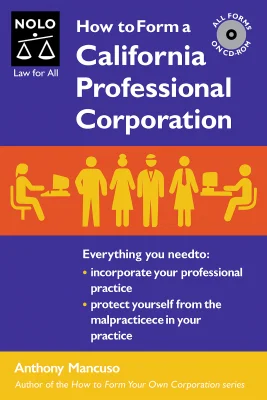
How to Form a California Professional Corporation with CD-ROM
Categories
Content Type
Book
Binding
Paperback
Year
1997
Publisher
Nolo
Language
English
ASIN
0873374967
ISBN
0873374967
ISBN13
9780873374965
File Download
PDF | EPUB
How to Form a California Professional Corporation with CD-ROM Plot Summary
Introduction
# Transform Your Practice: The Professional Corporation Success Blueprint Every professional reaches a pivotal moment when the question arises: should I incorporate my practice? Whether you're a doctor treating patients, an attorney serving clients, or an accountant managing finances, the decision to form a professional corporation represents more than just a business structure change—it's a strategic move toward greater financial flexibility, legal protection, and professional growth. The path to incorporation might seem daunting, filled with legal complexities and regulatory requirements. Yet thousands of California professionals have successfully navigated this journey, transforming their practices into thriving corporations that offer enhanced tax benefits, retirement planning opportunities, and limited liability protection. The key lies in understanding the process, following the proper steps, and making informed decisions that align with your professional goals and circumstances.
Chapter 1: Build Your Legal Foundation with Confidence
The cornerstone of any successful professional corporation lies in understanding and properly establishing its legal framework. A professional corporation differs fundamentally from regular business corporations because it's specifically designed for licensed professionals who must maintain their professional responsibilities while gaining corporate benefits. Consider Dr. Sarah Chen, a successful pediatrician who had been operating as a sole proprietor for eight years. While her practice generated substantial income, she found herself personally liable for all business debts and unable to take advantage of certain tax benefits available to corporations. Her accountant explained that as a sole proprietor, she was essentially the business—there was no legal separation between her personal assets and her practice's liabilities. Dr. Chen's situation illustrates the fundamental difference between unincorporated and incorporated business structures. When she incorporated, she created a separate legal entity that could enter contracts, own property, and assume liabilities independently of her personal assets. This transformation didn't change how she treated patients; instead, it provided a protective shield around her personal wealth while maintaining the same high standards of professional care. Begin your foundation work by selecting an appropriate corporate name that complies with professional regulations and reflects your practice identity. Research name availability through the Secretary of State's office and ensure compliance with your profession's naming requirements. Your articles of incorporation serve as the birth certificate of your corporation, clearly stating your professional purpose and establishing your registered agent. Establish clear governance structures by defining director and officer roles, creating meeting procedures, and developing decision-making protocols. Draft comprehensive bylaws that address operational issues, voting requirements, and conflict resolution procedures. These documents serve as your corporation's constitution and should reflect your professional values and operational preferences. Your foundation work today determines your corporation's effectiveness tomorrow. Invest time in creating robust organizational documents, establishing clear procedures, and building systems that support your professional objectives and facilitate smooth operations for years to come.
Chapter 2: Master Documentation and Compliance Requirements
Professional corporations operate under strict documentation requirements that, when properly managed, provide powerful legal protection and operational clarity. The key is developing systematic approaches that make compliance feel natural rather than burdensome. Attorney Michael Rodriguez and Jennifer Park learned this lesson when they decided to incorporate their partnership. Initially, they focused only on the filing requirements, overlooking crucial details about share ownership, director responsibilities, and operational procedures. Six months later, they faced conflicts over decision-making authority and profit distribution that could have been avoided with proper initial planning. After consulting with an experienced corporate attorney, Rodriguez and Park restructured their corporation with clear bylaws, defined officer roles, and explicit shareholder agreements. They established voting procedures, created conflict resolution mechanisms, and outlined succession planning protocols. This comprehensive approach transformed their practice from a source of confusion into a well-organized, efficiently operating professional corporation. Your corporate bylaws function as the operating manual for your business, establishing rules for meetings, voting procedures, and decision-making processes. Even if you're the sole shareholder, these procedures create important legal distinctions between you as an individual and your corporation as a separate entity. Draft bylaws that reflect your actual intended operations while meeting all legal requirements for your profession. Board resolutions document major corporate decisions and demonstrate that proper procedures were followed. Maintain records of all significant business decisions, from opening bank accounts to entering major contracts. These documents prove corporate legitimacy and can be crucial if your corporate status is ever questioned by creditors, courts, or tax authorities. Create a systematic filing system that makes document retrieval quick and efficient. Whether you choose physical binders or digital systems, consistency and accessibility are paramount. Establish regular review procedures to ensure all documentation remains current and compliant with evolving regulations. Remember that proper documentation extends beyond initial formation. Maintaining corporate formalities protects your limited liability status and demonstrates legitimate corporate operations that distinguish your business as a separate legal entity worthy of corporate protection.
Chapter 3: Unlock Tax Advantages and Strategic Elections
The tax implications of professional incorporation often provide the most compelling reasons for making the transition, offering opportunities for income splitting, deferred taxation, and enhanced deduction strategies that can significantly impact your financial position. Consider the experience of Dr. Robert Kim, an orthopedic surgeon whose solo practice generated $400,000 annually. As a sole proprietor, he paid individual tax rates on his entire income, limiting his ability to control tax timing and reducing his overall tax efficiency. His accountant calculated that incorporation could save him over $15,000 annually through strategic income splitting and corporate tax benefits. After incorporating, Dr. Kim implemented a comprehensive tax strategy that involved paying himself a reasonable salary while retaining additional income in the corporation at lower corporate tax rates. He established a corporate retirement plan that allowed larger contributions than his previous Keogh plan, and he began taking advantage of corporate fringe benefits that were fully deductible to the corporation but not taxable to him personally. The transformation in Dr. Kim's tax situation extended beyond immediate savings. He gained flexibility in timing income recognition, ability to smooth income fluctuations across tax years, and access to sophisticated retirement planning strategies. His corporation could now provide health insurance, disability coverage, and other benefits as tax-deductible business expenses. To evaluate your tax advantages, start by analyzing your current tax situation with a qualified accountant. Calculate your effective tax rate, identify deduction limitations, and assess opportunities for tax deferral. Compare your current structure's tax implications with potential corporate benefits, considering both immediate and long-term impacts. Develop a comprehensive tax strategy that addresses income splitting opportunities, retirement plan contributions, and fringe benefit optimization. Consider whether S corporation election might benefit your situation, evaluate timing strategies for income recognition, and plan for tax-efficient wealth accumulation within your corporate structure. The tax advantages of professional incorporation can be substantial, but they require careful planning and proper implementation. Work with experienced advisors to maximize these benefits while ensuring compliance with all applicable regulations and requirements.
Chapter 4: Optimize Growth Through Corporate Structure
Professional corporations provide unique opportunities for strategic growth that aren't available through other business structures. Understanding and leveraging these advantages can accelerate your professional development and wealth building significantly. The retirement planning transformation experienced by Dr. Lisa Thompson illustrates these advantages perfectly. As a self-employed psychiatrist, she was limited to Keogh plan contributions and faced restrictions on benefit options. Her annual retirement savings were capped at levels that wouldn't support her desired retirement lifestyle, and she couldn't provide competitive benefits to her staff. After incorporating, Dr. Thompson established a corporate defined benefit plan that allowed her to contribute over $100,000 annually toward retirement—more than triple her previous Keogh contributions. She implemented a comprehensive benefits package including health insurance, disability coverage, and group life insurance, all fully deductible to the corporation. Her staff retention improved dramatically, and her own financial security increased substantially. The corporate structure enabled Dr. Thompson to explore sophisticated retirement strategies including profit-sharing plans, 401(k) options, and targeted benefit arrangements. She could now borrow from her retirement plan when needed, access better investment options, and implement tax-efficient wealth transfer strategies for her family. Professional corporations can employ other licensed professionals in your field, creating opportunities for practice expansion without the complexities of partnership arrangements. This employment model provides clear authority structures, simplified profit distribution, and easier exit strategies compared to traditional partnerships. Corporate structure facilitates professional development investments that benefit both you and your practice. Educational expenses, conference attendance, and professional certification costs often receive favorable tax treatment when paid by corporations, while building valuable skills and credentials that enhance practice value. Consider succession planning opportunities that professional corporations enable. Unlike sole proprietorships, corporations can continue operating beyond the founder's involvement, creating valuable assets that can be sold or transferred to successors. This continuity adds significant value and provides retirement security that isn't available through other practice structures. Strategic tax planning becomes more sophisticated with corporate structures, allowing income timing, expense optimization, and benefit maximization strategies that can significantly impact your financial outcomes and long-term wealth accumulation.
Chapter 5: Navigate Common Pitfalls and Avoid Costly Mistakes
Even well-intentioned professionals can make costly mistakes during incorporation that undermine their goals and create unnecessary complications. Understanding common pitfalls helps you avoid these problems and establish your corporation on solid ground from the beginning. The compliance challenges faced by Dr. Maria Santos illustrate the importance of systematic post-incorporation management. Six months after incorporating her dental practice, she received notices from multiple agencies regarding unfiled reports, missing tax returns, and professional board compliance issues. The accumulated penalties and potential sanctions threatened her corporation's good standing. Dr. Santos realized that incorporation was just the beginning of her corporate responsibilities. She needed to establish systems for ongoing compliance, maintain proper corporate records, and meet various reporting requirements. Working with her accountant and attorney, she created a comprehensive compliance calendar that tracked all filing deadlines, renewal requirements, and professional obligations. The transformation in Dr. Santos's compliance management was remarkable. She implemented monthly financial reviews, quarterly tax planning sessions, and annual corporate maintenance procedures. Her systematic approach eliminated missed deadlines, reduced professional stress, and ensured her corporation remained in full compliance with all applicable regulations. One of the most common mistakes involves inadequate capitalization of the new corporation. While you don't need massive initial investment, your corporation must have sufficient assets to operate legitimately and meet potential obligations. Undercapitalized corporations risk piercing the corporate veil, where courts ignore corporate protection and hold owners personally liable. Mixing personal and corporate finances destroys the legal separation that provides liability protection. Maintain separate bank accounts, credit cards, and financial records for your corporation. Never use corporate funds for personal expenses or personal funds for corporate obligations without proper documentation and procedures. Establish systematic record-keeping procedures that maintain corporate formalities and document all business decisions. Hold regular board meetings, maintain proper minutes, and document all significant corporate actions. Keep detailed financial records and maintain separation between corporate and personal finances. Choose qualified professionals to assist with incorporation and ongoing compliance. While online services might seem cost-effective, professional corporations often require specialized knowledge that general business services don't provide. Invest in proper formation to avoid costly corrections later.
Summary
The journey from professional practice to incorporated success represents more than a structural change—it's a strategic transformation that positions you for enhanced financial security, operational efficiency, and professional growth. As one successful professional noted, "Incorporation didn't just change how I did business—it changed how I thought about my professional future and the possibilities it held." Your next step is clear and immediate: schedule consultations with qualified advisors who can evaluate your specific situation and guide you through the incorporation process. Begin today by contacting a corporate attorney experienced in professional corporations and a CPA familiar with small business taxation. These initial conversations will provide the foundation for making informed decisions about your professional future and taking concrete steps toward achieving your incorporation goals.
Best Quote
Review Summary
Strengths: The review highlights the book as "useful" and "essential," indicating that it provides valuable information and guidance for individuals interested in incorporating their own businesses. Overall: The review conveys a positive sentiment, suggesting that the book is highly recommended for those undertaking DIY incorporation. It implies that the book is a crucial resource for understanding and navigating the incorporation process effectively.
About Author

Anthony Mancuso
Mancuso delves into the intricacies of business formation through his prolific work as a legal expert and author. Specializing in corporations and limited liability companies, he draws on his background as a California-based attorney and his academic pursuits in business taxation to offer readers comprehensive guides for navigating complex legal frameworks. His books, published by Nolo, focus on practical and accessible instructions, making it easier for non-lawyers to understand and implement legal concepts. This approach is particularly evident in titles such as "Form Your Own Limited Liability Company" and "LLC or Corporation?", which provide step-by-step guidance tailored to individuals seeking to establish and manage business entities.\n\nBeyond his literary endeavors, Mancuso's professional experience includes consulting for Silicon Valley technology companies and working at Google. These roles have enriched his understanding of the operational needs and challenges faced by modern businesses, thereby enhancing the depth and relevance of his legal advice. Readers benefit from Mancuso's unique ability to synthesize legal expertise with practical business strategies, offering valuable insights into entity formation and corporate governance. His work is recognized as a bestselling collection within the legal publishing field, affirming his impact and authority in corporate law education.\n\nFor aspiring entrepreneurs and seasoned business professionals alike, Mancuso's books serve as indispensable resources for making informed decisions about business structure and management. The clarity and thoroughness of his writing empower readers to navigate legal processes with confidence, fostering an informed approach to building and sustaining successful business ventures. Through his blend of legal acumen and instructional clarity, Mancuso has established himself as a leading figure in the field of business law, making a significant impact on both his readers and the broader legal community.
Read moreDownload PDF & EPUB
To save this Black List summary for later, download the free PDF and EPUB. You can print it out, or read offline at your convenience.
How to Form a California Professional Corporation with CD-ROM
by Anthony Mancuso
