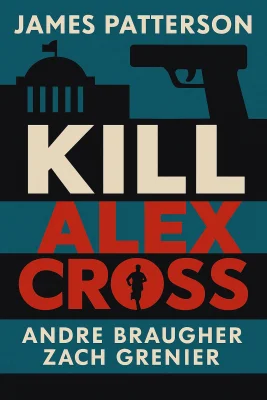
Kill Alex Cross
Categories
Fiction, Audiobook, Mystery, Thriller, Adult, Suspense, Crime, Mystery Thriller, Murder Mystery, Detective
Content Type
Book
Binding
Hardcover
Year
2010
Publisher
Century
Language
English
ASIN
B0092I42XM
ISBN13
9781846057649
File Download
PDF | EPUB
Kill Alex Cross Plot Summary
Introduction
# Shadows of Power: Terror and Vengeance in the Heart of America The morning started like any other at Washington's most exclusive private school, where the children of power learned to navigate privilege behind ivy-covered walls. But when twelve-year-old Ethan Coyle and his sixteen-year-old sister Zoe vanished from their classroom in under four minutes, leaving behind only shattered tracking devices in underground tunnels, the unthinkable became reality. The President's children had disappeared without a trace. As Detective Alex Cross arrived at the scene, smoke still rising from a crashed van that held no answers, he couldn't know that this was merely the opening move in a game of vengeance years in the making. While federal agents swarmed the prestigious Branaff School and helicopters thundered overhead, two parallel nightmares were about to converge on the nation's capital. One driven by international terrorism, the other by something far more personal and infinitely more dangerous.
Chapter 1: The Vanishing: When Presidential Children Disappear
The classroom window hung open like an accusation. Secret Service Agent Clay Findlay stared at the empty space where moments before, two of the most protected children in America had been cooling down from a schoolyard fight. He had given them exactly two minutes alone. When he returned, Ethan and Zoe Coyle had simply vanished. Alex Cross pushed through the chaos of federal agents descending on the Branaff School like locusts. The prestigious institution, where senators and cabinet members sent their children, had become ground zero for every parent's worst nightmare. Cross studied the escape route through nineteenth-century tunnels that had once sheltered runaway slaves. Now they had swallowed the President's children whole. The maintenance chief, George O'Shea, guided Cross through the labyrinthine passages beneath the school. His eagerness to help felt wrong, too practiced, as if he had rehearsed this moment. The tunnel emerged near athletic fields, offering multiple escape routes into the heart of Washington. But it was what they found scattered on the concrete floor that chilled Cross to the bone. The children's tracking devices lay in pieces, deliberately destroyed by someone who understood exactly how the Secret Service operated. This wasn't a crime of opportunity. Someone had planned every detail, used the school's own history against it, turned sanctuary into a hunting ground. As Cross examined the shattered electronics, he felt the cold touch of calculation that separated true predators from mere criminals. The first message arrived that evening, delivered to FBI headquarters in a plain manila envelope. Inside lay a single photograph of two small figures lying motionless in darkness, and words that would haunt every agent who read them: "There is no ransom. There are no demands. The price you pay, Mr. President, is knowing you will never see your children again."
Chapter 2: Twin Threats: Terror Strikes While Innocents Vanish
The white pickup truck slammed into Secretary of State Martin Cho's motorcade with the precision of a guided missile. The young man who emerged carried a detonator with the casual confidence of someone who had already made peace with death. When the explosion tore through Constitution Avenue, it announced the arrival of Al Ayla in America's heartland. Cross found himself pulled between two investigations as the scope of the terrorist threat became clear. The FBI had intercepted a hit list containing eighteen names, each one a link in the chain of presidential succession. From Vice President Flynn to Secretary of Homeland Security, someone was systematically targeting the foundation of American government while two children remained missing in the shadows. At Dulles Airport, customs agents discovered the first clue to the enemy's identity. Farouk and Rahma Al Zahrani, a seemingly innocent Saudi couple, bit down on cyanide capsules before security could process them. As they convulsed and died on the terminal floor, their sacrifice allowed other operatives to slip through the chaos undetected. The Family had arrived, and they brought death with surgical precision. The poisoning of Washington's water supply sent hundreds to hospitals and shut down the city's schools. Cross connected the dots between the airport suicides and the water attack, both involving cyanide, both timed to maximize terror. While the nation focused on the missing presidential children, a shadow war was being fought in the corridors of power. In a Chinatown parking garage, federal agents prepared for what they hoped would be a decisive strike against the terrorist cell. But when flash-bang grenades detonated and smoke filled the concrete structure, they discovered their enemy's true nature. Cross watched a woman with deadly precision execute her own wounded comrade before vanishing into the urban maze, her actions speaking to a truth that chilled him: these weren't just terrorists, they were soldiers in a war most Americans didn't know was being fought.
Chapter 3: The Hunt Begins: Following Breadcrumbs Through Darkness
The breakthrough came from a grieving ex-wife in Harrisburg, Pennsylvania. Molly Johnson sat across from Cross in a restaurant parking lot, her hands trembling as she revealed the truth about her marriage to Rodney Glass, the school nurse at Branaff. After their eight-year-old son Zachary died from medical complications, Glass had changed, becoming consumed with rage at a system that valued some lives more than others. The story she told made Cross's blood run cold. Glass had drugged her, held her captive for three days in an underground chamber that reeked of earth and despair. It was a dress rehearsal for something far worse, a father's grief twisted into a weapon of revenge against a world that had failed his child while protecting others. Back at the school, Cross studied personnel files with new eyes. Glass had access to the tunnel system, intimate knowledge of the children's routines, and the medical expertise to keep victims sedated indefinitely. More damning still, he had been absent from his post during the crucial minutes when Ethan and Zoe disappeared, claiming a bathroom break that could just as easily have been an underground rendezvous. The surveillance operation that followed revealed Glass's cunning. He led Cross's team through shopping centers and movie theaters, always staying just ahead of suspicion while never quite crossing the line into obvious guilt. But his confidence was also his weakness. He couldn't resist returning to the scene, drawn by the same compulsion that made him document everything on his digital recorder. When Cross finally confronted him in the sterile FBI interrogation room, Glass's mask slipped just enough to reveal the monster beneath. His casual dismissal of the children's suffering, his smug certainty that he would walk free, confirmed what Cross had suspected from the beginning. They were dealing with someone who had moved far beyond grief into something much darker, someone who saw two innocent children as instruments in his personal war against injustice.
Chapter 4: Unmasking the Enemy: Personal Vengeance Behind National Crisis
The interrogation room felt like a pressure cooker as Cross faced Rodney Glass across the metal table. Glass wore his innocence like armor, deflecting every question with the practiced ease of someone who had rehearsed this moment countless times. He spoke of bathroom breaks and bloody noses, of coincidences and circumstantial evidence, his voice carrying the wounded tone of a man wrongly accused. But Cross had done his homework. Phone records from a student's device showed someone had used it to send Zoe a text that morning, luring her to the tunnel. The timeline of Glass's movements, the testimony of his ex-wife, the pattern of his behavior all formed a web that should have been inescapable. Yet Glass slipped through every trap with maddening ease, his medical training evident in his calm pulse and steady breathing. The polygraph test results were devastating in their clarity. Glass was telling the truth about never seeing the van driver, about not knowing the children's current location, about having no connection to international terrorism. But Cross recognized the careful parsing of words, the way Glass answered only what was asked while concealing the larger truth beneath layers of technical honesty. When Cross finally lost control, grabbing Glass by his shirt and demanding answers, the nurse's reaction was telling. Instead of fear or anger, Glass smiled and waved goodbye as security dragged Cross from the room. It was the gesture of a man who knew he held all the cards, who understood that the system he despised would ultimately protect him from the consequences of his actions. The video that arrived the next day drove home Glass's message with brutal clarity. Ethan and Zoe lay unconscious in their underground prison, their faces gaunt with hunger and dehydration. The accompanying note was simple and devastating: "Draw your own conclusions, Mr. President." Glass wasn't just holding the children hostage. He was forcing their father to watch them slowly waste away, just as Glass had watched his own son die while the medical system failed them both.
Chapter 5: Breaking the Law: When Justice Demands Criminal Acts
The abandoned farmhouse stood like a broken tooth against the Pennsylvania sky, its collapsed roof and rotting timbers speaking of decades of neglect. Cross crouched in the darkness beside FBI agents Ned Mahoney and John Sampson, their breath forming clouds in the cold air as they watched Rodney Glass emerge from the woods carrying a dead rabbit and his ever-present digital recorder. What they were about to do violated every principle Cross had sworn to uphold as a police officer. But as he thought of Ethan and Zoe lying in their underground prison, slowly starving while the legal system protected their captor, those principles seemed like luxuries he could no longer afford. Sometimes justice required getting your hands dirty. The kidnapping itself was almost anticlimactic. Glass never saw them coming, never had a chance to reach for the pistol hidden under his mattress. The scopolamine injection left him compliant but conscious, his tongue loosened by chemicals while his mind struggled to maintain the lies that had protected him for so long. In the back of Mahoney's car, with his defenses chemically compromised, Glass finally began to tell the truth. The location came in fragments. References to an old potato cellar, to the smell of earth and decay, to a place where screams would never be heard. Glass seemed to find their desperation amusing, laughing at the irony of three law enforcement officers becoming criminals in their quest to save two innocent children. But his laughter died when they reached the farmhouse and saw what lay beneath the barn floor. The excavation that followed was a race against time and conscience. Federal agents worked by floodlight to carefully remove layers of earth from what appeared to be a grave, their faces grim with the possibility that they might be too late. But when the steel door was finally breached and medics descended into the darkness, their shouts of discovery brought tears of relief to hardened agents who had seen too much death in their careers.
Chapter 6: Underground Rescue: Racing Against Time and Death
The moment when Zoe emerged from her underground prison would haunt Cross for the rest of his life. The sixteen-year-old who had once argued with classmates and defied authority was gone, replaced by a fragile shadow who clung to her rescuer with desperate gratitude. Her clothes hung in tatters, her eyes hollow with hunger and trauma, but she was breathing. They both were breathing. Ethan came next, even more fragile than his sister, his twelve-year-old frame reduced to skin and bones by weeks of captivity. The medics worked with practiced efficiency, checking vital signs and starting IV lines while helicopters thundered overhead. But as they loaded the children onto stretchers, Ethan and Zoe reached for each other with a connection forged in shared suffering that no trauma could break. The forensic evidence painted a picture of calculated cruelty. Glass had kept the children sedated with a cocktail of drugs delivered through their food and water, maintaining them in a state of semi-consciousness that prevented escape while prolonging their suffering. The recordings found in his possession revealed the depth of his obsession, hours of rambling monologues about justice and revenge, about making the world understand the pain of losing a child. Cross watched the ambulances disappear into the night, carrying Ethan and Zoe toward Walter Reed Medical Center and the beginning of their long journey back to the light. But even as relief flooded through him, he knew the victory was incomplete. Glass had been released on a technicality, the evidence obtained through their illegal interrogation inadmissible in court. The man who had orchestrated this nightmare was free to walk the streets. The irony wasn't lost on Cross as he stood in the Pennsylvania darkness. They had saved the children by becoming criminals themselves, crossing lines that could never be uncrossed. The question that would torment him in the days to come was simple: had it been worth it? As he remembered Ethan and Zoe's whispered words of thanks, he knew the answer would always be yes.
Chapter 7: Final Reckoning: Confrontation in the Pennsylvania Woods
The forest path where Cross and Sampson waited had become a killing ground, though neither man knew it yet. Rodney Glass emerged from the trees carrying his hunting bow with the casual confidence of a predator in his natural habitat. His digital recorder had captured his final thoughts, his decision to end the game by eliminating the one man who truly understood his purpose. The confrontation was inevitable, written in blood from the moment Glass had first laid eyes on Ethan and Zoe Coyle. Cross's investigation had been too thorough, his understanding too complete. Glass couldn't allow such a witness to live, couldn't let his story be reduced to the simple narrative of a madman's revenge. There were larger truths at stake, lessons about justice and loss that the world needed to learn. When Cross ordered him to drop the bow, Glass smiled with genuine amusement. Here they were, miles from their jurisdiction, two cops playing vigilante in the Pennsylvania woods. The irony was delicious. They had become everything they claimed to despise, criminals hiding behind badges and righteous anger. Glass almost respected them for it. The pistol appeared in Glass's hand with practiced smoothness, but his medical training hadn't prepared him for the reality of combat. Cross and Sampson's shots were precise and devastating, two bullets to the chest that dropped him to the forest floor like a broken doll. As his life ebbed away among the fallen leaves, Glass managed one final smile, one last moment of satisfaction at having forced good men to become killers. His dying words carried the weight of prophecy: "You should have died. You ruined everything." But Cross felt no satisfaction in Glass's death, no sense of justice served. The man who had terrorized a nation and tortured two innocent children was gone, but the questions he had raised about fairness and loss would linger long after his body grew cold in the Pennsylvania dirt. Some victories came at a price that could never be fully calculated.
Summary
The months that followed brought a kind of peace to Washington, though it was built on foundations that had been tested to their breaking point. The Coyle family's public appearances showed a nation that resilience was possible, that even the deepest wounds could heal with time and love. Ethan and Zoe bore their scars with quiet dignity, their bond strengthened by shared trauma into something unbreakable. When Cross visited them at the White House, he saw not victims but survivors, children who had looked into darkness and emerged with their humanity intact. The terrorist threat that had paralyzed the capital gradually faded as Al Ayla's network crumbled under sustained pressure from law enforcement. Bodies found on distant beaches told the story of an organization consuming itself, loyalty replaced by paranoia as survivors turned on each other with the same ruthlessness they had once directed at their enemies. But for Cross, the true measure of success wasn't found in closed case files or commendations from grateful politicians. It was found in the knowledge that sometimes the hardest choices led to the most important victories, that the shadows of vengeance could pass, leaving behind the enduring light of bonds that no darkness could ever fully extinguish.
Best Quote
“I’d learned a long time ago that it’s better to ask forgiveness than permission.” ― James Patterson, Kill Alex Cross
Review Summary
Strengths: The book maintains a fast-paced narrative with short, sharp chapters that keep readers engaged. The storyline involving the President's children adds excitement, and revisiting Alex Cross's family provides a familiar touch for long-time readers. Weaknesses: The recurring theme of child kidnappings feels repetitive, and the terrorist subplot seems rushed and somewhat redundant. The protagonist, Alex Cross, lacks his usual depth and connection, making him feel unfamiliar to long-time fans. The overall plot appears to retread familiar ground, leading to a sense of mediocrity. Overall: The reviewer expresses mixed feelings, acknowledging the book's engaging pace but critiquing its lack of originality and depth. While it offers entertaining escapism, it may disappoint those seeking fresh developments in the Alex Cross series.
About Author

James Patterson
Patterson crafts narratives that resonate with universal themes of justice and resilience, drawing readers into high-stakes worlds through his masterful use of suspense and emotion. Known for his ability to create compelling characters and intricate plots, Patterson's books explore the complexities of the human condition, making him a staple in the world of thriller and suspense novels. His method often involves collaboration with co-authors and detailed outlines, allowing him to maintain an impressive volume of work, with series like the Alex Cross and Women's Murder Club becoming particularly notable for their psychological depth and multifaceted plots.\n\nWhile Patterson's prolific output and fast-paced storytelling have secured him a vast readership, his influence extends beyond his fiction. He has played a pivotal role in promoting literacy through initiatives like the ReadkiddoRead website and the JIMMY Patterson imprint. Therefore, his work not only entertains but also contributes significantly to the literary community. His nonfiction efforts, such as "Walk the Blue Line," further showcase his ability to engage with profound themes, emphasizing his versatility as a writer.\n\nPatterson's impact on readers and the literary landscape is underscored by numerous accolades, including the Edgar Allan Poe Award for his debut novel, "The Thomas Berryman Number." His collaborative work with notable figures like former President Bill Clinton in titles such as "The President Is Missing" highlights his innovative spirit. By weaving together accessible prose with strong protagonists, Patterson's books continue to capture the imaginations of diverse audiences, solidifying his legacy as an influential author in contemporary literature.
Read moreDownload PDF & EPUB
To save this Black List summary for later, download the free PDF and EPUB. You can print it out, or read offline at your convenience.
Kill Alex Cross
by James Patterson
