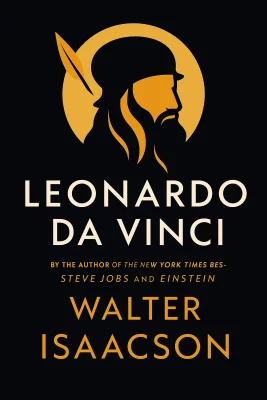
Leonardo da Vinci
Categories
Nonfiction, Art, Science, Biography, History, Audiobook, Biography Memoir, Historical, Italy, Art History
Content Type
Book
Binding
Hardcover
Year
2017
Publisher
Simon & Schuster
Language
English
ISBN13
9781501139154
File Download
PDF | EPUB
Leonardo da Vinci Plot Summary
Introduction
# Leonardo da Vinci: The Renaissance Mind That United Art and Science In the flickering candlelight of a Milan monastery in 1495, a middle-aged man with flowing curls and paint-stained fingers carefully applied another layer of oil to a monastery wall. Leonardo da Vinci was creating what would become The Last Supper, but at that moment, he was simply following his insatiable curiosity about how light plays across human features and how emotion manifests in physical expression. This scene captures the essence of a man who refused to be confined by the boundaries between disciplines, who saw art and science not as separate pursuits but as complementary ways of understanding the divine machinery of the world. Born in 1452 in the small Tuscan town of Vinci, Leonardo emerged during the Renaissance as the ultimate embodiment of human potential unleashed. He was simultaneously a painter whose works would define artistic excellence for centuries, an engineer whose designs anticipated modern technology by hundreds of years, and a scientist whose observations laid groundwork for fields from anatomy to geology. Through his extraordinary life, we discover how relentless curiosity can transform both the observer and the world around them. We witness how the marriage of artistic sensitivity with scientific rigor can produce insights that neither approach could achieve alone. Most importantly, we learn how one person's refusal to accept conventional limitations can inspire humanity to reach beyond what seems possible.
Chapter 1: Early Life and Artistic Formation in Florence
Leonardo's unconventional beginning as the illegitimate son of a notary and a peasant woman in 1452 proved to be a blessing in disguise. While legitimate sons were expected to follow their fathers into respectable professions like law or commerce, Leonardo's status freed him from such constraints. His father, Ser Piero, could not enroll him in the guild of notaries, but this exclusion opened doors to more creative pursuits. Growing up between his father's household in Florence and his mother's rural cottage, Leonardo developed an early appreciation for both urban sophistication and natural beauty. The young Leonardo displayed an almost supernatural ability to observe the world around him. While other children might glance at a bird in flight, he would study the precise angle of its wings, the rhythm of its wingbeats, and the way shadows fell across its feathers. This intense curiosity extended to everything from the flow of water to the expressions that flickered across human faces. His early notebooks reveal a mind that found wonder in the most ordinary phenomena, asking questions like "Why is the sky blue?" and "What causes the formation of clouds?" At fourteen, Leonardo's artistic talents caught the attention of Andrea del Verrocchio, one of Florence's most respected artists and engineers. Verrocchio's workshop was more than an art studio; it was a laboratory where painting, sculpture, engineering, and scientific inquiry intersected. Here, Leonardo learned not just how to mix pigments and prepare canvases, but how to understand the mathematical principles underlying perspective, the anatomical structures that gave bodies their form, and the optical laws that governed how light revealed the world to human eyes. The collaborative atmosphere of Verrocchio's workshop shaped Leonardo's approach to learning and creating. Unlike the solitary genius of popular imagination, Leonardo thrived in environments where ideas could be shared, tested, and refined through discussion. He learned from goldsmiths, architects, musicians, and philosophers, absorbing techniques and concepts that would later emerge transformed in his own work. This interdisciplinary education taught him that the boundaries between different fields of knowledge were often artificial, and that the most profound insights came from connecting seemingly unrelated observations. By his early twenties, Leonardo had already begun to surpass his master. His contribution to Verrocchio's "Baptism of Christ" demonstrated a revolutionary approach to painting that combined scientific understanding of light and shadow with an almost mystical ability to capture the essence of living beings. The angel he painted seemed to breathe with life, its features modeled with a subtlety that made Verrocchio's own work appear wooden by comparison. This early masterpiece announced the arrival of an artist who would transform not just how paintings were made, but how humanity understood the relationship between art and truth.
Chapter 2: Milan Years: Court Engineer and Universal Genius
In 1482, at the age of thirty, Leonardo made a decision that would define the next phase of his career. Leaving behind the artistic ferment of Florence, he traveled north to Milan, carrying with him a silver lyre shaped like a horse's head and a letter of introduction that would become one of history's most famous job applications. Writing to Ludovico Sforza, the de facto ruler of Milan, Leonardo presented himself primarily as a military engineer, boasting of his ability to design bridges, cannons, and armored vehicles. Only at the end of his lengthy pitch did he mention, almost as an afterthought, that he could also paint. Milan in the 1480s was a city of ambition and intrigue, ruled by a man who had seized power through cunning and maintained it through a combination of cultural patronage and political maneuvering. Ludovico Sforza understood that legitimacy could be built not just through military might but through the creation of beauty and wonder. His court became a magnet for artists, musicians, mathematicians, and engineers, creating an environment where Leonardo's diverse talents could flourish. Here was a place where designing stage machinery for court entertainments was considered as important as painting religious altarpieces. Leonardo's initial years in Milan were spent primarily as a producer of spectacles and pageants. He created mechanical birds that could fly across theater stages, designed costumes that transformed actors into mythological creatures, and engineered stage effects that left audiences gasping in amazement. These seemingly ephemeral projects served as laboratories for his more serious investigations into mechanics, optics, and human psychology. Every pulley system he designed for lifting an actor taught him something about leverage and force; every costume that needed to convey a character's emotions informed his understanding of how external appearance reflected internal states. The commission that truly established Leonardo's reputation in Milan was the massive equestrian monument honoring Ludovico's father, Francesco Sforza. This project, which would consume more than a decade of his life, required him to become an expert in everything from horse anatomy to bronze casting. He dissected horses to understand their musculature, studied ancient Roman sculptures to learn how static art could convey dynamic movement, and invented new techniques for casting bronze on an unprecedented scale. Though the monument was never completed due to political upheavals, the knowledge Leonardo gained in its pursuit would inform his art and engineering for the rest of his life. During these Milan years, Leonardo also began the systematic study of human anatomy that would revolutionize both art and medicine. Working with physicians at local hospitals, he dissected human corpses to understand how muscles, bones, and organs functioned together. His anatomical drawings combined the precision of scientific illustration with the beauty of fine art, revealing the human body as both a mechanical marvel and a work of divine artistry. These investigations were driven not just by artistic necessity but by a profound desire to understand what made humans uniquely human, how physical structures gave rise to consciousness, emotion, and creativity.
Chapter 3: Scientific Revolution: Anatomy, Flight, and Natural Philosophy
Leonardo's approach to understanding the world was revolutionary for his time, anticipating by centuries the methods that would become the foundation of modern science. Rather than accepting the received wisdom of ancient authorities or medieval scholars, he insisted on learning through direct observation and hands-on experimentation. "Wisdom is the daughter of experience," he wrote, establishing a principle that would guide all his investigations. This empirical approach led him to discoveries that would not be officially recognized by the scientific community until long after his death. His notebooks reveal a mind that found profound connections between seemingly unrelated phenomena. Studying the branching patterns of trees led him to insights about the flow of blood through arteries and the formation of river deltas. Observing the spiral patterns in water eddies helped him understand the curls of hair and the structure of shells. This ability to perceive underlying patterns across different domains of experience was perhaps his greatest intellectual gift, allowing him to develop theories that unified observations from biology, physics, geology, and engineering. Leonardo's experimental method was remarkably sophisticated for his era. When investigating the flight of birds, he didn't simply watch them soar; he analyzed the relationship between wing shape and air pressure, the role of tail feathers in steering, and the way different species adapted their flight patterns to their body structures. He built models to test his theories, conducted controlled observations under varying conditions, and meticulously recorded his findings in detailed drawings accompanied by mirror-script notes. His studies of bird flight led him to insights about fluid dynamics that wouldn't be formally recognized until the work of Newton and Bernoulli centuries later. The scope of Leonardo's scientific curiosity was breathtaking in its breadth. He investigated the formation of fossils and correctly deduced that they were evidence of ancient life forms, not sports of nature as commonly believed. He studied the properties of light and shadow, developing theories about reflection and refraction that informed both his painting techniques and his understanding of optics. He examined the flow of water through channels and pipes, leading to insights about hydraulics that he applied to engineering projects ranging from canal systems to fountain designs. What distinguished Leonardo from other natural philosophers of his time was his integration of theoretical understanding with practical application. His scientific investigations weren't pursued in isolation from his artistic and engineering work; instead, they formed a unified approach to understanding and shaping the world. When he studied human anatomy, the knowledge gained informed not only his paintings but also his designs for mechanical devices that mimicked biological functions. When he investigated the properties of materials, the insights were applied to everything from paint formulations to architectural structures.
Chapter 4: Masterpieces: The Marriage of Observation and Imagination
Leonardo's greatest paintings represent the culmination of his scientific investigations transformed into artistic expression. Each masterpiece demonstrates how his understanding of anatomy, optics, geology, and psychology could be synthesized into works of unprecedented beauty and emotional power. These paintings weren't simply illustrations of scientific principles; they were explorations of how art could reveal truths about human nature and the natural world that pure science alone could never capture. "The Last Supper," painted on the wall of a Milan convent between 1495 and 1498, showcases Leonardo's mastery of mathematical perspective combined with his deep understanding of human psychology. The composition is organized around precise geometric principles, with the vanishing point located directly behind Christ's head, drawing the viewer's eye to the central figure. But this mathematical framework serves an emotional purpose, creating a sense of divine order that contrasts with the human chaos of the disciples' reactions to Christ's announcement of betrayal. Each apostle's gesture and expression reflects Leonardo's studies of how internal emotions manifest in external movements. The painting also demonstrates Leonardo's revolutionary approach to depicting light and shadow. Rather than using the flat, even illumination typical of earlier religious art, he created a complex interplay of natural and artificial light sources that gives the scene dramatic depth and realism. The way light falls across the disciples' faces reveals their individual characters while unifying them within the larger composition. This sophisticated use of chiaroscuro was based on Leonardo's scientific studies of optics, but it served artistic purposes that transcended mere technical display. In the "Mona Lisa," Leonardo achieved perhaps the perfect synthesis of scientific observation and artistic intuition. The subject's enigmatic smile results from his understanding of how facial muscles work together to create expressions, combined with his mastery of sfumato, the subtle gradation of tones that eliminates harsh outlines. The landscape background demonstrates his geological knowledge, featuring rock formations and water systems that are both scientifically accurate and symbolically meaningful. The painting's famous sense of psychological depth comes from Leonardo's investigations into human anatomy and his theories about how the soul expresses itself through the body. The technical innovations visible in these masterpieces were the result of Leonardo's experimental approach to painting materials and methods. He developed new oil painting techniques that allowed for unprecedented subtlety in color gradation and texture. He experimented with different ground preparations and varnishes to achieve specific optical effects. His understanding of how different pigments behaved under various conditions enabled him to create colors that seemed to glow from within, giving his paintings a luminous quality that contemporaries found almost supernatural. These paintings also reflect Leonardo's belief that art should engage both the intellect and the emotions. They reward careful study with layers of meaning and technical sophistication, while simultaneously creating immediate emotional impact through their beauty and psychological insight. This combination of intellectual rigor and emotional power established a new standard for what art could achieve, influencing generations of artists who sought to match Leonardo's synthesis of scientific understanding and creative expression.
Chapter 5: Notebooks: Windows into a Universal Mind
Leonardo's notebooks provide an unparalleled glimpse into the workings of one of history's most creative minds. More than 7,200 pages survive today, representing perhaps only a quarter of what he originally wrote and drew. These pages reveal a thinker who refused to compartmentalize knowledge, instead pursuing connections between art, science, engineering, philosophy, and human nature with equal passion and rigor. The notebooks are simultaneously personal journals, scientific treatises, artistic sketchbooks, and engineering manuals, reflecting a mind that saw all knowledge as interconnected. The physical format of the notebooks themselves tells a story about Leonardo's approach to learning and discovery. He wrote in mirror script, from right to left, which came naturally to him as a left-handed person but also created a private language that protected his ideas from casual observers. He crammed every inch of expensive paper with drawings, calculations, observations, and speculations, often returning to pages months or years later to add new insights or corrections. This palimpsest-like quality reveals how his thinking evolved over time, with new discoveries building upon and sometimes contradicting earlier conclusions. The range of subjects covered in the notebooks is staggering in its breadth. A single page might contain anatomical drawings of the human heart, designs for flying machines, observations about cloud formations, mathematical calculations, and philosophical reflections on the nature of beauty. This apparent randomness actually reflects Leonardo's method of thinking through analogy and connection. He saw patterns in nature that linked the branching of arteries to the flow of rivers, the spiral of shells to the curls of hair, the mechanics of bird flight to the principles of engineering. Leonardo's to-do lists, scattered throughout the notebooks, provide intimate insights into his curiosity and working methods. These lists include items like "Describe the tongue of the woodpecker," "Ask Benedetto how they walk on ice in Flanders," and "Get the measurement of the sun promised me by Maestro Giovanni." These entries reveal a mind constantly seeking new information and experiences, driven by questions that ranged from the practical to the seemingly absurd. They also show how he learned through conversation and collaboration, constantly seeking out experts who could teach him about their specialized knowledge. The notebooks also document Leonardo's struggles with his own limitations and the constraints of his time. He repeatedly attempted to organize his scattered observations into systematic treatises on painting, anatomy, engineering, and other subjects, but these efforts were never completed. His frustration with his inability to master certain mathematical concepts is evident in pages of calculations and geometric constructions. Yet these apparent failures were often more valuable than success might have been, as they forced him to develop alternative approaches that led to unexpected insights. Perhaps most remarkably, the notebooks reveal Leonardo's emotional and psychological development over time. Early entries show a young man eager to prove himself and accumulate knowledge; later pages reflect a mature thinker grappling with profound questions about mortality, creativity, and the meaning of human existence. The evolution of his handwriting, drawing style, and areas of focus provides a unique record of how genius develops and changes over a lifetime of dedicated inquiry.
Chapter 6: Final Years in France and Enduring Legacy
Leonardo's later years were marked by both triumph and frustration as he struggled to complete the ambitious projects that had occupied his imagination for decades. Moving between Milan, Rome, and finally France, he carried with him a collection of unfinished paintings and notebooks filled with ideas that he never had time to fully develop. Yet these final years also saw some of his most profound insights, as the accumulated wisdom of a lifetime of observation and experimentation crystallized into works of unprecedented depth and beauty. The invitation from King Francis I of France to spend his final years at the Château du Clos Lucé near Amboise represented a recognition of Leonardo's unique genius. The young king understood that he was hosting not just an artist or engineer, but a universal mind whose insights transcended any single discipline. Leonardo's role at the French court was less about producing specific works than about serving as a source of inspiration and innovation, a living embodiment of human potential unleashed from conventional constraints. During these final years, Leonardo continued to work on the "Mona Lisa," adding subtle layers of paint that enhanced the psychological complexity of the world's most famous portrait. He also produced a series of drawings depicting apocalyptic deluges that seemed to synthesize his lifetime of observations about water, weather, and geological forces into visions of cosmic destruction and renewal. These late works suggest a mind grappling with ultimate questions about the relationship between human creativity and natural forces. Leonardo's influence on subsequent generations extended far beyond his immediate artistic legacy. His notebooks, though not published during his lifetime, were studied and copied by later artists and scientists who recognized their revolutionary insights. His integration of art and science inspired Renaissance thinkers to break down the artificial barriers between different forms of knowledge. His empirical approach to understanding nature helped lay the groundwork for the Scientific Revolution that would transform European thought in the centuries following his death. Perhaps most importantly, Leonardo demonstrated that human curiosity, properly directed, could unlock secrets of the natural world that had remained hidden for millennia. His life showed that the boundaries between different disciplines were often artificial, and that the most profound insights came from minds capable of seeing connections across seemingly unrelated fields. His example continues to inspire those who refuse to be limited by conventional categories, who insist on following their curiosity wherever it might lead. The enduring fascination with Leonardo da Vinci reflects something deeper than mere admiration for his artistic skill or scientific insights. He represents the human potential for growth, discovery, and creative synthesis that exists within all of us. His life reminds us that the world is full of wonders waiting to be discovered by those with eyes to see and minds open to possibility.
Summary
Leonardo da Vinci's greatest achievement was not any single painting or invention, but rather his demonstration that human curiosity, when combined with rigorous observation and creative synthesis, could unlock profound truths about both the natural world and human nature itself. His life stands as a testament to the power of refusing to accept artificial boundaries between different forms of knowledge, showing how art and science, theory and practice, imagination and observation could be woven together into a unified approach to understanding reality. From Leonardo's extraordinary journey, we can draw inspiration for our own pursuits of knowledge and creativity. His example teaches us to remain curious about the world around us, to question conventional wisdom, and to seek connections between seemingly unrelated phenomena. His integration of careful observation with bold imagination suggests that the most valuable insights often come from combining rigorous analysis with creative speculation. For anyone seeking to push beyond the limitations of specialized knowledge, Leonardo's life offers a model of how intellectual courage and persistent curiosity can lead to discoveries that transform our understanding of what it means to be human in a universe full of wonders waiting to be explored.
Best Quote
“Vision without execution is hallucination. .. Skill without imagination is barren. Leonardo [da Vinci] knew how to marry observation and imagination, which made him history’s consummate innovator.” ― Walter Isaacson, Leonardo da Vinci
Review Summary
Strengths: The review highlights Walter Isaacson's ability to present Leonardo da Vinci as a complete human being, showcasing his insatiable curiosity and breadth of knowledge. The biography is praised for its comprehensive coverage of Leonardo's life and work, appealing to those who enjoyed Isaacson’s previous biographies on Steve Jobs and Albert Einstein. The book effectively explains why Leonardo's work is revered, even for those not familiar with art history. Overall: The reader expresses a positive sentiment towards the biography, recommending it for its thorough and engaging portrayal of Leonardo da Vinci, making it a valuable read for those interested in understanding the multifaceted genius of Leonardo.
About Author

Walter Isaacson
Isaacson investigates the intricate tapestry of genius and innovation, exploring the interplay between creativity and intellect across his biographies. By weaving together historical context with the lives of multifaceted visionaries, he delves into themes of creativity, science, and leadership. His method involves meticulous research paired with an engaging narrative style, allowing readers to gain insights into the creative processes that drive transformative figures. For instance, his books "Steve Jobs" and "Einstein: His Life and Universe" illuminate how these individuals revolutionized their respective fields by blending art and science.\n\nThrough his work, Isaacson aims to enrich public understanding of pivotal personalities and their contributions to society. Readers benefit from his ability to articulate complex historical and scientific themes in a way that is both accessible and profound, enhancing their appreciation for the nuances of innovation and leadership. This approach appeals to those interested in the dynamics of genius, offering them a detailed bio of each subject that captures both their personal journeys and broader societal impacts.\n\nIsaacson's recognition extends beyond literary circles, as evidenced by receiving the National Humanities Medal in 2023. His influence spans across various sectors, highlighted by his roles on boards like United Airlines and Bloomberg Philanthropies. By examining the lives of innovators, Isaacson not only offers a window into the past but also inspires contemporary audiences to reflect on the future of creativity and technological progress.
Read moreDownload PDF & EPUB
To save this Black List summary for later, download the free PDF and EPUB. You can print it out, or read offline at your convenience.
Leonardo da Vinci
by Walter Isaacson
