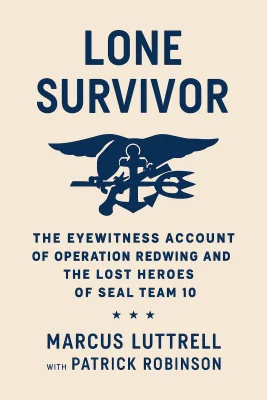
Lone Survivor
The Eyewitness Account of Operation Redwing and the Lost Heroes of SEAL Team 10
Categories
Nonfiction, Biography, History, Memoir, Audiobook, Military Fiction, Autobiography, Book Club, Military History, War
Content Type
Book
Binding
Hardcover
Year
2007
Publisher
Little, Brown and Company
Language
English
ASIN
0316067598
ISBN
0316067598
ISBN13
9780316067591
File Download
PDF | EPUB
Lone Survivor Plot Summary
Introduction
# Lone Survivor: A SEAL's Journey Through Brotherhood and Sacrifice In the treacherous mountains of Afghanistan, where ancient codes of honor collide with modern warfare, Marcus Luttrell faced a choice that would define not only his own fate but illuminate the profound bonds that unite America's most elite warriors. As the sole survivor of Operation Red Wings, one of the most devastating special operations missions in recent military history, Luttrell's story transcends the typical war narrative to reveal something deeper about courage, sacrifice, and the unbreakable brotherhood forged in the crucible of combat. His journey from a Texas ranch to the peaks of the Hindu Kush represents more than personal survival—it embodies the warrior spirit that has defined American military excellence for generations. This extraordinary account reveals the making of a Navy SEAL and the profound costs of serving in America's most demanding military unit. Through Luttrell's experiences, readers will discover the relentless training that transforms ordinary men into elite warriors, witness the life-and-death decisions that define modern combat, and understand how ancient codes of honor can bridge the gap between enemies in the most unlikely circumstances. His story illuminates the true meaning of brotherhood among warriors, the weight of survival when others have fallen, and the sacred obligation to honor those who paid the ultimate price for freedom.
Chapter 1: From Texas Ranch to SEAL: Forging the Warrior
The foundation of Marcus Luttrell's warrior spirit was laid not in military training facilities but in the piney woods of East Texas, where hard work, loyalty, and perseverance were not just values but necessities for survival. Growing up on a ranch with his twin brother Morgan, Luttrell learned early that comfort was temporary but character was permanent. His father, a Vietnam veteran, understood that toughness was not merely an asset but a requirement for navigating life's inevitable challenges. The boys learned to shoot straight at age seven, to survive in the wilderness, and most importantly, to never quit regardless of circumstances. The economic volatility of Texas oil country provided an early education in resilience that would prove invaluable in the mountains of Afghanistan. When the family lost everything during the oil crash of the 1980s, young Marcus witnessed how quickly fortune could turn and how true character was revealed in adversity. These lessons in perseverance, combined with the physical demands of ranch life, created a young man who understood that excellence was not negotiable and failure was simply not an option. Perhaps the most crucial influence in Marcus's development was Billy Shelton, a former Green Beret who ran an unofficial training program for local teenagers aspiring to join special forces. Under Shelton's merciless guidance, Marcus endured years of punishing physical conditioning that would have broken lesser men. Running with concrete blocks, endless calisthenics, and mental conditioning prepared him for challenges he could not yet imagine. Shelton's philosophy was elegantly simple: break them down completely, then build them back up as warriors. The transition from civilian to sailor marked the beginning of a transformation that would define the rest of his life. Navy boot camp, while challenging for most recruits, felt almost routine to someone who had been forged in the Texas wilderness and tempered by Shelton's brutal training regimen. Yet Marcus understood that this was merely the first step in a journey that would test every aspect of his character and determination. The foundation laid in East Texas had created more than just physical toughness—it had instilled a mindset that viewed obstacles as opportunities and setbacks as temporary inconveniences. This mental framework, combined with his natural leadership abilities and unwavering loyalty to his teammates, would prove essential as he faced the grueling selection process that separated SEALs from everyone else in the military. The boy who had learned to never quit on a Texas ranch was about to discover just how far that principle could carry him.
Chapter 2: Hell Week and Brotherhood: The Making of Elite Warriors
The Basic Underwater Demolition/SEAL training program represents one of the most demanding selection processes in the world, designed to identify men who possess not just physical capability but the mental fortitude to endure the unendurable. For Marcus Luttrell and his classmates in BUD/S Class 226, the journey began with the sobering reality that fewer than twenty percent would ultimately earn the coveted SEAL Trident. The instructors made no attempt to hide this statistic, understanding that false hope was crueler than harsh truth. Hell Week stands as the defining crucible of SEAL training, a five-and-a-half-day ordeal that pushes human endurance beyond all reasonable limits. Beginning with the chaos of "Breakout"—machine gun fire, explosions, and complete disorientation—the week systematically strips away every pretense and reveals the core of each man's character. Marcus and his teammates endured constant physical activity with virtually no sleep, hypothermic conditions in the Pacific Ocean, and relentless psychological pressure designed to make quitting seem like the only rational choice. The attrition rate during Hell Week was devastating to witness. Men who had seemed invincible just days before found themselves walking to the brass bell that signified surrender, placing their helmets in the growing line of those who could endure no more. Each ring of that bell echoed across the compound like a funeral toll, reminding the survivors that they were witnessing the elimination of fundamentally good men who simply lacked that indefinable quality separating SEALs from everyone else. What sustained Marcus through the darkest hours was not just physical conditioning but a spiritual conviction that he would rather die than quit. This was not mere stubbornness but a recognition that some things in life are worth any sacrifice. The bonds formed with his remaining classmates during those hellish days created relationships deeper than family, forged in shared suffering and mutual dependence. They learned that individual survival depended entirely on collective strength and that the man next to you was more important than your own comfort or safety. The lessons of Hell Week extended far beyond physical endurance to encompass fundamental truths about human potential and the power of brotherhood. The training revealed that the human body could withstand almost anything when the mind remained unbroken, and more importantly, that ordinary men could achieve extraordinary things when united by common purpose and unwavering commitment to one another. These principles would prove essential in the mountains of Afghanistan, where the margin between life and death often came down to the willingness to sacrifice for one's brothers.
Chapter 3: Operation Redwing: Mission into the Mountains of Death
The mission that would define Marcus Luttrell's life began with what seemed like routine intelligence about a high-value Taliban target operating in the mountains of northeastern Afghanistan. Ben Sharmak commanded an estimated force of 140 to 200 fighters and had been responsible for numerous attacks on coalition forces. The intelligence was solid, the photographs clear, and the mission parameters straightforward: locate, identify, and either capture or eliminate this dangerous enemy commander who posed a significant threat to American operations in the region. Operation Redwing called for a four-man reconnaissance team to infiltrate the target area, establish surveillance, and coordinate with a larger force for the actual assault. The team composition reflected the elite nature of the mission: Lieutenant Michael Murphy as team leader, Petty Officers Matthew Axelson and Danny Dietz as snipers and spotters, and Marcus Luttrell as the team medic and communications specialist. Each man was a seasoned warrior, trained to the highest standards and experienced in the unique challenges of mountain warfare in one of the world's most hostile environments. The insertion itself proceeded flawlessly, with the team fast-roping from a Chinook helicopter into the darkness of the Hindu Kush mountains. However, the terrain proved more challenging than anticipated, with rocky, barren landscape offering little concealment and the team finding themselves exposed on ridgelines that provided excellent fields of fire but minimal cover. The village they were tasked to observe lay far below, requiring careful positioning to maintain both surveillance capability and defensive security in increasingly difficult conditions. As dawn broke over the mountains, the team established their observation post on a rocky outcropping that offered commanding views of the target area. The position was tactically sound but precarious, with steep drops on multiple sides and limited escape routes should they be discovered. The men settled into their surveillance routine, taking turns on the spotting scope while others maintained security and attempted to establish communications with their headquarters through increasingly unreliable radio equipment. The mission parameters seemed clear enough, but the reality of operating in this remote region presented challenges that no amount of training could fully prepare them for. The rules of engagement, designed for conventional warfare, seemed inadequate for the complex tribal dynamics and guerrilla tactics they faced in this ancient land. The team understood they were operating in a gray area where split-second decisions could have far-reaching consequences, both tactical and political, that would extend far beyond their immediate mission.
Chapter 4: The Battle for Survival: Courage Against Impossible Odds
The encounter that transformed a routine surveillance mission into a desperate fight for survival began with the appearance of three Afghan goatherds and their flock stumbling upon the concealed SEAL position. In that moment, Marcus Luttrell and his teammates faced a decision that would haunt them forever: execute three unarmed civilians to protect their mission security, or release them and risk exposure to Taliban forces. The choice they made—to let the goatherds go—reflected their humanity and adherence to rules of engagement, but violated every principle of tactical security they had been taught. Within an hour of the goatherds' departure, the mountain erupted in gunfire as Taliban forces, numbering in the hundreds, surrounded the four-man SEAL team with devastating effectiveness. The enemy had achieved complete tactical surprise, occupying the high ground and attacking from multiple directions simultaneously with coordinated precision. What followed was a running battle across some of the most treacherous terrain on earth, with the SEALs fighting desperately to break contact and reach defensible positions while under constant fire from an overwhelming force. Lieutenant Murphy's leadership during the initial contact was exemplary, coordinating his team's movements while maintaining effective fire discipline under impossible circumstances. The SEALs' superior training and marksmanship took a heavy toll on their attackers, but the sheer weight of numbers made their position untenable within minutes. Forced to abandon their observation post, the team began a series of tactical withdrawals down the mountainside, using the terrain to break up enemy formations while seeking better defensive positions that seemed increasingly elusive. The battle quickly devolved into a series of desperate leaps and falls down near-vertical cliff faces, with the SEALs using gravity as their ally to escape encirclement while sustaining devastating injuries. Each bound down the mountain brought new wounds and equipment losses, but also temporary respite from the overwhelming enemy fire that seemed to come from every direction. The rocky terrain that had initially seemed so forbidding now became their salvation, providing concealment and breaking up enemy assault formations that would have otherwise overrun them completely. Matthew Axelson and Danny Dietz's performance throughout the engagement exemplified the SEAL warrior ethos in its purest form. Despite suffering multiple wounds that would have incapacitated most men, they continued to provide accurate suppressive fire, covering their teammates' movements and maintaining their sectors of responsibility with calm professionalism. Their refusal to surrender, even when mortally wounded, embodied the SEAL creed that warriors fight until they can fight no more, inspiring their teammates and demonstrating the effectiveness of their training even under the most adverse conditions imaginable. The battle raged across multiple positions as the team conducted a fighting withdrawal down the mountain, with each new defensive position offering temporary advantages but ultimately proving untenable against the coordinated Taliban assault. The enemy's use of rocket-propelled grenades and their intimate knowledge of the terrain gradually wore down the SEALs' defensive capabilities, forcing them into increasingly desperate measures to survive against odds that seemed to worsen with each passing hour.
Chapter 5: Ancient Honor Codes: Finding Sanctuary Among Enemies
As the battle reached its devastating conclusion, Marcus Luttrell found himself alone on a hostile mountain, separated from his teammates and facing almost certain death from his injuries and the Taliban fighters closing in from all directions. The wounds he had sustained during the running firefight—including a broken back, shrapnel wounds, and severe dehydration—would have been enough to incapacitate most men, but his SEAL training and sheer force of will kept him moving, seeking cover and evading capture in terrain that offered little sanctuary to a wounded American warrior. The physical challenges of survival were compounded by the psychological trauma of losing his brothers-in-arms, with the sounds of gunfire gradually fading as the Taliban completed their grim work. The guilt and grief threatened to overwhelm him, but his training kicked in, focusing his mind on the immediate necessities of staying alive long enough to be rescued. Water became his most pressing need as the Afghan sun beat down mercilessly on the rocky slopes, and every movement brought fresh agony from his injuries while remaining stationary meant certain death if the Taliban search parties found him. The arrival of Pashtun villagers marked a turning point in his ordeal that would challenge everything he thought he knew about enemies and allies in this ancient land. According to the tribal code of lokhay warkawal, these mountain people were bound to protect him once they had offered sanctuary, despite the obvious risks that harboring an American soldier would bring Taliban retribution upon their entire village. This act of courage by people who had every reason to fear both sides of the conflict demonstrated a nobility that transcended the immediate brutality of war. The villagers' protection came at enormous personal cost that humbled the wounded SEAL and revealed the depth of their commitment to ancient principles. Taliban fighters arrived demanding that Marcus be turned over to them, threatening the village with destruction if their demands were not met, but the village elder's refusal to violate the code of hospitality, even in the face of overwhelming force, showed a moral courage that matched anything Luttrell had witnessed on the battlefield. These simple farmers were willing to risk everything for a stranger, guided by principles older than any modern conflict. Mohammad Gulab, the villager who first found Luttrell and became his primary protector, embodied the complex realities of Afghan society where ancient tribal loyalties often superseded political allegiances. His decision to personally undertake the dangerous journey to alert American forces demonstrated courage that transcended cultural boundaries and revealed the common humanity that exists even between supposed enemies. The cultural exchange that occurred during Luttrell's recovery, from learning basic Pashto phrases to participating in daily prayers, illustrated bonds of human compassion that could bridge the artificial divisions created by war and politics.
Chapter 6: The Weight of Survival: Honoring the Fallen
The rescue operation that finally extracted Luttrell from the Afghan mountains came at a terrible cost that illustrated both the dedication of American forces to their own and the ruthless effectiveness of Taliban tactics in their home territory. The MH-47 Chinook helicopter carrying the quick reaction force, including eight SEALs and eight members of the 160th Special Operations Aviation Regiment, was shot down by a rocket-propelled grenade as it attempted to insert reinforcements. All sixteen men aboard died instantly, making the incident the deadliest day in SEAL history and adding another devastating chapter to an already tragic mission. Among the fallen were some of Luttrell's closest friends and teammates, including Lieutenant Commander Erik Kristensen, who had volunteered to lead the rescue mission despite having no obligation to do so. The loss of these additional warriors, men who had risked everything to save a brother in arms, added another crushing layer of survivor's guilt to Luttrell's already overwhelming burden. Their sacrifice ensured that the search for survivors would continue, but at a price that seemed almost too heavy for one man's life to justify. The eventual successful rescue, conducted by Army Rangers and Green Berets working with Afghan special forces, required careful coordination and significant risk in hostile territory. The rescue team had to navigate not only the treacherous terrain and Taliban presence but also the delicate political situation surrounding Luttrell's presence in the village, where his protectors had risked everything to keep him alive. The operation demonstrated the multi-service cooperation that characterizes modern special operations, with different units working seamlessly together to achieve their common goal of bringing home a fallen brother. Luttrell's extraction from Sabray marked the beginning of a long journey back to physical and emotional health that would prove more challenging than the original battle. His injuries, while not immediately life-threatening, were extensive and would require months of treatment and rehabilitation, but more challenging than the physical wounds were the psychological scars left by the loss of his teammates and the crushing weight of being the sole survivor of such a catastrophic mission that had claimed nineteen American lives. The weight of survival carried with it an obligation that would define the remainder of Luttrell's life and service to his country. His promise to tell the story of his fallen teammates, to ensure that their courage and sacrifice would not be forgotten or diminished by political convenience, became a sacred duty that transcended personal comfort or privacy. The decision to share his story publicly, despite the painful memories it would inevitably resurrect, represented another form of service to his brothers and his country, ensuring that their heroism would inspire future generations of warriors. The formal recognition of the team's heroism, including Lieutenant Murphy's posthumous Medal of Honor and the Navy Cross awards presented to the others, provided official acknowledgment of their extraordinary courage under fire. Yet for Luttrell, no medal could adequately represent the true cost of the mission or fully capture the character of the men who paid the ultimate price, and his commitment to honoring their memory through continued service became the defining mission of his life.
Summary
Marcus Luttrell's extraordinary journey from Texas ranch hand to decorated Navy SEAL survivor embodies the fundamental truth that true heroism lies not in individual glory but in unwavering loyalty to one's brothers in arms and the courage to honor their memory through continued service to something greater than oneself. His story transcends the boundaries of military memoir to become a testament to the power of human resilience, the bonds that unite warriors across cultural divides, and the sacred obligation to bear witness to the sacrifices of others who gave everything in service to their country and their brothers. The lessons embedded in Luttrell's experience offer profound insights for anyone facing seemingly impossible challenges or grappling with survivor's guilt and the weight of loss. His demonstration that survival itself can become a form of service, and that honoring the fallen requires the courage to continue living and fighting for the values they died defending, provides a framework for transforming tragedy into purpose and meaning. For those seeking to understand the true cost of freedom or the depths of human courage and brotherhood, this account serves as both inspiration and sobering reminder of the price paid by those who stand guard over our civilization and the ancient codes of honor that bind warriors together across time and circumstance.
Best Quote
“I will never quit. My nation expects me to be physically harder and mentally stronger than my enemies. If knocked down I will get back up, every time. I will draw on every remaining ounce of strength to protect my teammates and to accomplish our mission. I am never out of the fight.” ― Marcus Luttrell, Lone Survivor: The Eyewitness Account of Operation Redwing and the Lost Heroes of SEAL Team 10
About Author

Marcus Luttrell
Luttrell considers resilience and duty through his firsthand accounts of military service, highlighting the mental and physical fortitude required of a Navy SEAL. His experiences, encapsulated in the memoir "Lone Survivor: The Eyewitness Account of Operation Redwing and the Lost Heroes of SEAL Team 10", showcase the extreme challenges faced during operations in hostile territories. For Luttrell, the trials he endured in missions, like Operation Red Wing, reflect a broader commitment to his nation and teammates, underscoring a personal philosophy of perseverance and strength.\n\nThe author's work, including the book "Service: A Navy SEAL at War", emphasizes the authentic narrative of soldiering, blending personal testimony with broader themes of heroism and sacrifice. This approach not only preserves the integrity of these stories but also offers readers an intimate glimpse into the lived experiences of combat personnel. By engaging with these narratives, readers gain a deeper understanding of the complexities and demands of military life, while also appreciating the courage and tenacity required to navigate such environments.\n\nThrough his writing, Luttrell provides valuable insights into the psyche of those who serve, making his bio a compelling resource for anyone interested in military history or personal resilience. His contributions extend beyond literature; by founding the Lone Survivor Foundation, he supports veterans and their families, illustrating a continued commitment to those affected by military service. This dual impact—literary and philanthropic—makes Luttrell's work significant for readers seeking both inspiration and a genuine portrayal of service members' experiences.
Read moreDownload PDF & EPUB
To save this Black List summary for later, download the free PDF and EPUB. You can print it out, or read offline at your convenience.
Lone Survivor
by Marcus Luttrell
