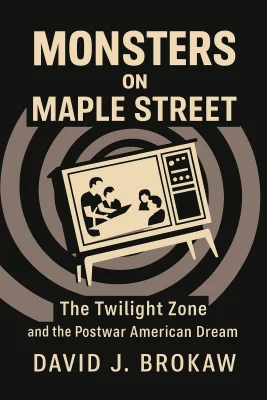
Monsters on Maple Street
The Twilight Zone and the Postwar American Dream
Categories
Nonfiction
Content Type
Book
Binding
Hardcover
Year
2023
Publisher
University Press of Kentucky
Language
English
ASIN
0813197848
ISBN
0813197848
ISBN13
9780813197845
File Download
PDF | EPUB
Monsters on Maple Street Plot Summary
Introduction
# Nightmares in the American Dream: The Twilight Zone and Cold War Society On a quiet evening in 1961, millions of Americans settled into their living rooms to watch a television drama that would haunt them long after the credits rolled. "The Shelter" presented viewers with their worst nightmare: neighbors turning against each other when nuclear attack seemed imminent, revealing how quickly civilized society could collapse into savage self-interest. This episode of The Twilight Zone, like so many others created by Rod Serling, held up a dark mirror to postwar American society, exposing the anxieties and contradictions lurking beneath the gleaming surface of suburban prosperity. The series emerged during one of the most paradoxical periods in American history. While the nation celebrated unprecedented economic growth and technological achievement, it simultaneously grappled with existential fears of nuclear annihilation, racial upheaval, and social transformation. Television programming of the era typically reinforced optimistic narratives about American progress and consumer abundance, but Serling dared to explore the shadows cast by this supposed golden age. Through science fiction and horror, he examined how the very solutions offered to contain Cold War anxieties—from fallout shelters to suburban conformity—might themselves become sources of terror. His work reveals a society caught between its democratic ideals and its deepest fears, struggling to maintain humanity in an increasingly mechanized and polarized world.
Chapter 1: Confronting White Supremacy: Race and Democracy in Postwar America
The years following World War II exposed a fundamental contradiction at the heart of American democracy. While the nation celebrated its victory over fascist ideology abroad, it continued to maintain systems of racial oppression at home that bore uncomfortable similarities to the very ideologies it had fought against. The Double V Campaign, launched by African American communities during the war, had called for victory against enemies both foreign and domestic, yet the domestic battle remained largely unfinished as the 1950s dawned. Rod Serling understood this hypocrisy intimately through his wartime service in the Pacific Theater, where he witnessed firsthand how racial hatred fueled military violence. His attempts to address racial violence directly in television drama met fierce resistance from sponsors and networks who feared alienating white Southern audiences. When his teleplay "Noon on Doomsday," based on the Emmett Till murder, was sanitized beyond recognition—relocated from the South to New England and stripped of any racial context—Serling realized he would need more subtle approaches to explore America's racial contradictions. The civil rights movement of the 1950s and 1960s provided the crucial backdrop for this cultural battle. As Martin Luther King Jr. challenged the nation's conscience and events like the Montgomery Bus Boycott demonstrated the power of organized resistance, television remained largely silent on these transformative developments. The medium that was supposed to unite Americans instead reflected and reinforced the racial segregation that divided them, with African Americans virtually absent from mainstream programming except as stereotypical caricatures. Episodes like "He's Alive" provided one of television's most explicit examinations of white supremacist ideology, featuring a neo-Nazi demagogue guided by Hitler's ghost. The character drew inspiration from real figures like George Lincoln Rockwell and his American Nazi Party, demonstrating how fascist thinking had found fertile ground in American soil. More troubling still, the episode revealed how Nazi racial theories had drawn inspiration from American precedents, from immigration quotas to anti-miscegenation laws. This uncomfortable truth suggested that the ideologies America had fought against in World War II were not foreign imports but homegrown products of American white supremacy. The structural absence of nonwhite characters from most television programming served as what scholars would later term "symbolic wish fulfillment" for white supremacists, normalizing segregation and reinforcing the notion that America was, by default, a white nation. Even when The Twilight Zone attempted to address racial themes directly, the constraints of television censorship forced compromises that revealed the medium's limitations in confronting racial injustice. The series thus reflected both the urgent need to address America's racial contradictions and the powerful forces arrayed against such honest examination.
Chapter 2: Wounds of War: Combat Trauma and the Military Mythology
The generation that returned from World War II carried invisible wounds that American society was neither equipped to understand nor willing to acknowledge. Despite the popular mythology of the "Greatest Generation," many veterans struggled with what military psychiatrists had begun to recognize as combat neurosis—a condition that would later be understood as post-traumatic stress disorder. The official response to psychological casualties often involved shame and denial, with military leaders dismissing such conditions as cowardice or weakness rather than natural responses to the horrors of modern warfare. Rod Serling's own experience as a paratrooper in the Pacific Theater profoundly shaped his understanding of war's psychological toll and his determination to challenge romanticized portrayals of military service. The brutal realities of combat—watching friends die, witnessing atrocities on both sides, surviving by chance rather than merit—stood in stark contrast to the sanitized, heroic narratives that dominated popular culture. Hollywood war films typically emphasized glory and sacrifice while ignoring the lasting psychological damage that combat inflicted on those who survived. Episodes like "The Thirty-Fathom Grave" explored the haunting persistence of combat trauma, depicting a Navy chief whose survivor guilt manifests in supernatural encounters with his dead shipmates. The story emerged from Serling's intimate knowledge of how war's psychological wounds could fester for decades, creating ongoing torment for veterans who were expected to simply readjust to civilian life without support or understanding. The episode's portrayal of battle fatigue challenged prevailing notions that psychological trauma indicated personal failure rather than a natural response to inhuman circumstances. "A Quality of Mercy" exposed the racist foundations of the Pacific War, where Japanese soldiers were systematically dehumanized as vermin to be exterminated rather than human beings to be defeated. The episode's central device—transforming an American officer into a Japanese soldier—forced viewers to confront the arbitrary nature of national identity and the universal humanity that war propaganda sought to obscure. This reversal revealed how easily the rhetoric of civilization versus barbarism could be applied to any conflict, making Americans themselves potential targets of dehumanization. Serling's war-themed episodes served a dual purpose: honoring the genuine sacrifices of combat veterans while critiquing the mythologization of warfare that made future conflicts more likely. The romanticized portrayals of war in popular culture not only dishonored the dead by misrepresenting their experiences but also prepared the ground for new generations to march into battle with unrealistic expectations. By presenting war as traumatic, morally complex, and psychologically devastating, The Twilight Zone offered a necessary corrective to the dangerous mythology that equated military violence with heroic virtue and national greatness.
Chapter 3: The Space Age Paradox: Technology's Promise and Social Reality
The launch of Sputnik in October 1957 shattered American confidence in technological superiority and triggered a national crisis of identity that would define the following decade. Suddenly, the Soviet Union appeared to have gained the upper hand in what journalists dubbed the "Space Race," forcing Americans to confront uncomfortable questions about their educational system, scientific capabilities, and national priorities. The technological optimism that had characterized the postwar era now carried undertones of anxiety about whether American democracy could compete with Soviet authoritarianism in mobilizing resources for grand projects. President Kennedy's bold promise to land Americans on the moon before 1970 captured the national imagination while raising deeper questions about the wisdom of such massive expenditures. Critics like sociologist Amitai Etzioni argued that the billions spent on space exploration could have been better used to address earthbound problems of poverty, education, and urban decay. The space program, while inspiring, also represented a form of escapism that allowed Americans to focus on distant frontiers while ignoring problems in their own communities. "I Shot an Arrow into the Air" deflated the heroic mythology surrounding manned space flight by revealing it as a potentially wasteful and dangerous enterprise driven more by political prestige than scientific necessity. The episode's astronauts, crashed on what they believe to be an asteroid, turn against each other in a desperate struggle for survival that ultimately proves unnecessary—they never left Earth. This twist served as a metaphor for the space program itself, suggesting that the resources consumed in reaching for the stars might have been better spent addressing problems closer to home. The automation revolution promised to complement space-age achievements by freeing workers from drudgery while increasing productivity and prosperity. However, "The Brain Center at Whipple's" exposed the darker reality: technological progress that served corporate profits rather than human needs, displacing workers without providing alternative employment or sharing the benefits of increased efficiency. The episode's portrayal of Wallace Whipple, ultimately replaced by a robot himself, suggested that no one was immune to the dehumanizing logic of pure efficiency. These technological nightmares reflected broader concerns about the pace and direction of postwar innovation. The same scientific advances that produced consumer conveniences and space spectaculars also created nuclear weapons and surveillance systems that threatened human freedom and survival. Labor leaders like James Carey warned that automation could create mass unemployment and social instability if not carefully managed, particularly affecting women workers who had gained factory jobs during World War II only to see them eliminated by mechanization. The Twilight Zone suggested that technology was neither inherently good nor evil, but rather a tool whose value depended entirely on how it was deployed and who controlled its development. Without democratic oversight and humanistic values, the technological frontier risked becoming a wasteland rather than a promised land, serving the interests of power and profit rather than human flourishing.
Chapter 4: Nuclear Paranoia: Security Culture and Democratic Erosion
The atomic age brought unprecedented fears to American society, creating psychological burdens that permeated every aspect of daily life. For the first time in human history, ordinary people lived with the knowledge that civilization itself could be destroyed within hours, transforming abstract geopolitical conflicts into immediate threats to personal survival. The Cuban Missile Crisis of October 1962 brought these fears to their peak, as Americans faced the genuine possibility that nuclear war might begin at any moment. Civil defense programs like "Duck and Cover" attempted to provide reassurance while inadvertently highlighting the absurdity of the situation. School children practiced hiding under desks that would offer no protection against nuclear weapons, while adults debated the merits of backyard fallout shelters that might preserve individual families at the cost of community solidarity. President Kennedy's call for a national shelter program triggered intense discussions about survival ethics and social responsibility that revealed deep tensions within American society. "The Shelter" dramatized these moral dilemmas by showing how the prospect of nuclear attack could transform neighbors into enemies and reveal the fragility of social bonds under extreme stress. When a false alarm triggers panic among suburban residents, their civilized veneer quickly dissolves into violence and xenophobia as they fight for access to the only fallout shelter on the block. The episode suggested that mere survival was insufficient if it required abandoning the values that made life worth living, turning the shelter from a symbol of preservation into a tomb for American ideals. McCarthyism added another layer of paranoia to Cold War culture, creating an atmosphere of suspicion and conformity that stifled political debate and artistic expression. The search for communist infiltrators transformed ordinary Americans into potential enemies, while loyalty oaths and blacklists punished those who dared to question official policies. "The Monsters Are Due on Maple Street" used the metaphor of alien invasion to explore how fear and suspicion could destroy communities from within, showing how the hunt for enemies could be more dangerous than the enemies themselves. The episode's aliens succeed in conquering Earth not through superior firepower but by exploiting human tendencies toward paranoia and scapegoating. They need only cut the power to watch humans destroy themselves through suspicion and violence, suggesting that America's real enemies were not foreign agents but internal responses to fear that sacrificed democratic values in the name of preserving them. The story served as a warning that the greatest threats to American democracy came not from external enemies but from the erosion of civil liberties and rational discourse in the pursuit of absolute security. Both nuclear fears and political paranoia revealed the self-defeating nature of security measures based on fear rather than principle. The pursuit of absolute safety led not to greater security but to the erosion of the very freedoms and relationships that gave life meaning, creating a society that might survive physical attack but lose its soul in the process.
Chapter 5: Suburban Anxieties: Consumer Culture and Family Under Pressure
The suburban boom of the 1950s promised Americans the perfect synthesis of urban convenience and rural tranquility, creating communities where families could raise children in safety while enjoying unprecedented material prosperity. Yet for many residents, suburbia became a gilded cage where conformity stifled individuality and material success failed to provide spiritual fulfillment. The commuter culture that connected suburban homes to urban offices created new forms of alienation and stress that challenged traditional notions of the good life. The nuclear family served as both sanctuary and battlefield in this suburban landscape, where parents struggled to raise children according to middle-class values while navigating unprecedented social pressures. The baby boom generation represented hope for the future but also anxiety about proper child-rearing in a rapidly changing world. Popular culture celebrated idealized family life through shows like "Father Knows Best" and "Leave It to Beaver," yet real families faced complex challenges that television sitcoms rarely acknowledged. "It's a Good Life" presented the ultimate nightmare of permissive parenting, where six-year-old Anthony Fremont wields godlike power over his terrorized family and community. The episode tapped into widespread fears about Dr. Benjamin Spock's child-rearing advice and the potential consequences of abandoning traditional authoritarian discipline. Yet the story's horror lay not in the child's power itself but in the adults' complete capitulation to his whims, creating a totalitarian environment where dissent and even honest emotion became impossible. The rise of children as consumers added another layer of complexity to family dynamics, as explored in "Living Doll." The episode's Talky Tina represented the new generation of toys designed to form emotional bonds with children while extracting money from parents. The doll's malevolent behavior toward the stepfather reflected deeper anxieties about masculinity, fertility, and family authority in an era when traditional gender roles were beginning to shift under pressure from economic and social changes. Consumer culture promised happiness and fulfillment through material acquisition, yet many suburban families found themselves trapped in cycles of work and consumption that left little room for genuine human connection or personal growth. "The After Hours" used the metaphor of department store mannequins to examine how consumer culture could dehumanize both workers and customers, reducing people to their economic functions as producers and purchasers rather than complex human beings with diverse needs and aspirations. These suburban nightmares revealed the inadequacy of domestic containment as a solution to Cold War anxieties. Rather than providing refuge from social tensions, the family often became a pressure cooker where those tensions intensified and exploded. The attempt to create perfect children and perfect homes frequently produced the opposite: dysfunctional relationships and psychological damage that could persist for generations, suggesting that healthy families required honest communication and genuine democracy rather than the artificial harmony imposed by consumer culture and social conformity.
Chapter 6: Television as Mirror: Media Constraints and Social Commentary
Television in the 1950s and early 1960s operated under severe constraints that limited its ability to address controversial social issues directly. Sponsors wielded enormous power over programming content, while network executives feared alienating audiences or triggering government censorship. Shows like "Father Knows Best" and "Leave It to Beaver" presented idealized versions of American family life that bore little resemblance to the complex realities most viewers actually experienced, creating a sanitized media landscape that reinforced official optimism while ignoring underlying social tensions. Rod Serling's genius lay in his ability to work within these constraints while still delivering powerful social commentary that challenged viewers to confront uncomfortable truths about their society. By using science fiction and fantasy elements, he could explore topics like racism, war trauma, and economic inequality without triggering the immediate censorship that direct treatment might provoke. The Twilight Zone's anthology format provided additional flexibility, allowing each episode to tackle different issues without the need for ongoing character development or consistent settings that might limit creative freedom. The show's success demonstrated that audiences were hungry for more sophisticated and challenging content than most television programming provided. While critics like FCC Chairman Newton Minow dismissed television as a "vast wasteland," Serling proved that the medium could serve as a vehicle for serious artistic and social commentary. His work influenced a generation of television writers and producers who would later create more socially conscious programming during the turbulent decade that followed. The tension between commercial imperatives and artistic integrity that Serling navigated remains relevant in contemporary media landscapes. As advertising revenue became increasingly important and media ownership concentrated in fewer hands, the challenges of creating meaningful content within commercial constraints only intensified. Serling's example suggests that creative artists can still find ways to address important social issues, but doing so requires both artistic skill and moral courage to challenge audience expectations and industry conventions. Episodes like "Number 12 Looks Just Like You" and "The Lateness of the Hour" explored how media and consumer culture could manipulate human desires and reshape social relationships in disturbing ways. These stories suggested that the real power of television lay not in its ability to inform or entertain, but in its capacity to shape consciousness and influence behavior on a mass scale. Serling's work served as both an example of television's potential for social good and a warning about its capacity for manipulation and control. The series ultimately demonstrated that popular culture could serve as a battleground for competing visions of American society, offering space for dissent and critical thinking even within commercial entertainment formats. This legacy reminds contemporary creators that they bear responsibility for using their platforms wisely, recognizing that the stories they tell have the power to shape public consciousness and influence social change.
Summary
The Twilight Zone emerged from the fundamental contradictions of postwar American society, when unprecedented prosperity coexisted with existential anxiety and democratic ideals clashed with social realities. Rod Serling's anthology series succeeded in addressing the most pressing issues of the Cold War era—racial injustice, military trauma, technological displacement, nuclear paranoia, and consumer alienation—precisely because it disguised its social criticism within the seemingly safe framework of science fiction and fantasy. This approach allowed viewers to confront uncomfortable truths about racism, conformity, and the erosion of human values without triggering the defensive reactions that direct commentary might provoke. The series revealed how the supposed solutions to Cold War anxieties often created new problems while failing to address underlying social tensions. The fallout shelter that promised to preserve civilization became a tomb for human values. The suburban dream that offered security and prosperity became a source of isolation and conformity. The consumer goods that promised happiness delivered only temporary satisfaction and mounting debt. The space program that demonstrated American superiority consumed resources that might have addressed earthly problems of poverty and injustice. Through these paradoxes, Serling demonstrated that the real monsters threatening American society were not supernatural beings but human institutions and attitudes that dehumanized individuals and corrupted communities. Today's media landscape faces similar challenges in balancing commercial pressures with social responsibility, as consolidation of ownership, dependence on advertising revenue, and political polarization echo the constraints that Serling navigated in his era. His example demonstrates that creative artists can still find ways to address important social issues, but doing so requires both artistic innovation and moral courage to challenge audience expectations and industry conventions. The enduring relevance of The Twilight Zone reminds us that popular culture has the power to shape public consciousness and that those who create it bear responsibility for using that power to promote empathy, critical thinking, and social justice rather than mere entertainment and profit.
Best Quote
Review Summary
Strengths: The review highlights the author's ability to balance philosophical examination with pop culture, specifically through the lens of The Twilight Zone. Brokaw effectively contextualizes episodes within post-WWII American themes, such as consumer culture, fear-mongering, and technological advancements. The book is praised for its in-depth analysis and historical context, particularly in chapters discussing the space race and technology. Overall: The reader expresses a positive sentiment, appreciating the book's exploration of The Twilight Zone's cultural context. It is recommended for enthusiasts of the show, as it provides a well-researched and engaging analysis of its episodes and themes.
About Author

David J. Brokaw
Brokaw delves into the intricate relationship between media and sociopolitical themes in postwar America, with a focus on how popular culture reflects and challenges societal norms. As a historian specializing in 20th-century cultural history, he is particularly interested in the critical examination of the "American Dream," often using the lens of Rod Serling's "The Twilight Zone". This show, for Brokaw, serves as a rich case study in how science fiction, horror, and fantasy can critique idealized narratives while exposing deep-seated issues such as white supremacy, technology, war, labor, and McCarthyism. By providing close readings of key episodes, he not only highlights these underlying social tensions but also places them within a broader historical context, enriched by references to influential 20th-century thinkers.\n\nBrokaw's academic journey includes being a T. Harry Williams Fellow, a distinction awarded to scholars with a significant focus on American history. This achievement complements his role as a professor of history at the University of Advancing Technology, where he continues to inspire students through his innovative exploration of media's impact on society. His most recognized book, "Monsters on Maple Street: The Twilight Zone and the Postwar American Dream", published in 2023, delves into how the iconic TV show critiques the American lifestyle of the 1950s and 1960s. Furthermore, his scholarly article, "Writing History with Lightning: Cinematic Representations of Nineteenth-Century America", expands his inquiry into how films shape historical narratives.\n\nFor readers and scholars interested in the intersection of media and history, Brokaw's work offers a compelling exploration of how cultural artifacts can serve as mirrors to societal issues, offering insights into the persistent complexities of American identity. His accessible yet scholarly style ensures that his analyses resonate with both academic audiences and those intrigued by media's sociopolitical dimensions.
Read moreDownload PDF & EPUB
To save this Black List summary for later, download the free PDF and EPUB. You can print it out, or read offline at your convenience.
Monsters on Maple Street
by David J. Brokaw
