
Not Without Laughter
Categories
Fiction, Classics, Historical Fiction, Poetry, Literature, Historical, African American, 20th Century, Novels, Race
Content Type
Book
Binding
Paperback
Year
1995
Publisher
Scribner
Language
English
ASIN
0020209851
ISBN
0020209851
ISBN13
9780020209850
File Download
PDF | EPUB
Not Without Laughter Plot Summary
Introduction
The storm came without warning that evening in Stanton, Kansas. Aunt Hager Williams stood in her doorway watching the sulphurous yellow sky, her weathered hands gripping the frame as the wind began to howl. Beside her, ten-year-old Sandy clutched her apron, sensing something terrible was about to happen. When the cyclone struck, it tore away more than just the porch—it marked the beginning of a journey that would scatter a black family across America like seeds in the wind. This is the story of Sandy Rogers, a brown-skinned boy caught between two worlds in early twentieth-century America. Raised by his grandmother Hager, a former slave turned washerwoman, Sandy must navigate the treacherous waters of Jim Crow society while his family fragments around him. His father Jimboy drifts like music itself, never staying long enough to plant roots. His mother Annjee works endless hours in white folks' kitchens, chasing dreams that seem always just out of reach. And his young aunt Harriett burns with a defiant fire that will either forge her freedom or consume her entirely.
Chapter 1: Roots and Storms: Sandy's Early Years in Stanton
The cyclone that ripped through Stanton that night in 1912 left more than debris in its wake. As Sandy and Aunt Hager emerged from their battered house, the boy saw their front porch sailing through the moonlight like a ghost ship headed for some distant shore. The old woman laughed at the sight, but her laughter carried an edge of something harder—the sound of someone who had survived worse storms than nature could provide. Aunt Hager Williams had weathered slavery, the Civil War, and forty years of washing white folks' clothes. At sixty-eight, she stood as solid as the cottonwood trees that lined Stanton's dusty streets, her dark hands permanently stained with lye soap and her back bent from decades over the washtub. She had raised three daughters and now found herself raising her grandson, the product of her middle daughter Annjee's marriage to a wandering musician named Jimboy. Sandy's world was small but complete in those early years. The little house on Cypress Street buzzed with the constant activity of women's work—Hager's washing and ironing, Annjee's cooking when she returned from her job at Mrs. Rice's, and the sound of his Aunt Harriett's voice rising above it all like smoke from a sacred fire. Harriett was barely sixteen but already restless, her eyes holding secrets that made the other women in the neighborhood whisper behind their hands. The boy learned early that storms came in many forms. There were the weather storms that shattered windows and toppled trees, but there were also the storms that lived inside people—the kind that made his father disappear for months at a time, leaving only the echo of guitar strings and the scent of pomade on his pillow. The kind that made his mother weep over letters that never came, her tears falling onto the kitchen table where Sandy did his schoolwork by lamplight. But between the storms, there was music. When Jimboy was home, the house filled with blues and ragtime, spirituals and work songs that seemed to rise from the very earth beneath their feet. Sandy would sit on the back steps, watching his aunt dance in the moonlight while his father's guitar wove spells that made even old Hager's feet tap against her will. Those were the moments when the world seemed whole, when the weight of being colored in a white man's world lifted just enough to let them breathe.
Chapter 2: Blues and Hymns: The Cultural Crossroads of Black Identity
The music that flowed through Sandy's childhood home created its own weather system, with pressures and currents that shaped everyone who lived there. When Jimboy returned from his wanderings, he brought with him the raw, unfiltered songs of the American road—blues born in prison camps and work songs that had carried generations through cotton fields. His guitar spoke in tongues that made respectable church ladies clutch their pearls and made young women like Harriett move in ways that scandalized their elders. Aunt Hager stood at the center of this musical storm, torn between the sacred and the profane. She had found Jesus in a Mississippi plantation church before the war ended, and her faith ran as deep as the Missouri River. Sunday mornings found her in the front pew of the Baptist church, her voice joining the congregation in spirituals that could raise the dead or heal the wounded. But Sunday evenings brought Jimboy's guitar to the back porch, and despite her protests about "devil's music," Hager's body swayed to rhythms older than Christianity. The tension between salvation and celebration defined not just the Williams household but the entire black community in Stanton. On one side stood the respectable folks—teachers and preachers, small business owners and lodge members who wore their Christianity like armor against a hostile world. They spoke proper English, straightened their hair, and tried to prove they were worthy of white America's grudging acceptance. On the other side lived the Saturday-night sinners—the gamblers and drinkers, the blues singers and dancers who found their salvation in music and laughter rather than prayer books and pews. They talked in the language of the streets, dressed in whatever made them feel beautiful, and refused to apologize for the African rhythms that lived in their bones. Sandy absorbed both traditions like a sponge. He learned to sing the old spirituals with Hager on quiet evenings, his young voice blending with hers in songs that carried the pain and hope of centuries. But he also learned to move his hips to Jimboy's guitar, to feel the pulse of blues that spoke truths the church couldn't contain. This musical education would prove more valuable than any classroom learning, teaching him that identity wasn't something you chose but something you carried like a tune you couldn't shake. The boy understood, even at his young age, that this wasn't just about music—it was about survival. In a world that wanted to crush the spirit of black folk, some found refuge in Jesus while others found it in jazz. Some wore the mask of respectability while others danced defiantly in the face of oppression. Sandy was learning that perhaps the real wisdom lay not in choosing sides but in understanding that both responses came from the same deep well of human dignity.
Chapter 3: Education and Awakening: Sandy's Path to Self-Discovery
The schoolhouse became Sandy's second home, though it was a divided kingdom that reflected the fractured nature of American society. Until fourth grade, colored children learned in their own classrooms under colored teachers who understood their struggles and celebrated their achievements. But fifth grade brought integration of a sort—black children suddenly found themselves seated in the back rows of white classrooms, taught by teachers who saw them as problems to be managed rather than minds to be cultivated. Miss Abigail Minter, the principal, stood guard at the school entrance each morning like a sentinel of civilization. She believed in education with the fervor of a missionary, but her vision of progress meant teaching black children to be grateful for whatever crumbs fell from the white table. Sandy learned to navigate her expectations while harboring his own dreams, dreams that grew larger with each book he read and each poem he memorized. The real education happened in the margins—in conversations with Earl, a white boy who treated Sandy like a human being rather than a curiosity; in stolen moments with Pansetta Young, a coffee-colored girl whose smile could light up the darkest winter day; in the barber shop where Sandy worked Saturdays, listening to men debate everything from Jack Johnson's fights to Booker T. Washington's politics. At Pete Scott's barber shop, Sandy encountered a different kind of classroom. The men who gathered there on Saturday afternoons spoke truths that would never appear in any textbook. They talked about the real America—the one where a colored man could work twice as hard as a white man and still be passed over for promotion, where talent and education meant nothing if your skin was the wrong shade, where dignity was something you had to fight for every single day. Old Uncle Dan Givens held court in the corner chair, spinning tales that might have been lies but contained deeper truths than any history lesson. His stories of slavery times weren't sanitized for young ears—they were raw and real, filled with the kind of details that made Sandy understand exactly what his grandmother had survived. These weren't the noble, long-suffering slaves of white imagination but flesh-and-blood people who had used wit and cunning and sheer stubbornness to endure the unendurable. The boy absorbed it all—the formal lessons about American democracy and the informal education about American hypocrisy. He learned to read between the lines of his textbooks, to understand that the liberty and justice they proclaimed had always come with invisible asterisks that excluded people who looked like him. But he also learned that knowledge was power, that every book he read and every skill he mastered was a small act of rebellion against a system designed to keep him ignorant and subservient.
Chapter 4: Loss and Transition: Hager's Death and Sandy's Move to Tempy's
The winter Aunt Hager died, the cold seemed to seep into the very bones of the house on Cypress Street. Sandy found her collapsed beside the washtub one December morning, her strong hands finally stilled after decades of labor. The doctor came and spoke in hushed tones about worn-out hearts and bodies pushed beyond endurance. There was nothing to be done but wait and pray and watch the strongest woman in Sandy's world slowly fade away. Hager's final days were spent in a peculiar kind of peace. The lodge sisters gathered around her bed like guardian angels, their voices joining in the old songs that had sustained generations of black women through trials that would have broken weaker spirits. She spoke of her girlhood in slavery, of the white mistress who had taught her to read, of the long journey north after emancipation. Her stories weren't bitter—they were simply true, told with the clarity that comes when you know your time is running short. When death finally claimed her on a bitter February night, it felt like more than just the passing of one old woman. Hager had been the anchor that kept the Williams family from drifting apart, the moral center around which all their lives revolved. Without her steady presence, the family began to scatter like leaves in a winter wind. Harriett, who had been living in the Bottoms since her bitter fight with Hager over her wild ways, appeared at the funeral dressed in borrowed mourning clothes. She wept like a child, all her defiance temporarily washed away by grief. Annjee sobbed for the mother who had held the family together while she chased after Jimboy's dreams. Even Tempy, the eldest daughter who had climbed into the ranks of respectable Negro society, showed cracks in her composed facade. Sandy found himself caught between worlds once again. Annjee had neither the money nor the stability to care for a growing boy—she was barely keeping herself afloat in Detroit, following Jimboy from job to job like a woman under a spell. Harriett's life in the entertainment world was no place for a child who still harbored dreams of education and respectability. That left Tempy, the sister who had married well and lived in a fine house on the right side of town. Tempy Siles represented everything Hager had wanted her children to become—educated, prosperous, accepted by white society. But she also represented something colder, something that had been lost in the climb toward respectability. As Sandy packed his few belongings and prepared to leave the only home he had ever known, he wondered if the price of advancement was worth paying. The house on Cypress Street might have been humble, but it had been filled with laughter and music and the kind of love that didn't measure itself against white standards.
Chapter 5: The Urban Experience: Chicago and the Great Migration
The train that carried Sandy away from Kansas toward Chicago in the summer of 1918 was part of the greatest population movement in American history. Thousands of black families were abandoning the South and the border states, seeking something that might charitably be called freedom in the industrial cities of the North. They came with cardboard suitcases and infinite hope, believing that distance might somehow heal the wounds of centuries. Chicago hit Sandy like a physical blow. The sheer size of the city overwhelmed senses accustomed to small-town rhythms, where everyone knew everyone and the horizon was never lost behind a wall of brick and steel. The South Side, where Annjee had found them a tiny room, pulsed with a different kind of energy than anything he had experienced. This was the Black Metropolis, where colored folks didn't have to step off sidewalks for white pedestrians but where new kinds of dangers lurked in every alley. Annjee had aged in the years since she left Stanton, her face lined with worry and her body thickened by hard work and disappointment. She worked now in a beauty parlor, learning to straighten hair and massage faces, serving women who had money enough to spend on vanity. The irony wasn't lost on Sandy—his mother had left home to follow her dreams and ended up ministering to other people's insecurities about their appearance. The elevated trains that roared past their window every few minutes became the soundtrack of Sandy's urban education. He found work as an elevator operator in a downtown hotel, standing in his red uniform in a metal box, carrying white guests up and down all day like some kind of human machinery. The job paid better than anything he could have found in Stanton, but it also taught him new lessons about the geography of race in America. In the hotel, Sandy observed the casual cruelty of white privilege up close. Wealthy guests treated him as invisible, discussing their business and their prejudices as if he were no more sentient than the elevator machinery. He learned to keep his face blank and his thoughts to himself, but inside he burned with the knowledge that intelligence and dignity meant nothing if you were trapped in service to people who would never see your humanity. The city's Black Belt offered its own contradictions. Here were churches and businesses, theaters and newspapers, all owned and operated by colored people. Here was a world where black folks could be doctors and lawyers, where they could own property and speak their minds without fear. But it was also a world bounded by invisible walls, a gilded cage that looked like freedom until you tried to leave it. Sandy walked the streets of this urban promised land with wonder and growing understanding. The Great Migration had brought his people north, but it hadn't carried them to the true freedom they sought. It had simply created new forms of the same old struggles, painted them in different colors and set them to different music.
Chapter 6: Finding Purpose: Sandy's Educational Determination
The decision to return to school came to Sandy like a revelation during one particularly stifling summer day in the hotel elevator. As he stood in his red uniform, watching the floors tick by for the thousandth time, he understood with crystal clarity that education was the only ladder that might carry him out of this mechanical existence. The revelation arrived with the force of prophecy, accompanied by the ghostly voice of Aunt Hager whispering about the importance of learning, of making something of yourself, of lifting up the race. His Aunt Harriett had arrived in Chicago like a whirlwind, billed as the "Princess of the Blues" at a State Street theater. When Sandy and Annjee found her backstage after her performance, she was everything their small-town memories had promised and more—sophisticated, successful, and still burning with that inner fire that had made her leave Stanton in the first place. But success had exacted its own price, leaving her voice hoarse from smoke and late nights, her laughter edged with something that might have been wisdom or might have been weariness. The reunion in the Chinese restaurant that night became a crossroads moment for the scattered Williams family. As the sisters wept over their shared past and uncertain futures, Harriett made a decision that would change Sandy's life. She would provide the financial support that Annjee couldn't manage, ensuring that the boy could return to his education rather than spend his youth trapped in service jobs that led nowhere but to more service. This wasn't charity—it was investment. Harriett had seen enough of the world to understand that talent without education was like a song without words, beautiful but ultimately limited. She had watched too many gifted people waste their potential because they never learned to read the sheet music of success. Sandy would not make that mistake if she could help it. The decision came with its own complications. Annjee felt the sting of her sister's implied criticism, the suggestion that she had been willing to sacrifice her son's future for the sake of a few dollars in rent money. But beneath her wounded pride, she recognized the truth—she had been so focused on survival that she had forgotten to think about what they were surviving for. As autumn approached and Sandy prepared to re-enter the classroom, he carried with him more than just books and paper. He carried the accumulated wisdom of his fractured family—Hager's faith in the power of education, Annjee's stubborn determination to keep going no matter what, Harriett's refusal to accept the limitations others tried to impose. These gifts would prove more valuable than any curriculum, teaching him that sometimes the most important lessons happen outside the classroom walls. The boy who returned to school that fall was no longer the innocent child who had left Stanton. He had seen too much, learned too much about the ways of the world to ever again believe in simple solutions or easy answers. But he had also learned something more valuable—that knowledge was indeed power, and that every book he read, every skill he mastered, was a small victory against the forces that wanted to keep him in his place.
Chapter 7: Legacy of Dreams: Carrying Hager's Vision Forward
Sandy's final return to school in Chicago carried the weight of generations. As he walked into the classroom that autumn morning, he wasn't just another colored boy seeking an education—he was the living embodiment of Aunt Hager's dreams, carrying forward the hopes of a woman who had been born in slavery and died believing that learning could set her people free. The city's rhythm had become his rhythm now. The elevated trains that had once startled him with their noise now marked time like a giant metronome, keeping pace with his growing understanding of what it meant to be young and black and ambitious in America. In the school hallways, he moved with new purpose, no longer the uncertain boy who had been overwhelmed by urban complexity but a young man who understood that education was both weapon and shield in the ongoing battle for dignity. His teachers, mostly white women who had come to see black children as either problems to be solved or causes to be championed, didn't know what to make of this serious boy who read everything they put in front of him and asked for more. They were accustomed to Negro students who were either sullenly resistant or pathetically grateful, not ones who seemed to view education as their birthright rather than their privilege. But Sandy had learned to navigate these expectations with the same skill his grandmother had used to manage her white customers—giving them what they needed to feel comfortable while never forgetting who he really was or where he had come from. He wrote essays that earned prizes while keeping his deepest thoughts to himself, understanding that true education often happened in the spaces between official lessons. The music that had shaped his childhood continued to influence his urban education. In the jazz clubs and blues joints of the Black Belt, he heard the sounds of his people transforming their pain into art, their struggles into something approaching beauty. This was education too—learning that survival wasn't enough, that the human spirit demanded not just existence but expression, not just freedom from oppression but freedom to create. In quiet moments, Sandy could feel the presence of all those who had come before—Hager at her washtub, dreaming of better days; Jimboy with his guitar, singing stories that couldn't be contained in any textbook; Harriett on stage, proving that talent could indeed overcome circumstance if it burned bright enough. They had all contributed to the man he was becoming, each adding their own notes to the complex melody of his identity.
Summary
The journey that began with a cyclone tearing through a small Kansas town had carried Sandy Rogers across the geography of American possibility and limitation. From Aunt Hager's kitchen to the stages of Chicago, from the divided classrooms of Stanton to the elevated platforms of urban ambition, he had traced the path of a generation seeking to transform the promise of freedom into lived reality. The scattered Williams family had each found their own way to cope with the peculiar burden of being black in America. Hager had found her strength in faith and family, washing white folks' clothes while dreaming of better days for her children. Annjee had chosen love over security, following Jimboy's restless spirit even when it led nowhere but heartache. Harriett had picked rebellion over resignation, transforming her anger into art and her pain into performance. And Sandy—Sandy had chosen the hardest path of all, education, betting his future on the radical notion that knowledge might indeed prove stronger than prejudice. The music that had provided the soundtrack to Sandy's childhood—blues and spirituals, ragtime and work songs—represented more than entertainment. It was the sound of a people refusing to be silenced, transforming their suffering into something that could heal not just themselves but anyone willing to listen. As Sandy prepared to carry Aunt Hager's dreams into an uncertain future, he understood that he was part of this great composition, adding his own voice to a symphony that had begun in the cotton fields and was still being written in the city streets. The boy who had once clutched his grandmother's apron during a storm had grown into a young man ready to face whatever weather awaited, armed with education, sustained by music, and guided by the unwavering belief that tomorrow could indeed be better than today.
Best Quote
“I’s been livin’ a long time in yesterday, Sandy chile, an’ I knows there ain’t no room in de world fo’ nothin’ mo’n love. I know, chile! Ever’thing there is but lovin’ leaves a rust on yo’ soul. An’ to love sho ‘nough, you got to have a spot in yo’ heart fo’ ever’body – great an’ small, white an’ black, an’ them what’s good an’ them what’s evil – ‘cause love ain’t got no crowded-out places where de good ones stay an’ de bad ones can’t come in. When it gets that way, then it ain’t love.” ― Langston Hughes, Not Without Laughter
Review Summary
Strengths: The review highlights the engaging nature of Langston Hughes' novel "Not Without Laughter," noting its ability to provoke thought and reflection on racial issues. The reviewer appreciates the novel's historical context and its relevance to contemporary political and social climates. Weaknesses: The review is heavily interspersed with the reviewer's personal political opinions, which may detract from an objective analysis of the book itself. The focus on current political events and personal sentiments may overshadow the literary critique. Overall: The reader expresses a strong emotional response to the novel, linking its themes to ongoing racial and political issues in America. While the review is insightful, it is more of a political commentary than a traditional book review, potentially limiting its utility for readers seeking a purely literary evaluation.
About Author
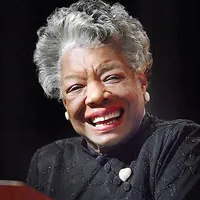
Maya Angelou
Angelou reframes the narrative of personal struggle and triumph through her rich tapestry of work, emphasizing themes of racial identity and resilience. Her writing captures the raw complexities of the Black experience in America, drawing from her own turbulent childhood in the segregated South. With autobiographical detail fused with lyrical prose, Angelou's debut book, "I Know Why the Caged Bird Sings," defies traditional autobiographical conventions, offering a profound examination of trauma and empowerment. Her thematic exploration extends across a series of autobiographies and poetry collections, employing African-American oral traditions to convey dignity amid adversity. This method underscores her role as a formidable voice in literature, where each piece contributes to a broader cultural critique.\n\nIn her diverse roles as a performer, civil rights activist, and academic, Angelou connected her multifaceted career to her literary output. Collaborating with figures like Martin Luther King Jr. and Malcolm X, she integrated activism into her narratives, using her platform to advance social justice causes. This holistic approach not only reinforces her thematic focus on freedom and womanhood but also amplifies her impact across various fields. As a result, readers gain a deeper understanding of the human condition through her introspective storytelling, which champions themes of perseverance and identity. Her contributions are recognized with significant honors, including three Grammy Awards and the Presidential Medal of Freedom, underscoring her lasting influence on American culture.\n\nThe author’s work continues to resonate with audiences seeking insight into race and gender dynamics. Her ability to intertwine personal bio with broader societal issues enriches the reader's perspective, while her literary style, characterized by both a personal voice and poetic elegance, offers an engaging narrative journey. Scholars, students, and general readers alike benefit from Angelou's exploration of the human spirit, making her body of work an essential touchstone in understanding contemporary social and cultural landscapes.
Read moreDownload PDF & EPUB
To save this Black List summary for later, download the free PDF and EPUB. You can print it out, or read offline at your convenience.

Not Without Laughter
by Maya Angelou
