
One Day in the Life of Ivan Denisovich
Categories
Fiction, Classics, Historical Fiction, Literature, School, Historical, Russia, 20th Century, Novels, Russian Literature
Content Type
Book
Binding
Paperback
Year
2005
Publisher
Farrar, Straus and Giroux
Language
English
File Download
PDF | EPUB
One Day in the Life of Ivan Denisovich Plot Summary
Introduction
At five in the morning, the hammer strikes the rail with mechanical precision, its metallic clang cutting through the Siberian darkness like a blade through bone. Ivan Denisovich Shukhov lies motionless on his bunk, feeling the fever that should have granted him respite from another day of frozen hell. But in the Soviet labor camp, illness is a luxury few can afford, and survival depends on understanding a simple truth: every minute counts, every scrap of bread matters, and every small victory against the system might mean the difference between living another day or joining the silent ranks of those who never saw their sentences end. This is January 1951, deep in Stalin's gulag archipelago, where 3,653 days stretch before Shukhov like an eternity. Today will be day number 2,946 of his sentence for the crime of being captured by Germans and living to return home—a treachery the Soviet state cannot forgive. In this place where human dignity seems as frozen as the permafrost beneath their feet, Shukhov has learned to find meaning in the smallest acts of defiance, the briefest moments of warmth, and the precious bonds forged between men reduced to numbers but determined to remain human.
Chapter 1: The Bitter Dawn: Waking to Captivity
The fever burns through Shukhov's body like liquid fire, but he knows better than to trust it. In this camp, sickness is a gamble that usually ends in disaster. The medical orderly, young Kolya Vdovushkin, sits in his pristine white coat, more interested in his secret poetry than the prisoners' ailments. When Shukhov finally drags himself to the medical bay, his temperature reads only 37.2 degrees—not enough to escape the day's labor. The Tartar guard finds him still in his bunk, assigns him punishment duty, but offers an unexpected mercy: floor-washing instead of the punishment cell. Shukhov seizes this stroke of luck, knowing that in the gulag's brutal calculus, even the smallest reprieve can shift the balance between survival and destruction. As he mops the warders' quarters, their casual conversation about rice and millet rations reveals the vast gulf between the guards' concerns and the prisoners' reality. These men eat meat while the zeks subsist on watery gruel and the eternal hope of extra bread. The floor cleaned, Shukhov hurries toward the mess hall, where Gang 104 awaits him. His fever has broken, replaced by the familiar hunger that gnaws at every prisoner's belly like a living thing. The camp sprawls under the pale winter sun, a maze of wooden huts surrounded by watchtowers and wire. Here, 500 men live at the mercy of temperatures that could kill a wolf, sustained only by the unspoken bonds of their work gangs and the slim hope that today might bring something—anything—better than yesterday.
Chapter 2: A Cold March: Journey to Forced Labor
The march to the work site transforms the prisoners into a black column of bent figures trudging through snow that squeaks like bones under their feet. Shukhov walks with his face wrapped in rags against the wind that cuts through multiple layers of clothing as if they were paper. The guards, wrapped in their own warm coats, follow alongside with weapons ready, their breath steaming in the minus-twenty-seven-degree air. Gang 104's foreman, Tyurin, has worked a miracle overnight. Through carefully distributed bribes of precious fatback, he has saved them from assignment to Sotsgorodok—a barren field where gangs dig holes in frozen earth with nowhere to warm themselves. Instead, they will work at the half-finished Power Station, a concrete skeleton that at least offers the possibility of shelter and fire. The column passes signs of the Soviet system's contradictions: housing built by prisoners for free workers to inhabit, a recreation center constructed by zeks but forbidden to them, workshops where they labor to create comforts they will never enjoy. The irony weighs on Shukhov less than the cold. Philosophy is a luxury when survival requires all your energy. Captain Buynovsky, the former naval officer still adjusting to camp life, announces the temperature with scientific precision. The other prisoners listen with the careful attention men pay to information that might kill them. Weather is not merely atmospheric condition here—it is life and death, the difference between working and freezing, between maintaining strength and watching it ebb away into the vast Siberian emptiness that swallows the weak without ceremony.
Chapter 3: Building Walls, Preserving Self: Work as Survival
The Power Station rises from the snow like a monument to human stubbornness, its concrete walls half-finished and crusted with ice. Gang 104 attacks the work with desperate efficiency, knowing that survival depends not just on completing tasks but on creating warmth. Shukhov and Kildigs, the skilled bricklayers, immediately assess the challenge: windows must be sealed with stolen tar paper, a fire must be lit, and mortar must be mixed before it freezes solid. Tyurin, the gang foreman, orchestrates the operation with the skill of a military commander. His own survival story—discharged from the army as a kulak's son, hunted by the secret police, betrayed by the very system he once served—has taught him that leadership in the camps means one thing: keeping your men fed and alive. Every decision he makes calculates the balance between official requirements and practical survival. The work becomes a kind of prayer. Shukhov handles his trowel with reverence, laying each brick with precision that has nothing to do with Soviet construction goals and everything to do with maintaining dignity through craftsmanship. The bricks are cold enough to burn bare skin, the mortar threatens to freeze before it can set, but the rhythm of the work generates its own heat. As the walls rise, something magical happens. The men stop feeling the cold. Their bodies generate warmth through motion, their spirits kindle through shared purpose. For these few hours, they are not prisoners but builders, not numbers but craftsmen, not victims but men engaged in the ancient human act of creating shelter against an hostile world.
Chapter 4: The Sacred Bowl: Hunger and Human Worth
The mess hall erupts in controlled chaos as gangs jostle for position, each man protecting his meager portion with fierce concentration. Shukhov's skilled maneuvering secures two extra bowls of gruel—a triumph that feels like winning a battle. In this place where a single potato can determine whether you sleep hungry or satisfied, his small deception represents a victory of cunning over authority. The gruel itself is thin, watery, barely deserving the name of food. Fish bones float alongside frost-blackened cabbage leaves, and the few fragments of actual fish flesh must be chewed completely, bones and all, to extract every trace of nutrition. But Shukhov approaches his meal with ritualistic reverence, removing his cap despite the cold, savoring each spoonful, making the precious warmth last as long as possible. Around him, other prisoners reveal their strategies for survival. Fetyukov scavenges cigarette butts from spittoons, his desperation making him a pariah among men who still maintain threads of dignity. The old man Alyoshka the Baptist eats slowly, praying over his food with quiet intensity that puzzles and sometimes irritates his fellow prisoners. Captain Buynovsky still expects military courtesies that no longer apply in this upside-down world. Tsezar, the former filmmaker, represents another category entirely. His periodic parcels from outside allow him to occupy the camp's office positions, trading favors with guards and administrators. When Shukhov delivers Tsezar's bowl to the warm office, he glimpses a world of intellectual discussion about Eisenstein films and artistic merit—concerns that seem impossibly distant from the daily struggle for calories and warmth that defines existence for ordinary prisoners.
Chapter 5: Small Victories: Finding Freedom Within Chains
The afternoon brings the kind of work that transforms suffering into purpose. As Shukhov lays bricks with increasing speed and precision, the wall begins to take shape under his hands. Each course of blocks rises straight and true, a testament to skill that no amount of Soviet ideology can diminish. The foreman has negotiated a good rate for the job, meaning better rations for the entire gang if they can complete the work to standard. The other prisoners fall into their assigned roles with practiced efficiency. The captain and Alyoshka carry mortar in handbarrows, their academic backgrounds irrelevant to the simple physics of moving weight up ramps. Senka Klevshin, deafened by wartime injuries and brutalized in German camps, communicates through gestures but understands the work better than men with perfect hearing. When Der, a prisoner overseer drunk on his small authority, tries to cause trouble over their improvised tar-paper windows, the gang closes ranks with shocking solidarity. Tyurin's quiet threat carries more weight than official regulations. The other prisoners stand ready to defend their foreman with tools that could easily become weapons. In this moment, the camp's careful hierarchy of oppression reveals its fundamental weakness: men pushed beyond limits can push back. The sun climbs higher, transforming the frozen work site into something almost beautiful. The guards in their watchtowers stamp their feet against cold while the working prisoners generate heat through motion. For these hours, Shukhov feels something approaching contentment. His body moves with practiced efficiency, his mind focuses on the immediate task, and the larger questions of justice and injustice fade before the simple satisfaction of work done well.
Chapter 6: Return to Barracks: Navigating the Camp's Ecosystem
The march back to camp reveals the complex social structures that govern survival in the gulag. Shukhov positions himself strategically to help Tsezar collect a parcel, knowing that small favors create debts that might pay dividends later. The parcel line represents another world entirely—prisoners with outside connections who receive sausages, condensed milk, and tobacco while others subsist entirely on camp rations. The body search at the gate tests every prisoner's nerve. Shukhov carries a piece of broken hacksaw blade that could be shaped into a valuable knife, but discovery would mean ten days in the punishment cell. The guards probe and pat with hands that could detect the smallest contraband, but today luck favors the prepared. The blade passes undetected, hidden in his mitten while the searcher checks the wrong one. Inside the compound, the evening ritual of survival begins. Men hurry to the various services that make camp life barely tolerable—the barber who shaves with paper instead of cloth, the clerk who might expedite letters, the trusties who control access to everything from clean underwear to medical attention. Each transaction requires payment in the camp's alternative economy of cigarettes, food, and favors. Captain Buynovsky's arrest for the punishment cell demonstrates the arbitrary nature of camp justice. His crime was possessing an extra layer of clothing against regulations, but his real offense was maintaining the dignity of his former rank. Lieutenant Volkovoy, the camp disciplinarian known for his wolfish cruelty, remembers every slight and settles every score. Ten days in the stone punishment block will either break the captain completely or teach him the humility necessary for survival.
Chapter 7: One Day Ends: Counting Blessings in Darkness
As lights-out approaches, Shukhov takes inventory of the day's small victories. He avoided the punishment cell, earned extra food, completed satisfying work, and added valuable tobacco to his precious store. The hacksaw blade, now hidden in his mattress, represents future possibility—a knife for cobbling or tailoring that could bring additional income. These tiny accumulations of advantage make the difference between merely surviving and living with some small margin of security. The evening roll call transforms 400 men into a herd, counted and recounted by guards who treat human beings like livestock. One prisoner's absence—a Moldavian who fell asleep in the work site and delayed the entire return—provokes fury from prisoners more than guards. When survival depends on maintaining routines that lead to warmth and rest, individual selfishness threatens the collective welfare. Alyoshka the Baptist attempts to share his faith with Shukhov, speaking of prayer and divine providence. But Shukhov's theology has been shaped by experience that reduces grand questions to immediate needs. He believes in God when thunder rolls, but finds little evidence of divine intervention in daily camp life. The stars fall to fill holes in the sky, mountains move only when human hands move them, and survival depends on practical wisdom rather than spiritual hope. The day's end brings Tsezar's gratitude in the form of extra food—sausage, biscuits, and sugar that represent temporary abundance in a world of scarcity. Shukhov shares a biscuit with Alyoshka, recognizing kindness even when he cannot accept its theological packaging. As he settles into his bunk with a full belly and warm feet, he counts the day's blessings with the careful attention of an accountant recording assets in the ledger of survival.
Summary
The hammer will strike the rail again at five tomorrow morning, beginning day 2,947 of Ivan Denisovich's sentence. But tonight, wrapped in his thin blanket with borrowed food in his belly and useful contraband hidden in his mattress, he has achieved something more precious than freedom: he has preserved his humanity in a system designed to destroy it. Through small acts of cunning, mutual aid, and stubborn dignity, he and his fellow prisoners create meaning in meaninglessness, warmth in freezing cold, and hope in hopelessness. The gulag represents humanity's capacity for systematic cruelty, but Shukhov's story reveals something equally profound: the impossibility of completely breaking the human spirit. In a world where men are reduced to numbers and survival measured in grams of bread, the persistence of craftsmanship, friendship, and moral choice becomes a form of victory. Each day survived with dignity intact is a day stolen from the system that seeks to grind individual worth into collective submission. The stars may fall and new ones take their place, but some essential human quality endures even in the darkest places, counting not the days of suffering but the moments of grace that make suffering bearable.
Best Quote
“The belly is an ungrateful wretch, it never remembers past favors, it always wants more tomorrow.” ― Aleksandr I. Solzhenitsyn, One Day in the Life of Ivan Denisovich
Review Summary
Strengths: The review highlights the author's ability to vividly depict the monotonous and oppressive life in a Soviet gulag, creating a powerful emotional impact on the reader. The narrative's realism extends beyond the specific context to resonate with broader themes of imprisonment and existential despair. The reviewer appreciates the novel's concise yet profound storytelling, which evokes empathy and introspection. Overall: The reader expresses a deep admiration for Solzhenitsyn's work, noting its significant emotional and intellectual impact. The novel is highly recommended for its compelling portrayal of life in a gulag and its broader existential themes, establishing Solzhenitsyn as a favorite author of the reviewer.
About Author
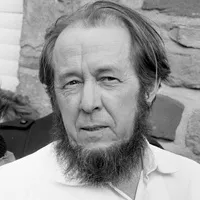
Aleksandr Solzhenitsyn
Solzhenitsyn interrogates the moral complexities of life under totalitarianism by weaving personal narrative with historical analysis. His commitment to exposing the grotesque injustices of the Soviet regime informs his literary works, characterized by stark realism and moral gravity. His early book, "One Day in the Life of Ivan Denisovich", revolutionized the literary landscape by providing a raw glimpse into the life of a Gulag prisoner. Meanwhile, his seminal work, "The Gulag Archipelago", offered a sprawling account of the labor camps, blending exhaustive research with personal experience. These writings underscore his pursuit of truth, challenging state narratives and illuminating the hidden facets of human endurance.\n\nThrough incisive narratives and profound thematic exploration, Solzhenitsyn bridges the gap between personal conscience and state authority, resonating with readers who seek an understanding of human dignity and freedom. His approach combines literary artistry with historical documentation, creating a narrative force that invigorates global discussions on morality and resilience. For those immersed in the study of political repression or human rights, his books serve as essential texts that deepen comprehension of the Soviet epoch and the universal quest for justice. The author’s receipt of the Nobel Prize in Literature further cements his influence and acknowledges his ethical contributions to global discourse.\n\nBy synthesizing personal experiences with broader sociopolitical themes, Solzhenitsyn’s bio captures the essence of an era marred by oppression yet illuminated by the indomitable spirit of resistance. His narratives, marked by simplicity and clarity, delve into the everyday struggles of individuals, exploring the intersection of faith, morality, and freedom. While his works, such as "The First Circle" and "Cancer Ward", engage readers with their moral seriousness, they also offer profound insights into the resilience of the human spirit, providing a vital resource for anyone exploring the complexities of totalitarian societies.
Read moreDownload PDF & EPUB
To save this Black List summary for later, download the free PDF and EPUB. You can print it out, or read offline at your convenience.

One Day in the Life of Ivan Denisovich
by Aleksandr Solzhenitsyn
