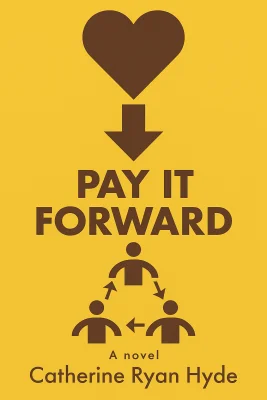
Pay It Forward
Categories
Fiction, Young Adult, Adult, Book Club, Inspirational, Contemporary, Novels, Realistic Fiction, Media Tie In, Drama
Content Type
Book
Binding
Mass Market Paperback
Year
2000
Publisher
Pocket Books
Language
English
ASIN
0743412028
ISBN
0743412028
ISBN13
9780743412025
File Download
PDF | EPUB
Pay It Forward Plot Summary
Introduction
The night twelve-year-old Trevor McKinney saved Jerry Busconi's life, neither of them knew they were about to change the world. Jerry lay bleeding in a Dumpster behind an auto parts store, another casualty of addiction and desperation, while Trevor rode his battered bicycle through the streets of Atascadero, delivering newspapers in the pre-dawn darkness. When their paths crossed on that October morning in 1992, it seemed like nothing more than a moment of random kindness—a boy with spare change helping a stranger buy food. But Trevor wasn't thinking randomly. He was thinking systematically, mathematically, about an assignment his seventh-grade social studies teacher had scrawled across the blackboard just weeks before. The assignment itself was deceptively simple: Think of an idea for world change, and put it into action. Most students ignored it entirely, content with their C-minus grades and their certainty that the world was too big, too broken, too set in its ways to ever really change. But Trevor McKinney wasn't most students. Sitting in that classroom, staring at his scarred teacher's challenge, Trevor began sketching circles on notebook paper—three circles branching into nine, nine into twenty-seven, twenty-seven into eighty-one. The mathematics of kindness, he called it. Pay it forward to three people instead of paying it back to one. Help three strangers with something big, something that really matters, and ask them to do the same for three others. Watch the numbers explode across the globe like ripples in a pond, each act of generosity creating waves that would eventually circle back to transform everything.
Chapter 1: The Assignment: A Teacher's Challenge and a Boy's Vision
Reuben St. Clair stood before his new class, knowing they saw him as a monster. The left side of his face was gone, carved away by shrapnel in Vietnam, leaving smooth grafted skin where an eye should be. Twenty-five years of surgeries had given him function but not normalcy. Students always stared, then looked away, then stared again. But Trevor McKinney did something different. After class, the thin boy with unruly dark hair walked straight up to Reuben's desk. "What happened to your face?" The question hit like a slap, but Trevor's voice held no cruelty. Just curiosity, direct and honest. Reuben found himself explaining about Vietnam, about seven weeks in hell before the grenade that sent Artie Levin's body parts flying and left Reuben's face a medical puzzle. Trevor listened without flinching. "Sorry about your face," Trevor said when Reuben finished. "But you know, it's only just that one side. The other side looks real good." No one had ever said that before. No one had ever looked at him and seen anything good. The assignment Reuben wrote on the blackboard the next week came from decades of isolation, from watching a world that seemed determined to tear itself apart. Think of an idea for world change, and put it into action. Most students would ignore it, write some halfhearted essay about recycling or teenage pregnancy. But when Trevor raised his hand to present his idea, something in his voice made Reuben lean forward. Trevor drew three circles on the blackboard. "See, this works like my dad's old riddle about compound interest," he said, though everyone in class knew Trevor's father had abandoned them years ago. "You help three people with something really big. Not money—something they can't do for themselves. Then instead of paying you back, they each help three more people. Those nine help twenty-seven. Twenty-seven help eighty-one." The numbers grew impossibly large impossibly fast. Within a few generations, everyone on earth would be touched by the movement. Trevor called it Pay It Forward, and the beauty of it took Reuben's breath away. "But people won't do it," Mary Anne Telmin interrupted, her voice sharp with adolescent cynicism. "They'll take the help and forget to help anyone else." Trevor's face flushed, but his voice stayed steady. "Some will. But some won't. And the ones who do it right, they'll make up for the ones who don't." The class laughed. Even Reuben felt doubt creeping in. The boy was twelve years old, still believed in Santa Claus and fair play and the basic goodness of human nature. The real world would crush that optimism soon enough. Trevor collected his papers and walked back to his seat, his shoulders set with determination that made Reuben's chest ache. The boy believed it would work. Against all evidence, against all reason, Trevor McKinney believed human beings were capable of sustained, systematic kindness.
Chapter 2: First Attempts: Planting Seeds of Change Against Odds
Jerry Busconi had been sleeping rough for three months when Trevor found him. The man looked forty but claimed twenty-eight, his face aged by addiction and countless beatings. His shoes were held together with electrical tape, his jeans stiff with dirt and dried blood. When Trevor offered him five dollars for breakfast, Jerry almost wept. "What's the catch, kid?" "No catch. Just pay it forward when you can." Trevor gave him thirty-five dollars over the next two weeks, money earned from his paper route. Enough for Jerry to buy decent clothes, get clean, apply for work at the Quicky Lube down on El Camino Real. Jerry got the job, got a cheap room, started believing maybe his luck had finally turned. Then payday came. Jerry stood in the bar, rolling bills between his fingers, telling himself he deserved one beer to celebrate. Just one. The needle found his arm three hours later, and by morning his week's wages had vanished into his bloodstream. When the police found him passed out behind the Kmart, he had violated parole without even knowing it. Trevor visited him at county jail, sitting across from Jerry in the visitors' room with a phone pressed to his ear. Jerry wouldn't come out to see him. "Tell the kid I'm sorry," Jerry told the guard. "Tell him I'm not in the mood." Trevor's mother, Arlene, watched her son's face crumble as they walked back to the car. Twelve years old and already learning that good intentions mean nothing against the weight of human weakness, that kindness can be wasted as easily as money thrown down a drain. But Trevor wasn't ready to give up. He had two more circles to fill. Mrs. Greenberg lived three houses down, an elderly woman whose arthritis had turned her once-perfect garden into a wilderness of weeds and dying roses. Trevor knocked on her door after school, offering to work for free. She invited him in for cherry Kool-Aid and they sat at her kitchen table while he explained about Pay It Forward, drawing the circles on notebook paper. "It's like random acts of kindness," she said, "but better. There's a system to it." Trevor spent three days bringing her garden back to life, trimming hedges and planting bulbs while she watched from her kitchen window. When he finished, Mrs. Greenberg tried to pay him, but he shook his head. Just pay it forward, he said. Help three people who really need it. She promised she would. Two weeks later, she was dead.
Chapter 3: Personal Connections: Healing Broken Hearts at Home
Arlene McKinney stood in her driveway at three in the morning, baseball bat in hand, taking her frustrations out on the rusted hulk of the Ford pickup that had destroyed her credit and her faith in men. Each swing sent vibrations up her arms, metal crumpling under the force of her rage. The truck had come home without Ricky, rolled and battered from whatever accident or foolishness had finally caught up with him. She swung again, harder, imagining Ricky's face in the twisted metal. Thirteen years she'd waited for him to grow up, to become the man he promised to be every time he crawled back into her bed. Now she was working two jobs to pay for his wreckage while he was off somewhere with his ex-wife Cheryl, driving around in that pristine GTO he'd rebuilt with such tender care. "Mom?" Trevor stood in the doorway, small and worried in his pajamas. At twelve, he looked so much like Ricky it sometimes took her breath away—the same dark curls, the same wide eyes that seemed to see everything and forgive too much. "Go back inside, honey." "You okay?" No, she wasn't okay. She hadn't been okay since she'd thrown away her engagement ring and told Reuben St. Clair to get out of her life, choosing Ricky's empty promises over the solid love of a good man. Reuben had wanted to marry her, had bought a ring and planned a future, but when Ricky showed up with his sob stories and his pretty lies, she'd sent Reuben away like yesterday's garbage. Now Ricky was gone again, probably for good this time, and she was alone with her son and her mistakes, beating on a dead truck in the middle of the night like some crazy woman. "I'm fine," she lied. "Just getting some exercise." Trevor walked toward her across the driveway, his bare feet silent on the cold concrete. "You could call him." "Call who?" "Mr. St. Clair. Tell him you were wrong." The bat slipped from her hands, clattering onto the concrete. Trevor's voice held no judgment, just the calm certainty of a child who believed problems could be solved if adults would just act like adults. "It's not that simple, honey." "Why not?" Because she'd humiliated him. Because she'd chosen a worthless drunk over a man who would have loved them both forever. Because some mistakes can't be undone with a phone call and an apology. But looking at Trevor's hopeful face, Arlene found herself wondering if maybe, just maybe, forgiveness was possible. If maybe Reuben St. Clair was lonely too, missing what they'd almost had together. "Maybe I will," she said.
Chapter 4: Spreading Outward: The Movement Gains Momentum
Three thousand miles away, Charlotte Renaldi stood on the Golden Gate Bridge at three in the morning, staring down into the black water that promised an end to everything. The platform beneath the bridge felt narrow as a tightrope, the wind whipping her hair across her face as she prepared to step into nothing. That's when Jerry Busconi found her. He'd been sleeping rough in Golden Gate Park, staying awake at night to watch for jumpers. It was the only thing he could think of to make up for failing Trevor, the only way to pay forward the kindness he'd thrown away on drugs and self-pity. Jerry had made it to San Francisco on stolen rides and empty promises, carrying Trevor's lesson like a prayer in his damaged heart. "You don't want to do that," Jerry called out, his voice steady despite his fear. Charlotte turned, surprised to see the small, dirty man climbing down from the bridge rail. He didn't look like much—greasy hair, torn jacket, shoes held together with duct tape. But something in his eyes made her pause. "What do you know about it?" "I know that water's a lot colder than it looks. And I know there's better ways to change your life than ending it." They sat on the platform together, legs dangling over the abyss, while Jerry told her about a twelve-year-old boy in California who believed people were basically good. Who thought kindness could spread like a virus, jumping from person to person until it infected the whole world. Charlotte laughed bitterly—she worked tech support for a phone company, dealt with angry customers all day, knew exactly how cruel people could be. But Jerry was persistent. "Kid gave me a chance when nobody else would. Didn't work out like he hoped, but that's on me, not him. Point is, he tried. And now I'm trying. Maybe you could try too." When dawn broke over San Francisco Bay, Charlotte was still alive. She went home with Jerry, helped him get clean, used her computer skills to set up a website where people could share stories about paying it forward. The first story was Jerry's—how a kid in a small California town had saved his life with five dollars and a crazy dream. Within weeks, the website crashed from too much traffic. People from around the world were writing in with their own stories: a teacher in Bangladesh who'd used his life savings to build a school; a grandmother in Detroit who'd adopted three crack babies; a businessman in Tokyo who'd given away his fortune to build homeless shelters. All of them had been touched by someone who'd been touched by someone else, ripples spreading outward from Trevor McKinney's three simple circles.
Chapter 5: Recognition and Sacrifice: A Brief Moment in the Spotlight
The phone call came on a Tuesday morning while Trevor was eating cereal before school. Chris Chandler, the investigative reporter who'd been tracking the movement, was shouting into the phone from New York, his words tumbling over each other in excitement. "Trevor, you need to sit down. The president wants to meet you." The President of the United States had seen the news coverage, read the magazine articles, watched the movement spread across the globe like wildfire. Bill Clinton wanted to honor Trevor at the White House, wanted to hold him up as an example of what one person could accomplish with enough determination and heart. The trip to Washington was like a dream. Trevor stood in the Oval Office, shaking hands with the most powerful man in the world, listening to Clinton praise his vision and his courage. Cameras flashed, reporters shouted questions, and for a few shining hours Trevor McKinney was the most famous twelve-year-old on earth. "You've shown us that age doesn't matter," Clinton said, his hand warm on Trevor's shoulder. "That one person, no matter how small, can change everything." Trevor grinned, still unable to believe this was really happening. Tomorrow was his birthday—thirteen years old and already he'd accomplished more than most people manage in a lifetime. When they left the White House, he was practically floating. They were walking back to their hotel when Trevor saw the attack. Three men had cornered a couple outside a restaurant, one with a knife, another with a baseball bat. The victims were on the ground, bleeding, while their attackers stood over them like predators. Trevor didn't think. He just ran. Reuben screamed his name, sprinting after him, but Trevor was already there, slamming into the man with the bat, knocking him down. The attackers scattered like roaches when the lights come on, disappearing into the DC night. Trevor stood in the street, hands pressed to his stomach, looking confused. "I'm okay," he told Reuben, his voice small and surprised. "Don't worry. I'm okay." But when he pulled his hands away, they were covered in blood. The knife had found him in the collision, sliding between his ribs like it was meant to be there. Trevor McKinney, who'd spent his short life trying to save the world, bled out on a Washington sidewalk three blocks from the White House, one day before his thirteenth birthday.
Chapter 6: Legacy Beyond Loss: How Kindness Transformed the World
The candlelight vigil stretched for miles through the streets of Atascadero. Twenty thousand people had come to say goodbye to Trevor McKinney, carrying candles and flowers and handmade signs that read "Pay It Forward" in dozens of languages. Arlene McKinney walked down the center of El Camino Real, flanked by Reuben St. Clair and the reporter who'd made her son famous, while thousands of voices whispered the same promise into the night: "I will. I will. I will." President Clinton ordered flags flown at half-staff. The United Nations held a moment of silence. In Bangladesh and Detroit and Tokyo, people lit candles and remembered a boy who'd believed the world could be better. But the real memorial wasn't in the speeches or the ceremonies. It was in what happened next. Jerry Busconi, sober now for three years, ran a halfway house in San Francisco that had saved hundreds of lives. Charlotte Renaldi had quit her job at the phone company to work full-time for a suicide prevention hotline, talking jumpers down from bridges and buildings across the Bay Area. Mrs. Greenberg's insurance money had paid for college scholarships for three young people who went on to become teachers, doctors, social workers. The ripples kept spreading. A businessman in New York gave away his fortune to build schools. A gang member in Los Angeles put down his gun and became a youth counselor. A grandmother in Iowa adopted ten foster children. Each act of kindness created more ripples, more circles, more connections between strangers who suddenly found themselves part of something larger than their own small lives. The world Trevor McKinney had dreamed of—where no one went hungry, where everyone had a second chance, where kindness was as common as breathing—didn't happen overnight. But it happened. Slowly, inexorably, one person at a time, the mathematics of generosity transformed everything.
Summary
In the end, Trevor McKinney got his wish. Not the way he'd imagined, not the way anyone would have chosen, but completely and forever. The boy who'd believed that people were basically good, who'd drawn three circles on a blackboard and called them the future, had been proven right in ways he'd never live to see. Jerry found sobriety and purpose. Arlene and Reuben found each other again, building a family from the ashes of their separate griefs. Even Ricky, Trevor's biological father, received an unexpected gift of grace when Reuben wrote him a check for two thousand dollars with no strings attached except the simple instruction: pay it forward. The movement Trevor started with pocket change and optimism had become something larger than any one person's vision. It lived now in a million small acts of courage, in strangers helping strangers, in the quiet understanding that we are all connected by invisible threads of possibility. Trevor McKinney died believing he'd failed, that Jerry's relapse and Mrs. Greenberg's death had doomed his grand experiment. He never knew that failure was just another word for the beginning, that sometimes you have to plant seeds in winter to see flowers in spring. The boy who'd wanted to change the world had done exactly that, one person at a time, one act of kindness at a time, until kindness itself became the most natural thing in the world.
Best Quote
“There is no wrong way to perform an act of kindness.” ― Catherine Ryan Hyde, Pay It Forward
Review Summary
Strengths: The review highlights the emotional impact of the book, noting that it moved the reader to tears in the final chapters. The concept of "paying it forward," initiated by a child, is praised for its inspirational message. The author’s focus on diverse characters affected by the movement is appreciated. The book successfully instills a belief in kindness and altruism during the reading experience. Weaknesses: The reader expresses disappointment upon realizing the book is fictional, which affected their perception of its authenticity. The ending is described as unfair, leaving the reader dissatisfied. Overall: The reader initially rated the book four stars but revised it to five, indicating a strong positive sentiment. Despite some personal disillusionment with its fictional nature, the book is recommended for its powerful message and emotional depth.
About Author

Catherine Ryan Hyde
Hyde explores the human condition through stories that emphasize personal growth and transformation. Her books often delve into the lives of characters who face significant challenges, highlighting themes of love, self-improvement, and the impact of caring relationships. Central to her writing is the idea of connection, where characters—often a combination of young and older individuals, and sometimes animals—work together to overcome adversity. This narrative approach can be seen in her acclaimed work "Pay It Forward," which was adapted into a major film, and other titles like "Where We Belong" and "The Language of Hoofbeats."\n\nHyde's method involves crafting emotionally resonant stories with well-developed characters, aiming to inspire and offer hope. As a prolific author, she has published over 50 books, including novels and non-fiction like "The Long, Steep Path." Her commitment to exploring uplifting themes has not only garnered a wide readership but also recognition from literary circles, with works such as "Becoming Chloe" and "Jumpstart the World" earning spots on the ALA Rainbow List and the latter being a finalist for Lambda Literary Awards. These accolades underscore her influence and the universal appeal of her compassionate storytelling.\n\nReaders benefit from Hyde's books as they navigate life's complexities, finding solace and inspiration in her optimistic narratives. Her focus on ordinary people achieving extraordinary personal breakthroughs resonates with a diverse audience, making her an enduring figure in contemporary literature. This short bio of Hyde's career highlights her impact as a writer whose works continue to encourage positive change and foster understanding among her readers.
Read moreDownload PDF & EPUB
To save this Black List summary for later, download the free PDF and EPUB. You can print it out, or read offline at your convenience.
Pay It Forward
by Catherine Ryan Hyde
