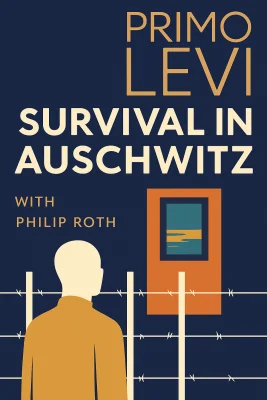
Survival in Auschwitz
Categories
Nonfiction, Biography, History, Memoir, Classics, Historical, Italian Literature, Holocaust, World War II, War
Content Type
Book
Binding
Paperback
Year
1996
Publisher
Simon & Schuster
Language
English
ASIN
0684826801
ISBN
0684826801
ISBN13
9780684826806
File Download
PDF | EPUB
Survival in Auschwitz Plot Summary
Introduction
In the darkest chapter of human history, when industrial machinery was turned toward the systematic destruction of human dignity and life, one young Italian chemist discovered that survival required more than mere endurance—it demanded an unwavering commitment to remaining human. Primo Levi entered Auschwitz in 1944 as prisoner 174517, a twenty-four-year-old with little wisdom and no experience of the world's capacity for evil. What he found there would challenge everything he believed about civilization, human nature, and the meaning of existence itself. Yet from this descent into hell emerged not just a survivor, but a witness whose clear-eyed testimony would illuminate the depths of human cruelty and the heights of human resilience. Levi's journey reveals three profound dimensions of the human experience: how ordinary people can endure extraordinary circumstances through the power of observation and rational thought, how professional skills and intellectual curiosity can become instruments of survival, and how the act of bearing witness transforms personal trauma into universal wisdom. His story demonstrates that even in humanity's darkest hour, the commitment to understanding, remembering, and maintaining one's essential humanity can triumph over forces designed to destroy the human spirit entirely.
Chapter 1: Early Life and the Shadow of Fascism
Primo Levi was born into the comfortable, assimilated Jewish community of Turin in 1919, a world that seemed stable and secure. His family had deep roots in the Piedmont region, tracing their ancestry back to Spanish Jews who had arrived in 1500. Growing up in the same apartment building where he would spend most of his life, Levi inhabited a universe of bourgeois respectability, intellectual curiosity, and cultural integration. His father worked as an engineer, his mother came from a well-established family, and young Primo showed early promise as a student with a particular fascination for chemistry and the natural sciences. The racial laws enacted by Mussolini's government in 1938 shattered this world of assumed belonging. Suddenly, at nineteen, Levi found himself legally defined as a second-class citizen, barred from many opportunities and marked as different from his classmates and neighbors. The experience was profoundly disorienting for someone who had never felt particularly Jewish in a religious or cultural sense. He later described how these laws awakened in him a sense of being an "impurity," though he would come to wear this designation with a kind of pride. Despite these restrictions, Levi managed to complete his chemistry degree at the University of Turin in 1941, writing his thesis on "Measurements of dielectrical constants." His professor reluctantly supervised the work of this brilliant but now legally problematic student. The degree opened few doors in Fascist Italy, where Jewish graduates faced systematic exclusion from professional opportunities. Levi found himself taking odd jobs and temporary positions, his scientific training seeming increasingly irrelevant in a world bent on defining him by his ancestry rather than his abilities. The German occupation of northern Italy following the country's surrender in September 1943 transformed Levi's situation from civic exclusion to mortal danger. Like many young Italian Jews, he felt compelled to choose between passive acceptance and active resistance. Despite his admitted lack of political experience or military training, he joined a small partisan band in the mountains above Turin. It was a romantic, almost literary gesture by a young man who had spent more time with books than weapons. The partisan adventure lasted barely two months. Levi's group was woefully unprepared, lacking weapons, contacts, and basic survival skills. When Fascist militia captured him in December 1943, Levi made a fateful decision that would save his life: he admitted to being Jewish rather than claiming to be a partisan. He calculated, incorrectly, that this admission would lead to internment rather than immediate execution. Instead, it led to deportation and Auschwitz, where his real education would begin.
Chapter 2: Auschwitz: The Dehumanization Process
The journey to Auschwitz began with the cattle car, forty-five human beings crammed into a space designed for livestock, traveling for four days without adequate food or water. Levi observed with the eye of a scientist even as he experienced the degradation as a victim. He noted how quickly social conventions dissolved under extreme stress, how the physical discomfort was so immediate and pressing that it prevented the luxury of despair. The train carried not just bodies but an entire world toward destruction. Arrival at Auschwitz completed the first phase of a carefully designed process of dehumanization. The selection process that separated the "fit" from the "unfit" was conducted with bureaucratic efficiency, SS officers pointing left or right with the casual gesture of sorting mail. Levi learned later that of his transport of 650 people, only 96 men and 29 women entered the camps; the rest went directly to the gas chambers. The randomness of this selection would haunt him—survival often depended not on strength or virtue but on chance. The initiation ritual stripped away every external marker of individual identity. Heads were shaved, clothes confiscated, personal possessions lost forever. Levi received his new identity: prisoner number 174517, tattooed on his left arm. The number would outlast the war, remaining visible on his skin for the rest of his life as a permanent reminder of his transformation from person to inventory item. Names became irrelevant; guards and fellow prisoners alike identified him by his number. The systematic destruction of human dignity extended to every aspect of daily existence. Prisoners received inadequate rations calculated to produce slow starvation, insufficient clothing for the harsh climate, and shelter that barely qualified as such. The daily routine of roll calls, work assignments, and survival scrambles eliminated privacy, contemplation, and almost all opportunities for human connection. The rules were deliberately contradictory and constantly changing, creating an environment where compliance was impossible and punishment inevitable. Yet even within this machinery of destruction, Levi discovered unexpected spaces for human observation and connection. He met Lorenzo, the Italian civilian worker who shared his food rations, not from any expectation of reward but from simple human decency. He encountered fellow prisoners who maintained their professional pride even while performing slave labor, building walls straight and true despite their hatred for their captors. These glimpses of persistent humanity became anchors for his own survival and sources of hope that the human spirit could endure even systematic attempts at its destruction.
Chapter 3: The Will to Bear Witness
From the earliest days of his imprisonment, Levi felt an overwhelming compulsion to observe, remember, and eventually testify about what he witnessed. This impulse emerged not from literary ambition but from something deeper—a profound need to resist the Nazi project of making their victims disappear without a trace. The very act of paying attention became a form of rebellion, a way of preserving human dignity in conditions designed to obliterate it entirely. His scientific training served him well in this endeavor. Levi approached the camp with the systematic curiosity of a researcher, noting hierarchies among prisoners, economic systems that developed around scarce resources, and the social dynamics that determined survival. He observed how different nationalities adapted to camp conditions, how various strategies for obtaining extra food played out over time, and how the camp's internal politics affected individual fates. This analytical approach provided both emotional distance from immediate suffering and valuable insight into human behavior under extreme stress. The chemistry background that had seemed irrelevant in Fascist Italy became literally life-saving in Auschwitz. When German authorities decided to establish a chemical laboratory staffed by prisoner technicians, Levi's expertise made him eligible for indoor work, protection from the worst weather, and slightly better treatment. The examination by Dr. Pannwitz, the German chemist who would determine his qualification, represented a surreal collision between his former academic world and his current reality as a numbered slave. During his months in the laboratory, Levi discovered that maintaining intellectual engagement was as crucial as obtaining adequate nutrition. He taught Italian to a young French prisoner while they carried soup across the camp, attempting to recite Dante's Ulysses canto from memory. The effort to remember and transmit culture became another form of resistance, a way of preserving what the camps were designed to destroy. These moments of mental activity provided respite from the grinding physical demands of survival. The approaching end of the war brought new dangers as the German authorities prepared to evacuate healthy prisoners westward, likely to their deaths in forced marches. Levi's illness with scarlet fever, which landed him in the camp infirmary, paradoxically saved his life by making him too sick to move. When the Germans abandoned the camp ahead of Soviet forces, he found himself among a small group of dying prisoners left behind. This experience of near-total abandonment would become the foundation for his most powerful writing about human resilience and the bonds that can form even in extremity.
Chapter 4: The Long Journey Home
Liberation by Soviet forces on January 27, 1945, marked not the end of Levi's ordeal but the beginning of a different kind of adventure. The journey home to Italy would take eight months and carry him thousands of miles through the chaos of postwar Eastern Europe. This odyssey, which he would later describe as a gift of fate despite its hardships, provided crucial time for processing his camp experiences and beginning his transformation from victim to witness. The immediate aftermath of liberation was hardly celebratory. Levi found himself among hundreds of displaced persons in Soviet-controlled territory, facing bureaucratic indifference, material scarcity, and the complex politics of postwar settlement. The Red Army, while liberating the camps, showed little understanding of or particular sympathy for the survivors' plight. Former prisoners competed with millions of other refugees for scarce resources and transportation home. During months of waiting in displaced persons camps and transit stations across Eastern Europe, Levi encountered an extraordinary cross-section of humanity. He met fellow survivors from across Nazi-occupied territory, Soviet citizens returning from German forced labor, and a remarkable array of characters thrown together by war's chaos. His powers of observation, sharpened by his camp experience, allowed him to appreciate both the comedy and tragedy of these encounters. The slow pace of repatriation, frustrating as it was, provided essential time for psychological recovery. Levi began to process not just his own survival but his responsibility to those who had not survived. The guilt that would accompany him for the rest of his life—why him and not the others?—began to clarify into a sense of obligation. He had been spared not through any virtue of his own but through chance, and this survival carried with it the duty to remember and testify. The actual return to Turin in October 1945 brought its own disorientation. Family members who had survived in hiding welcomed him, but the city seemed both familiar and strange after his experiences. The ordinary concerns of civilian life—career, relationships, daily routine—felt simultaneously precious and trivial. Levi had to learn how to live again in a world where survival was not the primary daily concern, where human decency was assumed rather than remarkable.
Chapter 5: Chemical Work and Literary Voice
Returning to civilian life, Levi faced the practical necessity of rebuilding a career interrupted by war and deportation. His chemistry training, temporarily rendered irrelevant by racial laws, now provided a path back to professional respectability and economic security. He found work with a small Turin paint company, eventually becoming its manager and developing expertise in the specialized field of wire enamels for electrical conductors. This return to scientific work proved essential not just for earning a living but for psychological recovery. The daily routine of laboratory work provided crucial normalcy after years of extremity. The precision required for chemical analysis, the systematic approach to problem-solving, and the satisfaction of work properly done offered healing counterpoints to the arbitrariness and senselessness he had experienced in the camps. Chemistry became a way of re-engaging with rational, predictable processes in a world that had seemed fundamentally chaotic and evil. Yet the compulsion to write about his experiences refused to disappear. During evenings and weekends, while managing his professional responsibilities, Levi began setting down his memories of Auschwitz. He approached this task with the same systematic methodology he brought to chemical analysis, striving for precision, clarity, and accuracy. His goal was not literary but testimonial—to create a record that others could understand and believe. The writing process itself became a form of therapy and further resistance to Nazi goals. By transforming his experiences into clear, accessible prose, Levi was defeating the German intention that their crimes remain hidden and their victims forgotten. Each precisely rendered scene, each carefully explained detail about camp life, represented a victory for human memory over intended oblivion. The act of writing completed the transformation from victim to witness. When his first book was finally published in 1947, it initially found few readers. Italian society was eager to move beyond wartime trauma, and the systematic nature of Nazi atrocities remained difficult for many to comprehend. Levi continued his chemical work while slowly building a reputation as a writer whose clear, unsentimental prose could make incomprehensible experiences understandable. His scientific training had given him more than a profession—it had provided the analytical tools and communicative skills that would make him one of the twentieth century's most important witnesses.
Chapter 6: Bridging Science and Humanity
Throughout his career, Levi maintained that his dual identity as chemist and writer represented not a contradiction but a synthesis. The same qualities that made him an effective industrial chemist—precision, curiosity, systematic observation—enabled him to become an extraordinary witness to human experience. His scientific background provided both the analytical framework for understanding extreme situations and the communicative discipline necessary for rendering them comprehensible to others. The connection between his professional and literary work became most explicit in "The Periodic Table," where Levi used chemical elements as organizing principles for autobiographical stories. Each chapter, named for a different element, explored how the properties of substances paralleled aspects of human experience. Carbon's versatility mirrored life's adaptability, zinc's reactive nature reflected the unpredictability of human encounters. These analogies were not forced but emerged naturally from Levi's deep understanding of both chemistry and human nature. His approach to writing maintained the scientific values of accuracy and reproducibility. Levi insisted that his accounts of camp life were factually precise, that his observations could be verified by other survivors, that his conclusions about human behavior emerged from evidence rather than ideology. This commitment to truth over dramatic effect gave his testimony unique authority and made his books valuable not just as literature but as historical documents. The factory environment where he spent most of his working life provided ongoing contact with what he called "the world of real things." Unlike many intellectuals who lived primarily in academic or literary circles, Levi daily encountered the practical challenges of production schedules, worker relations, and technical problem-solving. This grounding in material reality informed all his writing, keeping it connected to immediate human concerns rather than abstract theorizing. Even his retirement from chemical work at age fifty-eight was motivated by the desire to integrate rather than separate his various activities. Free from managerial responsibilities, he could devote full attention to writing while drawing on thirty years of industrial experience. The chemical factory had not been a distraction from his literary calling but an essential component of his development as a writer capable of bridging scientific and humanistic ways of understanding the world.
Chapter 7: The Ethical Imperative of Memory
For Levi, survival carried with it an inescapable moral obligation to serve as a witness for those who could not speak for themselves. This responsibility shaped not only what he wrote but how he lived, making him a public figure who regularly spoke to students, answered countless letters from readers, and engaged with historical and ethical questions raised by his experience. He understood that his survival was meaningful only if it contributed to preventing future atrocities. His approach to testimony emphasized the importance of precise, factual account over emotional manipulation. Levi believed that the truth about Nazi crimes was horrifying enough without embellishment, that accuracy served both historical record and moral purpose better than dramatic license. He insisted on distinguishing between what he had personally witnessed and what he had learned from others, maintaining the scientist's commitment to reliable data even when dealing with experiences that challenged rational comprehension. The questions that haunted Levi throughout his life centered on the randomness of survival and the meaning of memory. Why had he lived when so many others, perhaps more deserving, had died? What obligation did survival create toward both the dead and future generations? His writing struggled with these questions without offering easy answers, acknowledging the element of chance in his survival while insisting on the importance of learning from rather than simply commemorating the past. As the years passed and direct survivors of Nazi camps became fewer, Levi increasingly saw himself as a bridge between lived experience and historical memory. He worried about the tendency to mythologize or simplify the Holocaust, insisting instead on the complexity of human behavior under extreme stress. His testimony included not just German brutality but also the moral ambiguities faced by prisoners, the ways victims could become complicit in oppression, and the difficulty of maintaining ethical standards under impossible conditions. The burden of witness ultimately contributed to Levi's death in 1987, when he fell from the stairway of his Turin apartment building in what was likely suicide. The weight of memory, the responsibility of testimony, and perhaps the growing awareness that his generation of survivors was passing away had become unbearable. Yet his books remain as permanent testimony, ensuring that the voices of the victims continue to speak to new generations about both human capacity for evil and the possibility of maintaining dignity even in extremity.
Summary
Primo Levi's extraordinary journey from a comfortable middle-class existence through the depths of Nazi brutality to become one of the twentieth century's most important witnesses demonstrates that survival is not merely a matter of physical endurance but of maintaining one's essential humanity even in conditions designed to destroy it. His life teaches us that the commitment to understanding, remembering, and bearing witness can transform personal trauma into universal wisdom, and that the analytical skills we develop in professional life can become instruments of both survival and service to others. From Levi's example, we can learn the importance of precise observation and clear communication when confronting evil, the value of maintaining professional dignity and intellectual curiosity even under extreme stress, and the moral obligation that survival creates to speak for those who cannot speak for themselves. His integration of scientific methodology with humanistic concerns offers a model for approaching complex moral questions with both rigor and compassion. Anyone seeking to understand how ordinary individuals can respond to extraordinary circumstances, how professional skills can serve larger human purposes, or how personal experience can be transformed into lasting testimony will find in Levi's story both inspiration and practical guidance for confronting the challenges of our own time.
Best Quote
“Sooner or later in life everyone discovers that perfect happiness is unrealizable, but there are few who pause to consider the antithesis: that perfect unhappiness is equally unattainable. The obstacles preventing the realization of both these extreme states are of the same nature: they derive from our human condition which is opposed to everything infinite.” ― Primo Levi, Survival in Auschwitz
Review Summary
Strengths: The review highlights the profound impact of Primo Levi's writing, emphasizing his ability to convey experiences with remarkable calmness and clarity despite the horrific events he endured. Levi's work is praised for its significant content and purpose, transcending mere literary value. The review also notes the emotional depth and shock value of Levi's narrative style. Overall: The reviewer expresses deep admiration for Levi's work, particularly "The Periodic Table," and recommends it highly. The review conveys a sense of reverence for Levi's ability to articulate his experiences with such tranquility, urging readers to engage with his writing for its profound insights into human resilience and suffering.
About Author

Philip Roth
Roth reframes the American experience by delving into the complexities of identity, using his birthplace of Newark, New Jersey, as a frequent setting to explore themes of Jewish life and broader American culture. His works often blur the lines between reality and fiction, infusing a deeply autobiographical style with a philosophical edge. This technique allows Roth to interrogate personal and cultural conflicts, as seen in his early book "Goodbye, Columbus", which critiques the clash between traditional values and modern aspirations. Roth's writing, known for its "sensual, ingenious style," provocatively addresses issues of identity, earning him both acclaim and controversy.\n\nThrough characters like Nathan Zuckerman, Roth extends his exploration of the self and society, using the alter ego in a series of novels to navigate the intersections of art and life. His narrative method, involving fictionalized versions of himself, as in "The Plot Against America", provides a rich terrain for examining the interplay between personal and historical narratives. For readers, Roth's work offers an intricate map of American identity, blending humor and gravity to illuminate the human condition. This bio highlights his impact on literature, marked by accolades such as the Pulitzer Prize for "American Pastoral", underscoring his status as one of the most honored authors of his generation.
Read moreDownload PDF & EPUB
To save this Black List summary for later, download the free PDF and EPUB. You can print it out, or read offline at your convenience.
Survival in Auschwitz
by Philip Roth
