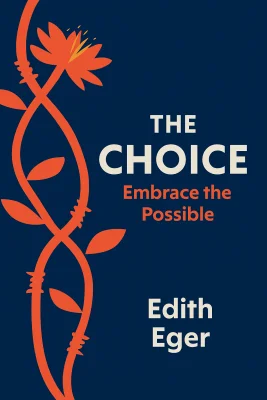
The Choice
Embrace the Possible
Categories
Nonfiction, Self Help, Psychology, Biography, History, Memoir, Audiobook, Book Club, Holocaust, World War II
Content Type
Book
Binding
Hardcover
Year
2017
Publisher
Scribner
Language
English
ISBN13
9781501130786
File Download
PDF | EPUB
The Choice Plot Summary
Introduction
# From Auschwitz to Freedom: A Survivor's Journey of Choice and Healing In the darkness of a Nazi concentration camp barracks, a sixteen-year-old girl stands before Dr. Josef Mengele, the Angel of Death himself. The orchestra begins to play "The Blue Danube," and she must dance for her life. As her body moves through the familiar steps of her childhood ballet training, something extraordinary happens. Despite being surrounded by unimaginable horror, she discovers a profound truth that will guide her for the rest of her life: no one can take away what you put in your own mind. In that moment of terror, she finds an inner sanctuary that even the most brutal circumstances cannot touch. This remarkable story of survival and transformation reveals how the human spirit can transcend the most devastating experiences. Through decades of healing and helping others, we learn that our greatest prison is often not the external circumstances that confine us, but the mental barriers we construct within ourselves. The journey from victim to survivor to thriver shows us that while we cannot always choose what happens to us, we can always choose how we respond. This book illuminates the path from trauma to triumph, offering profound insights into the nature of resilience, the power of choice, and the possibility of finding meaning in even our darkest moments.
Chapter 1: Dancing for Life: The Birth of Inner Freedom
The cattle car doors burst open to blinding sunlight after days of suffocating darkness. Hundreds of Hungarian Jews stumble onto the platform at Auschwitz-Birkenau, desperate for air and light. A teenage girl notices the sign "Arbeit Macht Frei" and hears music playing. Her father, ever optimistic, declares it cannot be such a terrible place if there is music. Within hours, she watches her mother disappear into a line leading to the gas chambers, never to be seen again. That night, in the barracks, Dr. Mengele arrives seeking entertainment from the new arrivals. When fellow inmates push the young dancer forward, she faces an impossible choice. To refuse means certain death. To comply means dancing for her mother's murderer. As "The Blue Danube" begins, she closes her eyes and transports herself to the Budapest opera house of her dreams. Her body performs the familiar routine while her mind soars free, dancing not for Mengele but for love, for life, for the future she still dares to imagine. In that moment of ultimate powerlessness, she discovers her ultimate power: the freedom to choose her inner response. The bread Mengele tosses her afterward becomes more than sustenance; it becomes proof that even in hell, dignity can survive. She shares it with her sister and bunkmates, understanding instinctively that survival depends not on competition but on connection. This dance in the darkness illuminates a profound truth: when everything external is stripped away, when we face the absolute worst of human cruelty, we still retain the most fundamental human freedom—the ability to choose our attitude, to find meaning in suffering, and to maintain our humanity even when surrounded by inhumanity.
Chapter 2: The Invisible Prison: When Liberation Becomes Captivity
Liberation day arrives not with joy but with numbness. The skeletal survivors stumble from the forest camp, barely alive, carrying their trauma in bodies too weak to celebrate freedom. Years later, a successful psychologist sits on a Baltimore city bus, frozen in terror. The driver is shouting at her for a simple misunderstanding about paying the fare, but in her mind, she is back in the camps, facing armed guards and mortal danger. She collapses to the floor, shaking and crying, unable to distinguish between past and present. Fellow passengers mutter "stupid greener" under their breath as a kind stranger helps her to her seat. The flashbacks continue for decades, triggered by sirens, uniforms, or unexpected loud noises. At home, she unconsciously teaches her children to hide when ambulances pass, their wailing sirens a signal of danger in her traumatized mind. She works tirelessly to build a normal American life, but the past intrudes without warning, transforming ordinary moments into scenes of terror. Her inner world, once a sanctuary that saved her life in the camps, has become a source of torment. This paradox reveals trauma's cruel irony: the very mechanisms that help us survive extreme circumstances can become our captors long after the danger has passed. The mind that once provided refuge through imagination and hope now replays scenes of horror with vivid, inescapable clarity. Understanding this invisible prison is the first step toward recognizing that healing requires not just physical safety, but the courage to face the demons within and reclaim the power of choice over our own thoughts and responses.
Chapter 3: Breaking the Silence: Confronting Trauma's Hidden Power
A college student approaches her after class, holding a small paperback book. "You were there, weren't you?" he asks gently. "Auschwitz. You're a survivor." The question she has dreaded for twenty years hangs in the air like smoke. Her carefully constructed wall of silence trembles as he offers her Viktor Frankl's "Man's Search for Meaning," written by another Auschwitz survivor who found the courage to speak his truth. That night, alone in her living room, she opens the book with trembling hands. Page by page, she recognizes her own experience reflected in Frankl's words about the three phases of camp life: the shock of arrival, the adaptation to impossible conditions, and the disillusionment that can follow liberation. For the first time, she realizes she is not alone in her struggle. Someone else has walked this path and found meaning in the darkness. Reading Frankl's account of imagining himself free while imprisoned, giving lectures about his experience, she remembers her own survival technique of mental escape. The recognition is both painful and liberating. She weeps for the first time in years, not from despair but from the relief of being understood. The book becomes a bridge between her past and present, showing her that speaking about trauma can heal rather than harm, that silence is not protection but another form of imprisonment.
Chapter 4: Returning to Hell: Transforming Pain into Purpose
Thirty-five years after liberation, she makes the most difficult decision of her life: she will return to Auschwitz. The invitation to speak to military chaplains in Germany awakens something in her, a recognition that her healing is incomplete. Despite her husband's warning that "if you don't go to Germany, then Hitler won," and her daughter's fears that the journey might kill her, she knows she must face the place where her parents died. Standing at the gates of Auschwitz, reading the cruel lie "Arbeit Macht Frei," she is overwhelmed by the silence. No birds sing here; even nature seems to avoid this place of systematic death. Walking through the barracks where she had slept five to a wooden shelf, seeing the piles of shoes and glasses and hair, she feels the full weight of the million souls who perished here. But she also feels something unexpected: her own strength. In the place where her mother had been murdered, she finally allows herself to remember the moment she had spent seventy years trying to forget. When Mengele asked if the woman beside her was her mother or sister, she had said "Mother" out of pure love, not calculation. That word had condemned her mother to death, but it had also been the truth of a sixteen-year-old girl who couldn't deny her deepest bond even in the face of annihilation. Standing on the ground where her barrack once stood, she picks up a small gray stone—not as a burden to carry, but as a symbol of love transformed from guilt into acceptance.
Chapter 5: The Healing Dance: Teaching Others to Choose Freedom
Back in her therapy practice in California, she begins to understand that healing is not about forgetting trauma, but about integrating it into a life of meaning and purpose. When a catatonic Army captain sits frozen in her office, she recognizes the familiar signs of someone imprisoned by their own pain. His wife's infidelity has triggered a rage so consuming that he has brought a loaded gun to their session, ready to commit murder. Instead of calling the police, she chooses to stay present with his pain. She asks him about his children, helping him see that his choice in that moment will determine not just his fate, but theirs. When he finally drops the gun and collapses in tears, she holds him like the broken child he has become. In that moment, both healer and patient are transformed by the power of choosing love over violence, connection over isolation. With each patient, she discovers new dimensions of freedom. A young woman with anorexia learns that starving herself is not control but captivity, and that true freedom means nourishing her body and dreams. A couple trapped in cycles of blame and resentment finds that taking responsibility for their own happiness is the only path to genuine intimacy. The dance of freedom, she realizes, has specific steps that anyone can learn: take responsibility for your responses, take risks that align with your authentic self, and choose to release the wound.
Chapter 6: Legacy of Choice: From Victim to Healer
At ninety years old, she continues to see patients, give lectures, and bear witness to the transformative power of choice. When a fourteen-year-old neo-Nazi comes to her office spouting hatred about killing Jews and minorities, she could respond with righteous anger. Instead, she chooses to see the wounded child beneath the hate, asking simply, "Tell me more." By the end of their session, his rage has transformed into tears, his hatred into a hunger for genuine connection. Her therapeutic wisdom is born from lived experience. She treats each person as whole and capable, not broken and needy. Instead of asking "How can I fix you?" she asks "How can I be useful to you as you heal yourself?" This subtle shift places responsibility and power back in the hands of her patients, transforming them from victims waiting to be rescued into agents of their own recovery. Her office becomes a sanctuary where people can safely explore their deepest wounds without judgment. Having survived the ultimate test of human endurance, she knows that no emotion, no matter how intense, can destroy the essential self that lives beneath all suffering. Her life stands as proof that our worst experiences can become our greatest gifts, not because suffering is good, but because of what we choose to do with it. The young girl who once danced for her life in a Nazi death camp became a woman who teaches others to dance with their own darkness, to find light in the deepest shadows.
Summary
Through the extraordinary journey of one Holocaust survivor, we discover that healing is not about erasing our wounds but about transforming them into sources of wisdom and compassion. The path from victim to healer requires three essential choices: taking responsibility for our responses rather than remaining trapped by circumstances, taking risks that align with our authentic selves, and choosing to release our grip on past pain. These choices, made daily and deliberately, become the foundation of genuine freedom. The most profound lesson emerges not from the horror of the concentration camps, but from the decades of healing that followed: our greatest suffering can become our most powerful tool for helping others. When we stop running from our pain and instead learn to dance with it, we discover that the prison we thought was permanent was actually a classroom preparing us for our life's true work. The choice to heal ourselves becomes the gift we offer to a wounded world, proving that love, not hatred, has the final word in every human story.
Best Quote
“Our painful experiences aren’t a liability—they’re a gift. They give us perspective and meaning, an opportunity to find our unique purpose and our strength.” ― Edith Eger, The Choice: Embrace the Possible
Review Summary
Strengths: The review highlights the memoir's emotional depth and inspirational nature, emphasizing Edith Eger's resilience and transformation from a Holocaust survivor to an eminent psychologist. The narrative's ability to evoke strong emotional responses and its potential to leave a lasting impact on readers are noted. The inclusion of Desmond Tutu's endorsement adds credibility and weight to the memoir's significance. Overall: The reviewer expresses a highly positive sentiment, recommending the memoir as a transformative and unforgettable read. The book is praised for its absorbing and brilliant storytelling, with a strong endorsement for its inspirational impact on readers.
About Author

Edith Eger
Eger reflects on the profound resilience of the human spirit through her exploration of trauma, healing, and personal growth. As a Holocaust survivor who endured the horrors of Auschwitz and multiple concentration camps, Eger's life serves as a testament to overcoming adversity. Her experiences during the Holocaust inform her later work as a clinical psychologist specializing in post-traumatic stress disorder. Eger's collaboration with Viktor Frankl further shaped her therapeutic approach, emphasizing the transformative power of choice and perspective in the face of trauma. \n\nIn her book, "The Choice: Embrace the Possible", Eger shifts the narrative from victimhood to empowerment, advocating for a mental framework that asks "Why not me?" instead of "Why me?" This perspective encourages readers to transcend their circumstances by focusing on personal growth and healing. Her subsequent book, "The Gift: 12 Lessons to Save Your Life", continues this theme, offering practical advice for changing self-destructive thoughts and behaviors. Eger’s work impacts not only those dealing with trauma but also anyone seeking to liberate themselves from limiting beliefs, providing a powerful roadmap for personal transformation. \n\nAs a recognized author and therapist, Eger has gained acclaim for her contributions to both literature and psychology. Her books have achieved bestseller status and are celebrated for their profound insights into the human condition. Eger's journey, from surviving Auschwitz to educating future psychologists, exemplifies the potential for healing and growth after unimaginable hardship. Her work continues to inspire readers and audiences globally, underlining the enduring importance of resilience and choice in overcoming life's challenges.
Read moreDownload PDF & EPUB
To save this Black List summary for later, download the free PDF and EPUB. You can print it out, or read offline at your convenience.
The Choice
by Edith Eger
