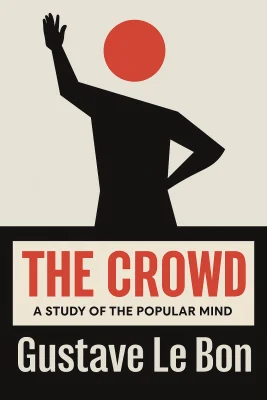
The Crowd
A Study of the Popular Mind
Categories
Nonfiction, Psychology, Philosophy, Science, History, Politics, Classics, Audiobook, Sociology, Social Science
Content Type
Book
Binding
Paperback
Year
2014
Publisher
Createspace Independent Publishing Platform
Language
English
ISBN13
9781502303264
File Download
PDF | EPUB
The Crowd Plot Summary
Introduction
Why do intelligent individuals sometimes make irrational decisions when they join a group? This fundamental question about human behavior has puzzled observers of society for centuries, from political upheavals to market panics, from religious movements to social reforms. The psychological transformation that occurs when individuals merge into crowds represents one of the most fascinating and consequential aspects of human nature. This work presents a comprehensive theoretical framework for understanding crowd psychology, establishing foundational principles that explain how collective behavior differs fundamentally from individual psychology. Through systematic analysis of mental unity, emotional contagion, and leadership dynamics, the book reveals the hidden mechanisms that drive mass movements and social change. The theoretical insights offered here illuminate core questions about suggestibility, the role of ideas in shaping collective action, the psychology of belief formation, and the conditions under which crowds become either constructive or destructive forces in society.
Chapter 1: The Mental Unity of Crowds
The foundational principle of crowd psychology rests on understanding how individual consciousness dissolves into collective unity when people gather for common purposes. This mental unity represents a profound psychological transformation where separate personalities merge into a single, cohesive mental entity guided by shared impulses and emotions. The process begins with the disappearance of conscious personality and the emergence of what can be termed the collective mind. When individuals join a crowd, their personal identity becomes submerged beneath layers of racial heritage and unconscious motivations. This transformation operates through three primary mechanisms: the anonymity that provides a sense of invincible power, the contagion that spreads emotions and ideas rapidly through the group, and the heightened suggestibility that makes individuals susceptible to collective influence. The psychological law governing this phenomenon reveals that crowds always operate at the intellectual level of their least capable members, regardless of the individual intelligence of participants. A gathering of distinguished professors will demonstrate the same basic crowd characteristics as a collection of laborers when engaged in collective action. This occurs because crowds can only access those qualities common to all members, which typically represent the most primitive and universal human traits. The implications of mental unity extend far beyond simple group dynamics. Historical examples demonstrate how educated, rational individuals can participate in both heroic and destructive acts when swept up in collective psychology. The French Revolution provides compelling evidence of how crowds could simultaneously exhibit noble self-sacrifice and brutal violence, often within the same individuals across different situations. Understanding mental unity helps explain why crowds are capable of accomplishments impossible for individuals, such as building civilizations, creating languages, and establishing enduring institutions. Yet this same principle accounts for the mob mentality that can lead to persecution, violence, and the destruction of social order. The crowd represents both humanity's greatest creative potential and its most dangerous destructive capacity, unified under the same psychological principles.
Chapter 2: Sentiments and Morality of Crowd Psychology
The emotional life of crowds operates according to distinctive patterns that amplify and simplify human feelings while creating new moral frameworks. Crowd sentiments exhibit remarkable characteristics including impulsiveness, extreme mobility, and the tendency toward exaggeration that transforms moderate individual opinions into passionate collective convictions. Impulsiveness manifests as the crowd's inability to deliberate between desire and action. Unlike individuals who can resist immediate urges through rational consideration, crowds lack this inhibitory capacity and move directly from emotional impulse to collective behavior. This impulsiveness combines with extraordinary mobility, allowing crowds to shift rapidly between contradictory emotional states. A crowd can transform from vengeful fury to generous compassion within moments, responding to immediate stimuli rather than consistent principles. The exaggeration tendency means crowds never experience moderate emotions or nuanced perspectives. They perceive situations in stark terms of absolute good or evil, complete truth or total falsehood. This binary thinking eliminates the subtle distinctions that characterize mature individual judgment, but it provides the emotional intensity necessary for collective action. Crowds require clear, simple, and powerful emotional themes to maintain unity and purpose. Regarding morality, crowds can exhibit both superior virtue and extreme depravity compared to their individual members. Historical examples reveal crowds performing acts of extraordinary heroism and self-sacrifice that isolated individuals would rarely attempt. The Crusades, revolutionary movements, and other collective enterprises demonstrate how crowds can inspire individuals to transcend personal limitations for higher ideals. However, crowd morality operates differently from individual ethics. Rather than following consistent moral principles, crowds respond to immediate suggestions and emotional appeals. They may commit acts their individual members would normally consider abhorrent, yet feel completely justified in their actions because they believe they serve a greater good. This moral transformation illustrates how collective psychology can override personal conscience while creating new ethical frameworks based on group identity and shared purpose.
Chapter 3: The Power of Ideas, Reasoning, and Imagination in Crowds
Ideas function as the driving force of crowd behavior, but they must undergo specific transformations to become accessible to collective psychology. Crowds cannot process complex, nuanced concepts, but they respond powerfully to simplified, emotionally charged ideas presented as vivid images rather than abstract propositions. The transformation process requires reducing sophisticated philosophical, political, or social theories to their most basic elements. Complex democratic principles become simple slogans about equality or freedom. Intricate economic theories reduce to straightforward concepts about wealth distribution or national prosperity. This simplification process does not diminish the power of ideas but makes them psychologically accessible to crowds whose mental processes operate through association and emotion rather than logical analysis. Crowd reasoning follows patterns of association rather than logical deduction. Ideas connect not through rational relationships but through emotional resonance, symbolic similarity, or sequential occurrence. This associative thinking explains why crowds can simultaneously hold contradictory beliefs without experiencing logical discomfort. They process ideas as isolated images rather than components of coherent systems. Imagination serves as the primary faculty through which crowds engage with ideas. Abstract concepts must be translated into concrete, visual images that evoke emotional responses. Political movements succeed when they provide compelling imagery rather than detailed policy proposals. Religious ideas spread through vivid metaphors and symbolic representations rather than theological arguments. The historical power of ideas demonstrates their capacity to reshape entire civilizations despite their logical limitations. The democratic ideals of the French Revolution, though philosophically imperfect, generated sufficient emotional force to transform European society. Similarly, religious ideas that may seem intellectually primitive have created lasting cultural institutions and motivated extraordinary human achievements. Understanding how ideas operate in crowd psychology reveals why intellectual arguments rarely change collective opinions, while emotional appeals and symbolic imagery can rapidly transform mass attitudes. The practical implications extend to all forms of leadership, education, and social change, showing why successful communication with crowds requires psychological insight rather than logical sophistication.
Chapter 4: Leaders and Their Influence on Crowd Behavior
Leadership represents the crucial element that transforms unorganized masses into directed collective action. Crowd psychology reveals that groups instinctively seek authoritative figures who can provide focus, direction, and the psychological anchor necessary for sustained collective behavior. Effective crowd leaders typically emerge from two distinct categories. The first includes individuals with intermittent but intense willpower who can inspire dramatic short-term action. These leaders excel during crises or revolutionary moments when their passionate energy can galvanize masses for specific objectives. However, their influence tends to be temporary and closely tied to immediate circumstances. The second category encompasses leaders with persistent, unwavering determination who can sustain long-term influence over crowds. These figures possess the rare psychological capacity to maintain consistent direction despite obstacles, opposition, or changing conditions. Historical examples include religious founders, empire builders, and transformative political figures who reshape entire civilizations through sustained effort and uncompromising vision. Leadership influence operates through three primary mechanisms: affirmation, repetition, and contagion. Successful leaders make bold, unequivocal statements without extensive supporting arguments. They repeat key messages consistently until these ideas become embedded in collective consciousness. Through emotional contagion, their conviction spreads throughout the crowd, creating unanimous acceptance of their guidance. The phenomenon of prestige provides leaders with almost mystical authority over crowds. This prestige may derive from personal charisma, social position, or demonstrated success, but once established, it enables leaders to command obedience without rational justification. Crowds follow prestigious leaders not because of logical persuasion but because of psychological fascination and the deep human need for authoritative guidance. Understanding leadership dynamics reveals both the constructive and dangerous aspects of crowd psychology. Visionary leaders can inspire populations to achieve remarkable progress and overcome seemingly impossible obstacles. However, the same psychological mechanisms enable demagogues and tyrants to manipulate masses for destructive purposes. The key lies in recognizing how leadership authority functions and developing societal mechanisms to channel it constructively.
Chapter 5: Types of Crowds and Their Characteristic Behaviors
Different categories of crowds exhibit distinct behavioral patterns based on their composition, purpose, and psychological characteristics. Understanding these variations provides insight into predicting and managing collective behavior across various social contexts. Heterogeneous crowds, composed of individuals from diverse backgrounds united temporarily by common circumstances, display the most unpredictable behavior. These anonymous gatherings, such as street crowds or spontaneous assemblies, lack stable leadership or clear objectives. Their behavior tends toward extreme volatility, rapid mood changes, and susceptibility to immediate influences. However, racial characteristics still exert strong influence, explaining why heterogeneous crowds from different cultures exhibit markedly different tendencies even under similar circumstances. Criminal crowds represent a specific manifestation of collective psychology where normal moral restraints disappear under the influence of group dynamics. Historical examples demonstrate how ordinary citizens can participate in violence and destruction while feeling completely justified in their actions. The psychological mechanisms include diffusion of responsibility, collective suggestion, and the belief that they serve higher purposes. Specialized crowds like juries present fascinating examples of how collective psychology operates within formal institutional frameworks. Despite careful selection procedures and legal safeguards, juries consistently demonstrate classic crowd characteristics including emotional decision-making, susceptibility to prestige and suggestion, and reduced individual critical thinking. These patterns remain consistent regardless of the educational or social background of individual jurors. Electoral crowds reveal how democratic processes interact with crowd psychology. Voters respond more to emotional appeals, prestigious candidates, and simplified messages than to complex policy arguments. The electoral process becomes a competition for psychological influence rather than rational deliberation about governance options. Parliamentary assemblies represent the most sophisticated form of crowd behavior, operating within established institutional constraints while still exhibiting fundamental crowd characteristics. These bodies demonstrate how collective psychology can be partially channeled through formal procedures, yet they remain susceptible to emotional contagion, leadership influence, and the tendency toward extreme positions. The challenge lies in maintaining democratic participation while minimizing the destructive potential of collective psychology.
Chapter 6: The Limitations of Crowd Opinion and Belief
Crowd beliefs operate within specific constraints that determine their formation, persistence, and eventual dissolution. These limitations reveal both the stability and fragility of collective convictions, explaining why some ideas endure across centuries while others vanish rapidly. Fixed beliefs represent the foundational layer of crowd psychology, consisting of fundamental convictions that define entire civilizations. These beliefs, such as religious systems, political ideologies, or cultural values, develop slowly over generations and become deeply embedded in collective consciousness. Once established, they resist rational criticism and provide the psychological framework within which all other ideas must operate. The formation of fixed beliefs requires specific conditions including repeated exposure across multiple generations, emotional resonance with deep psychological needs, and integration with existing cultural patterns. These beliefs gain strength not through logical demonstration but through constant reinforcement and their capacity to provide meaning and social cohesion. Changeable opinions represent the surface layer of crowd psychology, consisting of temporary attitudes that shift rapidly in response to immediate circumstances. These opinions cover topics like political preferences, social fashions, or economic policies. While they appear important in daily discourse, they lack the deep roots necessary for lasting influence on collective behavior. The modern era presents unique challenges for crowd belief systems. Traditional fixed beliefs have weakened without being replaced by equally powerful alternatives, creating unprecedented psychological instability. Simultaneously, mass media and rapid communication accelerate the formation and dissolution of temporary opinions, making collective attitudes increasingly volatile and unpredictable. Understanding belief limitations provides crucial insights for anyone seeking to influence collective behavior. Attempts to change fixed beliefs through rational argument typically fail because these convictions operate below the level of conscious reasoning. However, the current weakening of traditional belief systems creates both opportunities for positive transformation and dangers of social fragmentation. The key lies in recognizing which aspects of crowd psychology can be modified and which represent unchangeable features of human nature.
Chapter 7: How Political and Social Institutions Shape Crowds
The relationship between institutions and crowd behavior reveals a complex dynamic where formal structures interact with collective psychology to produce social stability or transformation. Understanding this interaction illuminates why some societies maintain effective governance while others experience chronic instability. Institutions serve primarily as expressions of underlying collective beliefs rather than as independent forces shaping crowd behavior. Political systems, legal frameworks, and social organizations emerge from deep cultural patterns and psychological tendencies within populations. Attempts to impose institutional changes without corresponding shifts in collective psychology typically result in superficial modifications that leave fundamental behaviors unchanged. The parliamentary system represents humanity's most sophisticated attempt to harness crowd psychology for constructive governance. These institutions acknowledge the reality of collective decision-making while providing formal procedures to channel crowd behavior toward deliberative rather than destructive outcomes. However, parliamentary assemblies still exhibit fundamental crowd characteristics including emotional reasoning, susceptibility to leadership influence, and the tendency toward extreme positions. Electoral systems reveal how democratic institutions interact with crowd psychology to produce governance outcomes. The electoral process becomes a competition for psychological influence rather than rational policy evaluation. Successful candidates must understand crowd psychology principles including the power of prestige, emotional appeal, and simplified messaging. This dynamic explains why electoral outcomes often seem disconnected from objective policy considerations. The modern challenge involves balancing democratic participation with effective governance. Institutions must acknowledge crowd psychology realities while providing mechanisms to moderate its most destructive tendencies. This requires sophisticated understanding of how formal procedures can influence collective behavior without attempting to eliminate its fundamental characteristics. Historical experience demonstrates that institutional effectiveness depends on alignment with underlying cultural patterns and collective psychology. Successful systems work with crowd psychology rather than against it, providing outlets for collective energy while preventing its concentration into dangerous forms. The ongoing evolution of democratic institutions reflects humanity's continued effort to achieve this delicate balance between collective participation and social stability.
Summary
The fundamental insight of crowd psychology lies in recognizing that collective behavior operates according to distinct psychological principles that differ dramatically from individual reasoning, creating both humanity's greatest achievements and its most dangerous tendencies. This understanding reveals why rational arguments fail to influence crowds while emotional appeals and symbolic imagery can rapidly transform mass attitudes and behavior. The enduring significance of these principles extends far beyond academic interest, providing essential insights for navigating our increasingly connected and collectively influenced world. Whether in politics, business, education, or social movements, success requires understanding how ideas spread through populations, how leadership authority functions, and how collective psychology can be channeled constructively rather than destructively. For individuals, this knowledge offers protection against manipulation while revealing the deeper currents that shape social change and cultural evolution.
Best Quote
“The masses have never thirsted after truth. They turn aside from evidence that is not to their taste, preferring to deify error, if error seduce them. Whoever can supply them with illusions is easily their master; whoever attempts to destroy their illusions is always their victim. An individual in a crowd is a grain of sand amid other grains of sand, which the wind stirs up at will.” ― Gustave Le Bon, سيكولوجية الجماهير
Review Summary
Strengths: The review provides a detailed personal account of the political climate in Egypt during the protests against the military coup, offering a firsthand perspective. It also discusses the book's exploration of Le Bon's theories on crowd psychology, highlighting the depth of analysis on the influence of leaders on masses. Weaknesses: The review lacks a clear focus on the book's content, instead dwelling on personal experiences and political commentary. It may not provide enough information for readers seeking a comprehensive understanding of the book's arguments and insights. Overall: The review conveys a critical view of both the political events in Egypt and Le Bon's conservative stance on revolutions. It suggests that the book offers valuable insights into crowd psychology, though the review itself may not fully capture the book's scope. Recommended for readers interested in historical and psychological analyses of mass movements.
About Author

Gustave Le Bon
Le Bon delves into the complexities of social dynamics through the lens of psychology and sociology, proposing that crowd behavior transcends individual intentions to form a collective psychological entity. His work on crowd psychology, especially in "The Crowd: A Study of the Popular Mind", introduces the idea that crowds operate under a "racial unconscious," leading to actions that are more emotional and less rational. Le Bon's theories suggest that the conscious personalities of individuals are submerged in a crowd, which then acts with a collective mind. This insight offers a framework for understanding how social groups can be manipulated or swayed, which remains relevant to fields like political science and marketing.\n\nThroughout his multifaceted career, Le Bon's writings traversed various disciplines, providing a comprehensive exploration of human behavior. His interest in anthropology during his travels informed his essentialist views, while his engagement with the physical sciences anticipated concepts like mass-energy equivalence. As the author of twenty-eight books, Le Bon's work covers diverse topics, including his studies of cranial capacity and intelligence, further earning him accolades like the Godard Prize. This bio encapsulates Le Bon's intellectual contributions that extend beyond social psychology, enriching fields like anthropology and physics. Readers, particularly those interested in social sciences and human behavior, can gain valuable insights from Le Bon's methodologies and perspectives, which continue to influence contemporary discussions on crowd behavior and social influence.
Read moreDownload PDF & EPUB
To save this Black List summary for later, download the free PDF and EPUB. You can print it out, or read offline at your convenience.
The Crowd
by Gustave Le Bon
