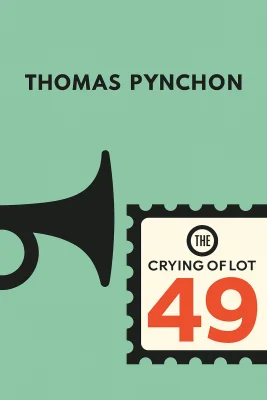
The Crying of Lot 49
Categories
Fiction, Classics, Mystery, Literature, American, Book Club, Contemporary, 20th Century, Novels, Literary Fiction
Content Type
Book
Binding
Paperback
Year
2006
Publisher
Harper Perennial Modern Classics
Language
English
File Download
PDF | EPUB
The Crying of Lot 49 Plot Summary
Introduction
Oedipa Maas sits in her living room, staring at the dead eye of her television screen, holding a letter that will unravel her world. The document informs her that Pierce Inverarity, a California real estate mogul and former lover, has named her executor of his vast, tangled estate. What begins as a simple legal obligation becomes a descent into America's hidden networks of communication, conspiracy, and isolation. The letter arrives like a signal from another frequency, pulling Oedipa from her suburban cocoon into a labyrinth where every clue spawns more questions. In the sprawling developments of Southern California, among the aerospace factories and endless freeways, she will discover traces of an ancient postal conspiracy called the Tristero. Each symbol she encounters, each mysterious contact, draws her deeper into a web that may be revealing America's secret history—or driving her inexorably toward madness.
Chapter 1: The Designation: Oedipa Becomes Executor
The call comes at three in the morning, shattering the silence like broken glass. Pierce Inverarity's voice dances through disguises—Slavic diplomat, comic Negro, hostile Pachuco, then finally his Lamont Cranston impression, that radio shadow voice she remembers from their time in Mazatlan. Her husband Mucho rolls over, suggesting she hang up, but Pierce has already vanished into the darkness, leaving only dial tone and memory. Now the letter makes that midnight call prophetic. Sitting in her Tupperware-scented afternoon, kirsch still warm in her veins, Oedipa tries to process the weight of executorship. The law firm of Warpe, Wistfull, Kubitschek and McMingus has chosen her to untangle Pierce's empire of assets, each one "numerous and tangled enough to make the job more than honorary." She thinks of Pierce's face, his gifts, the things she pretended not to hear him say. The relationship had ended a year before her marriage to Mucho, but Pierce's presence lingered like smoke. She remembers the whitewashed bust of Jay Gould above his bed, balanced on a shelf so narrow she always feared it would topple and crush them both. Perhaps that's how he died, she wonders, among dreams. Her lawyer Roseman explains the duties ahead: learn the business intimately, inventory assets, collect debts, pay claims, distribute legacies. But as he lists these mundane tasks, Oedipa senses something larger stirring. She feels like Rapunzel in her tower, waiting for someone to call down her hair. Only when Pierce climbed halfway up, her lovely tresses turned into an unanchored wig, and down he fell. Yet somehow he'd picked the lock and climbed the stairs anyway, reaching her in that circular prison she'd never truly escaped.
Chapter 2: San Narciso: Entering Inverarity's Labyrinth
Driving south toward Pierce's headquarters, Oedipa enters San Narciso on a blazing Sunday afternoon. The city spreads below her like a circuit board, houses arranged in ordered swirls that spring at her with hieroglyphic clarity. She thinks of the first time she opened a transistor radio, seeing those mysterious pathways etched in silicon and metal, patterns that seemed to conceal meaning, an intent to communicate. Smog hangs on the horizon. The sun burns the beige countryside. For a moment, Oedipa feels poised at the center of a religious instant, as if words are being spoken on some other frequency, just beyond her perception. The sensation passes like a cloud over the sun, but the unease remains. She checks into the Echo Courts motel, its neon nymph towering thirty feet above the parking lot. The painted metal figure writhes in artificial wind, revealing enormous breasts and pink thighs with each mechanical gust. The nymph's face resembles Oedipa's own, smiling a lipsticked smile that's neither innocent nor quite corrupt. That evening, Metzger arrives. Pierce's co-executor appears almost too handsome to be real, his enormous eyes lambent and extravagantly lashed. He carries French Beaujolais and confessions about his past as a child movie star called Baby Igor. They drink and watch his old films on television, placing bets on whether the characters will survive their wartime adventures. As the night progresses, through strip games and tequila, through power failures and scattered clothing, Oedipa finds herself drawn into Metzger's orbit, losing herself in the flickering light of memory and desire.
Chapter 3: The Courier's Tragedy: First Encounter with Tristero
The morning after her encounter with Metzger brings fragments and revelations. Pierce's stamp collection awaits inventory, those "thousands of little colored windows into deep vistas of space and time" that had so fascinated him. But first, there are other mysteries to unravel, beginning with a visit to a defense contractor bar called The Scope. Among the electronics workers drinking beneath the oscilloscope sign, Oedipa meets Mike Fallopian, a mild conspiracy theorist who tells her about the Peter Pinguid Society. His tale involves Confederate naval maneuvers, Russian fleets, and the first military confrontation between America and Russia off the California coast in 1864. But it's another story that captures her attention—the mailman who appears to serve the bar's patrons, carrying letters stamped not with government postage but with the initials PPS. Later, at Fangoso Lagoons, Pierce's artificial lake development, she encounters The Courier's Tragedy, a bloody Jacobean revenge play performed by a local theater group. The drama tells of Duke Angelo's schemes, poisoned saints, and mysterious assassins dressed in black. In the final act, the noble Niccolo meets his doom by the lake, carried away by three silent figures in dark costumes. But it's a single word in the play's final couplet that lodges in Oedipa's mind like a splinter: Trystero. The director, Randolph Driblette, performs the lead role with hypnotic intensity, but when Oedipa confronts him backstage about this mysterious word, he becomes evasive, almost frightened. Something in his response suggests knowledge he's not ready to share, a secret that runs deeper than stage directions or Jacobean drama.
Chapter 4: The Muted Post Horn: Signs and Symbols Emerge
The symbol begins appearing everywhere once Oedipa knows how to look. First, scrawled on a bathroom wall at The Scope: a loop, triangle and trapezoid forming what looks like a muted post horn. Beneath it, an address for "sophisticated fun" accessible only through something called WASTE. At Yoyodyne, the aerospace corporation that employs half of San Narciso, she encounters Stanley Koteks, a young engineer doodling the same symbol. He tells her about John Nefastis and his machine, a device supposedly powered by Maxwell's Demon that can violate the laws of thermodynamics. But when Koteks mentions a Berkeley address, he catches himself, realizing he's revealed too much. His face hardens into distrust. The symbol multiplies like a virus. She finds it on a bronze historical marker describing a Wells Fargo massacre by mysterious "marauders in black uniforms." At Vesperhaven House, an elderly resident named Mr. Thoth shows her a signet ring cut from the finger of a dead Indian fighter—except these weren't real Indians, but false ones who blackened feathers with burned bones and attacked at night. The ring bears the same symbol. Each discovery leads to more questions. The Tristero seems to exist in the margins of American history, a shadow postal system running parallel to official channels. But whether it's real or some elaborate hoax orchestrated by Pierce Inverarity remains unclear. Oedipa finds herself caught between paranoia and revelation, unsure whether she's uncovering truth or being manipulated by forces she can't comprehend.
Chapter 5: W.A.S.T.E.: Underground Networks Revealed
In San Francisco's North Beach, Oedipa stumbles into The Greek Way during a tourist invasion. Pinned with a ridiculous name tag reading "Hi! my name Is Arnold Snarb!" she finds herself talking to a man wearing the muted post horn symbol as a lapel pin. He reveals himself as a member of Inamorati Anonymous, an organization for recovering love addicts who use the WASTE postal system to communicate. The acronym stands for "We Await Silent Tristero's Empire." The man tells her about the system's origins: a Yoyodyne executive, automated out of his job, nearly committed suicide by setting himself on fire. When gasoline dissolved the ink on some letters in his pocket, he saw the watermark of the muted post horn and took it as a sign. He founded the IA to help others avoid the addiction of love, using Tristero's network to maintain contact while preserving anonymity. Throughout the city, Oedipa discovers an invisible community. She sees the symbol chalked on sidewalks, tattooed on hands, stitched onto gang jackets. In an all-night laundromat, a note promises: "If you know what this means, you know where to find out more." The network seems to serve all of America's dispossessed and alienated: suicides who failed, outcasts seeking connection, anyone who has withdrawn from the official channels of communication. At dawn, she follows a WASTE carrier through Oakland and Berkeley, watching him collect and distribute mail through a system that parallels but never touches the government postal service. The trail leads her back to John Nefastis's apartment, completing a circle that suggests either conspiracy or coincidence. In her hotel room, surrounded by deaf-mute conventioneers dancing to unheard music, Oedipa realizes she may have discovered something vast and terrible about American society.
Chapter 6: Historical Threads: Tracing Tristero Through Time
Professor Emory Bortz's backyard becomes a classroom under the California sun, beer bottles scattered like archaeological evidence. The literature professor has discovered historical traces of Tristero reaching back to 16th-century Europe. He tells Oedipa about Hernando Joaquin de Tristero y Calavera, a Spanish exile who claimed inheritance rights to a postal monopoly held by the Thurn and Taxis family. From 1578 to 1585, Tristero waged guerrilla war against his cousin Jan Hinckart, Orange's postmaster in the rebellious Low Countries. When the Spanish reconquered Brussels, Tristero disappeared into history, but his organization survived, adapting, evolving, spreading across Europe like a shadow network dedicated to opposing all official postal systems. According to fragments discovered in Italian archives and German libraries, Tristero agents infiltrated mail routes, intercepted correspondence, and recruited from among the disinherited and dispossessed. Their symbol, the muted post horn, became a sign of resistance to established authority. They dressed in black to symbolize the night, the only thing that truly belonged to them in their exile. But the trail grows cold in the 18th century, and Bortz warns Oedipa about the dangers of historical speculation. Documents can be forged, sources corrupted, patterns imposed where none exist. The academic enthusiasm that initially fueled their research begins to feel hollow, even suspect, when Oedipa realizes that many of her sources—including Bortz's own rare books—were purchased from establishments owned by Pierce Inverarity's estate. The revelation forces her to confront an uncomfortable possibility: that everything she's discovered about Tristero might be an elaborate practical joke orchestrated by her dead lover, a posthumous manipulation designed to torment or test her in ways she can't begin to understand.
Chapter 7: Dissolution: The Unraveling of Certainty
The world around Oedipa collapses like a house of cards. Her psychiatrist, Dr. Hilarius, barricades himself in his office with a rifle, convinced that Israeli agents have come to arrest him for war crimes committed at Buchenwald. He speaks of faces he could make, expressions so terrible they could drive men permanently insane. When police finally take him away, Oedipa glimpses the abyss beneath respectable surfaces. Her husband Mucho has discovered LSD, obtained from Hilarius's experimental program. The drug has given him superhuman auditory abilities—he can break down any sound into component frequencies, hear the hidden harmonies in human speech. But this gift has cost him his individual identity. He speaks of becoming "a whole roomful of people," his ego dissolved into the collective unconscious of American mass media. Metzger elopes with a fifteen-year-old girl, abandoning both the estate and any pretense of romantic attachment to Oedipa. Even Mike Fallopian turns against her, suggesting with gentle cruelty that her entire quest might be delusion or manipulation. One by one, her sources of support and information vanish, leaving her increasingly isolated. Most devastating of all, Randolph Driblette walks into the Pacific Ocean wearing his Gennaro costume, choosing death over whatever revelations the Tristero mystery might contain. When Oedipa visits his grave, she tries to reach across the barrier between life and death, hoping he might somehow communicate the truth about that fateful performance. But the dead offer no comfort, no answers, only the terrible silence of endings.
Chapter 8: Lot 49: Awaiting the Final Revelation
Genghis Cohen calls with news that Pierce's stamp collection will be auctioned. The Tristero forgeries comprise lot 49, and a mysterious book bidder has emerged, working through an agent but refusing to reveal his identity. Cohen speculates that someone from Tristero wants to acquire the evidence, to keep their secrets safe from public exposure. Oedipa faces the final test of her sanity. Either she has discovered a genuine conspiracy reaching back centuries, a shadow communication network serving America's outcasts and exiles, or she has constructed an elaborate paranoid fantasy from coincidence and manipulation. The symmetry is perfect, inescapable: every piece of evidence leads back to Pierce Inverarity's estate, every revelation could be part of a posthumous practical joke. Standing on railroad tracks in the California night, she contemplates the alternatives. Behind the hieroglyphic streets of San Narciso lies either transcendent meaning or mere earth. The songs her husband hears contain either fragments of luminous truth or only acoustic data. The bones of dead soldiers at the bottom of artificial lakes rest there either for reasons that matter to the world or for skin divers and cigarette filters. The auction approaches like judgment day. Oedipa prepares to attend, knowing she may finally meet the mysterious bidder who seeks lot 49. Perhaps he will reveal himself as another of Pierce's paid actors, ending the game with cruel laughter. Or perhaps he will represent something far more dangerous: proof that the Tristero exists, that America contains hidden networks of communication and conspiracy beyond official recognition.
Summary
In the gleaming auction house, Oedipa takes her seat among dealers and collectors, waiting for the crying of lot 49. The auctioneer raises his arms like a priest or descending angel, and she settles back to discover whether her months of investigation have revealed truth or madness. The moment approaches when all ambiguity must resolve into certainty, when the hidden bidder will either validate her discoveries or expose them as delusion. Thomas Pynchon's labyrinthine novel captures the paranoia and isolation of 1960s America through Oedipa's quest for meaning in Pierce Inverarity's legacy. Her journey through the suburbs and cities of California becomes a metaphor for the search for authentic communication in a society increasingly dominated by corporate interests and mass media. The Tristero, whether real or imaginary, represents the possibility that alternative networks of meaning and connection exist beneath the surface of American conformity, waiting to be discovered by those brave or desperate enough to look.
Best Quote
“I came," she said, "hoping you could talk me out of a fantasy."Cherish it!" cried Hilarious, fiercely. "What else do any of you have? Hold it tightly by it's little tentacle, don't let the Freudians coax it away or the pharmacists poison it out of you. Whatever it is, hold it dear, for when you lose it you go over by that much to the others. You begin to cease to be.” ― Thomas Pynchon, The Crying of Lot 49
Review Summary
Strengths: The review creatively compares the reading experience to an engaging and dynamic encounter, highlighting the book's compelling narrative and intriguing storytelling style. The reviewer appreciates the book's ability to captivate and maintain interest through its mysterious and complex nature. Weaknesses: The review suggests a lack of fulfillment or resolution, likening the reading experience to an encounter that ends abruptly and unsatisfactorily. The narrative's stream of consciousness and convoluted style may also be challenging for some readers to fully grasp. Overall: The reviewer conveys a generally positive sentiment, finding the book worth reading despite its abrupt ending. The book is recommended for those who enjoy intricate and enigmatic narratives, although it may not provide complete satisfaction for all readers.
About Author

Thomas Pynchon
Pynchon interrogates the complexities of modern life through narratives rich in historical and scientific references. His work is defined by its encyclopedic scope and a fascination with the intersection of reality and fiction, reflecting on themes like entropy and paranoia. By intertwining these elements with nonlinear plots and a metafictional style, Pynchon crafts stories that challenge traditional storytelling. His books often delve into the boundaries between order and chaos, as seen in works like "Gravity's Rainbow," which secured the National Book Award for Fiction in 1973.\n\nHis novels appeal to readers who appreciate intellectually demanding literature, offering a deep dive into the intricacies of societal and philosophical concerns. The bio of this elusive author reveals a dedication to exploring the fragmentation of modern society through complex characters and settings. Titles like "V." and "The Crying of Lot 49" exemplify his method of embedding dense references within the narrative, providing a rich tapestry for analysis and interpretation. Readers gain insights into the multifaceted nature of human existence and the hidden patterns that shape it.\n\nPynchon's literary achievements extend beyond his writing, influencing postmodern literature and earning him recognition as a pivotal figure in American letters. While "Gravity's Rainbow" remains one of his most celebrated works, other novels such as "Mason & Dixon" continue to captivate audiences with their intricate storytelling and thematic depth. His ability to weave humor with erudition ensures his place among the most influential novelists, offering works that remain relevant and thought-provoking.
Read moreDownload PDF & EPUB
To save this Black List summary for later, download the free PDF and EPUB. You can print it out, or read offline at your convenience.
The Crying of Lot 49
by Thomas Pynchon
