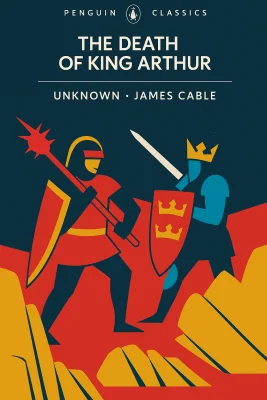
The Death of King Arthur
Categories
Fiction, Classics, Historical Fiction, Poetry, Fantasy, Literature, Mythology, France, Medieval, Arthurian
Content Type
Book
Binding
Paperback
Year
2004
Publisher
Penguin Classics
Language
English
ASIN
B0DLT2LW32
File Download
PDF | EPUB
The Death of King Arthur Plot Summary
Introduction
The wind howled across Salisbury Plain as two armies faced each other in the grey dawn, father against son, king against usurper. Arthur gripped Excalibur with hands that had once lifted Mordred as a child, while across the battlefield, his bastard son raised a stolen crown in defiance. Between them lay the corpses of the Round Table's finest knights, men who had died for love, honor, and a kingdom now bleeding to death. This is not the Arthur of legend you know. This is the final act of Camelot, where the greatest knight in the world loves another man's wife, where friendship curdles into vengeance, and where the price of passion is paid in blood. Lancelot and Guinevere's adultery has set in motion a chain of betrayals that will destroy everything Arthur built. The Round Table, that symbol of perfect chivalry, will splinter under the weight of human desire and divine judgment.
Chapter 1: The Adulterous Love: Lancelot and Guinevere's Fatal Affair
Lancelot returned from the Holy Grail quest a changed man, purified by divine vision and sworn to chastity. The transformation lasted exactly one month. The moment he set eyes on Queen Guinevere again, all his holy resolutions crumbled like sand before the tide. By winter's end, they were lovers once more, but with a recklessness that would have horrified their younger selves. Agravain, Gawain's brother and a man who nursed grudges like fine wine, watched them with predatory patience. Where once their stolen glances had been subtle as whispers, now they burned like beacons in the night. Guinevere, at fifty, remained the most beautiful woman in Arthur's realm, and Lancelot, the greatest knight alive, could no more resist her than a moth could flee flame. The queen's beauty had become legend, men said she was the fountain of all earthly loveliness. But Agravain saw only opportunity in that beauty. He had always hated Lancelot, envied his prowess, his honor, his place at Arthur's right hand. Now he had found the weapon that would destroy them all. One winter evening, as snow fell on Camelot's towers, Agravain approached the king. Arthur sat alone by his fire, an old man of ninety-two winters, white-bearded and weary. When his nephew whispered poison in his ear, telling him of Lancelot's treachery with the queen, Arthur's first reaction was disbelief. Not Lancelot. Never Lancelot. The man who had saved his kingdom a dozen times over, who had been like a son to him. But seeds of doubt, once planted, grow in darkness. Arthur gave Agravain permission to set his trap, though his heart broke with every word. The stage was set for the final act of Camelot's glory. Love had made Lancelot careless, and carelessness would make him prey.
Chapter 2: Tournaments and Jealousy: The Girl of Escalot and the Queen's Wrath
The tournament at Winchester blazed with pageantry, but Lancelot did not ride with Arthur's knights. Instead, he came in disguise, bearing a maiden's silk sleeve on his helmet like a lovesick boy. The crowds gasped as the mysterious knight in red scattered champions like wheat before the scythe, but none more so than Queen Guinevere, watching from the royal pavilion. The maiden of Escalot had given him the token—a beautiful girl barely past her sixteenth year, daughter to a minor lord who had sheltered Lancelot when he traveled in secret. She had begged him to wear her favor, and Lancelot, courteous to a fault, could not refuse such innocence. It was meant to be nothing more than chivalrous kindness. It became the spark that lit Camelot's funeral pyre. Guinevere's jealousy was a cold, killing thing. When Gawain confirmed that the victorious knight was indeed Lancelot, she felt the world tilt beneath her feet. For years she had held his heart as completely as he held hers. Now she imagined him in another's arms, whispering the same sweet lies he had whispered to her. The thought was agony sharper than any blade. When Lancelot finally returned to court, wounded from his victory, he found the queen transformed into a stranger of ice and venom. She forbade him her presence, commanded that he never darken her chambers again. Lancelot, who had faced dragons and armies without flinching, crumpled before her fury like a child. He tried to explain, to tell her of his innocence, but she would not hear him. The maiden of Escalot never learned that her gift of love had been returned with hatred. She died of a broken heart soon after, floating down the Thames on a funeral barge with a letter clutched in her dead hands. When they found her body, the note told the truth—that Lancelot had refused her love entirely, remaining faithful to another. But by then, the damage was done. Love and jealousy had already set the wheels of destruction spinning.
Chapter 3: Treachery Revealed: The Lovers Exposed and the Kingdom Divided
Arthur had grown suspicious since Agravain's whispered accusations, but he lacked the stomach for certainty. It was easier to doubt than to know for sure that his dearest friend had betrayed him with his beloved wife. But Agravain was patient as a spider, weaving his web of surveillance and preparing his trap. The moment came when Arthur announced a hunt, commanding all his knights to attend—except Lancelot. The greatest knight begged off with claims of illness, though he seemed hale enough to those who watched him carefully. As soon as the king's party disappeared into the forest, a messenger arrived at Lancelot's chambers with the queen's summons. Guinevere's fury had burned itself out, replaced by the deeper fire of desperate love. Months of separation had only proven to her that life without Lancelot was no life at all. When he came to her chambers that night, she fell into his arms like a woman drowning, and for a precious hour they were simply lovers again, the weight of kingship and queenship forgotten. The pounding on the door began just after midnight. Agravain's voice, thick with triumph, demanded entry in the king's name. Lancelot had come unarmed, trusting in secrecy, but he was still the greatest knight alive. When the door splintered open, he killed the first man through it with his bare hands, then fought his way to freedom in borrowed armor torn from the corpse. In the morning, Arthur found his queen cowering in her chambers and his nephew Agravain's accusations proven true. The old king aged ten years in a single moment, his white beard trembling as he pronounced the sentence that law demanded. Guinevere would burn at the stake for adultery and treason. The Round Table, that perfect circle of brotherhood and honor, lay shattered beyond all hope of repair.
Chapter 4: The War of Kinsmen: Arthur, Gawain, and Lancelot's Tragic Conflict
The execution pyre blazed in Camelot's great field, but Guinevere never felt its flames. Lancelot came for her with thirty knights at his back, and what followed was not rescue but slaughter. In the desperate melee, as steel rang against steel and good men died for love and loyalty, the greatest tragedy of all unfolded. Gaheriet, Gawain's beloved brother, fell beneath Lancelot's sword. The greatest knight in the world, fighting to save his lady's life, never saw the young man's face beneath the helm. It was an accident of war, a moment's blindness in the chaos of battle, but it sealed all their fates. Gawain, who had loved Lancelot like a brother, now hated him with the pure, white heat of grief transformed to rage. Arthur, swayed by Gawain's fury and bound by his own wounded pride, declared war on Lancelot and his kin. The papal legate forced him to take Guinevere back—she was queen by God's grace, whatever her sins—but the war would continue. Lancelot must pay for the blood he had spilled, the honor he had stained. At the castle of Joyous Guard, Lancelot made his final plea for peace. He offered everything—exile, penance, even to become Gawain's liege man and serve ten years barefoot as a penitent. Gawain refused it all. Nothing would satisfy his grief but Lancelot's death, preferably at his own hands. Love had curdled into hatred, fellowship into enmity. When Arthur's army besieged the castle, Lancelot fought with a heavy heart, pulling his blows when he faced the king himself, letting Arthur live when he could have ended it all. Even now, even with everything broken between them, he could not raise his hand against the man who had been like a father to him. But Gawain's hatred was relentless as winter, and it would drive them all across the sea to their final doom.
Chapter 5: Mordred's Usurpation: The Betrayal of the Throne
Arthur's greatest mistake was leaving Mordred in charge of England. The young knight—Arthur's bastard son by his sister Morgana, though few knew the truth of his parentage—had always been hungry for power. With the king safely across the Channel, besieging Lancelot in Gaul, Mordred saw his chance and seized it with both hands. The false letter bore Arthur's forged seal and told of disaster: the king was dead, struck down by Lancelot's treacherous blade, his army slaughtered to the last man. Mordred, weeping crocodile tears, presented the document to the assembled barons and begged them to crown him king to save the realm from chaos. They believed him, these lords who had known Arthur for decades, because the alternative was civil war and they were tired of fighting. But Mordred wanted more than just the crown. He wanted Guinevere as well, to legitimize his claim and satisfy his lust. The queen, trapped in London and believing herself truly widowed, found herself pressed to marry her supposed stepson. When she refused, Mordred showed his true colors, besieging her in the Tower of London with all the cruelty of a man who had tasted power and found it sweet. Guinevere's desperate message reached Arthur just as he was winning his war against the Romans in Gaul. The aging king read of his realm's betrayal and felt his heart break anew. Not content with destroying his marriage and his fellowship, fate now demanded that he fight his own son for his birthright. The circle was closing, the prophecies coming true, and Arthur knew with cold certainty that this final battle would be his last. Gawain, dying of wounds taken in the Roman campaign, tried one last time to make peace. He begged Arthur to recall Lancelot, to heal the breach that his own hatred had opened. But Arthur, proud and wounded, refused. He would face Mordred with what strength remained to him, and God would judge between them. The stage was set for the final tragedy, and there would be no reprieve.
Chapter 6: The Final Battle: Salisbury Plain and the Death of Kings
Salisbury Plain stretched grey and barren under a pewter sky, a fitting stage for the death of Arthur's dream. The aging king, bent with years and sorrow, led what remained of the Round Table against his own bastard son. Mordred's army was larger, swollen with Saxon mercenaries and ambitious lords who saw opportunity in chaos, but Arthur's men were veterans hardened by decades of war. The battle began at dawn and raged until darkness fell. Knights who had once shared bread at the Round Table now carved each other apart with grim efficiency. Sir Gawain's prophecies proved true—this would be the battle to orphan the kingdom of Logres. By afternoon, the field was carpeted with corpses, and the survivors could barely lift their swords. As the sun set blood-red through the smoke of burning, only Arthur and Mordred remained standing among their fallen armies. The king, though past ninety, fought with desperate fury, while his son met him blow for blow with a younger man's strength. When they finally closed, it was with the inevitability of tragedy. Arthur's spear took Mordred through the body, pinning him to the earth, but the dying prince summoned strength for one last stroke, splitting his father's skull with a blow that would prove mortal. Father and son fell together in the gathering darkness, surrounded by the dead flowers of Camelot's chivalry. Lucan the Butler and Girflet alone survived to help their wounded king from the field, carrying him to the Black Chapel by the sea. There Arthur spent his final night in prayer, while outside the waves whispered against the shore like voices of the dead calling him home. When morning came, mysterious ladies arrived in a black barge to carry Arthur across the water to Avalon, there to sleep until England's greatest need should wake him. Girflet watched the boat disappear into the mist, then found his king's tomb already prepared, its inscription carved by prophetic hands: "Here lies Arthur, who through his valor conquered twelve kingdoms." The once and future king was dead, and with him died the dream of perfect knighthood.
Chapter 7: Aftermath: Lancelot's Return and Final Penitence
News of Arthur's death reached Lancelot like a sword through the heart. The greatest knight in Christendom, living in exile across the Channel, learned that his king had died calling not for him but for enemies to stand at his side. Love had driven them apart, pride had kept them so, and now there would never be forgiveness in this world. Lancelot returned to England with fire and sword, hunting down Mordred's surviving sons with relentless fury. It was not conquest he sought but penance, written in the blood of traitors. When the last of the usurper's line lay dead, he rode alone into the forests of his youth, seeking something he could not name. He found it at a hermitage lost in the greenwood, where the Archbishop of Canterbury and his cousin Bleobleeris had retreated from a world grown too cruel for gentle souls. There, in a chapel smaller than Camelot's stables, Lancelot laid down his sword forever and took up the cross. The greatest knight became the humblest priest, spending his days in prayer and penance. For four years he lived thus, fasting until his body was little more than bone and sinew, his famous beauty worn away by grief and holiness. When death finally came, it was with a vision of angels bearing his soul to heaven, witnessed by his fellow hermits in a dream of blazing glory. They buried him beside Galahad in the tomb he had requested, at the castle he had once won for love's sake. Queen Guinevere had preceded him to the grave by mere days, having spent her final years as a nun, praying for the souls of all the men who had died for her beauty. She never saw Lancelot again after that terrible parting at Joyous Guard, but legend says she knew the moment of his passing, and smiled in her sleep before joining him in whatever peace awaits lovers beyond the grave.
Summary
Thus ended the dream of Camelot, not in glory but in the bitter ashes of human failure. Arthur's kingdom, built on ideals of perfect chivalry and noble fellowship, crumbled because its champions were not angels but men, prey to love and jealousy, pride and rage. The Round Table shattered not from external enemies but from the contradictions within its own heart. Yet perhaps there was grace even in the ending. Lancelot found redemption in humility, Gawain in forgiveness, Arthur in sacrifice. The kingdom they built and destroyed together became legend, a story told by firelight of what might be possible when flawed humans dare to dream of perfection. Their failure was complete, but their aspiration eternal. In reaching for Heaven, they at least proved that earth-bound souls could look beyond the mud and see the stars.
Best Quote
Review Summary
Strengths: The review highlights the book's mystical elements and the engaging portrayal of Arthurian legends, noting the well-described chivalric battles and the inclusion of intriguing characters like Boores and Morgana. The narrative's ability to evoke various adaptations of the legend is also appreciated. Weaknesses: The reviewer criticizes the prolonged deception and the soap opera-like plot mechanics, which detract from the story's appeal. The constant emergence of new conflicts and abrupt character changes make the narrative difficult to follow, potentially requiring a re-read to fully grasp the details. Overall: The reader finds the book worthwhile but advises patience with its unexpected twists, which may cause fatigue rather than surprise. The sentiment is lukewarm, suggesting the book is not bad but challenging to enjoy fully.
About Author

Unknown
"Unknown" reframes our understanding of literary legacy by infusing anonymous authorship with profound impact. Their works, such as "Beowulf" and "The Song of Roland," address the universal themes of heroism and cultural values, while their stylistic mastery of alliteration and narrative cadence enhances the storytelling experience. Whereas many authors seek personal recognition, "Unknown" demonstrates that anonymity can amplify a work's influence over time, as their narratives have inspired scholars and storytellers for generations.\n\nThe mysterious nature of "Unknown" allows readers to engage with the texts free from preconceived notions about the author, thereby prioritizing the content itself. This approach underscores the timeless relevance of the themes explored, such as the moral dichotomy between good and evil and the ideals of chivalry and loyalty. Through vivid imagery and engaging narratives, the works attributed to this elusive figure captivate audiences, making them essential readings for anyone interested in the evolution of epic poetry.\n\nFor those delving into literary studies, the significance of "Unknown's" contributions cannot be overstated. The anonymity offers a unique lens through which to explore cultural and historical contexts, enhancing our appreciation of these epic narratives. This bio highlights the transformative power of storytelling that transcends the author, allowing readers to connect deeply with the human experience captured in these timeless works.
Read moreDownload PDF & EPUB
To save this Black List summary for later, download the free PDF and EPUB. You can print it out, or read offline at your convenience.

The Death of King Arthur
by Unknown
