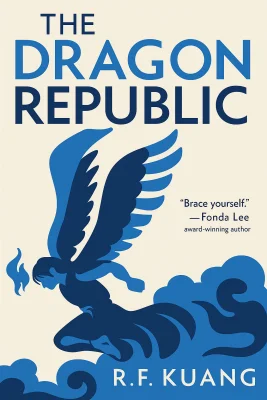
The Dragon Republic
Categories
Fiction, Audiobook, Historical Fiction, Young Adult, Fantasy, Adult, Historical, War, Magic, High Fantasy
Content Type
Book
Binding
Hardcover
Year
2019
Publisher
Harper Voyager
Language
English
ASIN
0062662635
ISBN
0062662635
ISBN13
9780062662637
File Download
PDF | EPUB
The Dragon Republic Plot Summary
Introduction
# Phoenix Rising: From Weapon to Revolutionary The opium coursed through Rin's veins like liquid fire, but it could not drown the screams that echoed in her mind. Chained and muzzled in the grand hall of the Autumn Palace, the last Speerly sat powerless before the twelve Warlords of Nikara. The Phoenix that had once incinerated an entire island now lay buried beneath layers of narcotic numbness, its divine fury reduced to whispers in her fractured consciousness. Eight months had passed since she unleashed genocide upon the Federation of Mugen, ending the Third Poppy War in a holocaust of flame. Yet victory tasted like ash. The Empire she had fought to save was crumbling from within, its provinces squabbling over scraps while their people starved. Empress Su Daji, who had once welcomed Federation occupation, now ruled over a council that could barely agree on grain distribution. And in the southern waters, Dragon Warlord Yin Vaisra was gathering his fleet for a war that would either birth a republic or drown the nation in blood. The question haunting every soul in that palace was simple: in a world where gods walked among mortals and power corrupted absolutely, who truly deserved to rule?
Chapter 1: The Broken Speerly: Addiction and the Loss of Power
The wine cellar beneath Adlaga's magistrate building reeked of desperation and stale opium. Rin huddled in the shadows, her hands trembling as she fought the withdrawal that clawed at her sanity. Three months working for the pirate queen Moag had reduced the legendary Cike to common assassins, trading kills for supplies in a war that seemed to have no end. Yang Yuanfu would die today. The incorruptible magistrate who refused to let Moag's opium flow through his city had signed his own death warrant with his integrity. Rin watched through the grimy window as crowds gathered for the victory celebration, their laughter a mockery of the screaming ghosts that haunted her dreams. The Phoenix stirred restlessly in her mind, feeding on her anguish like a parasite. Each time she reached for its power, the god demanded payment in blood and sanity. The opium that dulled the connection was both salvation and damnation, leaving her weak when she needed strength most. Then she saw the crimson palanquin cutting through the crowd like a blade through silk. Empress Su Daji had come to Adlaga herself, carried like a bride to her own funeral. The woman who had sold the Cike to Federation scientists sat mere yards away, close enough to kill. Fire erupted from Rin's hands without conscious thought, wild and uncontrolled. The celebration became a stampede as flames scattered the crowd in screaming panic. Imperial guards rushed toward her, but they might as well have charged into a furnace. Through the smoke and chaos, she glimpsed Daji's palanquin disappearing into the maze of streets. The Empress had escaped, but their eyes had met across the burning square. The hunt had begun.
Chapter 2: The Dragon's Gambit: Seduction of Republican Dreams
The Seagrim rose from the ocean like a steel leviathan, its paddle wheels churning the waters of Omonod Bay. Rin awoke in chains aboard the massive Hesperian warship, her head pounding from the gas that had rendered the Cike unconscious. But her captors wore familiar colors—the blue and silver of the Dragon Province. Nezha Yin stood before her like a ghost made flesh, half his face bearing geometric scars from Federation torture. The boy she had watched die at Khurdalain was alive, transformed by suffering into something harder and more dangerous. His pale eyes held no warmth as he explained their capture with clinical precision. Dragon Warlord Vaisra received her in his opulent cabin, every inch the aristocrat despite his military bearing. His proposal struck like a physical blow—join his revolution against the Empire, help establish a republic built on democratic principles rather than the corrupt system of provincial warlords that had failed so spectacularly. "The Empire is already crumbling," Vaisra declared, his conviction burning like cold fire. "The Poppy Wars have exposed every weakness in our system. I offer something better—a government of elected officials, a parliament answerable to the people rather than gods and tyrants." Rin laughed bitterly at the audacity. One province against eleven, a warlord preaching democracy while holding her prisoner. But Moag had betrayed them, the Empire wanted them dead, and Vaisra offered the only path to Daji's throat. The choice felt like no choice at all. As she agreed to his terms, watching the Red Cliffs of Arlong rise from the sea like a fortress of living coral, Rin couldn't shake the feeling that she was trading one master for another. The Phoenix whispered warnings in her mind, but she had learned to distrust the god's counsel. Some cages, after all, were more comfortable than others.
Chapter 3: War's True Face: The Brutality of Liberation
The Autumn Palace at Lusan gleamed like a jewel against the northern mountains, its golden walls unmarked by war's devastation. Rin entered in chains, playing the role of Vaisra's captured prize while opium dulled her supernatural senses. The warlords' council devolved into petty squabbling over refugees and resources, revealing fractures that ran deeper than anyone admitted. Empress Daji led her to a private garden that served as a monument to contradiction—half preserved in pristine beauty, half left as Hesperian ruins from seventy years past. "A reminder," Daji explained with genuine pain in her voice, "of what happens when we trust foreigners." The confrontation Rin had dreamed of became a nightmare of revelation. Daji spoke of calculated sacrifice and necessary betrayals, of an Empire that could only be saved through collaboration with its enemies. When Rin finally attacked with a rusted rake, Daji moved like smoke, her silver needles finding flesh with surgical precision. Then came the true horror. Daji's eyes became twin suns, pulling Rin into the spiritual realm where the serpent goddess Nüwa waited. In that place of primordial darkness, illusions bloomed like poisonous flowers—visions of Speer Island restored, of Altan alive and reaching for her with desperate love. But Chaghan's psychic intervention shattered the spell, and Ramsa's explosives brought down half the palace in their wake. They escaped through underground waterways as Lusan burned behind them, but the damage was done. War had begun in earnest, and Rin carried with her a spiritual poison that would slowly devour her memories and power. Daji had marked her prey, and the hunt would continue until one of them lay dead.
Chapter 4: Colonial Chains: Foreign Masters in Victory's Shadow
Arlong rose from the sea like a fortress carved from living coral, its red cliffs scarred with ancient warnings that nothing lasts forever. Here, Vaisra had built his revolution in secret, constructing a fleet that rivaled the Empire's combined naval power. But victory came with a price that grew steeper with each passing day. The Hesperians descended from the sky in metal whales, their flying vessels defying every law of nature. As the pale foreigners disembarked with their impossible weapons and clinical detachment, Rin felt the weight of their judgment like a physical force. These were not allies but evaluators, determining whether the Nikara deserved to exist. Sister Petra's laboratory became a chamber of horrors disguised as scientific inquiry. The Gray Company missionary spoke of Chaos and divine architecture while her instruments probed every inch of Rin's body. Each measurement was catalogued, each humiliation justified by theories of racial evolution that painted the Nikara as lesser beings in need of guidance. The detoxification nearly killed her. Days of hallucinations and seizures wracked her body as Vaisra cut off her opium supply with ruthless efficiency. But Suni stayed with her through the worst of it, telling stories of ancient heroes while she vomited blood on the deck. Slowly, painfully, she emerged from the chemical fog with her mind intact. The Phoenix still whispered, but now she could answer back. For the first time since Speer, she felt truly in control of her power. But that control came with the bitter knowledge that she was still a weapon, still a tool to be wielded by those who claimed to know better. The Republic's democratic ideals rang hollow when enforced by foreign guns and justified by theories of racial superiority.
Chapter 5: The Serpent's Kiss: Betrayal at the Hour of Triumph
The wine tasted of victory and promises, but beneath the sweetness lay the bitter tang of betrayal. Rin sat with Nezha on the palace tower, watching funeral pyres drift out to sea like burning stars. The war was over, the Empire defeated, and for the first time in years, she allowed herself to believe in peace. They spoke of the future with careless optimism, painting dreams across the darkness like children drawing with chalk. A democratic Nikara, free from tyranny and want. A world where power served the people rather than consuming them. Nezha's hand was warm in hers as they shared the bottle, his smile genuine in the moonlight. But even as they laughed and planned, the trap was closing. The wine was drugged, the friendship poisoned, and the boy she had loved since childhood had already chosen his side. When the knife slid between her ribs, Rin felt something more than physical pain—she felt the death of innocence, the final severing of bonds that had once seemed unbreakable. "I'm sorry," Nezha whispered as her blood stained his hands. "I'm so sorry." His sorrow was meaningless against the cold calculation in his eyes. He was his father's son, heir to the Dragon Province and all its power. She had been naive to think that friendship could compete with dynasty, that love could triumph over politics. The capture was swift and efficient—Hesperian soldiers filled the room like pale ghosts, binding her with chains that burned against her skin. As consciousness faded, Rin caught a glimpse of Nezha's face frozen in the doorway, his hands still stained with her blood. In his eyes she saw not hatred but something far worse—pity. The Phoenix raged within her, demanding vengeance, but the chains held and the drugs flowed. Her world crumbled into ash and betrayal.
Chapter 6: Breaking Free: Escape from Golden Cages
The palace dungeon was a cage of stone and sorrow, but it could not hold a god forever. Rin lay in darkness, feeling the Phoenix's fire pulse weakly against Hesperian chains, when familiar pain burned across her arm. Kitay was calling to her, carving messages into his own flesh that appeared on hers like ghostly scars. The rescue came at the darkest hour. Kitay descended from her window like a spider, his face grim with determination and love. Lock picks moved with surgical precision in his hands, but when they reached her shattered hand trapped in the manacle, there was only one solution. His boot came down on her fingers with sickening force. The pain was transcendent, burning away everything but the will to survive. Bones cracked, flesh tore, but the manacle opened and she was free. They fled through the palace like shadows, past the execution ground where Baji and Suni lay broken and still, their blood dark on the stones. Ramsa's sacrifice lit up the night like a fallen star. The boy who had loved explosions more than life went out in a blaze of glory, his bombs turning the courtyard into a crater of fire and smoke. His laughter echoed through the flames even as bullets tore him apart, defiant to the very end. Venka waited at the harbor with a stolen boat and Hesperian uniform, her archer's eyes bright with rebellion. The escape was a blur of dark water and desperate rowing, but behind them Arlong burned. The refugee camps had risen when news of the arrests spread, and Vaisra's troops were putting down the rebellion with clinical efficiency. As they reached the Red Junk ships waiting in the harbor, Rin looked back at the city that had been her prison and salvation. Nezha stood alone on the dock, watching them go. He made no move to raise the alarm, offered no pursuit. In the end, he simply let her leave, as if their shared past meant nothing at all.
Chapter 7: Southern Fire: Birth of a People's Revolution
The southern provinces burned with more than Hesperian fire—they burned with rage. Rin stood on the deck of Moag's flagship, watching smoke rise from a dozen coastal cities, and felt the Phoenix sing with approval. This was what the god had always wanted: not careful politics but the raw fury of the oppressed finally unleashed. Gurubai bore the scars of his own escape from Vaisra's purge. The Monkey Warlord's weathered face was grim as he laid out the scope of betrayal—the Southern Warlords dead or imprisoned, their troops scattered, their people left to face occupation alone. But from that desperation, something new was being born. "They see you as their salvation," he told Rin as they sailed toward refugee camps that dotted the southern coast. "The Speerly who burned the Federation fleet. The Phoenix Warrior who brought down gods. They've been waiting for you to come home." Home. The word felt strange on her tongue. Rin had spent so long trying to escape her origins, to become something more than a mud-skinned peasant from Rooster Province. But now, looking at the faces of her people—scarred by war, hardened by suffering, but unbroken in their defiance—she understood what she had always been meant to be. The refugee camps welcomed her like a returning goddess. Thousands of voices rose in acclamation as she walked among them, her ruined hand hidden beneath a glove, her face set in the mask of leadership she was still learning to wear. These were not soldiers but farmers and fishermen, shopkeepers and servants. They had survived Federation brutality and Republican betrayal, and that made them stronger than any army. Kitay worked beside her, his brilliant mind calculating supply lines and recruitment strategies. Venka trained the first volunteers, teaching them to fight with whatever weapons they could find. Slowly, carefully, they began building something that had never existed before—a true people's army, bound not by loyalty to lords or provinces but by shared suffering and common cause. The Phoenix whispered of battles to come, of cities that would burn and enemies that would fall. Rin listened to its promises and felt no fear, only anticipation.
Summary
In the ashes of victory, Fang Runin discovered that the greatest enemies had worn the masks of allies all along. The Republic she had bled for was revealed as a Hesperian puppet state, and the boy she had loved became the architect of her downfall. But from betrayal came clarity, and from chains came the terrible freedom to choose her own path. No longer would she be anyone's weapon—not Vaisra's, not the Empire's, not even the Phoenix's. She would be the fire that burned away the old world's lies. The true war was not between Empire and Republic, but between those who would rule and those who refused to kneel. In the refugee camps of the south, among the dispossessed and forgotten, Rin found her true army. They were not soldiers trained in academies or bound by oaths of loyalty—they were the people themselves, risen at last to claim what had always been theirs. The Phoenix sang in her veins as she looked toward the north, toward the palaces and towers where her enemies waited in their golden cages. Let them come with their dirigibles and guns, their treaties and chains. She would show them what it meant to cage a god, and in the burning of their world, forge something new and terrible and free.
Best Quote
“Fire and water looked so lovely together. It was a pity they destroyed each other by nature.” ― R.F. Kuang, The Dragon Republic
Review Summary
Strengths: The book is praised for introducing real-world historical events to a new audience, potentially enlightening readers about Chinese Revolutions. Weaknesses: The narrative is criticized for lacking originality and being predictable for those familiar with Chinese history. The dialogue is described as immature, and the characters are largely seen as morally reprehensible, making it difficult for readers to empathize with them. The reviewer also questions the book's classification as fantasy, suggesting it fits better as historical fiction with mythological elements. Overall: The reviewer holds an unpopular opinion, expressing disappointment with the book's predictability and character development. They suggest it may not meet the expectations of those seeking original fantasy narratives.
About Author

R.F. Kuang
Kuang reframes the landscape of contemporary fantasy and science fiction literature by weaving historical richness into her imaginative storytelling. Her books, such as "The Poppy War" trilogy and "Babel: An Arcane History", exemplify her ability to merge historical authenticity with speculative fiction, crafting narratives that delve into themes of power, colonialism, and identity. This approach not only highlights her fascination with the stories people tell about historical events but also reflects her belief in literary history's ability to transcend the confines of military history. \n\nHer literary journey, while impressive, is rooted in a profound connection to her family's history, notably her father's involvement in the 1989 Tiananmen Square protests. This personal connection drives her to explore complex socio-political themes through fiction. Meanwhile, Kuang's rigorous academic background, including degrees from Georgetown, Cambridge, and Oxford, and her ongoing PhD studies at Yale, provide a solid foundation for her storytelling. These experiences enrich her narratives, making them relatable to readers interested in a blend of fantasy with historical depth.\n\nRecognized with prestigious accolades like the Nebula and Locus Awards, Kuang's impact on the literary world is undeniable. Her work's resonance extends to a broad audience, appealing to those who appreciate narratives that challenge conventional perspectives. As an author, Kuang has captured the imagination of readers worldwide, her books achieving bestseller status on both the "New York Times" and "Sunday Times" lists. This bio highlights not only her literary achievements but also her ongoing contribution to the fields of fantasy and historical fiction.
Read moreDownload PDF & EPUB
To save this Black List summary for later, download the free PDF and EPUB. You can print it out, or read offline at your convenience.
The Dragon Republic
by R.F. Kuang
