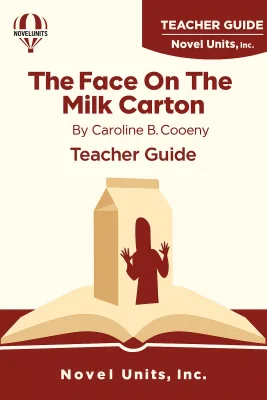
The Face On The Milk Carton By Caroline B. Cooney
Teacher Guide
Categories
Content Type
Book
Binding
Paperback
Year
2019
Publisher
Novel Units, Inc.
Language
English
ISBN13
9781561377299
File Download
PDF | EPUB
The Face On The Milk Carton By Caroline B. Cooney Plot Summary
Introduction
Fifteen-year-old Janie Johnson sits in the high school cafeteria, reaching for her friend's milk carton when her world implodes. The face staring back at her from the missing child advertisement is her own—taken twelve years ago from a New Jersey shopping center. The polka-dotted dress, the pigtails, even the uncertain smile belong to someone called Jennie Spring, a three-year-old who vanished without a trace. What begins as a moment of startled recognition becomes a devastating journey into fractured memory and impossible choices. Janie's loving parents, Frank and Miranda Johnson, have given her everything—a stable home, endless affection, and the kind of suburban normalcy most teenagers take for granted. But as fragments of another life surface like shards of broken glass, she must confront an unbearable question: how do you reconcile loving the family who raised you with the growing certainty that they might not legally be yours? In a world where milk cartons carry the faces of stolen children, sometimes the most dangerous discovery is learning who you really are.
Chapter 1: The Face on the Carton: A Disturbing Discovery
The cafeteria buzzes with typical teenage chaos when Janie Johnson grabs Sarah-Charlotte's milk carton and takes a long, satisfying gulp. She's been avoiding dairy for months due to lactose intolerance, but the peanut butter sandwich demands milk as its natural companion. The moment should be ordinary, forgettable even—just another small rebellion against dietary restrictions. But when she sets the carton down, the little girl on the back panel stops her cold. The missing child advertisement shows a three-year-old in a white dress with tiny dark polka dots, red hair pulled into tight pigtails framing thin cheeks. Something evil and thick settles over Janie, blocking her throat and dimming her vision. "It's me on there," she whispers to her friends, her voice flat as if she'd ironed it. The words hang in the air like smoke from a distant fire, impossible and undeniable. She remembers that dress, how the collar itched against her neck, how the summer fabric let the wind blow through it, how those braids swung like red silk against her cheeks. Her friends laugh it off—Sarah-Charlotte accuses her of trying to get out of reading her essay aloud, Pete jokes about her being stolen from a New Jersey shopping center. But their dismissive chatter fades into background noise as Janie stares at the photograph of Jennie Spring, taken at age three from a shopping mall twelve years ago. The details etched beneath the image might as well be written in fire. The bell rings, and her friends race back to class, leaving their garbage scattered across the table. Janie remains frozen, clutching the empty carton like evidence of a crime she can't quite name. The little girl's face seems to watch her with patient, accusing eyes. For the first time in her fifteen years, Janie Johnson doesn't know who she is.
Chapter 2: Daymares and Denials: Memory Fragments Surface
School becomes a strange, floating place where Janie's body functions without her. She answers questions in biology lab, takes notes, even manages conversations, but her mind spins like a color wheel, blending primary facts into dizzying possibilities. When the spinning slows, things separate into manageable pieces: she has parents who love her, a normal childhood, no memories of being kidnapped. When it speeds up, everything blurs into terrifying uncertainty. The first daymare hits without warning, triggered by ice cream with Reeve, her neighbor and secret crush. Suddenly she's somewhere else entirely—perched on a high swiveling stool at a green Formica counter, tiny feet dangling above a foot rest that's too low for her short legs. A woman with long, straight hair cascading down her back sits beside her, keeping one protective hand behind Janie's back as the child spins in delighted circles. They're sharing sundaes, the woman letting Janie eat the cherries from both dishes. The memory comes complete with sensory details—the whipped cream's sweetness, the woman's gentle laughter, the hot wind in a vast parking lot that might be the biggest in the world. Her white dress with tiny dark dots billows in the air as someone takes her hand, saying, "Let's go for a ride now." Reeve's worried voice pulls her back to the present, but the vision leaves her shaking and cold. These aren't normal daydreams she can control and shape to her liking. They crawl out of her brain like creatures of the dark, carrying fragments of a life she doesn't want to remember. That night, she carefully cuts open the milk carton and clips it inside her English notebook, hiding it behind the cover where only she can see Jennie Spring's patient, waiting face. The 800 number printed below the photograph seems to pulse with possibility and threat. One phone call could shatter everything she believes about her life, but the alternative—living with these erupting memories—might drive her mad.
Chapter 3: Uncovering the Truth: Hannah's Cult and Family Secrets
The confrontation comes when Janie can no longer bear the weight of her questions. Demanding to see her birth certificate triggers something desperate in her parents' eyes—a flicker of panic that confirms her worst suspicions. When she presses them about the absence of baby photos, about why there are no pictures of her until age five, their careful composure finally cracks. The story emerges in fragments, each revelation more devastating than the last. Frank and Miranda Johnson—whose real name is Javensen—had a daughter named Hannah, beautiful and haunting, who worried constantly about the inequities of the world. While her parents could volunteer for causes and return home satisfied, Hannah never felt she deserved dinner when others starved. The Hare Krishna movement offered her what she desperately needed: answers to life's cruelties and rules to purify her existence. At sixteen, Hannah fell to her knees and begged to join the cult. She disappeared into their California commune, becoming a dulled, mechanical version of herself who spoke only in memorized responses. Years passed with rare visits and rarer letters, until Hannah was matched with a man chosen by their Leader and vanished completely into that strange, enclosed world. Then one day, the impossible happened. Hannah appeared at their door, holding a three-year-old girl by the hand. She had escaped, bringing her daughter to safety, terrified that cult guards might find them through the windows. The little girl—Janie—had no clothes except what she wore, and Hannah spoke of other children she'd left behind, asking constantly about the twins in high chairs at some distant day care. But Hannah's addiction to the cult proved stronger than maternal love or family bonds. She wanted to return, to surrender again to the Leader's absolute control. In an act that would haunt them forever, Frank and Miranda let her go—but kept the child. Hannah asked them to raise Janie, gave her the only gift she had to give: freedom from the cult's poisonous influence. As Janie listens to this terrible, beautiful story, she feels something settle in her chest like peace after a long war. These are her parents, the ones who chose to love her, who built their entire lives around protecting her from the truth that could destroy them all.
Chapter 4: Journey to New Jersey: Confronting Another Life
Unable to resist the pull of her buried past, Janie convinces Reeve to skip school and drive to New Jersey. The journey stretches for hours through unfamiliar highways while her mind churns with possibilities she doesn't want to face. Reeve, struggling with his own fears about the future, tries to talk her out of this quest, but Janie feels compelled forward by forces beyond her control. The address from the phone book leads them to a comfortable suburban development—split-levels with bay windows and neat shrubs, the kind of neighborhood where you could predict what happens next and feel safe. When the school bus arrives, two red-headed boys jump out and head toward 114 Highview Avenue. A woman with hair the same color as Janie's opens the bright red door to welcome them home. From another bus comes a tall, skinny teenager with enormous sneakers tied to his backpack. He vaults over hedges and touches tree branches with the casual athleticism of youth, his red hair catching the afternoon light. As he disappears through that same front door, Janie feels the earth shift beneath her feet. This boy carries himself with an easy confidence that speaks of belonging, of never doubting his place in the world. The family she glimpses from the Jeep window represents everything she walked away from at age three—brothers who share her coloring, parents who spent twelve years wondering if their stolen daughter was alive or dead. Reeve tries to comfort her as they sit in the car, both understanding that they're witnessing a parallel life, the one Janie might have lived if not for Hannah's desperate flight from the cult. The drive home passes in uncomfortable silence, heavy with the weight of discovery. Reeve suggests they could still turn back, could pretend this trip never happened, but Janie knows the damage is done. She's seen the faces that share her features, felt the pull of blood calling to blood across the years. The little girl who traded one family for an ice cream sundae has finally come face to face with what she left behind.
Chapter 5: Divided Loyalties: The Impossible Choice
Back home, the weight of her double life begins crushing Janie from all directions. Her parents, still reeling from their own confession about Hannah, watch her with desperate eyes, terrified of losing another daughter to forces beyond their control. Every meal becomes a careful dance around dangerous topics, every question about school or friends weighted with unspoken fears about what she might be planning. The daymares intensify, bringing clearer memories of her life before Hannah took her away. She remembers spilling milk in a chaotic kitchen while twins screamed in high chairs, remembers a father with a red mustache who lifted her high in the air while she tugged at the bristles and giggled. Most painfully, she remembers a family blessing they recited at dinner: "Bless this food, bless this house, may all my brood be quiet as a mouse." Her relationship with Reeve becomes both salvation and torment. He's the only one who knows her terrible secret, the only person she can talk to without lying, but even his patience has limits. When she loses herself in New Jersey memories during their moments together, she can see his frustration building. He wants to be enough for her, wants to pull her back from the edge of obsession, but he's fighting ghosts from a past he never lived. The breaking point comes when Janie discovers the polka-dot dress hidden in their attic, stored in a trunk labeled "H" for Hannah. The physical proof of her other identity sends her into a spiral of guilt and confusion. She begins writing letters to the Spring family in a silver spiral notebook, trying to find words that could explain the inexplicable, attempting to craft an apology for a crime she committed as a toddler. School becomes a minefield where every casual question about her background feels like an interrogation. When friends ask about her family history for a class project, or tease her about her unusual reactions to simple topics, Janie feels herself fragmenting into multiple people—the daughter the Johnsons raised, the missing child the Springs mourned, and someone else entirely that she's only beginning to understand.
Chapter 6: The Letter: When Secrets Escape Control
The unraveling begins with a moment of careless desperation. During a particularly difficult week where nightmares rob her of sleep and Reeve's frustration reaches a breaking point, Janie makes a catastrophic mistake. She writes a detailed letter to the Spring family, explaining everything she knows about the kidnapping, Hannah's role in it, and her current situation. In a moment of exhausted confusion, she addresses and seals the envelope, then loses track of it when her notebook's clip breaks. The missing letter sends Janie into a panic that brings Reeve running from his chemistry class to help. They search frantically, knowing that if some well-meaning student found it and added a stamp, or if the post office delivers it with postage due, the Springs will know everything within days. The FBI could be at their door, reporters could descend on their quiet street, and her parents could face criminal charges for harboring a kidnapped child. Reeve calls his sister Lizzie, a law student whose sharp analytical mind cuts through emotional chaos to practical solutions. Lizzie explains that kidnapping is a federal offense with no statute of limitations—like murder, it can be prosecuted no matter how many years pass. If the authorities get involved, they'll have to locate Hannah to prove or disprove their theory about who actually took Janie from that shopping center. The conversation forces Janie to confront the publicity nightmare that could destroy all their lives. She imagines her parents' faces on tabloid covers, their volunteer work and coaching reduced to headlines about child theft. She pictures herself on talk shows discussing her double identity alongside people with bizarre sexual habits, her private agony transformed into public entertainment. When Janie finally confesses everything to her parents, their reaction confirms her worst fears. Her father's hands shake as he talks about SWAT teams surrounding their house, while her mother dissolves into tears, finally understanding the torment that parents of missing children endure. They realize that keeping Janie meant condemning another family to twelve years of wondering, hoping, and grieving for a child who was safe but unreachable. The weight of their shared guilt and love creates an impossible situation where every choice leads to devastation. They can't undo the past, can't give Janie back to the Springs without destroying themselves, yet can't continue living with the knowledge that they've stolen another family's happiness. The letter, whether lost or delivered, has opened a door that can never be closed again.
Chapter 7: Reconciliation: Building Bridges Between Two Families
With Lizzie's legal expertise guiding them, the Johnson family prepares for the inevitable confrontation. They decide that honesty, however painful, offers their only chance of salvaging something from the wreckage. Lizzie will make first contact with the Springs, explaining the situation and attempting to negotiate a meeting that doesn't involve FBI raids or criminal prosecutions. The call comes on a weekend evening when Janie, her parents, Reeve, and Lizzie are huddled together in the living room like survivors of a natural disaster. Her mother, gathering courage from some deep well of maternal strength, dials the New Jersey number while her hands shake with twelve years of suppressed guilt and terror. When she offers the phone to Janie, everything crystallizes into this single moment of truth. "Hello?" says a woman's voice from New Jersey, carrying undertones of hope that never quite died despite years of disappointment. The sound hits Janie like a physical blow, recognition flowering in her chest even though she can't remember this particular voice. Her mother's face crumples as she realizes she's about to deliver news that will shatter another woman's carefully constructed world. Janie takes the phone with numb fingers, understanding that this moment will divide her life forever into before and after. The little girl who wanted attention badly enough to trade families for ice cream is gone. In her place stands someone more complex—a teenager who loves the parents who raised her while acknowledging the ones who lost her. She's no longer Janie Johnson or Jennie Spring but someone entirely new, forged from the collision of two identities. "Hi," she manages to say, her voice barely steady. "It's... your daughter. Me. Jennie." The words hang in the air between Connecticut and New Jersey, between past and present, between the family that found her and the one that lost her. Whatever happens next, Janie knows there's no going back to the simple certainty of belonging to one world or the other. The conversation that follows will reshape three families forever—the Springs who never stopped hoping, the Johnsons who loved fiercely but lived with lies, and Hannah somewhere in the world, still lost in her own way. Janie realizes that some stories don't end happily ever after; they simply continue, complicated and messy and real, carrying forward the weight of choices made by desperate people in impossible circumstances.
Summary
In the end, Janie Johnson's story becomes a meditation on the fluid nature of family and identity. The milk carton that shattered her world also freed her from the burden of unknowing, allowing her to acknowledge all the parents who shaped her life—the Springs who gave her biological existence, Hannah who chose love over obedience to a cult, and Frank and Miranda who transformed from devastated grandparents into devoted parents through the sheer force of their need to protect and nurture. The resolution offers no easy answers, no clean conclusions that erase years of pain and separation. Instead, it acknowledges that some wounds transcend healing while still allowing space for forgiveness and growth. Janie emerges not as a victim of circumstances beyond her control, but as a young woman capable of holding multiple truths simultaneously—that she was taken from one family and given to another, that both acts stemmed from love rather than malice, and that identity is something we choose as much as something we inherit. The face on the milk carton may have started her journey, but it doesn't define where it ends.
Best Quote
Review Summary
Strengths: The book is praised for its engaging and mysterious plot, which captivates readers and keeps them engrossed. The emotional depth and relatability of the protagonist, Janie, are highlighted, making readers empathize with her situation. The story is described as an emotional roller coaster that is hard to put down. Weaknesses: Some reviewers note that the book feels dated for contemporary readers in 2023. Additionally, there is mention of "nasty" content that may not be suitable for younger audiences, specifically those below high school age. One reviewer expressed a lack of interest in continuing with the sequel. Overall: The general sentiment towards "The Face on the Milk Carton" is positive, with strong recommendations for those who enjoy mystery novels. However, potential readers should be aware of its dated elements and mature content.
About Author

Novel Units, Inc.
Novel Units, Inc. situates its educational mission in the development of comprehensive literature teaching guides that aim to enhance student engagement and literacy skills. By focusing on instructional materials rather than original works, the company dedicates its efforts to producing detailed guides that include synopses, lesson plans, and assessments for over 860 titles. This approach reflects a commitment to supporting teachers in delivering differentiated instruction that adapts to various learning needs and promotes immersive experiences with literature.\n\nTheir resources cover a wide range of classic and contemporary books, such as "To Kill a Mockingbird" and "Harry Potter and the Prisoner of Azkaban", offering tools like vocabulary exercises and writing prompts. These materials are carefully crafted to support teachers in integrating literary skills across diverse genres and grade levels, thereby fostering a deeper understanding of literature among students. Unlike a traditional author, Novel Units, Inc. does not possess a distinct literary style but excels in providing educational content designed to cultivate critical thinking and analysis in students.\n\nEducators and students are the primary beneficiaries of Novel Units, Inc.'s work, as the guides serve to streamline lesson planning and encourage active participation in literature discussions. The company has earned a strong reputation for creating adaptable resources widely used in classrooms, even though it does not claim specific awards. By focusing on educational content, Novel Units, Inc. enhances the teaching and learning process, offering a practical and effective alternative to standard literary analysis tools found in typical author bios or books.
Read moreDownload PDF & EPUB
To save this Black List summary for later, download the free PDF and EPUB. You can print it out, or read offline at your convenience.
The Face On The Milk Carton By Caroline B. Cooney
by Novel Units, Inc.
