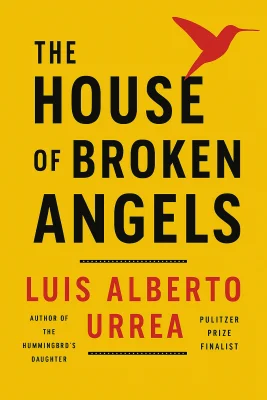
The House of Broken Angels
Categories
Fiction, Audiobook, Historical Fiction, Adult, Family, Book Club, Contemporary, Adult Fiction, Literary Fiction, Latinx
Content Type
Book
Binding
ebook
Year
2018
Publisher
Little, Brown and Company
Language
English
ASIN
B0DWVLWYDT
File Download
PDF | EPUB
The House of Broken Angels Plot Summary
Introduction
The morning sun burned through the California smog as Big Angel de La Cruz struggled to rise from his deathbed. Today was his mother's funeral, and for the first time in his seventy years, the family's human clock was running late. His body, ravaged by cancer, had betrayed him at the worst possible moment. As his wife and daughter wrestled him into his wheelchair, Big Angel's mind blazed with a desperate plan—tomorrow would be his birthday party, his final performance as patriarch of this sprawling Mexican-American clan. But death wouldn't wait for his schedule. The tumors had spread like dark flowers through his organs, his bones were turning to chalk, and every breath felt like swallowing broken glass. Yet Big Angel de La Cruz, the man who had lifted his family from poverty and shame into something resembling the American Dream, refused to exit quietly. He would orchestrate his own farewell, gather his fractured children one last time, and prove that even dying could be done with tremendous style. The question wasn't whether he would survive the weekend—it was whether his family would survive losing him.
Chapter 1: The Patriarch's Final Morning
Big Angel woke to find his father's ghost smoking beside his bed. The old man's cigarette smoke curled against the ceiling as he spoke in smoothly accented English: "That's a lot of weight to carry around. Time to wake up and let it go." Before Big Angel could respond, the apparition dissolved, leaving only the acrid smell of Pall Malls and the terrible realization that they were late to his mother's funeral. His wife Perla sprang into action, shouting for their daughter Minnie, who had spent the night on their couch to ensure punctuality. They lifted Big Angel's skeletal frame from the bed like handling an injured bird. His arms had stopped working properly—he couldn't even tuck in his own shirt. The man who had once commanded respect through sheer force of will now weighed less than a child, his voice reduced to a reedy whisper. As they dressed him in his white shirt and slacks, Big Angel stared at the gallery of ancestor photographs hanging crooked above his mirror. There was his grandfather Don Segundo in his revolutionary sombrero, his grandmother faded brown behind him, and his parents—Father Antonio and Mama America. Three generations of struggle and survival, and now he was about to bury the last link to their Mexican origins. His son Lalo emerged from his garage bedroom in full military dress uniform, every crease sharp, his Purple Heart pinned proudly to his chest. The family's wounded warrior, back from Iraq with a limp and secrets he'd never share, appointed himself head of security for this final mission. Together, they loaded Big Angel into the minivan, a small American flag fluttering from its antenna like a banner of conquered territory.
Chapter 2: Between Two Worlds: Memories of Mexico
As the minivan crawled through traffic toward the funeral home, Big Angel's mind drifted back to La Paz, where his story began. He remembered his father Don Antonio in his police uniform, the massive Harley-Davidson motorcycle that served as their chariot through the dusty streets. Young Angel would cling to his father's back, breathing in cigarette smoke and bay rum, watching people scatter before the approaching law. That was where he first saw Perla—fifteen years old with huge deer eyes, sitting on a suspect's bench after a car wreck. Her skinny gray knees were cut, glass sparkled in her black hair, and she clutched the hand of her younger sister. Angel, barely sixteen himself, offered her his handkerchief, and in that moment of adolescent gallantry, their future was sealed. Don Antonio, recognizing opportunity when he saw it, let the Castro family walk free in exchange for future shrimp tacos. But La Paz couldn't contain their ambitions forever. The revolution was a memory, but its aftermath left families scattered like seeds in the wind. When Angel was seventeen, his aunt's husband—the notorious pirate Chente Bent—sailed into their lives aboard the reeking fishing boat El Guatabampo. They shipped Angel off to Mazatlán as an apprentice, not knowing they were saving him from witnessing their family's spectacular collapse. In Mazatlán, Angel learned that paradise could be hell. Chente Bent was a predator who worked the boy mercilessly by day and visited him by night. The breaking point came when Bent, drunk on rum and entitlement, tried to force himself on Angel one final time. The boy swung a gaff with his eyes closed, felt the sickening crunch of metal meeting skull, and watched his tormentor sink into the oily harbor water. He burned the boat and caught the first bus north, carrying the weight of murder and the ashes of his innocence.
Chapter 3: Crossing Borders and Building Homes
The funeral was a blur of mariachi music and tears, relatives he barely recognized offering condolences in spanglish. Big Angel sat in his wheelchair like a withered king, receiving their homage while calculating how much time he had left. His youngest brother Little Angel had flown in from Seattle—the family's great success story, the college professor who'd escaped their gravitational pull of struggle and drama. They had always been oil and water, these two Angels. Big Angel, who'd fought for every scrap of dignity in America, building a computer career through pure determination. Little Angel, whose white mother had given him advantages that felt like betrayal to those left behind. Yet watching his baby brother now, Big Angel felt an unexpected tenderness. They were both orphans now, the last witnesses to their father's complicated legacy. After the ceremony, they drove to the cemetery where Braulio—Big Angel's beloved stepson—had been buried ten years earlier. Minnie, his daughter, couldn't make it across the lawn without collapsing. The memories were too sharp: Braulio and his cousin Guillermo, cut down in their prime by gangsters' bullets, their blood mixing on a National City sidewalk while their families' hearts broke in unison. As they lowered America's ashes into the ground, Big Angel made his peace with the past. Tomorrow was his birthday party, his final performance as the family patriarch. He'd orchestrated it like a military campaign—mariachis, mountains of food, relatives flying in from across the country. It would be his living wake, his chance to bless and forgive and say goodbye while he still had the strength to make it count.
Chapter 4: The Funeral: Honoring América and Confronting Mortality
The priest at Mama America's service proved to be a fire-and-brimstone zealot who seemed more interested in condemning the living than honoring the dead. His sermon blazed with accusations about absentee family members and threats of eternal damnation. Big Angel, trapped in his wheelchair in the front row, listened with growing irritation as the man turned his mother's farewell into a theological assault. "She gave you nearly one hundred years of motherly sacrifice!" the priest thundered. "Where are the rest of you? Watching television?" His teeth gleamed like a rat's as he sprayed spittle across the mourners, demanding they sacrifice their favorite TV shows for Lent. The absurdity wasn't lost on Big Angel, who muttered to his siblings, "There goes Ice Road Truckers." When the priest finally finished his performance, Big Angel took control. "Now the family will speak for itself," he announced, his reedy voice carrying more authority than the bombast they'd just endured. One by one, his siblings and children rose to offer their own memories—gentle, funny, human tributes that restored dignity to the proceedings. Little Angel watched his brother orchestrate this moment from his wheelchair, marveling at how Big Angel could command respect even in his diminished state. The family's dynamics were shifting like tectonic plates. With America gone and Big Angel dying, who would hold this sprawling clan together? The question hung in the air like incense, unanswered but urgent.
Chapter 5: The Reunion of Angels: Brothers Reconciled
That night, Little Angel found himself sharing his brother's bed—a strange intimacy for men who'd spent decades as polite strangers. Big Angel's bedroom had become command central, stacked with pill bottles and medical equipment, but also with books. His Jesuit friend Dave had given him spiritual texts to speed-read before death: Thomas Merton, Brennan Manning, volumes on trust and salvation that seemed almost mocking given the circumstances. "I told this cabrón I don't have time to read these," Big Angel wheezed, gesturing at the books. "All my life is just three words over and over: today I die." Yet he wasn't morbid—if anything, his approaching death had filled him with manic energy, as if he could outmaneuver mortality through pure force of will. They talked through the night, two middle-aged men processing decades of misunderstanding. Little Angel confessed his lifelong sense of exile from the family, his guilt over the privileges his white mother had afforded him. Big Angel, in turn, revealed the depth of his resentment—how he'd watched his baby brother coast through life while the rest of them scraped and fought for every advantage. The conversation turned dark when Big Angel began confessing his sins. He'd broken into Little Angel's childhood home with their sister, destroying their mother's jewelry and clothes with hammers and scissors. He'd stolen their father's silver coins. These weren't the noble struggles of an immigrant patriarch—they were the petty cruelties of a boy consumed by jealousy and rage. "Tell me how good a man I am now," Big Angel challenged, but Little Angel surprised them both by offering forgiveness. Some wounds, it seemed, could only heal in the shadow of death.
Chapter 6: The Last Birthday: A Feast of Forgiveness
The party began before dawn, with relatives arriving like migrating birds returning to their ancestral roost. Little Angel found himself swept into preparations, buying birthday cakes and observing the intricate choreography of a Mexican family celebration. Minnie—Big Angel's fierce daughter—had organized everything with military precision, but the emotional weight was crushing her. This wasn't just a birthday party; it was a wake for the living. By noon, the backyard overflowed with three generations of de La Cruzes and their extended family. Children shrieked and played while their elders caught up on decades of gossip. Food appeared in endless waves—not the homemade Mexican feast Little Angel had imagined, but a wonderfully chaotic mix of pizza, Chinese takeout, Kentucky Fried Chicken, and someone's grandmother's spaghetti. It was gloriously American in its cultural confusion. Big Angel held court from his wheelchair like a benevolent emperor, receiving visitors who knelt to thank him for jobs secured, bail posted, and crises weathered. Each person carried a story of how he'd helped them survive America's promises and betrayals. Little Angel began to understand that his brother hadn't just built a career—he'd constructed a vast network of mutual aid that kept their community afloat. The highlight came when mariachis burst through the garage, their silver-trimmed uniforms blazing in the afternoon sun. They surrounded Big Angel's wheelchair and unleashed a torrent of sound that seemed to shake the very foundations of the house. Big Angel wept openly as they played, his skeletal frame shaking with joy. It was Minnie's gift to him—a perfect moment of Mexican theater that honored both his origins and his achievements. For those few minutes, the dying patriarch was transformed back into the vital man who'd dreamed himself across borders and into legend.
Chapter 7: Legacy Written in Blood: The Patriarch's Final Stand
As evening fell, the party's energy began to shift. Lalo, Big Angel's youngest son, had disappeared hours earlier with his own boy Giovanni, returning high and paranoid from some street business gone wrong. The family's carefully orchestrated celebration was fracturing along familiar fault lines—addiction, violence, the weight of too many secrets. Then a gunman materialized at the edge of the gathering, a gang member seeking revenge against Lalo for some perceived slight. He'd come armed with Lalo's own stolen pistol, intending to execute the veteran in front of his family. The party guests scattered like startled birds as the man took aim at the slumping, intoxicated Lalo. What happened next would become family legend. Big Angel, this dying skeleton of a man, somehow found the strength to rise from his wheelchair. He positioned his fragile body between the gunman and his son, daring the killer to shoot through him first. "Right here," he tapped his chest, grinning like a wolverine. "I'm dying anyway. Kill us together—I'd like that." But if the gunman hesitated, Big Angel promised to hunt down his entire family and "go bowling" with their severed heads. It was pure theater, delivered with such conviction that the armed man began to doubt his own resolve. Then, like a miracle, Big Angel's eldest son Yndio materialized from the shadows—the prodigal child returning at the perfect dramatic moment to deliver a knockout punch that sent the gunman scrambling into the night. The family legend was complete. Big Angel had literally risen from his deathbed to save his child, orchestrating his own heroic finale with the precision of a master storyteller. As his relatives helped him back into his wheelchair, he was laughing—not from relief, but from the pure joy of having authored his own perfect ending.
Summary
Three days later, Big Angel de La Cruz died quietly in a hospital bed, his family gathered around him like the cast of a play taking their final bow. The gunman's threat had been his last performance, but not his last gift—that came in the form of handwritten notebooks filled with gratitudes and observations, small treasures he'd hidden for his children to discover after he was gone. Little Angel returned to Seattle carrying his father's police overcoat and the weight of unexpected responsibility. He'd come home expecting to attend a funeral; instead, he'd witnessed a masterclass in how to die with tremendous dignity. The family would continue its chaotic dance of love and dysfunction, but they'd carry forward Big Angel's example—his stubborn insistence that even the humblest lives could be lived with epic scope and profound meaning. In the end, he'd proven that dying, like living, was just another story waiting to be told with courage and style.
Best Quote
“That is the prize: to realize, at the end, that every minute was worth fighting for with every ounce of blood and fire.” ― Luis Alberto Urrea, The House of Broken Angels
Review Summary
Strengths: The review highlights the book's vibrant energy, humor, and emotional depth, describing it as fresh, funny, and heartbreaking. It emphasizes the book's exploration of family dynamics, complex relationships, and memorable storytelling. The narrative's ability to evoke a range of emotions, from sadness to laughter, is praised. The book is noted for its relatability and human touch, particularly in portraying the protagonist's reflections on life and missed experiences. Overall: The reader expresses a highly positive sentiment, finding the book constantly enjoyable and relatable. The recommendation is strong, suggesting the book is a must-read for its engaging and life-affirming qualities.
About Author

Luis Alberto Urrea
Urrea investigates the intricacies of cultural identity and the human experience, drawing from his own Mexican and American heritage. His writing, marked by themes of borders, immigration, and the quest for belonging, offers a profound reflection on dual cultures and shared humanity. This purpose is evident in works such as "The Devil's Highway", a nonfiction narrative that brought him to the Pulitzer Prize finalist list in 2005. Meanwhile, his historical novel "The Hummingbird's Daughter" explores familial legacy and personal identity, inspired by the life of his great-aunt Teresa Urrea. These books exemplify his ability to bridge cultural divides, resonating with readers seeking stories that illuminate the complexities of border life.\n\nUrrea's method combines rigorous research and storytelling, allowing him to capture the nuanced realities of borderlands. His approach is further reflected in "Into the Beautiful North" and his collection "The Water Museum", both of which explore universal themes of love, loss, and resilience. This focus on cross-cultural experiences and personal narratives makes his work particularly compelling for audiences interested in the multifaceted nature of identity and belonging. As a professor of creative writing, Urrea influences a new generation of writers, extending his impact beyond the page.\n\nCelebrated with awards such as the American Book Award and the Lannan Literary Award, Urrea's contributions to literature are widely recognized. This brief bio highlights his role not only as an accomplished author but also as a cultural bridge-builder, whose stories continue to foster understanding and empathy across diverse communities. His literary achievements have solidified his status as a prominent voice in contemporary literature, inspiring readers and writers alike.
Read moreDownload PDF & EPUB
To save this Black List summary for later, download the free PDF and EPUB. You can print it out, or read offline at your convenience.
The House of Broken Angels
by Luis Alberto Urrea
