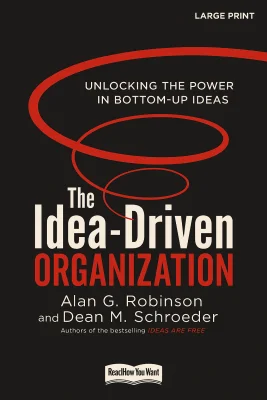
The Idea-Driven Organization
Unlocking the Power of Bottom-Up Ideas
Categories
Business, Nonfiction, Leadership, Audiobook, Management, Entrepreneurship
Content Type
Book
Binding
Paperback
Year
2022
Publisher
ReadHowYouWant
Language
English
ISBN13
9781459676121
File Download
PDF | EPUB
The Idea-Driven Organization Plot Summary
Introduction
Most organizations today face a profound paradox: they possess an untapped wealth of knowledge and creativity in their frontline employees, yet struggle to access this valuable resource. Leaders and managers often overlook the fact that approximately 80% of an organization's improvement potential lies in ideas from frontline staff—those who directly interact with customers, operate machinery, or deliver services daily. This fundamental disconnect explains why so many improvement initiatives fall short of expectations. The concept of an idea-driven organization represents a paradigm shift in management thinking. Rather than relying solely on top-down directives, these organizations create systems that capture, evaluate, and implement ideas flowing upward from frontline workers. This approach challenges traditional command-and-control leadership models by recognizing that those closest to the work often have the most valuable insights about how to improve it. By realigning organizational structures, processes, and leadership behaviors to support bottom-up innovation, companies can unleash extraordinary levels of creativity, engagement, and continuous improvement that transform organizational performance.
Chapter 1: The 80/20 Principle: Where Organizational Improvement Comes From
The 80/20 Principle of improvement represents a profound insight into organizational change: approximately 80 percent of an organization's potential for improvement comes from frontline ideas, while only 20 percent stems from management-driven initiatives. This principle, substantiated through research across diverse industries, challenges conventional wisdom about where valuable innovation originates within organizations. The power of this principle becomes evident when examining companies that effectively tap into frontline ideas. Organizations implementing high-performing idea systems regularly achieve twenty, fifty, or even a hundred ideas per employee annually, with implementation rates exceeding 90 percent. Unlike traditional suggestion box programs that might generate 0.5 ideas per person yearly with low implementation rates, these systematic approaches transform everyday observations into continuous improvement. At Brasilata, a Brazilian can manufacturer, employees average 150 ideas per person annually, with 90 percent implementation rates, creating a sustained competitive advantage. What makes frontline ideas so valuable is their intimate connection to daily operations. Frontline workers identify problems invisible to management—inefficient processes, customer pain points, safety concerns—and often suggest practical, low-cost solutions. A warehouse worker might propose a better shelving arrangement, a receptionist might identify a way to streamline appointment scheduling, or a machine operator might develop a simple fix that prevents equipment failures. These improvements, while individually modest, collectively generate substantial impact through their volume and direct relevance to operational realities. The 80/20 Principle also explains why traditional top-down improvement initiatives often disappoint. Management typically lacks the granular understanding of work processes possessed by frontline employees. When Coca-Cola Stockholm tracked improvement sources, they discovered that 82.4 percent of actual cost savings came from frontline-initiated projects, while management-initiated projects delivered only 17.6 percent—exactly the opposite of what leadership had projected. This pattern repeats across industries, from manufacturing to healthcare to financial services, highlighting the universal applicability of the principle. Understanding this principle fundamentally changes how leaders should approach organizational improvement. Rather than focusing exclusively on strategic initiatives designed by senior management, organizations should invest significant resources in capturing ideas from those who encounter problems and opportunities daily. This represents not merely an alternative improvement methodology but a fundamental shift in how organizations harness their human capital for innovation and competitive advantage.
Chapter 2: Leadership Beyond Command and Control
Leadership in idea-driven organizations represents a radical departure from traditional command-and-control approaches. This distinct leadership model centers on humility, facilitation, and the ability to create environments where frontline ideas flourish rather than focusing on hierarchical authority and top-down decision-making. Leaders in these organizations understand that their primary value comes not from having all the answers, but from enabling others to contribute their knowledge. Research reveals that traditional power dynamics create significant barriers to idea flow. As leaders rise in organizations, they typically experience psychological changes that impair their receptivity to others' ideas. Studies show that power reduces thinking complexity, diminishes perspective-taking abilities, and increases self-focus—all undermining the capacity to recognize the value in frontline contributions. Physical manifestations of hierarchy, from executive parking spaces to private dining rooms, further reinforce these psychological barriers, creating environments where subordinates' ideas are systematically devalued. Effective idea-driven leaders counteract these tendencies through specific practices that keep them connected to frontline realities. Regular "gemba walks" (visiting the actual place where work happens) represent a cornerstone practice, as seen at ThedaCare, where even the CEO spends several hours weekly observing frontline operations. These aren't ceremonial visits but structured opportunities to observe problems, hear ideas, and provide coaching. At Toyota, this practice is so fundamental that managers at all levels regularly go to gemba to maintain direct contact with operational realities. The selection and development of leaders also differs dramatically in idea-driven organizations. When hiring managers, companies like Inditex (Zara's parent company) prioritize humility as the primary selection criterion. This isn't mere personality preference—humble leaders more readily acknowledge their limitations and value others' contributions. Some organizations take extreme measures to instill this perspective; when Jesus Vega was hired as Inditex's HR director, despite his impressive credentials, he was assigned to work as a sales associate under a 20-year-old supervisor before taking his executive position. Perhaps most critically, idea-driven organizations create clear accountability mechanisms for idea performance. Leaders are evaluated not just on traditional metrics like sales or productivity, but on specific idea-related measures: how many ideas their teams generate, implementation rates, and the impact of those ideas. At Siemens VDO, the CEO regularly reviewed a Pareto chart showing idea performance across business units, making it clear that lagging in this area carried serious consequences. This accountability creates the necessary tension to overcome natural resistance to bottom-up input. By fundamentally redefining leadership as facilitation rather than command, idea-driven organizations create cultures where thousands of small improvements continuously accumulate, ultimately generating remarkable performance advantages that traditional management approaches cannot match.
Chapter 3: Aligning Strategy, Structure and Systems for Ideas
Creating an idea-driven organization requires fundamental realignment of strategy, structure, and systems to support the flow of frontline ideas. This alignment process represents far more than simply setting up an idea collection mechanism; it demands a comprehensive examination of how organizational elements either enable or impede bottom-up innovation. Strategic alignment begins with ensuring that frontline ideas connect directly to organizational priorities. Many organizations fail at this first critical step by assuming their formal cascading goal processes effectively translate high-level objectives into meaningful frontline targets. Research reveals this rarely happens effectively. In one telling case, a CEO's strategic priorities were completely misunderstood even by his direct reports—none of his top three goals matched those identified by his leadership team. Effective organizations translate abstract strategic goals like "increase market share" into specific, actionable metrics that frontline employees can influence through their ideas. At Fresh AB, a Swedish ventilation manufacturer, leadership transformed a broad goal of "double retail sales" into the more actionable "double the number of product displays in retail stores"—generating dozens of implementation ideas from employees across departments. Structural realignment addresses both vertical and horizontal dimensions. Vertically, organizations must create clear pathways for ideas to move upward, with appropriate decision rights at each level. Horizontally, they must eliminate the silos that impede cross-functional collaboration on ideas. Traditional functional structures often create goal conflicts where departments optimize their own metrics at the expense of overall performance. A classic example comes from an aerospace company where territorial battles between IT and inventory control departments rendered a $3.5 million automated storage system completely unusable—while a more agile competitor later purchased the same system at auction for just $600,000 and quickly had it operational. Truly idea-driven organizations often adopt unique structural configurations designed explicitly for idea flow. Zara's three-person teams (designer, commercial specialist, and country manager) represent a radical departure from conventional fashion industry structure. This configuration allows rapid decision-making on new clothing designs based partly on frontline retail employees' observations of customer preferences. Twice weekly, country managers speak with every store manager to gather insights from sales associates about what customers are requesting and wearing—information that flows directly to design teams who can create new items within days, not months. The realignment process extends beyond formal structures to encompass management systems like budgeting, performance reviews, and promotion criteria. Each of these systems must be examined through the lens of how it affects idea flow. Organizations successful in this transition recognize that alignment is never complete—it requires ongoing vigilance as new policies, procedures, and structural elements are continuously introduced that can inadvertently create barriers to frontline ideas. By systematically addressing these alignment issues, organizations create environments where ideas naturally flow upward and across boundaries, rather than requiring heroic efforts to overcome institutional resistance.
Chapter 4: Creating Effective Idea Processes
Effective idea processes form the operational core of any idea-driven organization, serving as the mechanisms through which frontline knowledge transforms into implemented improvements. These processes differ fundamentally from traditional suggestion systems in both philosophy and execution, reflecting a deeper understanding of how ideas naturally develop and flourish. Three archetypal processes dominate successful idea-driven organizations. The kaizen teian system, pioneered in Japan, represents the first generation of high-performing idea systems. At Brasilata, the Brazilian can manufacturer employing this approach, employees submit ideas either online or on paper, with dedicated teams processing submissions and helping with implementation. Simple ideas are implemented directly by employees, while more complex ones follow clearly defined evaluation pathways. This highly structured system delivers remarkable results—150 ideas per employee annually with 90% implementation rates—but requires years of cultural development to reach full effectiveness. More accessible and rapidly deployable are team-based approaches like idea meetings and idea boards. These processes integrate idea management directly into regular work rather than treating it as a separate activity. In the idea meeting format, teams gather regularly (typically weekly) to discuss problems and opportunities, decide which to pursue, assign implementation responsibilities, and track progress. This approach makes idea management a natural extension of daily work rather than an add-on program. Springfield Technical Community College exemplifies this approach, where departmental teams meet regularly to evaluate problems, develop solutions, and implement improvements that have dramatically enhanced student services. The idea board variation adds a highly visual dimension to team meetings. Using physical boards (or electronic displays) prominently placed in work areas, teams post problems and ideas under specific focus areas aligned with organizational goals. This visual management approach maintains continuous awareness of improvement opportunities, creates accountability through public tracking, and allows leaders to quickly assess idea activity across the organization. At Scania, the Swedish truck maker, idea boards at every level of the organization—from production teams to the executive suite—make the idea process transparent and promote appropriate escalation of more complex ideas. Regardless of the specific model employed, effective idea processes share critical characteristics that distinguish them from failed suggestion systems. They focus on problems as much as solutions, recognizing that someone who identifies a problem may not have the best solution. They empower teams to make decisions about their own ideas rather than routing everything through distant managers. They incorporate simple but effective facilitation techniques that draw out diverse perspectives and maintain momentum. And they include clear escalation pathways for ideas requiring broader coordination or resources. Perhaps most importantly, effective idea processes avoid the "electronic suggestion box trap"—the mistaken belief that merely automating a traditional suggestion process will transform it into a high-performing system. No technology can overcome the fundamental flaws in processes that separate ideas from their context, concentrate decision-making with distant managers, and fail to integrate improvement into daily work. By designing processes that reflect how ideas naturally develop and flourish in social contexts, idea-driven organizations create sustainable engines of continuous improvement.
Chapter 5: Building Problem Sensitivity and Idea Generation Capabilities
Problem sensitivity—the ability to recognize improvement opportunities others miss—represents a fundamental capability that separates high-performing idea-driven organizations from their competitors. Rather than waiting for problems to become obvious, these organizations systematically develop their employees' capacity to see subtle improvement opportunities in everyday work situations. Initially, most organizations find no shortage of ideas. When Big Y Foods launched its idea system, employees quickly identified obvious issues: inconveniently placed deli counter buttons, confusing register layouts, and inefficient checkout procedures. However, once these readily apparent problems are addressed, idea flow typically diminishes unless organizations invest in developing deeper problem-finding capabilities. This represents a significant shift from traditional improvement approaches that focus exclusively on problem-solving while taking problem identification for granted. Idea activators—targeted training modules that introduce new perspectives on work—serve as primary tools for developing problem sensitivity. At Subaru Indiana Automotive, management used a series of focused activators to help employees identify environmental improvement opportunities. Beginning with simple concepts like the "Three Rs" (reduce, reuse, recycle), these modules progressively introduced more sophisticated perspectives on waste reduction. One activator focused specifically on compressed air usage, showing employees the high environmental and financial costs of generating compressed air and techniques for identifying leaks and inefficiencies. This single activator generated thousands of ideas that ultimately allowed the company to take two large air compressors offline permanently, saving substantial energy and maintenance costs. Idea mining represents another powerful technique for generating fresh perspectives. This approach extracts implicit novel viewpoints from existing ideas and uses them to trigger new thinking. At a European insurance company, leaders identified that customer confusion—initially noted in a specific context of misleading yellow pages advertising—represented a broader pattern they could systematically address. By making "whenever a customer is confused, write it down" a standard practice, they uncovered dozens of previously unrecognized improvement opportunities. Similarly, a health insurance company created a simple rule: "Every time a customer calls, document the reason why"—recognizing that each call represented a service failure requiring examination. Beyond individual techniques, idea-driven organizations develop systematic organizational approaches to problem sensitivity. Graniterock's pioneering "short-pay" policy—allowing customers to deduct payment for any aspect of service they found unsatisfactory—created a radical mechanism for surfacing problems invisible to management. Initially costing 2.3% of sales, this policy forced the company to address fundamental issues in colored concrete consistency, delivery timing, and customer communication that competitors continued to ignore. By systematically correcting these problems, Graniterock reduced short-pay costs to just 0.2% of sales while establishing a reputation for quality that allowed premium pricing. Through these deliberate approaches to building problem sensitivity, idea-driven organizations create what might be called "organizational mindfulness"—a heightened collective awareness of improvement opportunities that traditional organizations routinely overlook. This capability ensures a continuous flow of ideas long after the obvious problems have been solved, creating sustainable competitive advantage through ongoing incremental improvement.
Chapter 6: Leveraging Front-Line Ideas for Breakthrough Innovation
The relationship between frontline ideas and breakthrough innovation represents one of the most misunderstood aspects of organizational creativity. While many leaders view these as separate domains—small improvements versus transformative change—idea-driven organizations recognize their profound interdependence and leverage this relationship to achieve extraordinary innovation capabilities. This synergy operates through multiple mechanisms. First, breakthrough innovations often require numerous smaller ideas to actually work in practice. At Subaru Indiana Automotive, the company attempted a major environmental innovation—vacuum distillation of paint solvents—that would dramatically reduce hazardous waste. When the technology vendor went bankrupt before perfecting the system, frontline maintenance workers generated hundreds of small ideas that collectively solved the engineering challenges, making the breakthrough operational. Without these supporting ideas, the innovative technology would have been abandoned. Similarly, countless innovations fail not because their core concept is flawed, but because organizations lack the capability to implement the many small adjustments needed to make them functional. Second, frontline ideas create strategic capabilities that enable previously impossible innovations. Allianz China won industry recognition for its groundbreaking "Super Fit" customizable life insurance product, which competitors couldn't replicate even after two years. What made this possible wasn't simply the product concept, but the extraordinary organizational flexibility developed through years of systematically implementing employee ideas. This cumulative capability allowed Allianz to offer unprecedented customization options that competitors, despite understanding the concept, couldn't operationally deliver. Third, frontline ideas often transform routine innovations into major breakthroughs. When Task Force Tips, a firefighting equipment manufacturer, considered developing a water monitor (a specialized cannon for fighting large fires), the initial concept was straightforward. However, by engaging frontline workers—many of whom were volunteer firefighters themselves—in a company-wide brainstorming session, the team generated twenty-one unique safety and performance features. These features, from spring-steel legs for self-leveling to automatic shutdown mechanisms when the monitor became unstable, transformed a routine product extension into an award-winning breakthrough that revolutionized industry safety standards. Perhaps most surprisingly, becoming idea-driven removes many of the same organizational barriers that typically impede innovation. When HCSS software implemented its idea system, it was forced to address a long-standing misalignment in how product improvement ideas were prioritized across departments. Solving this issue not only improved everyday idea flow but created space for a programmer to propose a revolutionary automated testing system that dramatically accelerated the company's development cycle. By systematically addressing the organizational barriers to small ideas, companies simultaneously remove obstacles to bigger innovations. The multifaceted synergy between frontline ideas and breakthrough innovation explains why truly innovative organizations like Brasilata, ThedaCare, and Whirlpool have all embraced idea-driven principles. Far from representing competing approaches to improvement, small ideas and breakthrough innovations form a symbiotic relationship that creates sustainable innovative capability. Organizations that recognize and leverage this relationship develop what might be called "innovation ecosystems" where improvements of all sizes naturally reinforce and enable each other, creating competitive advantages that competitors cannot easily replicate.
Summary
The fundamental insight that defines the idea-driven organization is deceptively simple yet transformative: the most valuable resource for improvement and innovation already exists within every organization—the knowledge and creativity of frontline employees. By systematically capturing, evaluating, and implementing ideas from those closest to the work, organizations can access approximately 80% of their improvement potential that remains untapped in traditional management approaches. The shift toward idea-driven organizations represents not merely a passing management trend but a fundamental evolution in how we think about organizational capability. As global competition intensifies and the pace of change accelerates, the capacity to continuously improve and innovate becomes increasingly critical to survival. Organizations that successfully make this transition develop extraordinary adaptive capabilities that allow them to thrive amid disruption, while those clinging to outdated command-and-control models find themselves increasingly vulnerable to competitors who can harness the full creative potential of their entire workforce. The idea-driven organization ultimately offers a more humanistic and effective model of management—one that recognizes that the best answers often come not from those with the highest titles, but from those with the closest connection to the work itself.
Best Quote
“Very few managers know how to effectively tap the biggest source of performance improvement available to them: namely, the creativity and knowledge of the people who work for them.” ― Alan G. Robinson, The Idea-Driven Organization: Unlocking the Power in Bottom-Up Ideas
Review Summary
Strengths: The book stays true to its focus on employee suggestions and effectively uses real-world examples to illustrate its concepts. The structured approach to handling suggestions within a company is well-received, with particular praise for the example involving a firefighting equipment company. The book's timelessness is noted due to the absence of specific technology discussions, which prevents it from becoming outdated.\nWeaknesses: The book does not cover the use of technology for collecting and managing ideas, aside from a brief mention of spreadsheets. Some content is based on anecdotes and generalized suggestions, which may lack prescriptive detail.\nOverall Sentiment: Enthusiastic\nKey Takeaway: The book provides valuable insights into managing employee suggestions through a structured process, supported by real-world examples, and is recommended for its practical approach and timeless relevance.
About Author

Alan G. Robinson and Dean M. Schroeder
Robinson and Schroeder extend the boundaries of organizational improvement by focusing on the power of ideas from front-line employees. They delve into bottom-up innovation and lean management, arguing that empowering workers to contribute their insights leads to significant competitive advantages. For example, their book "The Idea-Driven Organization" emphasizes how unlocking employee ideas can transform businesses, a concept that earned it the Beverly Hills Book Award in General Business. Their accessible yet research-backed style provides readers with actionable strategies for fostering a culture of continuous improvement.\n\nTheir collaborative works, such as "Ideas Are Free", synthesize global studies and practical case examples, revealing how companies can effectively harness employee creativity. This book was recognized by "Fast Company" as a Reader’s Choice, demonstrating the wide appeal and impact of their approach. Moreover, Alan G. Robinson and Dean M. Schroeder's consulting efforts, which include advising major corporations like GE and IKEA, underline their practical influence in the business world. These experiences enrich their writing, making their insights particularly valuable for leaders aiming to implement idea-driven change in their organizations.\n\nThis author duo has significantly shaped management thinking, offering a roadmap for businesses to improve performance through the systematic engagement of their workforce. By advocating for the strategic management of ideas and lean methodologies, Robinson and Schroeder provide a comprehensive blueprint for organizational excellence. Their bio highlights the profound impact they have had on both academic and corporate landscapes, illustrating their roles as pivotal figures in the evolution of management practices.
Read moreDownload PDF & EPUB
To save this Black List summary for later, download the free PDF and EPUB. You can print it out, or read offline at your convenience.
The Idea-Driven Organization
by Alan G. Robinson and Dean M. Schroeder
