
The Ides of March
Categories
Fiction, Classics, Historical Fiction, Literature, American, Historical, 20th Century, Novels, Ancient History, Italy
Content Type
Book
Binding
Paperback
Year
2003
Publisher
Harper Perennial
Language
English
ASIN
0060088907
ISBN
0060088907
ISBN13
9780060088903
File Download
PDF | EPUB
The Ides of March Plot Summary
Introduction
Blood dripped from Moms' fingers as she held a warm sheep liver above her head in supplication. The ancient Roman sacrificial chamber reeked of death, lit only by a shaft of sunlight from above. The old woman across from her—Spurinna, the legendary seer who had warned Caesar to beware the Ides of March—suddenly pressed a knife to her throat. "You are not an Amata," Spurinna hissed. "You are not who you pretend to be." It was March 15th, 44 BC, and Moms had just materialized in a bubble of time that shouldn't exist. She wasn't alone. Across different years on this same cursed date, five other members of the Time Patrol had been thrust into history's most dangerous moments. Scout found herself standing among the 300 Spartans at Thermopylae, watching King Leonidas prepare for his final battle. Doc materialized in the Russian Imperial Palace as the Tsarina held a blade to her hemophiliac son's throat. Mac appeared in medieval Spain as Columbus returned from the New World. Eagle awakened as a slave in George Washington's camp, and Roland stood in the muddy road outside Ravenna as assassins closed in. The Shadow—an entity from another timeline bent on destroying theirs—had created these temporal intrusions. If even one mission failed, a cascade of changes would ripple through history, creating a time tsunami that would erase their present from existence. Each agent had twenty-four hours to ensure history unfolded as it should, but the Shadow had sent its own operatives back to stop them. Death waited in every timeline, and the fate of reality itself hung in the balance.
Chapter 1: The Call to Arms: Six Agents, Six Timelines, One Crucial Date
The Possibility Palace spiraled down through time like a massive inverted tower, its walls lined with analysts monitoring every thread of history. Dane stood on the observation deck, his once-black hair now streaked with premature gray from the weight of protecting a timeline that wasn't even his own. His Earth had already fallen to a time tsunami, leaving him the sole survivor to guard this reality. "We have another attack," he announced to the six operatives gathered in the sterile briefing room. "Six simultaneous strikes on March 15th across different years. The Shadow's getting bolder." Moms surveyed her team—the former Nightstalkers who had become humanity's last line of defense against temporal annihilation. Eagle, their team sergeant, bore ritual scars on his skull from an IED blast years ago. Scout, barely past her teens but gifted with supernatural intuition, gripped a Naga staff that could cut through almost anything. Mac, the demolitions expert turned monk for this mission, nursed a hangover that time travel wouldn't cure. Doc, their scientist, struggled to understand technologies that defied physics. And Roland, the gentle giant who solved problems with violence, stood ready for whatever carnage awaited. "You'll each go alone this time," Dane continued, chalk scratching against the blackboard as he wrote dates and locations. "Rome, 44 BC—the assassination of Caesar. Thermopylae, 480 BC—the last stand of the Spartans. Newburgh, 1783—Washington preventing a military coup. Russia, 1917—the fall of the Tsars. Spain, 1493—Columbus's return. Ravenna, 493 AD—the end of the Western Roman Empire." The missions read like a catalog of civilization's turning points, each balanced on a knife's edge between triumph and catastrophe. Change any one of them, and the modern world would never exist. "What are we supposed to do when we get there?" Mac asked, his voice rough with alcohol and resignation. Dane's expression hardened. "Whatever it takes to keep history on track. The Shadow will have agents waiting. Some of you may not come back." The words hung in the air like a death sentence. They had survived their last mission to Black Tuesday by luck and skill, but odds like these couldn't hold forever. Scout felt the familiar chill of premonition, while Roland unconsciously checked his weapons. They were walking into six different hells, and only hope would see them through.
Chapter 2: Stepping Through the Veil: Entering History's Critical Moments
The transition hit like a physical blow—one moment standing in the Possibility Palace, the next fully integrated into their assigned time and place as if they had always belonged there. Memory fragments flooded their minds: knowledge of languages, customs, and relationships they had never lived but now possessed. In Rome, Moms found herself trapped in a deadly game of politics and prophecy. Spurinna revealed herself to be more than a mystical fraud—she ran a network of slaves and gladiators who gathered intelligence from Rome's noble households. "Caesar will die today," she told Moms after lowering the blade. "But Marc Antony was supposed to save him. Something has gone wrong." They raced through Rome's shadowed alleys to find Antony drunk and broken, rehearsing a funeral speech that hadn't been written yet. A red-haired woman named Pyrrha watched from the shadows, claiming to be Pandora's daughter and speaking of fates that could not be changed. The future was bleeding backward into the past. Thousands of miles away in frozen Russia, Doc staggered through the Alexander Palace as revolution consumed the empire. The Tsarina had cut her son's arm, watching his blood flow in a desperate attempt to force God's hand. Doc saved the boy with modern medicine disguised as divine intervention, but Count Golovkin arrived with his own plan—to spirit the family away to England and safety. "They must stay," Doc insisted, knowing their escape would only delay the inevitable. History demanded its sacrifice, and the Romanov dynasty was already dead. They simply hadn't stopped breathing yet. Meanwhile, Scout stood on blood-soaked ground at Thermopylae as King Leonidas prepared his warriors for their final battle. Persian campfires stretched to the horizon like fallen stars. "If the Oracle's words are true, this is my final night," Leonidas said, but Scout sensed something wrong. A presence moved in the darkness beyond the wall of corpses—Pandora herself, wielding power that transcended mortal understanding. The missions were unfolding exactly as history recorded, yet everything felt wrong. The Shadow's influence crept through each timeline like poison, turning allies into enemies and heroes into pawns in a game whose rules no one understood.
Chapter 3: Shadows and Deceptions: Adversaries Across Time
The attacks came without warning, born from the Shadow's perfect knowledge of when and where the Time Patrol would appear. In Spain, Mac discovered his contact wasn't who he seemed. Friar de Cisneros held a syringe filled with modified plague, believing he was saving the New World's natives from European disease. A Valkyrie had visited him in the guise of an angel, twisting his compassion into a weapon that would make syphilis a world-killing pandemic. Swiss mercenaries stalked Mac through the narrow streets of Palos de la Frontera as Columbus returned with news of his discovery. The priest died with Mac's name on his lips, clutching the biological weapon that would have rewritten history in blood and madness. Roland faced a more direct assault in Ravenna's muddy streets. Four Gothic warriors ambushed him on the forest road, but as he cut them down, a fifth figure vanished through a temporal gate. The woman would return at the feast where King Odoacer was destined to die, orchestrating betrayals within betrayals as the last remnants of Rome collapsed. At Thermopylae, Scout climbed through fields of corpses to meet Pandora on neutral ground. The ancient Sibyl claimed kinship, speaking of bloodlines that stretched back to Atlantis and power that transcended time itself. But when Xerxes Dagger—the Persian king's deadliest assassin—attacked from the shadows, Pandora fought beside Scout with deadly grace. "We are sisters," Pandora whispered afterward, her cold fingers tracing Scout's skull. "You could be timeless like me." She opened a wooden box, revealing the severed head of Ephialtes—the traitor who was supposed to guide the Persians around the Spartan position. History was already changing, one corpse at a time. The most brutal revelation came to Eagle in Washington's camp. Colonel Caldwell, who should have died months earlier, had been saved by Shadow intervention and turned into an agent of chaos. He planned to poison the Continental Army's morale, perhaps triggering the military coup that Washington's famous speech was meant to prevent. When Eagle exposed him, Caldwell's pistol roared in the confined space of the general's office. Blood flowed in every timeline as the Shadow's true strategy became clear: they weren't just trying to change history. They were trying to break the Time Patrol itself, targeting the agents with surgical precision born from studying their previous missions. Each operative faced not just the dangers of the past, but enemies who knew exactly where to strike.
Chapter 4: Beyond the Mission: Ancient Powers and Hidden Agendas
The deeper each agent penetrated into their assigned timeline, the more they realized how little they truly understood about the forces shaping history. In Russia, Doc discovered that Anastasia alone among the royal children could see through the deception. Her diary spoke of "HIM"—Rasputin—as something unnatural, not of their time. The mad monk's prophecies had been too accurate, his influence too profound for a simple charlatan. "He is not of us," the young duchess had written. "He knows things he should not." Doc burned the diary in the palace furnaces, erasing evidence that would have revealed time travel's fingerprints on history, but the truth gnawed at him. How many historical figures were really temporal refugees or Shadow agents? Scout grappled with similar questions as Pandora led her through a maze of myth and reality. The ancient woman spoke of the fourth stage of awareness—consciousness beyond the physical world—and demonstrated powers that made the Naga staff seem like a crude tool. When a chimera materialized from another timeline to attack them, Scout realized the boundaries between dimensions were thinner than anyone suspected. "Your world is just one of many," Pandora explained after they killed the creature together. "The Shadow comes from timelines where different choices were made. Where evolution took darker paths." In Rome, Moms encountered Cleopatra in her exile villa, playing the political game with moves that wouldn't be invented for centuries. The Egyptian queen recognized something in Moms that transcended their shared mortality—a kinship of women who had seen too much death and carried too many secrets. But even Cleopatra couldn't prevent what was coming for Caesar. The assassination unfolded exactly as history recorded, yet felt completely different from within the temporal bubble. Brutus and his conspirators struck down their former friend on the Senate steps, but Moms sensed larger forces orchestrating the tragedy. Some events were fixed points that not even the Shadow could alter—pillars supporting the architecture of reality itself. Roland learned this truth in the bloodiest way possible at Odoacer's feast. Despite all his efforts, despite identifying the traitors and foiling the ambush, Theodoric still split the old king's skull with an axe. The method changed but not the outcome. Some deaths were written into the universe's code, immutable laws that transcended human will or temporal manipulation. The missions were succeeding, but at a cost none of them had anticipated. Each agent was discovering that their world—their present—was built on foundations of necessary suffering that stretched back through every age of human history.
Chapter 5: Standing at the Crossroads: Preserving the Timeline
The climax arrived simultaneously across all six timelines as the Shadow made its final desperate gambit. In Spain, Swiss mercenaries cornered Mac on a moonlit beach, forcing him to abandon weapons and clothing in a headlong flight along the surf. He had prevented the plague weapon's deployment, but survival remained uncertain as steel-clad killers pursued him into the night. Scout's mission reached its crescendo as dawn broke over Thermopylae. The golden map she had been sent to retrieve manifested as a sphere of living metal, passed through a temporal gate by hands burned raw from handling it. As the final Persian assault began, she opened her own gate to escape, but King Leonidas refused her offer of rescue. "My destiny is here," he said, passing her the Naga staff before turning to face Pandora's charge. The gate snapped shut behind Scout, leaving the Spartan king to his glorious doom while she carried the mysterious artifact to safety. Doc faced his own moment of truth when revolutionary soldiers dragged him before a firing squad. Count Golovkin had been discovered in his rescue attempt, and both men stood against a bloodstained wall as rifles were loaded. Doc waved goodbye to Anastasia's sad face in a palace window, accepting his fate as penance for the lies he had told her family about their future. The rifles fired, but the bullets passed through empty air as the temporal bubble collapsed, pulling Doc back to his own time while leaving the Count to face revolutionary justice alone. Eagle's mission ended in collapse and pursuit as bloodhounds tracked him through the forest beyond Washington's camp. He had ensured that Nancy remained to bear her son—the future Josiah Henson, whose autobiography would inspire Uncle Tom's Cabin and fuel the abolitionist movement. But the effort had cost him everything, and he fell unconscious in the snow as his life ebbed away. Roland's assignment concluded with Theodoric's axe splitting Odoacer's skull despite every intervention. The barbarian king seized control of Italy's remnants while Roland stood spattered with royal blood and brains, having learned that some events transcended human agency. Diana's arrow found him as the temporal extraction began, but too late to prevent his return. In Rome, Moms watched Caesar walk knowingly to his death, choosing martyrdom over cowardice because he understood that legends outlast life. "I fear being forgotten more than I fear dying," he told her before entering the Senate for the last time. The Ides of March claimed their most famous victim right on schedule, sealing the timeline's integrity with noble blood.
Chapter 6: The Return: Wounds, Revelations, and the Cost of Victory
The extraction tunnel pulled each agent forward through time, past flickering images of alternative histories that might have been. Doc glimpsed a world where King George V abdicated to save Alexei, destabilizing Britain and allowing Germany to win the First World War. Scout saw timelines branching and terminating like severed arteries, some ending in nuclear fire, others simply fading into darkness. Mac floated naked through the temporal stream, having shed everything material except the biological weapon he had prevented from being deployed. Roland carried wounds from Diana's arrow and the weight of questions about his true importance to the Shadow's plans. Why had they targeted him specifically across multiple missions? They materialized in the Possibility Palace's medical bay to find Eagle fighting for life on an operating table. The bullet wound had reopened during extraction, and only advanced surgical techniques saved him from bleeding out across multiple timelines simultaneously. "Everyone made it back," Dane reported, but his relief was tempered by disturbing intelligence from their debriefs. The appearances of Pandora, Pyrrha, and Diana suggested new players in the temporal war—entities that predated both the Time Patrol and the Shadow, pursuing agendas that transcended human understanding. Scout's burned hands still tingled from contact with the golden map, which had vanished into the Space Between upon her return. Whatever she had retrieved from Thermopylae was now beyond their reach, its purpose and power known only to forces that operated on cosmic scales. Doc struggled with the knowledge of what he had witnessed—an entire family's destruction that he could have prevented but didn't, because changing their fate would have doomed millions more. The weight of necessary evil crushed down on him like the lid of Pandora's box, sealing away hope and leaving only duty. "We're not just fighting the Shadow," Moms realized as they gathered around Eagle's hospital bed, looking out at the primordial landscape beyond the Possibility Palace. "There are forces older than time itself, and we're caught in the middle of a war we don't understand." The art in New York's museums was intact, confirming their mission's success, but Edith Frobish watched paintings flicker and fade as ripples spread through adjacent timelines. The battle for reality was far from over, and each victory came at a price measured in souls and sanity.
Summary
The Ides of March had passed, but its echoes would reverberate through every moment that followed. Six agents had walked through hell's antechamber and emerged forever changed, carrying scars both visible and spiritual from their encounters with history's darkest necessities. They had preserved the timeline by allowing atrocities to unfold, saved civilization by enabling suffering, and protected hope by embracing despair. Scout's revelation proved prophetic as they stood together in Eagle's hospital room, gazing out at stars that burned with ancient light. Elpis—hope—remained locked in Pandora's box throughout human history, but it was never truly absent. It lived in the choices ordinary people made in extraordinary circumstances, in the sacrifices of kings and slaves alike, in the willingness to stand watch between darkness and dawn even when victory seemed impossible. The Time Patrol had learned that their enemy was not just the Shadow, but the human tendency to believe that changing the past could perfect the future. History's great tragedy was also its greatest strength—the recognition that progress comes through struggle, that wisdom emerges from pain, and that hope endures precisely because it is tested by despair. They were guardians not of an ideal timeline, but of the only timeline that had produced beings capable of such guardianship. In preserving the past's imperfect beauty, they had earned the right to shape a future where hope might finally escape its eternal prison and walk free among the stars.
Best Quote
“You swore you loved me, and laughed and warned me that you would not love me forever. I did not hear you. You were speaking in a language I did not understand. Never, never, I can conceive of a love which is able to foresee its own termination. Love is its own eternity. Love is in every moment of its being: all time. It is the only glimpse we are permitted of what eternity is. So I did not hear you. The words were nonsense.” ― Thornton Wilder, The Ides of March
Review Summary
Strengths: The review highlights the book's inventive nature for its time, suggesting it may have inspired other works like John Williams' 'Augustus'. It is described as a work of considerable scholarship with lush language and insightful lessons. The reviewer appreciates the book's epistolary format and the depth of its quotes, indicating a richness in content. Weaknesses: The review implies that the book might not be engaging for all readers, as one commenter noted a lack of interest despite attempts to engage with it. The book's obscurity and its predictable ending, due to historical context, might also detract from its appeal. Overall: The reviewer presents 'The Ides of March' as a scholarly and linguistically rich work, though potentially challenging in engagement. It is recommended for those interested in historical epistolary novels and literary scholarship, but may not captivate all readers.
About Author
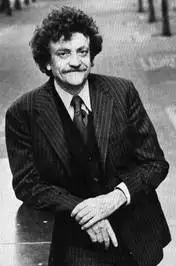
Kurt Vonnegut Jr.
Vonnegut investigates the human condition through a lens of dark humor and incisive social commentary, challenging readers to confront the absurdity of war and the search for meaning. His writing is deeply informed by personal experiences, including his capture during World War II and survival of the Dresden bombing. This trauma, alongside his Midwestern upbringing, informs his narrative style, marked by a blend of science fiction and satire. Vonnegut frequently uses nonlinear storytelling and metafictional techniques to unsettle conventional literary norms and provoke thought about free will and the inexorable passage of time.\n\nThrough novels such as "Slaughterhouse-Five" and "Cat's Cradle," Vonnegut critiques societal norms and explores existential dread, making his work both entertaining and thought-provoking. "Breakfast of Champions" further underscores his ability to critique American culture through metafictional layers. As an author, Vonnegut utilizes straightforward prose and a conversational tone to engage readers in his speculative worlds, inviting them to question reality and the fragility of human life. This approach has cemented his place in the literary canon, influencing generations of writers and readers who appreciate his unique blend of humor and critique.\n\nVonnegut's impact extends beyond his books, having been nominated for prestigious awards like the National Book Award. His legacy is celebrated through various honors, including being named Humanist of the Year by the American Humanist Association. By weaving themes of war, technology, and human dignity, Vonnegut's work remains relevant and revered, providing valuable insights into human nature that continue to resonate in contemporary discourse. His bio reflects a life dedicated to probing the complexities of existence, leaving a lasting mark on literature and culture.
Read moreDownload PDF & EPUB
To save this Black List summary for later, download the free PDF and EPUB. You can print it out, or read offline at your convenience.

The Ides of March
by Kurt Vonnegut Jr.
