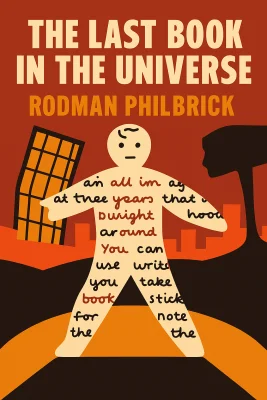
The Last Book in the Universe
Categories
Fiction, Science Fiction, Young Adult, Fantasy, School, Adventure, Childrens, Middle Grade, Post Apocalyptic, Dystopia
Content Type
Book
Binding
Paperback
Year
1999
Publisher
Scholastic
Language
English
ASIN
0439087597
ISBN
0439087597
ISBN13
9780439087599
File Download
PDF | EPUB
The Last Book in the Universe Plot Summary
Introduction
In the crumbling concrete wasteland of the Urb, where acid rain eats through steel and gangs rule territories called "latches," a boy named Spaz carries a curse that might be his salvation. While others rot their minds with neural probes—electronic needles that inject artificial dreams directly into the brain—his epilepsy keeps him trapped in harsh reality. The irony cuts deep: in a world where memory has become a forgotten art, only the broken boy can still remember. When a mysterious runner brings word that his foster sister Bean lies dying of blood sickness, Spaz faces an impossible choice. To reach her, he must cross three warring gang territories where strangers are killed on sight. But an ancient man called Ryter, the last writer in a world that has forgotten books, offers to guide him through the ruins. Together, they'll journey through burning cities and forbidden zones, toward a place of impossible beauty called Eden—where genetically perfected humans live in paradise, and where the cure for Bean's sickness might exist. In this final battle between memory and oblivion, the fate of human consciousness itself hangs in the balance.
Chapter 1: The Forgotten Art of Memory
The stackboxes rise like concrete tombstones against the gray sky, each one a perfect ten-by-ten cube where the desperate make their homes. Spaz moves through the shadows between them, hunting his assigned target—an old man the Bully Bangers have marked for "bustdown," their casual term for robbery. But when he reaches the designated stackbox, the door hangs open like a mouth waiting to swallow him whole. "Come on in," calls a voice from the darkness. "Make yourself at home." The old man sits behind a makeshift desk, his white beard catching what little light filters through the concrete. His possessions are already packed by the door—a broken vidscreen, an ancient baseball mitt, a coffee machine with its cord coiled neat as a prayer. He's prepared for this moment, accepting theft like weather. "Take it all," the old man says, gesturing to his meager belongings. But Spaz sees something else hidden beneath the desk—stacks and stacks of paper covered in strange black marks. When confronted, the man calls it a "book," a word that tastes strange in the poisoned air of the Urb. "Books are in libraries," Spaz protests, though he doesn't know why he remembers this. "Or they used to be." The old man's eyes light up with something between joy and sorrow. "You remember things," he says. "Most people can't anymore. The neural probes have softened their brains until they can barely recall yesterday." He introduces himself as Ryter—a name that means nothing to anyone but himself. He writes down stories, memories, the dying fragments of what the world used to be. "Everybody has a story," Ryter insists when Spaz claims he has none. "There are things about your life that are specific only to you. Secret things you know." But secrets are dangerous currency in the Urb, and Spaz leaves without taking anything—not the pathetic possessions, not the cryptic papers, and certainly not the old man's offer to teach him to read. Some gifts are too heavy to carry.
Chapter 2: A Sister's Dying Wish
The darkness in Spaz's concrete cube feels heavier than usual when the runner arrives. Professional message carriers risk their lives crossing gang territories, and this one speaks from the shadows like a ghost delivering prophecy: "Your sister lies close to death. She wishes to see you one last time." Bean. The only person who ever loved him, the only person he ever loved back. Not blood family—both of them foundlings taken in by the same foster parents—but family chosen by something deeper than genetics. Her name was really something else, but she'd been so small when she arrived that Spaz, barely four himself, had called her Bean. The name stuck like hope in a hopeless place. The message ignites a desperate plan. To reach Bean's latch, Spaz must cross territory controlled by warring gangs, each one sworn to kill strangers on sight. Only the latchboss Billy Bizmo has the power to grant safe passage, but when Spaz dares to enter the Bangers' underground headquarters uninvited, he finds Billy in the purple-lit depths of a neural probe session, his consciousness lost in artificial dreams. "My sister," Spaz begs when Billy finally surfaces from his electronic paradise. "I have to see her." Billy's answer cuts like broken glass: "People die every day. Every hour. Every minute. So put it out of your mind. There's nothing you can do about it." The refusal seals Spaz's fate. He must choose between certain death trying to cross the warring latches alone, or the slow death of never seeing Bean again. Some choices aren't really choices at all. By dawn, he's walking toward the Edge, where civilization frays into wasteland and the old water pipes point toward territories unknown. Better to die trying than live with the weight of abandoning the only person who ever called him family.
Chapter 3: Crossing the Broken Latches
The ancient water pipe stretches through the wasteland like the spine of a buried giant. Spaz isn't alone—Ryter has insisted on joining him, armed with nothing but a walking stick and stories older than memory. The writer claims he needs one last adventure for his book, but his real reason runs deeper. Some journeys require witnesses. They crawl through the rusted interior of the massive pipe, their footsteps echoing in the darkness while rats with red eyes watch from the shadows. Miles of forgotten infrastructure become their highway between the warring territories, a secret passage that most have forgotten exists. "By the Edge we travel," Ryter says, his voice carrying strange formality. "By the Edge we live or die." Their first destination lies in the territory of the Monkey Boys, where the gang members have painted their faces and sharpened their teeth to match their name. But when they emerge from the pipe, something is wrong. The city burns on the horizon, and wild howls echo through the concrete canyons. A mob of degenerate Monkey Boys swarms them before they can retreat, carrying them toward their fortress on a tide of mindless fury. The gang's leader, the legendary Mongo the Magnificent, has been "looping"—trapped in an endless neural probe cycle for over a year. His body lies rotting in its own filth while his mind dreams of paradise. With no real leader, his followers have reverted to something barely human. Ryter's solution is as elegant as it is dangerous. He convinces a young guard named Gorm that someone must take control, that leadership is simply a matter of will and timing. Within hours, Gorm has declared himself the new boss, and his first act is to grant them safe passage to the border. "The king is dead," Ryter murmurs as they escape in an armored vehicle. "Long live the king." But the wasteland between territories holds its own dangers, and ahead lies something far worse than the Monkey Boys' madness.
Chapter 4: The Girl with Sky-Colored Eyes
The latch burns. Smoke rises from every quarter while howling mobs tear through the streets, their minds broken by hunger and desperation. Through this chaos walks a figure that seems made of light itself—a young woman in shimmering white, her beauty so perfect it hurts to look at her directly. She's a "proov"—one of the genetically improved humans who live in the legendary paradise called Eden. Lanaya moves among the burning ruins handing out food to the starving, protected by armed guards until the mob overwhelms them. Her protectors flee, leaving her stranded atop a broken vehicle while grasping hands reach up like flames. "I am Lanaya, child of Eden!" she shouts. "Touch me and you'll die!" But madness recognizes no authority, and the mob surges closer. That's when Ryter acts, vanishing into the smoke with a desperate plan. Moments later his voice echoes from the flames: "Edibles! Get him, he's got food!" The distraction works. The mob abandons their perfect prey for the promise of sustenance, chasing Ryter into the burning maze while Spaz helps Lanaya into her armored vehicle. The old writer emerges battered but grinning, his arms covered in bite marks from people hungry enough to eat human flesh. "They wanted to eat me," he marvels. "That's how desperate they are." Lanaya's vehicle carries them swiftly through the destruction, its systems automatically avoiding obstacles while she processes what she's witnessed. In Eden, she explains, the sky is blue and the ground is covered with something called grass. It sounds like fantasy to those who've never seen anything but concrete and smog. "This is my first time seeing the real Urb," she admits as they reach safety. "I had no idea it was this bad." Her innocence would be charming if it weren't so dangerous. But when Spaz explains his mission to save Bean, something changes in her perfect features. Compassion, it seems, transcends genetic engineering.
Chapter 5: Eden's Forbidden Paradise
The journey to Eden requires crossing the Forbidden Zone, a wasteland seeded with mines that kill any normal who dares approach the proovs' paradise. Only Lanaya's vehicle carries the codes to disarm the weapons, creating a safe corridor through the killing field. When they finally pass through the Barrier—a wall of charged air that separates the two atmospheres—Spaz's world explodes into impossible color. The sky is blue, a shade so pure and vast it makes his eyes water. The ground is covered with green living carpet called grass, soft and alive beneath his feet. Trees rise like gentle giants, their leaves whispering secrets in a language older than words. "I had no idea," he breathes, unable to process the beauty surrounding him. Lanaya's home crowns a hillside like a crystal palace grown from the earth itself. Each room adapts to its occupants' needs, walls becoming windows or landscapes with a spoken command. Her parents—Jin and Bree, who prefer the term "contributors" to the primitive word "parents"—greet them with polite horror. Normals simply don't belong in Eden. But when they see Bean, dying in her transparent medical pod, their perfect composure cracks. The child's condition is terminal—her blood is eating itself from within, a disease the proovs eliminated from their own genetics generations ago. Their medical archives contain no cure, only ancient references to "chemotherapy" and "radiation treatment," technologies lost when the improved humans decided such primitive diseases no longer mattered. "We could try genetic therapy," Jin suggests reluctantly. "Inject her with improved genes that control blood cell production. But we don't know if it will work on someone who wasn't born with our enhancements." It's their only hope. As the modified genes flow into Bean's weakened body, Spaz can only watch and wait, praying to gods he's never believed in that science can accomplish what love alone cannot. Three days later, Bean opens her eyes and smiles.
Chapter 6: The Cure and the Cost
Bean's recovery seems like a miracle until the wider implications become clear. Word has spread through Eden that normals have been allowed into paradise, and not everyone approves. The genetic purists demand judgment, calling for a trial before the assembled population. Stadium fills with thousands of proovs, their perfect faces turned toward the black mirror platform where Bean, Spaz, and Ryter stand accused. Above them, the seven Masters of Eden emerge from the earth on a rising dais, their ancient authority absolute. Lanaya defends their presence with passionate eloquence, revealing herself as no ordinary proov but a future Master—one of the seven who will someday rule Eden. Her defense goes beyond saving three refugees; she challenges the fundamental assumptions of her people. "We despise the very idea of being 'normal,'" she declares to the assembled thousands, "and yet those who are normal do not despise us for our apparent perfection. They have courage we've never needed, wisdom earned through suffering we've never experienced." To prove her point, she reveals that Bean—a twelve-year-old "normal" girl—learned chess in an hour and fought Jin, one of Eden's best players, to a standstill. The crowd's disbelief turns to anger as their assumptions crumble. "Let these young normals be raised in Eden," Lanaya challenges, "and they'll do more than beat us at chess. They'll teach us what it truly is to be human." The crowd's response is immediate and devastating. Thousands stream from the stadium, leaving it empty except for the few who remain. When the voting ends, the verdict is clear: Eden shall remain Eden. The rule against normals must stand. "When you are a Master, things may change," the eldest judge tells Lanaya. "But for now, the law is the law." Enforcement comes swiftly. Spaz and Ryter are loaded into a vehicle and transported back to the wasteland, their brief glimpse of paradise already fading like a dream. Bean remains behind, her life saved but her future uncertain.
Chapter 7: The Last Writer's Legacy
Back in the concrete wasteland of the stackboxes, Ryter seems almost cheerful despite their exile. His little cube remains as barren as before, containing nothing but a makeshift desk and the precious pages of his manuscript—the only book left in a world that has forgotten reading. "Writers need a challenge," he explains to the brooding Spaz. "They need to struggle, to fight. What's to write about if life is perfect?" But their return hasn't gone unnoticed. The proov enforcers who brought them home also deactivated every neural probe in Billy Bizmo's territory, ending the artificial dream trade that kept the population docile. Without their electronic fantasies, the maddened masses need someone to blame. The jetbikes come at night, their engines screaming through the darkness like mechanical demons. The mob follows on foot, howling for blood and carrying torches that turn the sky orange. They want Ryter—the old man who was with the proovs, who must be responsible for stealing their dreams. "You're my son," Billy Bizmo tells Spaz as the crowd gathers. The truth hits like a physical blow—the latchboss is his father, the man who abandoned him at birth and watched him struggle from afar. "I did what I could. They could have blamed you. I made sure it was the old man." The mob ties ropes around Ryter's waist and attaches them to the jetbikes. As they drag him through the streets, the old man calls out to Spaz one final time: "You're the book now! You're the last book in the universe! Make it a good one!" The wheels of the jetbikes spin as they accelerate, and the greatest story ever told comes to its end in the dust and darkness of the Urb.
Summary
Years later, they call him Ryter now, and his voice echoes from an old recording device as he speaks the memories aloud. Bean lives, somewhere in the space between worlds—too improved to be truly normal, too normal to be a proov. The boy once known as Little Face grows up in Eden's gardens, raised by loving contributors who see past genetic categories to the child beneath. The original Ryter's sacrifice bore fruit in ways he never imagined. His stories live on in the voice of the boy he saved, spreading through the wasteland like seeds on the wind. Memory, it turns out, is more resilient than the forces that would destroy it. In a world where books have been forgotten, the stories themselves survive in the minds of those who remember. Sometimes at night, under the gray dome of the poisoned sky, Spaz looks up and thinks about blue heavens and green grass. These memories can never be erased, never be stolen by probe or fire. They live in the space between heartbeats, in the pause between words, in the eternal moment when a story passes from one generation to the next. In the end, perhaps that's all any of us are—the stories we choose to remember and the courage to tell them, even when the darkness rises and the world seems determined to forget everything that makes us human.
Best Quote
“The only real treasure is in your head. Memories are better than diamonds and nobody can steal them from you” ― Rodman Philbrick, The Last Book in the Universe
Review Summary
Strengths: The book is described as straightforward and engaging, with a compelling post-apocalyptic and dystopian theme that effectively contrasts with the reviewer's previous read, "Fahrenheit." The translation is considered good and readable despite minor issues. Weaknesses: The translation contains some errors, including a significant mistake in the author's name on the cover and inside the book, which is noted as an amateurish error. Additionally, there are a few grammatical issues. Overall: The reviewer expresses a strong preference for this book over "Fahrenheit," appreciating its ability to captivate and cleanse the palate from previous disappointments. While not deemed a masterpiece, it receives a solid four-star rating, with a recommendation to read it.
About Author

Rodman Philbrick
Philbrick investigates the intersection of resilience and adversity through narratives that span both historical and futuristic contexts. By incorporating themes of friendship and personal growth, he creates young adult novels that captivate readers' imaginations and encourage empathy. His renowned work, "Freak the Mighty", exemplifies this approach with its poignant exploration of unlikely alliances and overcoming personal challenges. In addition to his acclaimed young adult fiction, Philbrick has written adult thrillers under pen names such as William R. Dantz and Chris Jordan, which delve into the realms of genetic engineering and psychological suspense, as seen in titles like "Hunger" and "Pulse".\n\nThe author’s versatile style allows him to engage with diverse audiences, bridging the gap between young readers and adults. His books often feature dynamic plots and rich character development, appealing to those who appreciate action-packed storytelling and complex emotional landscapes. For instance, "The Last Book in the Universe" merges speculative elements with a tale of survival and hope, while "The Mostly True Adventures of Homer P. Figg" offers a humorous yet heartfelt perspective on historical events, earning it a Newbery Honor.\n\nPhilbrick’s contributions to literature are marked by a compelling ability to connect with readers across age groups, providing stories that entertain and inspire. His work has been recognized not only through numerous awards but also through adaptations that bring his characters to life on screen and stage. This short bio highlights how Philbrick's storytelling continues to resonate, proving his mastery in crafting narratives that leave a lasting impact.
Read moreDownload PDF & EPUB
To save this Black List summary for later, download the free PDF and EPUB. You can print it out, or read offline at your convenience.
The Last Book in the Universe
by Rodman Philbrick
