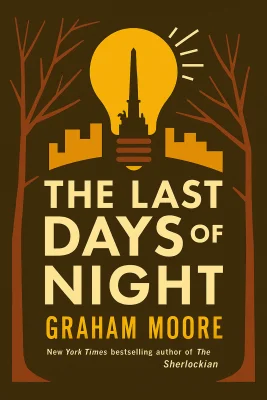
The Last Days of Night
Categories
Fiction, Audiobook, Mystery, Historical Fiction, Thriller, Adult, Book Club, Historical, Adult Fiction, New York
Content Type
Book
Binding
Hardcover
Year
2016
Publisher
Random House
Language
English
ASIN
0812988906
ISBN
0812988906
ISBN13
9780812988901
File Download
PDF | EPUB
The Last Days of Night Plot Summary
Introduction
# Currents of Power: The Electric War That Lit America The man burned like a fallen angel above Broadway, his body writhing in the electrical wires as blue flames shot from his mouth. Paul Cravath watched from the street below as alternating current tore through the workman's flesh, his blood raining down on the newsboys who scattered like startled pigeons. This was May 11, 1888, and this was Paul's introduction to the war that would consume his life—a billion-dollar battle between Thomas Edison and George Westinghouse for control of America's electrical future. At twenty-six, Paul was the youngest partner at a struggling Manhattan law firm, desperate for the case that would make his reputation. When Westinghouse offered him the chance to fight Edison's patent empire, Paul thought he understood the stakes. He was catastrophically wrong. This wasn't just about light bulbs or generators. This was about who would control the very power that lit American homes, and Edison would stop at nothing—including murder—to win. The current war had begun, and Paul Cravath was about to discover that in the battle for America's electrical soul, victory belonged to whoever could survive the darkness.
Chapter 1: The Young Lawyer's Electric Baptism
The telegram arrived like a royal summons, pulling Paul from his modest office into the blazing heart of Edison's Fifth Avenue empire. "Your presence is desired immediately," it read, signed simply "T. Edison." Paul had been fighting the world's most famous inventor in court for six months but had never faced the Wizard of Menlo Park himself. Edison's office burned with electric light so intense Paul could see the blue veins beneath his own skin. Behind the mahogany desk sat a man smaller than his photographs suggested, but radiating the unsettling confidence of someone who had bent the world to his will. Three hundred and twelve lawsuits covered the desk's surface—every single one targeting Westinghouse subsidiaries. "Do you really think you have a chance?" Edison asked, puffing his cigar with theatrical calm. He gestured toward the window where the Statue of Liberty's torch glowed in the distance. With a casual tap of a black button, Edison extinguished the torch five miles away. Another tap brought it blazing back to life. Paul felt the demonstration's weight—not just electrical power, but political, financial, and psychological dominance. This wasn't merely an inventor; this was a man who could control the sun itself. But Paul had come prepared. He slid the Sawyer-Man patents across the desk, watching Edison's face change as he realized Westinghouse now owned rights to earlier light bulb designs that predated Edison's own claims. "That is exceptionally clever, Mr. Cravath," Edison said with genuine admiration. Then his gray eyes hardened like winter steel. "If you think you can stop me, go ahead and try. But you'll have to do it in the dark."
Chapter 2: Recruiting Genius: Tesla Joins the Battle
Paul's journey to this confrontation had begun when his hemorrhaging law firm received an impossible offer. George Westinghouse, the railroad air brake magnate turned electrical pioneer, wanted legal representation against Edison's patent empire. At Westinghouse's Pittsburgh mansion, Paul found himself drowning among railroad barons and Yale professors until conversation turned ugly. When a professor made racist comments about a Negro physicist, Paul's Tennessee upbringing erupted. His father had founded Fisk University for freed slaves, and Paul wouldn't sit silent. "A generation that could have been lost to the fields will instead understand more about your air brakes and electrical wiring than I ever could," he declared. The room fell silent. Paul had committed social suicide at his first high-society dinner. But Westinghouse saw something different—a man of conviction willing to fight unpopular battles. In his study afterward, Westinghouse revealed the scope of Edison's assault: one billion dollars in lawsuits, enough to destroy any company in America. "Thomas Edison is suing me for one billion dollars," Westinghouse said, watching Paul's face carefully. "So then, do you still want the job?" Paul looked at the older man's weathered face, thinking of his father's moral crusades and his own desperate need for purpose. "Yes," he said. "I do." The breakthrough came when Paul discovered Nikola Tesla demonstrating his alternating current motor at Columbia University. The Serbian inventor, impossibly tall and painfully thin, struggled through broken English to explain his revolutionary breakthrough. Tesla's AC could transmit power over vast distances—something Edison's direct current could never achieve. After cornering Tesla outside the lecture hall, Paul made his pitch: "How would you feel about the opportunity for revenge?"
Chapter 3: Edison's Campaign of Fear and Death
Edison's response to Tesla's defection was swift and vicious. A failed inventor named Harold P. Brown began appearing in newspapers across the country, declaring alternating current a menace to public safety. "If arc current is potentially dangerous, then alternating current can be described by no adjective less forcible than 'damnable,'" Brown wrote in editorials that bore Edison's invisible fingerprints. Paul investigated Brown and discovered Edison's perfect front man—a bitter inventor whose own patents had been rejected, now hungry for revenge against the industry that had spurned him. Brown's campaign reached its horrific climax with traveling demonstrations where he electrocuted animals with alternating current while showing direct current was "harmless." Paul watched in revulsion as Brown killed a black retriever with three hundred volts of AC, then proclaimed to the shocked audience: "If this is what it does to a dog, imagine what it might do to a child!" The press coverage was predictably one-sided. While condemning Brown's methods, newspapers endorsed his message about AC's deadly nature. The campaign succeeded beyond Edison's wildest dreams. New York State adopted the electric chair for executions—powered specifically by Westinghouse's alternating current. The message was unmistakable: AC was the official current of death itself. Edison had weaponized public fear, turning Westinghouse's superior technology into a nightmare that haunted every American home. Meanwhile, Tesla clashed with his new employer over practical modifications to his designs. The pure inventor, interested only in ideas, stormed out when Westinghouse suggested commercial compromises. Paul found himself caught between two geniuses who couldn't work together, fighting an enemy who controlled the press, politicians, and public opinion through a masterful campaign of terror.
Chapter 4: Fire and Disappearance: A Genius Lost
Paul's world exploded on a September night when Tesla's secret laboratory on Grand Street erupted in flames. He had been visiting the inventor to discuss wireless telephones and other impossible devices when the building became an inferno. Paul watched the ceiling cave in, felt burning timber crash around him, and lost consciousness as Tesla vanished into the fire. Paul woke weeks later in Bellevue Hospital, his ribs broken, his body burned, his memory fragmented by morphine. Tesla was gone, presumably dead. The police investigation revealed arson—someone had deliberately set the fire. Commissioner Fitz Porter informed Paul that Thomas Edison himself had requested police protection for the young lawyer, a bitter irony that tasted like ash in Paul's mouth. Months passed with no word. Paul's injuries healed, but Tesla remained missing. The legal battles with Edison intensified, but without Tesla's testimony and expertise, Paul found himself fighting with one hand tied behind his back. The inventor's disappearance threatened to unravel everything they had built against Edison's patent empire. Then came salvation from an unexpected source. Agnes Huntington, the Metropolitan Opera's rising star, sent word that Tesla had appeared at the opera house in a state of complete mental collapse. Paul found the inventor sitting calmly in Agnes's dressing room, his eyes unfocused and distant. He was alive, but the brilliant mind that had conceived alternating current seemed lost in a maze of its own making. Agnes, showing unexpected compassion, helped Paul hide Tesla in her Gramercy Park home. The opera singer proved an unlikely ally, caring for the broken genius with genuine affection while helping Paul navigate the dangerous social waters of New York's elite. She was everything Paul wasn't—connected, sophisticated, fearless—and he found himself falling for a woman completely out of his league. Tesla's mind had shattered, but gradually Paul realized these weren't symptoms of madness—they were Tesla's method of invention. "I'm not hallucinating," Tesla explained with his first lucid smile in months. "I'm inventing."
Chapter 5: Courtroom Lightning: Patent Wars Unleashed
Paul's young associates made the breakthrough that changed everything. Combing through thousands of documents, they discovered that Edison had lied repeatedly about his light bulb invention. He'd told the press it used a platinum filament, told the patent office it used cotton, but actually manufactured bulbs with bamboo filaments discovered months after his patent was granted. "He was just making things up," Paul realized with growing excitement. "He didn't actually get the bulb working with bamboo till after the patent was granted." This revelation led to the moment Paul had been preparing for—taking Edison's deposition under oath, forcing America's greatest inventor to explain his contradictions in a court of law. The deposition took place in Grosvenor Lowrey's law offices, Edison sitting across from Paul with the arrogant confidence of a man who had never been seriously challenged. When Paul pressed him about the different filaments, Edison exploded with righteous fury: "I create things, Mr. Cravath. Things that did not exist before. Someone like you will never understand what it is to bring something new into the dull world." Edison's defense was audacious—he claimed to have invented not just a light bulb, but the entire concept of indoor electrical lighting. "I hired the band; I booked the hall. I advertised the show. And you hate me because my name is on the poster," he declared with the theatrical flair that had made him America's most celebrated inventor. The deposition revealed Edison's true genius—not as a technical innovator, but as a master of narrative and marketing. He had built an empire not on superior technology, but on superior storytelling. He had convinced the world that Thomas Edison was synonymous with electrical innovation itself, making any challenge to his patents seem like an attack on American ingenuity. "The light bulb is mine," Edison concluded with imperial finality. "Every bulb. Every vacuum. Every one of your piddling filaments. And to the mute ingratitude with which you've repaid me, I will say only one last thing: You're welcome."
Chapter 6: The Deposition: Exposing the Wizard's Lies
Paul left Edison's deposition knowing he had exposed the great inventor's lies, but also knowing that truth might not be enough to defeat a man who had made himself into a living legend. Edison's patent claims were built on fabrications, but his cultural authority seemed unshakeable. The Wizard of Menlo Park had transcended mere invention to become a symbol of American innovation itself. The legal victory came at a terrible cost. As Paul prepared for the final courtroom battle, he discovered the true scope of Edison's influence. J.P. Morgan owned sixty percent of Edison General Electric. Politicians received generous campaign contributions. Newspaper publishers held Edison stock. The inventor hadn't just built a company—he had constructed a web of financial and political connections that made him nearly untouchable. Paul's own firm began fracturing under the pressure. His partners, Walter Carter and Charles Hughes, resented his success with the Westinghouse account and maneuvered to share control of the case. They revealed that Paul had made a costly error in negotiating Tesla's contract—the inventor would receive full royalties even after leaving Westinghouse's employ, a financial disaster waiting to happen. "You are twenty-seven years old," Carter told him coldly. "You are buried over your head in dirt and you are too stupid to realize it's quicksand." Paul's humiliation was complete when he learned that Westinghouse had originally offered the job to more experienced attorneys who had turned it down, knowing it was unwinnable. Paul had been hired not for his brilliance, but because he was the only lawyer in New York who didn't owe Edison money. But Paul also began building his own network of power. He recruited four brilliant Columbia Law students as associate attorneys, creating a legal factory to match Edison's invention factory. While Edison had dozens of engineers working on technical problems, Paul would have dozens of lawyers working on legal ones. The current war was evolving into something unprecedented—a battle between industrial-scale innovation and industrial-scale litigation.
Chapter 7: Victory's Price: Truth, Betrayal, and Reconciliation
The revelation that destroyed Paul's faith came from an unexpected source. Charles Batchelor, Edison's right-hand man, sat across from him in a dim alehouse, casually demolishing everything Paul thought he knew about the war they had been fighting. "You really don't know, do you?" Batchelor said, swirling his gin with practiced indifference. "Who set that fire at Tesla's laboratory." The words hit Paul like a physical blow. "George Westinghouse did." The fire that had driven Tesla into madness, the tragedy that had nearly killed Paul himself—it hadn't been Edison's sabotage at all. It had been Westinghouse, trying to bring his wayward inventor back into line with a controlled demonstration that had spiraled horribly out of control. "Westinghouse wanted you both out of the lab that night," Batchelor continued. "He suggested dinner at Delmonico's, remember? He never meant for you to get hurt, never meant for the fire to be so severe. But his man didn't know you were still inside when he lit the kindling." The pieces fell into place with sickening clarity. Paul had thought himself clever, fighting the good fight against Edison's monopolistic ambitions. Instead, he had been a pawn in a game far more complex and morally ambiguous than he had ever imagined. The final betrayal came when Paul discovered that Reginald Fessenden, the engineer he had recruited from Edison's ranks, had been feeding information back to his former employer all along. Every strategy session, every technical breakthrough, every desperate plan—Edison had known it all in advance. Paul stared into his beer, watching the foam dissolve like his illusions about the righteousness of his cause. But from this moral wreckage came an unexpected opportunity. Batchelor revealed that Edison's own board of directors had grown tired of the inventor's expensive legal campaigns and public relations disasters. They wanted to remove Edison from his own company, and they needed Paul's help to do it legally. The current war was about to end not with victory or defeat, but with a corporate coup that would reshape American industry forever.
Summary
Paul Cravath's battle against Thomas Edison ended not with a single courtroom victory, but with the slow transformation of American industry itself. Though Edison won many early legal battles, Westinghouse's alternating current technology proved superior in the marketplace. The war of the currents was ultimately decided not by judges or juries, but by the simple fact that AC could power entire cities while DC could barely light a city block. Edison was removed from his own company in a boardroom coup, his name stripped from General Electric as investors chose profits over sentiment. Tesla recovered his sanity and his genius, eventually creating the polyphase system that would electrify the world. Paul's legal innovations—his factory of associate attorneys, his systematic approach to massive litigation—would reshape the practice of law itself. Agnes Huntington became Paul's wife and partner in building one of America's greatest law firms. The real victory was not defeating Edison, but surviving him and learning that in America, the greatest battles are fought not with armies or inventions, but with stories. The most dangerous enemy is the one who controls which stories get told, and the only lasting triumph is the one that illuminates the truth, no matter how much darkness tries to extinguish it.
Best Quote
“Be alone—that is the secret of invention: be alone, that is when ideas are born. —NIKOLA TESLA, FROM HIS DIARY A” ― Graham Moore, The Last Days of Night
Review Summary
Strengths: The review highlights the novel's ability to provide a vivid depiction of a significant historical period, specifically the electrification of modern life. It appreciates the engaging narrative that combines historical facts with fiction, making the learning of history more accessible and interesting. The novel's focus on the legal battle between Edison and Westinghouse is noted as a compelling aspect. Overall: The review suggests a positive sentiment towards the novel, appreciating its educational value and engaging storytelling. It implies a recommendation for readers interested in historical fiction that offers insight into significant technological advancements and the personalities involved.
About Author

Graham Moore
Moore crafts narratives that delve into historical and speculative realms, engaging readers with intricate plots that blend factual detail with fiction. His work, such as "The Last Days of Night", focuses on the rivalry to develop the electric light bulb, while "The Wealth of Shadows" explores the complexities of economic warfare during World War II. These themes demonstrate his commitment to making complex historical and economic concepts accessible and engaging to a wide audience, even as he approaches them without prior expertise.\n\nHis transition from novelist to screenwriter and director exemplifies his diverse storytelling skills. The screenplay for "The Imitation Game", which won him an Academy Award, showcases his ability to adapt real-life events into compelling narratives. Meanwhile, his directorial debut with "The Outfit" marks a new chapter in his film career, receiving critical acclaim and nominations. This versatility allows readers and viewers alike to engage with his stories across various media.\n\nFor those seeking an author who combines suspense with historical insight, Moore's work provides a rich tapestry of intrigue and knowledge. His novels and films appeal to readers and audiences interested in layered stories that challenge and entertain, making his bio a testament to a career marked by both literary and cinematic accomplishments.
Read moreDownload PDF & EPUB
To save this Black List summary for later, download the free PDF and EPUB. You can print it out, or read offline at your convenience.
The Last Days of Night
by Graham Moore
