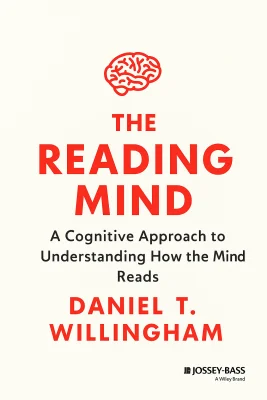
The Reading Mind
A Cognitive Approach to Understanding How the Mind Reads
Categories
Nonfiction, Self Help, Psychology, Science, Education, Academic, Neuroscience, Brain, Books About Books, Teaching
Content Type
Book
Binding
Hardcover
Year
2017
Publisher
Jossey-Bass
Language
English
ISBN13
9781119301370
File Download
PDF | EPUB
The Reading Mind Plot Summary
Introduction
Reading is one of the most remarkable cognitive processes humans engage in, yet we rarely pause to consider its complexity. When you look at a page filled with marks, how does your brain transform these symbols into meaning? This cognitive feat involves multiple interconnected processes that work together with astonishing efficiency. The cognitive theory of reading examines how our minds decode, process, and comprehend written information, revealing the intricate mechanisms behind this seemingly effortless activity. This theoretical framework explores fundamental questions: How do we recognize letters and words? How do we extract meaning from text? What roles do memory, attention, and background knowledge play in comprehension? How do motivational factors influence our reading habits? By understanding the cognitive architecture of reading, we gain insight not only into a crucial skill for modern life but also into the remarkable capacities of the human mind itself. The cognitive approach to reading illuminates both the universal patterns in how people process text and the individual differences that make each reader unique.
Chapter 1: Understanding Writing Systems and Decoding
Reading begins with recognizing that writing systems are codes designed to represent spoken language. Unlike intuitive pictographs that directly represent objects or ideas, alphabetic systems like English encode the sounds of speech. This fundamental insight—that writing is primarily a code for spoken language rather than directly for meaning—is essential to understanding how reading works in the mind. When we read, we're essentially converting visual symbols back into the language code they represent. The process of decoding written symbols involves three interrelated challenges. First, readers must visually distinguish one letter from another, differentiating shapes like "b" from "d" or "p" from "q." While this might seem straightforward, it requires sophisticated visual processing to recognize that different fonts or handwritten variations represent the same letter. Second, readers must develop phonemic awareness—the ability to hear and manipulate individual speech sounds. This skill isn't innate; young children often struggle to perceive that words consist of separable sounds. Third, readers must learn the mapping between letters and sounds, a relationship that in English is notoriously inconsistent. These processes combine in what cognitive scientists call the alphabetic principle—the understanding that written symbols represent speech sounds. For beginning readers, this principle doesn't come naturally. It requires explicit instruction and practice. Consider what happens when a child first encounters the word "cat." They must recognize the three letters, convert each to its corresponding sound (/k/, /æ/, /t/), and then blend these sounds together to form a word they recognize from spoken language. With practice, this process becomes increasingly automatic, allowing cognitive resources to be directed toward comprehension rather than decoding. The cognitive theory distinguishes between two routes to word recognition: the phonological route (sounding out words) and the direct route (recognizing familiar words by sight). Beginning readers rely heavily on the phonological route, laboriously converting letters to sounds. But as they encounter words repeatedly, they develop orthographic representations—mental images of how words look—allowing for faster, more efficient recognition. This dual-route model explains why experienced readers can instantly recognize familiar words while still being able to sound out unfamiliar ones. In everyday reading situations, these processes occur with remarkable speed and efficiency. When you read a restaurant menu, for instance, you don't consciously sound out familiar words like "salad" or "chicken"—you recognize them instantly. Yet when you encounter an unfamiliar culinary term, you might revert to sounding it out. This cognitive flexibility demonstrates how the reading mind adapts its approach based on familiarity, context, and need—a sophisticated system that becomes increasingly refined with experience.
Chapter 2: Letter Recognition and Sound Processing
Letter recognition forms the foundation of reading, yet it's far from a simple perceptual task. The cognitive theory reveals that letter identification involves pattern recognition networks in the brain that detect features like vertical lines, curves, and intersections. These networks don't simply match whole letters against stored templates; rather, they analyze component features and determine the most likely letter based on these elements. This explains how we can recognize letters across different fonts, sizes, and handwriting styles—the underlying feature patterns remain consistent even when surface appearances vary. Sound processing presents its own cognitive challenges. Speech sounds don't exist as discrete units in spoken language—they blend together seamlessly, influenced by neighboring sounds, accent patterns, and speaking rates. When someone says "cat," the sounds /k/, /æ/, and /t/ aren't separate in the acoustic signal; they overlap and influence each other. For reading, however, individuals must develop phonological awareness—the ability to mentally segment and manipulate these speech sounds. This cognitive skill doesn't develop spontaneously but emerges through language exposure and often requires explicit instruction for mastery. The mapping between letters and sounds constitutes a third major component of early reading cognition. In languages with transparent orthographies like Finnish or Spanish, these mappings are consistent and predictable. In English, however, the relationship is complex—the same letter can represent different sounds (like "c" in "cat" versus "city"), and the same sound can be spelled in multiple ways (like the /f/ sound in "fish," "phone," and "enough"). The reading mind must develop sophisticated contextual rules to navigate these inconsistencies, recognizing that letter combinations and positions affect pronunciation. Cognitive research has revealed that these processes become increasingly automatic with experience. Consider what happens when you read the word "table." As a skilled reader, you don't consciously analyze its features or sound it out—recognition happens almost instantly. This automaticity represents a shift in cognitive processing, where letter recognition and sound mapping no longer require conscious attention. Such efficiency allows cognitive resources to be directed toward higher-level comprehension processes instead. The development of these foundational skills follows predictable patterns across languages and cultures, though at different rates depending on orthographic consistency. Children learning to read in English typically take longer to master decoding than those learning more transparent writing systems, yet most eventually achieve fluency. This universal progression in cognitive development, despite varying challenges, demonstrates the remarkable adaptability of the human mind in acquiring the complex skill of reading.
Chapter 3: Orthographic Knowledge and Spelling Representations
Orthographic knowledge refers to our mental representations of written words—essentially, how words look in our minds. According to cognitive theory, skilled readers develop detailed mental images of familiar words, letter patterns, and spelling conventions. These orthographic representations allow for rapid word recognition without the need to sound out each letter. When you instantly recognize "elephant" without consciously processing each letter, you're drawing on orthographic knowledge stored in your long-term memory. The structure of these representations is hierarchical and interconnected. At the lowest level are features (lines, curves, angles), which combine to form letters. Letters then form common patterns or clusters (like "th" or "ing" in English), which in turn combine into whole-word representations. Interestingly, these mental representations include statistical information about letter frequency and positioning—we implicitly know that "tion" is a common ending in English while "tnio" is not, even if we've never explicitly learned this rule. This explains why nonsense strings like "blint" seem more word-like than "bnilt"—they conform to the statistical patterns stored in our orthographic knowledge. Research using sophisticated techniques like eye-tracking reveals how these representations operate during reading. Skilled readers don't process text letter-by-letter or even word-by-word; instead, they process multiple letters simultaneously, often predicting upcoming words based on context and partial visual information. When reading a sentence like "The chef cooked a delicious meal," you may identify "delicious" before your eyes have fully scanned it, based on the preceding context and perhaps just the first few letters. This predictive processing demonstrates how orthographic knowledge works in conjunction with other cognitive systems to enable efficient reading. The development of orthographic knowledge occurs largely through a self-teaching mechanism. Each time a reader successfully decodes an unfamiliar word, they strengthen the mental connection between its visual form and pronunciation. With repeated exposures, the word's orthographic representation becomes increasingly detailed and accessible. This explains why extensive reading practice is so crucial for developing fluent reading—each encounter with a word reinforces and refines its representation in memory. In everyday situations, orthographic knowledge manifests in our ability to instantly detect misspellings or unusual letter combinations. When you notice that "recieve" looks wrong, it's because it violates the orthographic pattern stored in your memory. Similarly, when reading quickly, you might overlook minor errors if they preserve the word's general shape and key letters—reading "teh" as "the," for instance. These phenomena demonstrate how orthographic knowledge functions as a sophisticated pattern-recognition system that balances precision with efficiency, allowing for rapid reading under normal conditions while maintaining sensitivity to meaningful variations.
Chapter 4: Word Meaning and Vocabulary Development
Word meaning in the reading mind extends far beyond simple dictionary definitions. Cognitive theory portrays word meanings as complex networks of associations rather than isolated definitions. When you read the word "apple," your mind activates not just a definition but a rich network of associations—its color, taste, texture, typical contexts, related concepts like "fruit" and "tree," personal memories, and even emotional responses. This network structure explains why context so powerfully influences which aspects of meaning become activated. In "She bit into the crisp apple," different features become salient than in "Apple announced a new product today." These meaning networks develop through experience and are highly individualized. They contain both declarative knowledge (facts about the word) and experiential knowledge (sensory and emotional associations). Cognitive research reveals that word meanings are grounded in our perceptual and motor experiences—when you read action words like "kick" or "grasp," the brain activates some of the same motor regions involved in performing those actions. This grounding explains why concrete words like "table" are typically processed more quickly than abstract concepts like "justice," which lack direct sensory referents. Vocabulary depth and breadth both contribute to reading comprehension. Breadth refers to how many words you know, while depth concerns how richly those words are represented in memory. A child might know the word "democracy" (breadth) but have only a shallow understanding of its meaning. Research shows that vocabulary knowledge is one of the strongest predictors of reading comprehension, explaining why readers with larger vocabularies understand texts more readily—they're less likely to encounter unfamiliar words that interrupt the flow of comprehension. The process of learning new word meanings is remarkably efficient in skilled readers. Adults can often infer the meaning of unfamiliar words from context after just a few exposures. This process, called statistical learning, involves unconsciously tracking the contexts in which words appear and inferring patterns of usage. If you encounter an unfamiliar word like "obdurate" in sentences about people refusing to change their minds, you begin forming a rough understanding of its meaning even without looking it up. In everyday reading situations, these vocabulary networks operate largely automatically. When reading a newspaper article about economic policy, your mind rapidly activates relevant meaning networks for terms like "inflation" or "interest rates," allowing you to comprehend without conscious effort. When an unfamiliar term appears, you might pause briefly to infer meaning from context or decide whether understanding that specific word is necessary for overall comprehension. This strategic allocation of attention to vocabulary is characteristic of skilled reading, demonstrating how the reading mind balances efficiency with accuracy in real-world contexts.
Chapter 5: Text Comprehension and Meaning Construction
Text comprehension involves far more than understanding individual words—it requires constructing a coherent mental representation of the text's meaning. Cognitive theory describes this as a multi-level process where readers simultaneously build representations at several levels. At the most basic level is the surface code—the exact wording and syntax. At an intermediate level is the textbase—the semantic content expressed as propositions or idea units. At the highest level is the situation model—a mental representation of what the text is about, incorporating the reader's prior knowledge and inferences beyond what's explicitly stated. These levels interact dynamically during reading. Consider what happens when you read "John dropped the vase. It shattered into pieces." At the textbase level, you understand two propositions: John dropped something, and that something broke. At the situation model level, you make causal connections (the vase broke because it was dropped) and inferences (the vase was fragile, it hit a hard surface). You might visualize the scene or activate personal memories of similar incidents. This construction of meaning extends far beyond the words themselves. Research reveals that skilled readers constantly generate inferences while reading, filling gaps in the text. These inferences might connect characters' motivations to their actions, relate current events to previous ones, or apply world knowledge to interpret ambiguous statements. When reading "Sarah walked into the restaurant and checked her watch," you might infer she has time constraints or is meeting someone, though neither is explicitly stated. This inferential activity creates a richer, more coherent mental representation than what's directly provided by the text. The construction of meaning is heavily influenced by the reader's background knowledge. Studies show that readers with domain knowledge related to a text comprehend it more deeply and remember it better than those without such knowledge, even when reading ability is otherwise equal. This explains why a sports enthusiast might easily understand technical jargon in a football article that confuses a non-fan, or why cultural references in literature might be transparent to readers from one culture but puzzling to those from another. In real-world reading, comprehension processes adapt to reading purpose and text type. When reading a novel for pleasure, you might focus on visualizing scenes and tracking character development. When studying a textbook, you might monitor your understanding more carefully, pausing to clarify difficult concepts. This strategic adaptation demonstrates that comprehension isn't a single uniform process but a flexible set of cognitive activities that readers adjust based on their goals and the demands of the text. The reading mind thus constructs meaning not as a passive receiver of information but as an active interpreter, constantly integrating new information with existing knowledge.
Chapter 6: Reading Motivation and Attitude Formation
Reading motivation operates as a complex interplay of attitudes, beliefs, and values that determine whether individuals choose to engage with text. Cognitive theory recognizes that motivation isn't simply about enjoying reading—it's about making decisions to read in contexts where multiple activities compete for attention. Even individuals with positive attitudes toward reading may choose other activities if the immediate value or reward seems greater. This explains why many people who consider reading important still struggle to make time for it in daily life. Motivation researchers distinguish between intrinsic motivation (reading for its own sake) and extrinsic motivation (reading for external rewards or outcomes). Intrinsic motivation develops through positive reading experiences that create emotional associations. When a child becomes absorbed in a captivating story, the pleasure of that experience becomes associated with reading itself. Over time, these positive associations form an emotional attitude toward reading that's more powerful than logical arguments about reading's importance. Conversely, frustrating or embarrassing reading experiences can create negative emotional associations that discourage future reading. Self-concept plays a crucial role in reading motivation. Individuals who see themselves as "readers"—who incorporate reading into their identity—are more likely to choose reading activities. This self-concept develops through social comparisons, past experiences, and cultural influences. Children who grow up in homes where reading is valued and modeled by adults are more likely to develop a reading self-concept. Similarly, peer attitudes toward reading can powerfully influence whether adolescents see reading as consistent with their desired social identity. The expectancy-value model explains how readers decide whether to engage with text. This model proposes that motivation depends on two factors: the value placed on the activity and the expectation of success. Value encompasses interest, utility, and social significance, while expectation relates to the reader's confidence in their ability to comprehend the text. A challenging book on a fascinating topic might be attempted despite difficulty because of high value, while an easy book on an uninteresting topic might be abandoned despite high expectation of success. In everyday contexts, motivation manifests in reading choices and persistence. A motivated reader might carry a book everywhere, finding moments to read throughout the day. They persist through challenging passages because the desire to understand outweighs the cognitive effort required. Less motivated readers might easily abandon texts when distracted or encountering difficulty. The reading environment also influences these choices—easy access to appealing books increases the likelihood of reading, while competing activities like digital entertainment can decrease it. Understanding these motivational dynamics helps explain why cognitive ability alone doesn't determine reading behavior—the decision to read depends on complex psychological factors that vary across individuals and situations.
Chapter 7: Digital Reading in the Modern Era
Digital reading has transformed the cognitive landscape of text processing in fundamental ways. When reading from screens, the mind engages with text differently than when reading from paper—not just in how information is displayed but in how it's processed and remembered. Research indicates that digital reading often encourages a pattern of scanning and skimming rather than sustained attention, with readers jumping between sections and searching for specific information rather than processing content linearly. This reading pattern activates different cognitive networks than the deep, sustained attention typical of traditional reading. The hypertext structure of digital content creates a distinctly different reading experience. When text contains links to other content, readers must constantly make decisions about whether to follow these pathways or continue with the current text. These decision points create additional cognitive load, requiring readers to maintain their place in the original text while evaluating whether to explore connected material. Studies show that this additional load can reduce comprehension and recall, particularly for complex material. The reading mind must allocate attention not just to understanding content but to navigating a web of possible reading paths. Digital platforms also influence metacognitive aspects of reading—how we monitor and regulate our own understanding. Research suggests that readers often overestimate their comprehension when reading digitally compared to print, perhaps because the ease of navigation creates an illusion of understanding. This metacognitive miscalibration can lead to less effective study strategies and poorer retention. Additionally, many digital platforms encourage multitasking, with readers frequently switching between reading and other activities like checking messages or browsing social media, further fragmenting attention. The multimodal nature of digital reading presents both opportunities and challenges. Digital texts often incorporate elements like animations, audio, video, and interactive features that can enhance engagement and support understanding, particularly for struggling readers. However, these elements can also create distraction if not carefully integrated with the text's purpose. The cognitive theory of multimedia learning suggests that such elements are most effective when they complement rather than compete with textual information, allowing the reading mind to integrate multiple information streams without overload. In everyday contexts, these cognitive differences manifest in how people approach different reading tasks. Many readers report preferring paper for materials requiring deep concentration or extended engagement, while favoring digital formats for quick information retrieval or casual reading. Students often print important materials despite having digital access, intuitively recognizing that certain cognitive processes seem better supported by physical text. These choices reflect an adaptive response to the different cognitive demands of various reading contexts, demonstrating how the reading mind continues to evolve alongside technological change—neither abandoning traditional processing patterns nor resisting new ones, but developing flexible strategies suited to an increasingly diverse reading landscape.
Summary
The cognitive theory of reading reveals that what appears to be a simple act of extracting meaning from text is actually an intricate symphony of mental processes working in perfect coordination. From the recognition of visual patterns that form letters to the construction of rich situation models that extend far beyond the words on the page, reading engages virtually every aspect of our cognitive architecture. This integrated theoretical framework helps us understand not just how reading happens, but why it sometimes fails, how it develops over time, and how it adapts to new technologies and contexts. The significance of this cognitive perspective extends beyond theoretical understanding. It illuminates the deeply personal nature of reading—how each reader brings unique knowledge, experiences, and motivations to every text, creating an interpretation that is both guided by the author's words and shaped by the reader's mind. As digital technologies continue to transform how we engage with text, this cognitive foundation remains essential for understanding the future of reading. By recognizing reading as a sophisticated cognitive achievement rather than a simple skill, we gain appreciation for one of humanity's most remarkable abilities—the capacity to transmit thoughts across time and space through written language.
Best Quote
Review Summary
Strengths: The review highlights the book's detailed exploration of the reading process, from basic letter recognition to advanced comprehension and the impact of the digital age. It appreciates the book's insights into the emotional aspects of reading attitudes and the importance of explaining the utility of reading to children. The reviewer also values the practical suggestions for promoting literacy and improving vocabulary.\nOverall Sentiment: Enthusiastic\nKey Takeaway: "The Reading Mind" by Daniel T. Willingham is a comprehensive and insightful resource for those passionate about reading or involved in literacy education. It emphasizes the emotional and practical aspects of reading, advocating for the importance of demonstrating the utility of reading to children and providing them with positive role models.
About Author

Daniel T. Willingham
Willingham probes how cognitive psychology can enhance educational practices, focusing on the intricate processes of learning and memory. His work bridges the gap between scientific research and practical teaching methodologies, aiming to dispel myths such as the learning styles theory while advocating for evidence-based education. Through his seminal book, "Why Don't Students Like School?", Willingham addresses fundamental questions about student engagement by translating complex cognitive theories into practical insights for educators. Meanwhile, "The Reading Mind" offers a comprehensive analysis of the cognitive mechanisms behind reading, underscoring the importance of cultural literacy in comprehension.\n\nHis methods combine empirical research with pedagogical insight, making cognitive psychology accessible to educators, parents, and policymakers. Willingham's contributions have significantly influenced educational practices by providing tools and strategies rooted in rigorous science, therefore helping teachers and learners improve outcomes. This practical application of cognitive science not only benefits educators seeking effective teaching strategies but also impacts education policy, as reflected in his appointment by President Obama to the National Board for Education Sciences.\n\nFor those interested in understanding the application of cognitive psychology to education, Willingham's books offer a wealth of knowledge. His latest work, "Outsmart Your Brain," continues this tradition, expanding on how scientific insights can optimize learning. As an author committed to clarity and rigor, his writing invites a broader audience to engage with cognitive science, ultimately contributing to more informed and effective educational environments.
Read moreDownload PDF & EPUB
To save this Black List summary for later, download the free PDF and EPUB. You can print it out, or read offline at your convenience.
The Reading Mind
by Daniel T. Willingham
